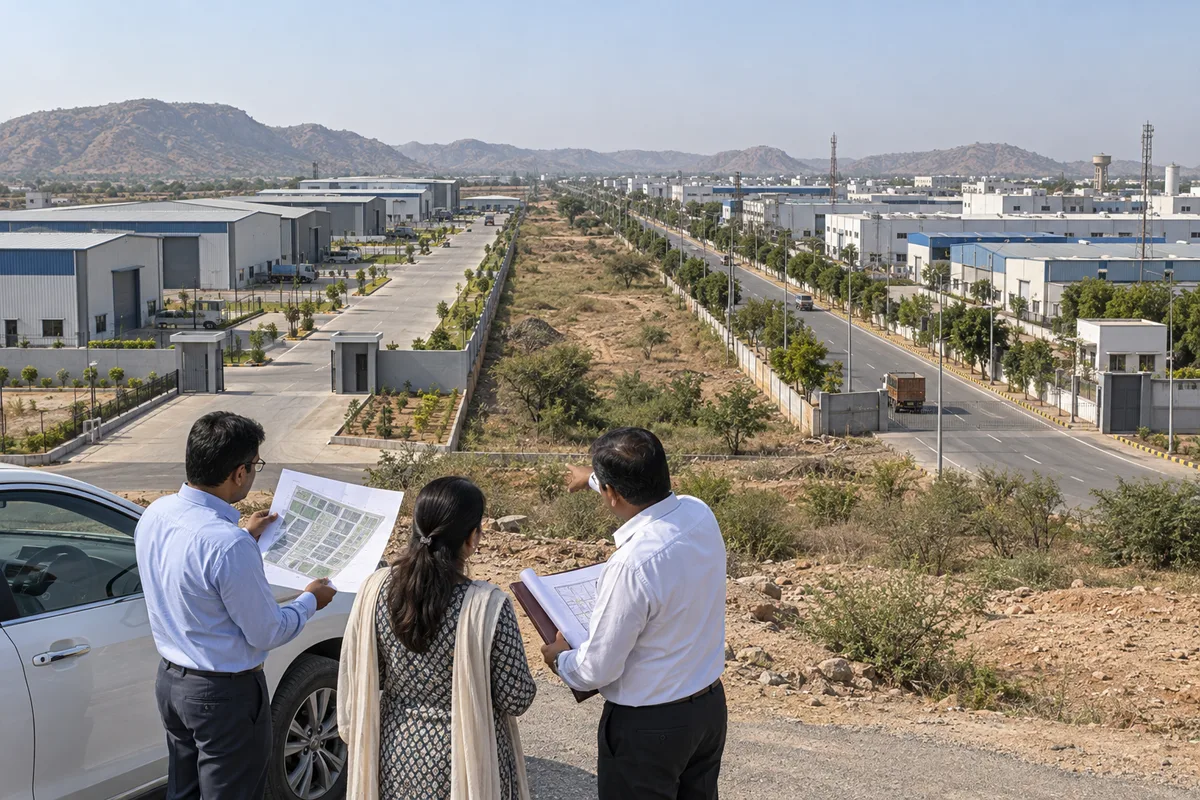
Key Answers in This Guide
- The distinction in one line: RIICO approval is a permission a private developer obtains.
- What a RIICO industrial area actually is: RIICO, the Rajasthan State Industrial Development and Investment Corporation, acquires land, develops it into a planned industrial area, and allots plots inside it to industrial units.
- What a private industrial park is: A private industrial park is the third product in this market, and it is the one most buyers have no mental model for.
- Why RIICO is still in the picture: Here is the part that confuses people, and it is the reason the phrase "RIICO approved" exists at all rather than being pure invention.
- The approvals a private industrial park needs, one by one: When a park is described to you as approved, the useful question is never "is it approved" but "which of these do you hold, and may I see the paper".
- Red flags when a private park is marketed to you: None of what follows means a park is bad.
In this guide
A private industrial park that holds RIICO approval is not the same thing as a plot inside a RIICO industrial area, and the difference decides which rulebook governs your purchase for the next twenty years. Both are legitimate. Both are sold in the Bhiwadi belt right now. But a buyer who hears “RIICO approved” on a site visit and understands it as “this is a RIICO plot” has just formed the wrong picture of his tenure, his transfer process, his transfer charges and the office he will be standing in when he wants to sell. This guide separates the two.
The distinction in one line
RIICO approval is a permission a private developer obtains. A RIICO industrial area is land RIICO acquired, laid out and allots itself. The first is a stamp on somebody else’s project. The second is an address inside RIICO’s own estate.
Every industrial park in Rajasthan needs approval before it can be developed and sold. That is not in question, and it is the reason a developer can say “RIICO approved” truthfully. What the phrase does not do is move the land inside a RIICO industrial area, put RIICO’s file behind your plot, or hand you the allotment trail that a Chopanki or Khushkhera plot carries.
| What differs | Plot inside a RIICO industrial area | Plot in a private park with RIICO approval |
|---|---|---|
| Who laid out the land | RIICO acquired, developed and allots it | A private developer bought, converted and developed it |
| Tenure | Allotment and lease from RIICO | Freehold, with no lease over the plot |
| Record behind your plot | RIICO’s own file on your plot number | The approval documents you hold yourself |
| Selling later | Through RIICO, with dues cleared and transfer charges paid | Registered sale deed, then namantaran in the revenue record |
| Internal roads and drainage | RIICO’s | The developer’s until handover, then the plot holders’ |
| Permitted use fixed by | The allotment and the lease | The conversion order and the sanctioned layout |
| First document to see | RIICO’s allotment trail for the plot | The change of land use order, matched to your khasra numbers |
What a RIICO industrial area actually is
RIICO, the Rajasthan State Industrial Development and Investment Corporation, acquires land, develops it into a planned industrial area, and allots plots inside it to industrial units. In this belt that means Bhiwadi itself, Chopanki, Khushkhera, Kahrani, Tapukara and Salarpur. If your plot sits inside one of those, RIICO is the authority for it. RIICO made the layout, built the internal roads and the drainage, and it keeps a file on your specific plot number.
That file is the product. It is why a resale purchase inside a RIICO area routes through RIICO rather than through a sale deed alone, why there are dues to clear and transfer charges to pay, and why the chain of holders on your plot is traceable through one office rather than reconstructed from decades of private paper. Our RIICO industrial plots buyer’s guide covers the allotment and resale mechanics, and RIICO plot transfer charges under Rule 18 covers what changing hands costs.
What a private industrial park is
A private industrial park is the third product in this market, and it is the one most buyers have no mental model for.
It is not a RIICO plot. It is also not the bare private industrial land our RIICO plot vs private industrial land guide compares, the converted parcel on a village road with an industrial land use and nothing built. A private park sits between them: a developer buys a block of land, obtains the approvals to develop it for industrial use, lays out internal roads, brings in power and drainage, gates the perimeter, and sells plots inside it to individual industrial buyers.
What you are buying is freehold land inside a planned, serviced estate that a private company built rather than RIICO. In the Bhiwadi-Alwar belt these parks are being marketed along State Highway 25 and the Alwar Bypass Road corridor, in plot sizes that typically run from around 500 square metres to 1,800 square metres, with internal road widths, a dedicated substation and a sewage treatment plant as the headline infrastructure.
For the right buyer that is a genuinely good product. You get freehold tenure with no lease sitting over the plot, you get infrastructure a bare parcel would never give you, and you get neighbours whose land use is fixed by the park’s own layout rather than by whatever the adjoining khasra decides to become. What you do not get is RIICO’s file, and that is the trade you need to make deliberately.
Why RIICO is still in the picture
Here is the part that confuses people, and it is the reason the phrase “RIICO approved” exists at all rather than being pure invention.
A private developer cannot simply buy agricultural land in this belt, print a layout and start selling industrial plots. The land use has to change, and industrial development in Rajasthan sits inside a framework that RIICO administers. Agricultural land is converted to industrial use through the formal change of land use process under Section 90-A of the Rajasthan Land Revenue Act, and the park’s development has to align with the industrial policy and zoning that governs the area. A park that has come through that process correctly has real approvals behind it, and the developer is entitled to say so.
The state has also moved to bring private park development into a named policy. The Industrial Park Promotion Policy 2026 was launched by the Government of Rajasthan in the State Budget for 2026-27 on 18 March 2026, and RIICO opened applications from private developers under it on 1 June 2026, covering around 645 hectares across nine locations. As reported from RIICO’s own announcement, the policy guidelines set a minimum park size of 50 acres and at least ten industrial units. We hold no copy of the policy document itself and give no clause numbers here; what we can tell you is that a formal route for privately developed parks now exists and is being actively tendered.
Two things follow from that, and they pull in opposite directions.
The first is that a park with genuine approvals is a real thing, not a marketing fiction. The second is that “approved” is not one approval. It is a stack of them, and a park can hold some and not others while a brochure prints one word for all of it.
The approvals a private industrial park needs, one by one
When a park is described to you as approved, the useful question is never “is it approved” but “which of these do you hold, and may I see the paper”.
Change of land use
This is the order converting the land from agricultural to industrial use. Without this, nothing else matters: you would be buying agricultural land with a layout drawn on it. Ask for the conversion order and check that the khasra numbers on it are the khasra numbers your plot sits on.
The approved layout
This is the park’s plan as sanctioned, showing plot boundaries, road widths and the open and common areas. Your plot number has to appear on the sanctioned layout, not only on the developer’s sales plan. These are frequently different documents and only one of them binds anybody. Our guide to reading a RIICO layout plan covers how to read one, and the same discipline applies here.
RERA registration, where the sale attracts it
A plotted development sold to the public generally requires registration with the Rajasthan Real Estate Regulatory Authority, and a registered project carries a registration number that you can look up yourself on the RERA portal. The number is the fact. The word is not.
Electricity, at the load you will actually draw
A dedicated substation in the brochure and a sanctioned connection at your plot at your load are separate things, and the gap between them is measured in months and lakhs. Ask what load is sanctioned to the park and what the process is for your own Sarkari Meter.
Pollution consent
You need consent to establish and later consent to operate from the Rajasthan State Pollution Control Board, for your category of activity. A park’s approvals do not carry your unit’s consent. That one is yours.
Fire and building approvals
These cover what you construct, on the terms that apply to the park.
A buyer who asks for these six by name gets a very different conversation from a buyer who asks whether the park is approved.
Red flags when a private park is marketed to you
None of what follows means a park is bad. It means a sentence has been compressed to the point where it no longer carries the information you need, and you should slow down and ask for the document behind it.
“RIICO approved.” True in the sense that approvals were obtained. Misleading if you take from it that the plot is inside a RIICO industrial area. Ask which is meant, in those words. A straight seller will tell you plainly that the park is privately developed and that RIICO is not the allotting authority for your plot.
“RERA approved.” RERA does not approve projects. It registers them. The correct phrase is RERA-registered, and it comes with a registration number you can verify yourself in about a minute. If a park is marketed as registered and nobody will give you the number, that gap is the finding. We hold our own registration to exactly this standard: our RERA number is printed on every page of this site precisely so that it can be checked rather than trusted.
“Government approved.” This means nothing on its own. Every one of the six approvals above is a government approval, and so is none of them. Ask which department, which order, which date.
“No GST.” The sale of plain land is outside GST by statute. That is true of every plot sale in India and is not a feature of any particular park. It also stops being true the moment construction is bundled into what you are buying, so if the deal includes a built shed, the position changes and you should price it with your accountant rather than off a brochure line.
A large company’s name used as the proof. A well-known manufacturer buying land nearby or inside a park is a genuine signal about the location. It is not a due-diligence finding about your plot, your title or your approvals, and it should not be doing the work that a conversion order and a layout should be doing.
Gaj or square metre: the twenty per cent question
This belt quotes land in two units and they are not close together. One gaj, the square yard people actually speak in, is 0.836 square metres. A rate quoted per gaj converts to roughly 1.2 times that number per square metre.
So a park quoted at ₹26,000 per gaj is a park at about ₹31,100 per square metre. The same figure heard as ₹26,000 per square metre is about ₹21,700 per gaj. Nobody has to be dishonest for this to go wrong. A number gets written down in a WhatsApp message without its unit, it gets forwarded, and a buyer builds a budget a fifth below the market and then cannot understand why no seller will engage.
The habit that prevents it costs you one sentence. When a rate is quoted to you, repeat it back with the unit attached, and get the unit written into the bayana receipt alongside the figure. On a 1,000 square metre plot, the difference between the two readings of the same number is over ₹90 lakh.
The same discipline is why our guide to asking, negotiated and registered value exists. A number without its definition is not a price.
What private park land costs in this belt
Our own rate card for developer-built industrial park land in the Bhiwadi-Alwar belt currently runs ₹26,000 to ₹30,000 per square metre, partner-confirmed in September 2026. That is per square metre, and it is land only: no shed, no boundary construction, no power infrastructure contribution.
For context, resale land inside the established RIICO industrial areas across this belt runs around ₹25,000 to ₹40,000 per square metre depending on the area, plot size, corner position and road width, partner-confirmed in July 2026.
Both are indications from our own rate card rather than quotations for a specific plot, and they move with the market, so contact us for current rates before you build a budget on either. What the comparison is for is the shape of the decision, not the arithmetic: a serviced private park and an established RIICO area are priced in the same broad territory in this belt. You are not buying the private park to save money on the land. You are buying it for freehold tenure and for infrastructure that arrives with the plot, and paying for those in a different currency, which is the absence of RIICO’s file behind your title.
Remember also that a resale band is only one of the four values you will be quoted on industrial land. Our guide to the RIICO allotment rate, reserve price, DLC and resale price explains why budgeting from an allotment rate or a DLC figure lands you on a number no seller will accept.
What changes for you after purchase
This is where the distinction stops being terminology and starts costing money and time.
Selling it later
A RIICO plot transfers through RIICO, with dues cleared and the transfer recorded in RIICO’s file. A plot in a private park transfers by registered sale deed like any other freehold property, followed by namantaran in the revenue record. The private route is faster and involves no authority permission. It also means the buyer’s diligence rests entirely on the paper you hand him, which is a reason to keep every approval document in the file from day one rather than assembling it in a hurry five years later.
Who fixes the road
Inside a RIICO area, the internal infrastructure is RIICO’s. Inside a private park, it belongs to the developer until it is handed over to whatever body the park’s documents nominate, and after that it belongs to the plot holders collectively. Ask what the maintenance arrangement is, what it costs per year, and what happens to it when the developer finishes selling and leaves. This is the single most commonly skipped question on a private park purchase and the one most likely to produce a dispute in year six.
Financing
Banks lend against both, but the file they want differs. For a private park plot the lender will look at the title chain, the conversion order and the approvals, and an incomplete approval stack shows up as a valuation problem or a refusal rather than as a polite request for more paper.
Permitted use
Inside a RIICO area, permitted use is fixed by the allotment and the lease. In a private park it is fixed by the conversion order and the sanctioned layout. Either way it is fixed, and either way an activity outside it is a compliance problem you inherit on day one. Our guide to freehold and leasehold property in Bhiwadi covers the tenure side of this.
Who a private industrial park suits
It suits you if you want freehold ownership with no authority permission needed to sell, if you want serviced land rather than a bare parcel, if you have the patience to verify a six-document approval stack yourself or the advisor to do it for you, and if the plot sizes on offer match the unit you are actually going to build.
It does not suit you if you are a first-time industrial buyer with no legal support, if you need the comfort of a single authority file behind your title, if your sanction requirements are heavy enough that the park’s own power position matters more than its road widths, or if you are buying primarily to hold rather than to build. On a hold, the RIICO area’s traceable chain is worth more at resale than the private park’s convenience, because your eventual buyer will be doing the same diligence you are doing now.
We transact in both products in this belt. If you tell us the unit you intend to build, the load you need and the timeline you are working to, we will tell you which of the two fits and why, including when the answer is the one we are not currently holding stock in.
Frequently Asked Questions About RIICO Approval on a Private Industrial Park
Is a RIICO approved private park the same as a RIICO plot?
No. The park holds approvals obtained by its developer. A RIICO plot is land inside a RIICO industrial area, allotted by RIICO, governed by an allotment and lease, and transferred through RIICO’s own process. The tenure, the transfer route and the authority behind your title are different in each case, so confirm in plain words which one you are being offered before you pay a bayana.
Does a private industrial park need RIICO approval at all?
Industrial development in Rajasthan sits inside a framework RIICO administers, and land has to be converted to industrial use before a park can be laid out and sold. The state has also opened a formal route for privately developed parks under the Industrial Park Promotion Policy 2026, launched in the State Budget for 2026-27 on 18 March 2026, with RIICO inviting developer applications from 1 June 2026. What matters for your purchase is not the phrase but the specific orders: the conversion of land use, the sanctioned layout, and the registration of the project where the sale attracts it.
How do I check whether a project is registered with RERA?
Ask for the registration number and look it up on the Rajasthan RERA portal yourself. A registration number is a fact you can verify in a minute. A brochure line is not, and no amount of confidence in the seller substitutes for the lookup. If the number is not forthcoming, treat that as the answer to your question.
Is a private park plot cheaper than a RIICO plot?
Not reliably. In this belt, our rate card puts developer-built park land at ₹26,000 to ₹30,000 per square metre and RIICO-area resale land at ₹25,000 to ₹40,000 per square metre, both partner-confirmed indications rather than quotations. The two overlap. The private park is bought for freehold tenure and serviced land, not for a discount, and a park priced far below both bands is telling you something about its approvals or its location rather than offering you a bargain.
What is the one document I should not proceed without?
The order converting the land to industrial use, checked against the khasra numbers your plot actually sits on. Every other approval assumes it. A park with a beautiful layout, a substation and a gate, sitting on land that is still agricultural in the revenue record, is selling you a picture rather than a plot.
Continue Reading
Discuss Your Industrial Requirement
18+ years in this market. Real prices, verified paperwork, no pressure.
Choose what you would like to do next:
Done. Our team will contact you during working hours.