Key Answers in This Guide
- For any resale property (flat, plot, or house): Five documents recur across every resale purchase in Bhiwadi regardless of property type: the title chain, an encumbrance certificate, tax receipts, a society no-dues certificate where applicable, and the seller's ID.
- Additional, for flats and apartments: A flat adds three checks on top of the resale basics: the Occupancy Certificate, the sanctioned building plan, and for an under-construction project, its RERA registration.
- Additional, for plots (authority schemes and private colonies): A plot adds three checks the flat branch does not have: the land-use conversion, the demarcation against the sanctioned layout, and the authority's dues clearance.
- Additional, for RIICO industrial plots and factories: A RIICO plot adds a layer the other two branches do not have: a second counterparty.
- The registry-day paperwork: Registry day needs a much shorter list than verification does, and that is the point: by the time you reach the Sub-Registrar office the checking is meant to be finished.
- When the seller cannot produce the originals: The most common reason a seller shows you photocopies is not that something is wrong.
In this guide
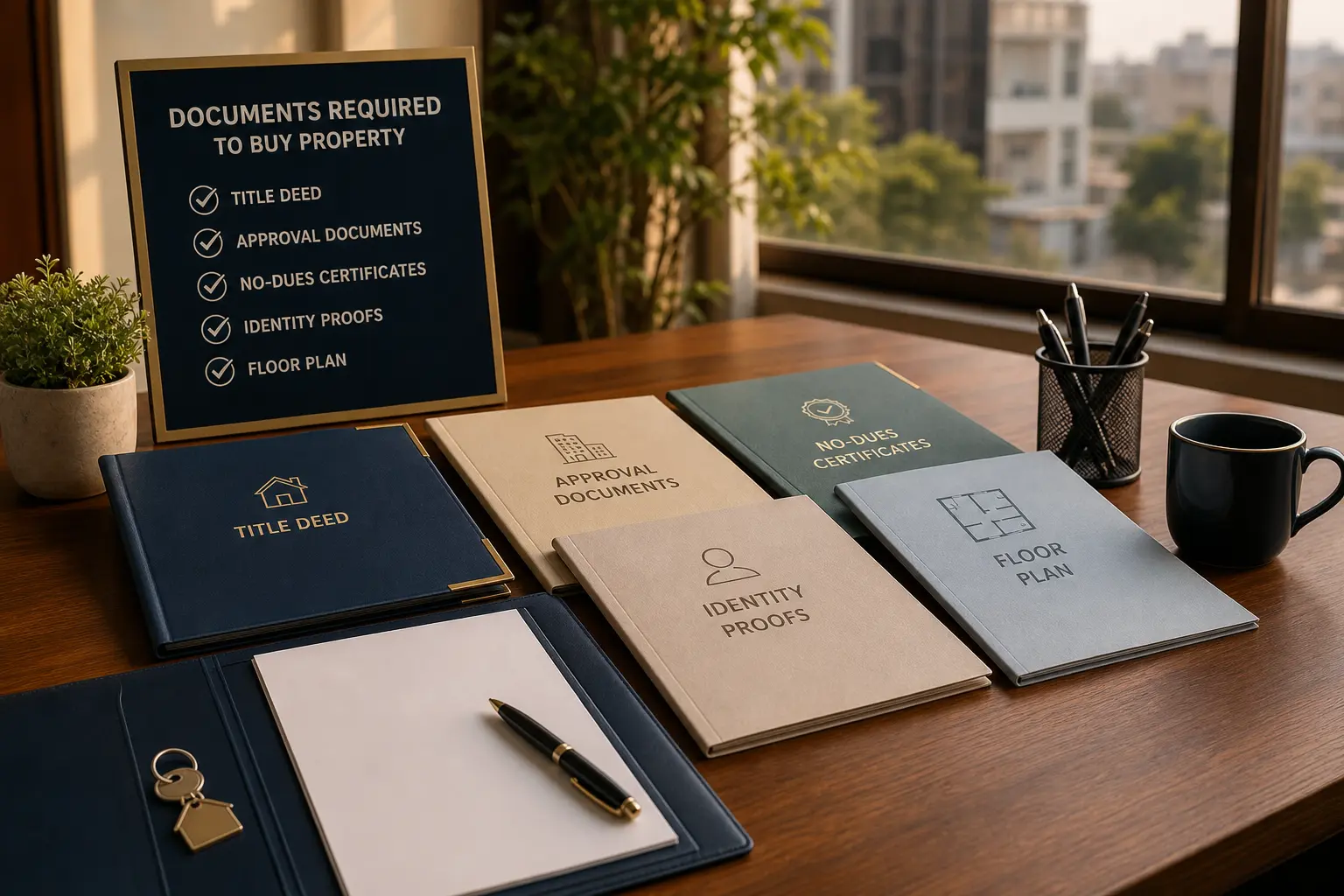
The documents required to buy property in Bhiwadi fall into three sets: a core set every resale buyer verifies, a branch specific to what you are buying (flat, plot, or RIICO industrial), and the registry-day paperwork everyone needs. Below is what to check in each set, who issues it, and what a gap looks like.
The file looks routine until the one gap that matters surfaces at registry, or after it. Two things make a Bhiwadi document set different from a generic Indian checklist. Approvals in this belt carry either BIDA’s name or the older UIT’s, depending on when they were issued, and a single locality here can hold a society flat, a colony plot and a RIICO industrial plot side by side, each with a different set of papers behind it. Work out which branch you are on before you start collecting. If you are on the other side of the table, the same file read from the seller’s chair is our guide to the documents required to sell property in Bhiwadi, which covers what you have to produce rather than what you have to check.
This is a checklist, not a legal opinion. It tells you what to ask for and what a gap looks like. Whether a specific title chain, POA or conversion certificate is actually clean for the property you are buying is a question for an independent property lawyer, engaged and paid by you, before you pay beyond token money.
For any resale property (flat, plot, or house)
Five documents recur across every resale purchase in Bhiwadi regardless of property type: the title chain, an encumbrance certificate, tax receipts, a society no-dues certificate where applicable, and the seller’s ID. Each is verified against the checks below, not taken on the seller’s word.
| Document | Who issues it | What it indicates | Red flag | Independent check |
|---|---|---|---|---|
| Title chain | Compiled from past registered deeds at the Sub-Registrar office, searchable via Rajasthan ePanjiyan | The unbroken record from original allotment/registration to the current seller | A gap in the chain, or a transfer that was never registered | Lawyer traces the full chain, not just the last deed |
| Encumbrance certificate | Sub-Registrar office | Whether the property carries a registered loan, mortgage or legal claim | Certificate covers only a short recent period | Get one covering at least the last 12 to 15 years |
| Latest property tax receipts | The local municipal body, or the authority whose area the property falls in | Tax is paid to date, in the seller’s name, with no dues pending | Receipts in a different name, or dues shown outstanding | Match the name on the receipt against the seller’s ID |
| Society/RWA no-dues certificate | The society or RWA (for flats and builder floors) | Maintenance and other society charges are cleared | Society refuses to issue one, or cites pending dues | Ask the society directly, do not rely on the seller’s word |
| Seller’s ID and PAN | Government (Aadhaar, Income Tax Department) | The person signing is the person named in the title documents | Name mismatch between ID and title papers | Compare spelling, parentage and address across all documents |
| Power of Attorney, if the seller is not present | Executed by the seller, registered at a Sub-Registrar office | Confirms who is legally authorised to sign on the seller’s behalf | An unregistered, expired, or general (not sale-specific) POA | Lawyer confirms the POA is registered, current, still valid, and specific to this sale |

Additional, for flats and apartments
A flat adds three checks on top of the resale basics: the Occupancy Certificate, the sanctioned building plan, and for an under-construction project, its RERA registration. Skipping any one of these is how buyers end up owning a flat the authority never cleared for occupation.
| Document | Who issues it | What it indicates | Red flag | Independent check |
|---|---|---|---|---|
| Occupancy Certificate (OC) | BIDA, the planning authority for the Bhiwadi belt; older buildings carry a UIT-era certificate | The building is legally fit for occupation | No OC at all | Treat as a serious gap, not a minor one; ask when it will be issued |
| Sanctioned building plan | BIDA, or UIT on a building approved before BIDA took over the role | Construction matches what was officially approved | Extra floors or extensions beyond the sanctioned plan | Compare the plan against the actual structure on site |
| RERA registration number, for under-construction projects | Rajasthan RERA | The project is registered and its status, promised possession date and complaints are on public record | Developer states a number but it does not appear on the portal | Verify directly on the Rajasthan RERA portal; see our RERA and BIDA verification guide |
Additional, for plots (authority schemes and private colonies)
A plot adds three checks the flat branch does not have: the land-use conversion, the demarcation against the sanctioned layout, and the authority’s dues clearance. Ask for all three from the same authority that sanctioned the layout, which in this belt means BIDA, the Bhiwadi Integrated Development Authority. Older approvals, allotments and lease deeds carry the name of the Urban Improvement Trust, UIT Bhiwadi, which handled the planning role before BIDA absorbed it. A document in UIT’s name is not invalid because of the name; it reflects when it was issued. What matters is that a competent authority sanctioned it at the time and that BIDA’s records recognise the plot now, because BIDA is the office you will deal with when you build.
| Document | Who issues it | What it indicates | Red flag | Independent check |
|---|---|---|---|---|
| Land-use conversion certificate | BIDA, or UIT on an older approval | The land has been legally converted for the use you intend | No conversion certificate on land outside an authority-planned scheme | A plot without conversion carries real legal and construction risk; conversion is also what makes building-plan approval available to you later |
| Demarcation/site plan | BIDA or a licensed surveyor, matched against the sanctioned layout | The boundaries on paper match what is physically shown to you on site | Site boundaries do not match the paper plan, or the plot number is not on the sanctioned layout | Walk the boundaries yourself against the demarcation plan before paying |
| Authority dues clearance | BIDA, or UIT on an older scheme plot | No pending development or maintenance charges owed to the authority | Dues shown pending, or seller cannot produce a clearance | Confirm directly with the authority office, not only through the seller |
Our BIDA plot vs developer plot guide sets out how far the authority’s own backing carries an approval, and where a private colony plot puts the burden of proof back on you.
For land parcels, also pull the record yourself on the Apna Khata portal and match the seller’s name against the jamabandi entry for the khasra number you are buying. Our guide to reading Apna Khata land records explains what the entries mean and what the portal cannot tell you. A revenue record shows possession and the recorded holder; it is not a title registry, so it corroborates the title chain rather than replacing it.
Additional, for RIICO industrial plots and factories
A RIICO plot adds a layer the other two branches do not have: a second counterparty. Besides the seller, RIICO itself has to recognise the transfer, clear the dues, and accept that your intended activity matches the category the plot was allotted for. So the industrial file is checked twice, once for the title chain and once against RIICO’s own records, and a plot can be clean on the first and blocked on the second.
| Document | Who issues it | What it indicates | Red flag | Independent check |
|---|---|---|---|---|
| RIICO allotment letter or transfer deed | RIICO | The chain from RIICO’s original allotment to the current holder | Transfer never recorded with RIICO | Lawyer confirms the transfer is reflected in RIICO’s own records |
| RIICO dues clearance certificate | RIICO | Service charges, lease rent and penalties are cleared before transfer | Seller cannot produce a current clearance | Confirm directly with the RIICO office, not the seller |
| Land-use compliance for your industry type | RIICO | The plot is allotted for a category of use that matches your intended business | Your intended use falls outside the allotted category | Confirm permitted use before you commit, not after |
| Building-plan approval, for built-up factories/sheds | Local authority / RIICO | Construction matches the approved plan, same logic as a residential OC | Unapproved construction | Unapproved built-up area is a liability, not an asset |
| Utilisation/construction-timeline compliance | RIICO | The allotment’s condition to build within a set period has been met | Plot in breach of its utilisation timeline | Check current compliance status with RIICO before buying |
Our RIICO industrial plots buyer’s guide covers this process in more depth.
The registry-day paperwork
Registry day needs a much shorter list than verification does, and that is the point: by the time you reach the Sub-Registrar office the checking is meant to be finished. Nothing in this section is a substitute for the branches above, and an appointment is a poor place to discover a gap.
Once verification is complete, registry itself needs: the sale deed (drafted and reviewed before the appointment, see our agreement to sell vs sale deed guide), stamp duty and registration fee paid in advance (see our registry and stamp duty charges guide and calculator), photo ID and PAN of both parties, and passport-size photographs for the deed.
When the seller cannot produce the originals
The most common reason a seller shows you photocopies is not that something is wrong. It is that the property still carries a running home loan, and the lender holds the original registered sale deed and the earlier title documents until that loan is closed. Ask the question directly rather than reading the photocopies as a red flag: is there a loan on this property, which bank holds it, and what is the outstanding.
Two things follow from the answer, and both belong in the deal’s timeline rather than in an argument on registry day. Lenders routinely release certified copies for exactly this kind of verification, so your lawyer can still trace the chain while the originals sit in a bank vault. And the originals reach you only after the loan is foreclosed and the bank issues its no-dues confirmation and releases the charge, which is a process with its own turnaround and has to be sequenced against your registry date. Our guide to selling a flat with a home loan in Bhiwadi sets out that sequence from the seller’s side, which is the side that controls it.
A seller who cannot name the bank, cannot say what is outstanding, or will not ask the lender for a list of what it holds is a different matter. That is not a custody problem, it is an information problem, and it is worth slowing down for.
What This Checklist Does Not Do
This list tells you what to ask for and what a missing or inconsistent document looks like. It does not replace a property-specific title and document review by an independent property lawyer, and it is not a substitute for verifying originals in person, not photocopies. Our common property mistakes and pre-purchase questions guides cover the mistakes that slip through even when buyers think they have checked everything.
What We Verify Before We Show You a Property
Every listing we show, residential or industrial, is screened against this checklist first: title chain, dues clearance, and approvals status. That screening is preliminary and filters out the obvious problems before your first site visit; it is not a legal opinion, and it does not replace your own lawyer’s review of the specific property you choose.
Frequently Asked Questions About Documents Required to Buy Property in Bhiwadi
What documents are required to buy property in Bhiwadi?
The core set is the seller’s registered sale deed and the title chain proving ownership, plus identity documents. A flat adds the occupancy certificate and society no-dues; a plot adds land-use and demarcation records. The matrix above details each.
Do I need the occupancy certificate to buy a flat?
Yes, confirm the building has one, because it certifies the building is legally fit to live in. Its absence on an occupied building is a question for your lawyer before you pay.
Can I buy property in Bhiwadi without a lawyer?
You can, and you should not. A dealer coordinates documents; an independent lawyer verifies the title and agreement for you alone, for a fraction of a per cent of the deal.
What documents does a RIICO industrial plot need?
Add the RIICO allotment or transfer papers, land-use and permitted-activity confirmation, and the pollution and fire NOCs relevant to the intended use, on top of the standard title checks.
Who issues the land-use conversion certificate for a Bhiwadi plot?
BIDA, the Bhiwadi Integrated Development Authority, which sanctions layouts and land use across the belt. An older plot may hold a conversion issued in UIT Bhiwadi’s name, from before BIDA absorbed that role, and that document is valid for its era. Ask BIDA whether its records recognise the plot, because BIDA is the office you apply to when you build.
The seller only has photocopies. Is that a problem?
Usually it means a home loan is still running and the bank holds the originals until it is closed. Ask which bank, what is outstanding, and for a written list of the documents it holds. A seller who cannot answer those three questions is the concern, not the photocopies.
Continue Reading

Verify Before You Pay, We Will Help
18+ years in this market. Real prices, verified paperwork, no pressure.
Choose what you would like to do next:
Done. Our team will contact you during working hours.