
Key Answers in This Guide
- The core file every Bhiwadi seller has to produce: Six documents decide whether your sale is a two-week process or a two-month one, and they are the same six whether you are selling a flat in a society or three bigha off the Tijara road.
- Selling a society flat: the parts the society controls: A flat sale has a third party in it who is not the buyer, not the bank and not you, and who can hold the deal up for reasons that have nothing to do with either side.
- Selling a plot in a BIDA, UIT or private colony: Plot sales fail on the record more often than flat sales do, because a plot has no building to inspect and the paperwork is the whole property.
- Selling an independent house built on a colony plot: An independent house is a plot sale with a building on top of it, and the extra documents are all about whether that building was approved and connected legally.
- Selling agricultural land or a farmhouse: Land is sold out of the revenue record rather than out of a builder's file, so the document set differs in kind and not merely in detail.
- Selling a RIICO industrial plot, shed or factory: An industrial sale carries a fourth party with real authority over whether it happens at all.
In this guide
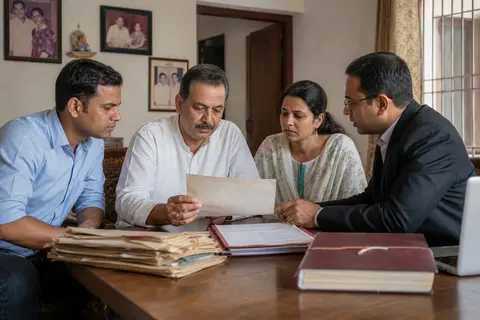
A buyer collects documents to decide whether to buy. A seller has to produce them, and that is a different job with a different failure mode. The buyer who cannot find a paper walks away from one property. The seller who cannot find it loses weeks on every deal, with every buyer, until it is fixed.
The other thing sellers underestimate is who the real reader is. Most Bhiwadi flat buyers fund the purchase with a home loan, so your file is read first by a bank’s legal panel and its valuer, not by the buyer standing in your drawing room. A bank raises a query in writing, the query goes back into a queue, and the days it costs are days in which your buyer keeps looking at other flats. Our seller’s guide to the whole sale covers the sequence around this; the file itself is below.
| Stage | What the file has to survive | Who is reading it |
|---|---|---|
| Before you list | The first serious buyer asking what you have | The buyer, and any dealer he brings |
| Before you accept bayana | A dues, name and record check against the property | The buyer, and often his lawyer |
| Loan sanction | A title chain read line by line, and a valuation visit | The bank’s legal panel and valuer |
| Registry day | Identity, payment of duty, and the deed matching the record | The sub-registrar |
The core file every Bhiwadi seller has to produce
Six documents decide whether your sale is a two-week process or a two-month one, and they are the same six whether you are selling a flat in a society or three bigha off the Tijara road. Each row below names what the document does on the buyer’s side, because that is what tells you how hard he will push when it is missing.
| Document | Who issues it | What it does for the buyer | If you cannot produce it |
|---|---|---|---|
| The registered deed that brought the property to you | The sub-registrar office where it was registered, searchable through Rajasthan ePanjiyan | Establishes the link from the previous owner to you, which is the link his lawyer starts from | A certified copy from the sub-registrar office replaces a lost original, and the process takes time you should spend before listing |
| The title chain behind it | Compiled from earlier registered deeds and allotment records | Lets his lawyer trace the property back through past owners rather than trusting one deed | A break in the chain is the most expensive gap on this page, because it cannot be fixed at the buyer’s speed |
| Proof your own namantaran was completed | Tehsil for revenue land, the authority for a BIDA or UIT plot, the society for a flat, RIICO for an industrial plot | Confirms the record names you, not the person you bought from | A record that still names a previous owner stalls the deal at exactly the point money would have moved. See our namantaran guide |
| Latest property tax receipts | The local municipal body or the authority billing the property | Shows tax paid to date and in your name | Arrears get deducted from your price, and the deduction is rarely limited to what the arrears actually are |
| Electricity and water bills in your name | The distribution company and the water utility | Confirms the connection is sanctioned and the dues are clear | A connection still billed to a previous owner reads to a buyer as unfinished business, which is what it is |
| Your photo ID and PAN | Aadhaar and the Income Tax Department | Confirms the person signing is the person named in the papers, and lets him deposit TDS against your PAN | A name spelt differently across your Aadhaar, your PAN and the deed is worth correcting before you list |
Two of these are worth acting on today rather than when a buyer asks. Pull a certified copy of your deed if the original is anywhere other than in your own cupboard, and check that your own mutation was actually completed after you bought. Sellers who bought ten or fifteen years ago in Bhiwadi discover the second problem often enough that we ask about it in the first conversation.
Selling a society flat: the parts the society controls
A flat sale has a third party in it who is not the buyer, not the bank and not you, and who can hold the deal up for reasons that have nothing to do with either side. The society or the builder, depending on who runs the complex, issues papers a buyer’s bank will not close without.
| Document | Who issues it | Why the buyer’s side needs it | Seller’s note |
|---|---|---|---|
| No-dues certificate | The society, RWA or the builder still managing the complex | Confirms maintenance, water and any sinking-fund dues are cleared to date | Ask for it before you list. If there are arrears you want to clear them on your own schedule, not under a buyer’s deadline |
| Transfer permission and the society’s transfer formalities | The society or builder | Records the flat into the buyer’s name in the society’s own register after registry | Every society sets its own transfer amount and its own process, so ask yours for its current figure in writing rather than assuming a neighbour’s number still holds |
| Occupancy certificate and possession letter | The local development authority, then the builder | Tells the bank the building is legally fit for occupation and that possession was formally given | Ask the society office rather than hunting your own file, since societies usually hold the building-level papers |
| Maintenance receipts | The society | Corroborate the no-dues certificate and show the charge the buyer inherits | Keep the last twelve months together in one place |
| Share certificate or membership record, where the society issues one | The society | Confirms your membership in the society’s own record | Not every Bhiwadi complex issues one, and a no-dues plus the transfer record is the working equivalent |
What goes wrong here is timing rather than paperwork. A society office that meets once a week, a secretary who is travelling, or a pending general-body approval will each add days at the worst moment. Our society inspection guide looks at the same complex from the buyer’s chair, which is a useful way to see what he will be asking your society about.
Selling a plot in a BIDA, UIT or private colony
Plot sales fail on the record more often than flat sales do, because a plot has no building to inspect and the paperwork is the whole property. The buyer is checking three separate things: that the colony was sanctioned, that your plot number exists inside that sanction, and that the boundaries on paper are the boundaries he walked.
| Document | Who issues it | What it establishes | Where sellers get caught |
|---|---|---|---|
| Allotment letter or the registered sale deed | The authority, the colonizer, or the sub-registrar for a resale | The link that brought the plot to you | An allotment that was never converted into a registered deed is a weak link in the chain |
| Sanctioned layout position of your plot | BIDA, or the UIT record for older colonies | That your plot number sits inside an approved scheme rather than outside it | A sanctioned colony does not by itself mean your specific number was part of the sanction. Our BIDA plot vs developer plot guide sets out the difference |
| Land-use conversion, where the land was agricultural | The competent revenue authority | That the plot may legally be used and built on for the purpose being sold | An unconverted plot marketed as residential is the most common serious defect in the private-colony belt |
| Development-charge clearance | BIDA, the UIT or the colonizer | That external development charges are not still owed on the plot | Unpaid charges follow the plot, so the buyer will price them in |
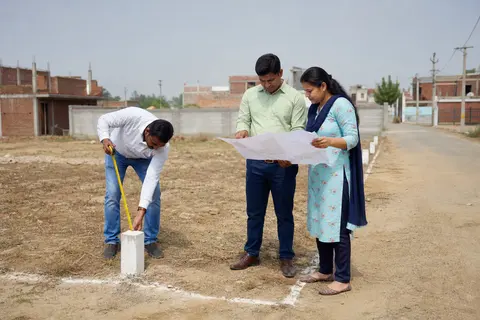
| Demarcation or site plan | The authority, or a licensed surveyor | That the plot on paper matches the plot on the ground | A boundary that has quietly moved through a neighbour’s construction is found on the site visit, not in the file |
| Latest jamabandi extract for the parent khasra, where applicable | Tehsil revenue record, readable on Apna Khata | That the revenue record and the colony record tell the same story | Search Khairthal-Tijara district, not Alwar. Bhiwadi moved, and a search against the old district returns nothing and reads like a missing record |
Selling an independent house built on a colony plot
An independent house is a plot sale with a building on top of it, and the extra documents are all about whether that building was approved and connected legally. House buyers in Bhiwadi ask fewer questions than flat buyers do, and their banks ask more.
Produce the full plot set above, and add three things. The sanctioned building plan, so the buyer can compare what was approved against what stands: an extra floor or a covered setback that never appeared on a plan is a liability he inherits, and his bank may decline to fund the unapproved portion. The electricity connection record, which in this belt means confirming the house runs on a sanctioned Sarkari Meter in your name, because a temporary or borrowed connection is a real deduction from a house price. And the completion or occupancy position where the local authority issues one, which our completion vs occupancy certificate guide explains, since the two are routinely treated as one document and are not.
Selling agricultural land or a farmhouse
Land is sold out of the revenue record rather than out of a builder’s file, so the document set differs in kind and not merely in detail. The tehsil is the office that matters, and the khasra number is the identifier everything else hangs from.
| Record | Who holds it | What the buyer reads in it | What it does not settle |
|---|---|---|---|
| Current jamabandi | Tehsil revenue record, on Apna Khata | Whose names the record carries, the khasra numbers, the shares and the recorded area | It is a revenue record and not a title deed. It cannot show an unregistered agreement or a mortgage |
| Girdawari | Tehsil | What the land was recorded as being cultivated or used for, season by season | It records use, not permission to change that use |
| Khasra numbers with area, in bigha and biswa | Tehsil, matched against your deed | That the parcel being sold is the parcel in the record | A khasra that has been split or renumbered needs the tehsil to reconcile it, not the seller |
| Patta or the allotment record, where the land came through one | The issuing authority | The origin of your holding | An old patta with no subsequent record update leaves the chain incomplete |
| Conversion order, if any part is non-agricultural | The competent revenue authority | That a farmhouse, shed or boundary structure stands on land permitted for it | Construction on unconverted land remains a defect after the sale |
| Co-sharer position | The revenue record itself | Whether the holding is joint, and who else must sign | This is the item that stops more land deals in this belt than any other |
Our agricultural land and farmhouse selling guide goes through the transaction itself. For reading the record, the Apna Khata walkthrough shows what each column means, and the land measurement units guide covers bigha, biswa and gaj so the area in your deed and the area in the record can actually be compared.
Selling a RIICO industrial plot, shed or factory
An industrial sale carries a fourth party with real authority over whether it happens at all. RIICO holds the allotment, the dues position and the transfer permission, and the buyer’s first question is not about your building.
| Document | Who issues it | Why it decides the deal | Seller’s note |
|---|---|---|---|
| Original allotment letter and every recorded transfer since | RIICO | Shows the chain from RIICO’s own allotment to you, in RIICO’s records rather than only in yours | A transfer completed between two parties but never recorded with RIICO is not a transfer as far as RIICO is concerned |
| Current dues position | The RIICO Bhiwadi unit office for the area | Service charges, lease rent and penalties have to be settled for a transfer to proceed | Ask for the current position early. Dues accrue, and last year’s figure is not the figure you will pay |
| Utilisation status | RIICO | Whether the allotment’s condition to build and operate within a set period has been met | This is not a filing detail. It decides which transfer-fee branch your sale falls into, and whether the plot may be transferred at all yet |
| Building-plan approval for covered area | The local authority or RIICO | That the shed or factory matches an approved plan | Unapproved built-up area is a liability for the buyer, not floor space he is paying for |
| Consents and licences for the operating unit | The pollution control board and the relevant departments | Which permissions attach to the premises and which follow the operator | Do not tell a buyer his licences will simply carry over. What transfers and what he must obtain fresh is a question for the issuing department |
Two of those rows decide more than the others, because both are settled by rule rather than by what a seller and a buyer agree between themselves.
The first is that utilisation status sets what RIICO charges to move the plot into the buyer’s name. Under Rule 18 of the RIICO Disposal of Land Rules, 1979, as amended up to 8 April 2026, published by the Rajasthan State Industrial Development and Investment Corporation, a utilised industrial plot transfers at 0.50 per cent of the prevailing allotment rate of the concerned industrial area, and a vacant one at 20 per cent of the prevailing or the original allotment rate, whichever is higher. The percentage attaches to RIICO’s allotment rate for that area and not to the price you negotiate, so it cannot be estimated from your deal value. What counts as utilised is also stricter than the way this market talks: a boundary wall, a watchman room or a block raised to plinth level leaves the plot vacant under the rule, which is how a seller who has walled his plot and calls it developed ends up quoting a buyer the wrong branch. Our Rule 18 transfer charges guide sets out every branch and what the percentage is charged on.
The second is timing, and it is the one sellers find out about late. Sale or transfer of a vacant or unutilised plot is generally permissible only after five years from allotment under the same rules, subject to the stated exception for plots allotted under Rule 3(AJ). So the allotment letter is not only a link in your chain. It carries the date the five years run from, and the provision you were allotted under, which together settle whether this sale can happen now or has to wait. Those same rules also provide for forfeiture of the transferor’s security deposit on a vacant-plot transfer, which is a seller-side cost and belongs in your arithmetic rather than in a surprise at the unit office. Establish the position with the Bhiwadi unit office before you agree a price, since orders issued after the consolidated edition above are not in it and govern where they differ.
Our RIICO buyer’s guide covers the transfer process from the other side, and operational factory vs vacant shed explains why the same premises sells differently depending on whether it is running.
The documents that exist only on the seller’s side
Four situations produce paperwork a buyer never has to think about, and all four are yours to solve before a buyer is standing in front of you.
A running home loan. Your lender holds the original deed and will release it only against foreclosure. Ask your bank for a foreclosure statement and the list of documents it holds, and establish its release timeline, because that timeline sits in the middle of your registry planning. The buyer is often funding part of your foreclosure from his own loan, so the two banks have to be sequenced rather than merely informed.
A property you inherited. The record has to name you before you can sell, which means succession documentation and a completed namantaran into the heirs’ names, and every co-heir has to be party to the sale. This is slow in a way no buyer’s deadline can compress.
Co-owners, or a seller who cannot attend. Joint ownership means every owner signs, and an absent owner needs a registered power of attorney specific to this sale rather than a general one. Our GPA guide sets out why the distinction matters and why a general power of attorney is not a substitute for a sale deed.
Tax paperwork. The buyer deducts TDS on the purchase and gives you the certificate for it, which is his compliance and your credit. Where the seller is a non-resident the deduction works on a different basis entirely, and a lower-deduction certificate is worth applying for early. What you owe is a separate calculation from what he deducts, and our capital gains guide keeps the two apart. Both are questions for your chartered accountant on your own numbers, not for a dealer.
The four gaps sellers arrive with, and what to do about each
Most sellers who come to us with a document problem have one of four, and three of them are fixable if the work starts before the property is listed rather than after a buyer has paid bayana.
The original deed is lost. A certified copy from the sub-registrar office where the deed was registered is the standard answer, and the registration record itself is unaffected by your copy going missing. Start it early, because a buyer will accept a certified copy and will not accept waiting for one.
Your own namantaran was never completed. The sale to you was registered, but the record still names the person you bought from. Complete it in your name before you sell. Doing it under a buyer’s timeline is how sellers end up accepting a discount for a problem that had nothing to do with the property’s value.
A link in the chain was never registered. An earlier transfer that happened on an agreement, on a general power of attorney, or on a will alone leaves a gap the buyer’s lawyer will find. This one is not a paperwork errand. It is a legal question, and it needs an advocate reading the actual chain rather than a checklist.
Names do not match across documents. A spelling that differs between your Aadhaar, your PAN, the deed and the electricity bill is common and usually curable, but each correction runs through a different office at its own pace. Read them side by side today.
What a missing document actually costs you
The cost of a thin file is commercial rather than legal, and it arrives in one of three forms.
Price, first. A buyer who finds a gap does not walk away as often as sellers fear. He renegotiates, and the deduction he asks for is set by his uncertainty rather than by the real cost of fixing the item, so an arrear of a few thousand rupees routinely costs several times that at the negotiating table.
Time, second, which then becomes price. Each bank query adds a round trip, each round trip adds days, and a buyer waiting on your paperwork is a buyer still looking at other properties. Our seller service page makes the same point from the pricing side.
Buyer quality, third, and this is the one sellers notice last. A clean file is legible to a loan-funded buyer, who is most of the flat market. An incomplete file quietly filters your enquiries down to cash buyers, who are fewer and who price accordingly.
What we check before we take a seller mandate
We read the file the way a buyer’s lawyer will read it, and we tell you what is missing in writing before the property is listed rather than after a buyer has found it. That means pulling the public records ourselves and comparing them against your papers: the jamabandi and girdawari for land, the RERA registration for a project flat, the BIDA or UIT position for a colony plot, the RIICO allotment and dues for an industrial plot, and the ePanjiyan entries we can reach.
The boundary is the same one we hold on the buy side, and our document verification page sets it out in full. We check records and tell you what they say. We do not issue a title certificate, we do not give a legal opinion, and where your chain needs an advocate we say so and you engage one. A dealer who offers a seller a clean chit on his own signature is offering something he cannot back.
Frequently Asked Questions About Documents Required to Sell Property in Bhiwadi
What is the minimum document set to sell a flat in Bhiwadi?
The registered deed that brought the flat to you with its chain, evidence that the record names you, society no-dues, latest tax and utility receipts, and your ID and PAN. A mortgaged flat adds the lender’s foreclosure statement, and a recently completed project adds the occupancy certificate and possession letter.
I lost my original sale deed. Can I still sell?
Yes. Apply for a certified copy from the sub-registrar office where the deed was registered, since the registration record is intact regardless of your copy. Start the application before listing rather than after a buyer has committed, because the wait otherwise falls entirely inside your deal timeline.
Does the buyer or the seller pay the stamp duty?
Stamp duty and the registration fee are ordinarily the buyer’s cost in this market, and our registry charges guide sets out how that bill is computed. What the seller carries is his own dues, his lender’s foreclosure amount, the brokerage as agreed, and the tax on his gain.
My property is jointly owned and one owner lives abroad. What do we need?
Every owner has to be party to the sale. An owner who cannot attend registration needs a registered power of attorney specific to this sale, executed and attested through the route that applies where they live, and a general power of attorney is not the same instrument.
The record still shows my father’s name. Is that a problem?
It has to be corrected before the sale rather than during it. Succession documentation and mutation into the heirs’ names take their own time through the tehsil or the authority, and every co-heir has to consent to the sale. This is the most common reason an otherwise ready Bhiwadi seller cannot transact this month.
Want your file checked before you list?
Send us what you already have. We will tell you which items above are missing, which office issues each one, and which of them need your own lawyer or chartered accountant rather than us, before a buyer finds the gap and prices it.
Continue Reading

Get a Realistic Valuation for Your Property
18+ years in this market. Real prices, verified paperwork, no pressure.
Choose what you would like to do next:
Done. Our team will contact you during working hours.