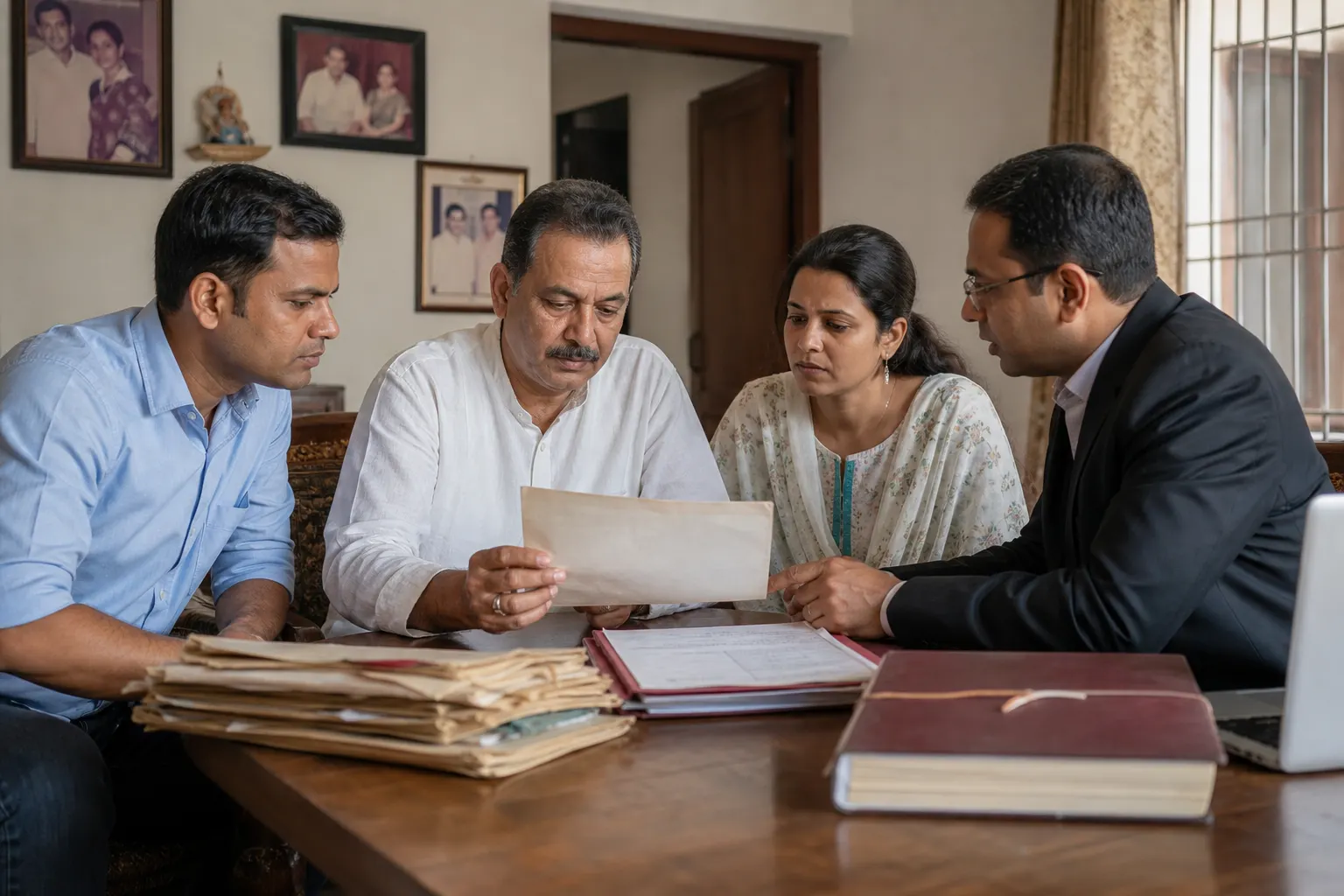
Key Answers in This Guide
- The record has to name the living owners before anything else: This is the whole page in one line, and everything below is detail.
- Establishing who the heirs are, and why we will not tell you which document you need: Succession is genuinely legal territory and it depends on facts about your family that a property page cannot know: whether there is a will, whether it was registered, whether probate is required, which personal law applies, and whether any heir has predeceased.
- Every heir is a party to the sale, and this is where deals actually die: Once the record names the heirs, the property belongs to all of them in whatever shares the law gives, and a buyer needs all of them at the deed.
- When a partition has to come first: Selling together and dividing the money is one path.
- Agricultural land carries two extra questions: Inherited land in the Bhiwadi belt raises issues that an inherited flat does not, and both should be checked before the family sets a price.
- Tax is a separate question, and it is not as bad as families fear: Inheriting is not a taxable event in itself.
In this guide
The obstacle in an inherited sale is almost never the buyer. It is that the record still names someone who has died, and a record in a dead person’s name cannot be transferred by the people who inherited it until it says so.
Sellers meet this late and at the worst moment. A buyer is found, a price is agreed, bayana (the token advance) changes hands, and then the buyer’s lawyer reads the jamabandi (the revenue record of rights) or the society record and asks a question nobody in the family has thought about since the funeral. What follows takes months that the buyer will not wait through.
| Stage | Where it happens | What it produces |
|---|---|---|
| Establish who the heirs are | Depends on whether there is a will, and on the personal law that applies | The document the recording office will accept |
| Namantaran (mutation) into the heirs’ names | Tehsil for revenue land, the authority for a BIDA or UIT plot, the society for a flat, RIICO for an industrial plot | A record that names the living owners |
| Agree how the family will sell | Among the heirs | One position, and one signatory list |
| Partition, where the family is dividing rather than selling together | Tehsil or by registered instrument, on legal advice | Separate shares that can be dealt with separately |
| The sale itself | Sub-registrar | A deed every heir is party to |
The record has to name the living owners before anything else
This is the whole page in one line, and everything below is detail. Whatever the family believes, whatever the will says, and however clear the position feels, a buyer buys from the people the record names.
The office that holds the record depends on what was inherited, and this is where families lose time by going to the wrong counter. A society keeps its own register regardless of what the sub-registrar’s record says, and a RIICO plot’s transfer carries its own permission layer.
| What was inherited | Where the record lives | What the heirs are correcting |
|---|---|---|
| Agricultural or revenue land | Tehsil, in Khairthal-Tijara district | The jamabandi entry |
| A plot in a BIDA or UIT colony | The authority that holds the colony | The authority’s record for the plot |
| A flat in a society | The society | The member register |
| A RIICO industrial plot | RIICO | The allottee record, subject to RIICO’s transfer permission |
Our namantaran guide covers the mutation process itself and which office to approach for each property type. The mechanics are the same as after a purchase; the difference is the document you are relying on to justify the change. For revenue land, the mutation entry sits under the Rajasthan Land Revenue Act, 1956, and the framework the tehsil applies is public; once it is made you confirm it yourself on Apna Khata, the state’s own land-records portal.
Establishing who the heirs are, and why we will not tell you which document you need
Succession is genuinely legal territory and it depends on facts about your family that a property page cannot know: whether there is a will, whether it was registered, whether probate is required, which personal law applies, and whether any heir has predeceased. The answer differs from family to family and it is not a form to be filled.
What we can tell you is the shape of it. Where there is a valid will, the family’s route runs through that will and the probate or succession-certificate formality the Indian Succession Act, 1925 sets out for the recording office to act on it. Where there is none, succession is intestate and the heirs are determined by the personal law that applies to your family, most commonly the Hindu Succession Act, 1956, and the office will want a document evidencing that. Both Acts are published in full on India Code, the Union government’s official legislation repository, for reference; which one governs your family and what it requires is still the advocate’s question, not this page’s. Which document is correct here, and whether a court process is needed at all, is the question to put to an advocate before you spend a single trip to the tehsil, because arriving with the wrong document is the most common way a family loses two months.
That is not a hedge to avoid saying something useful. It is the single largest source of wasted time in inherited sales, and no article that pretends the answer is uniform is doing a family any favour.
Every heir is a party to the sale, and this is where deals actually die
Once the record names the heirs, the property belongs to all of them in whatever shares the law gives, and a buyer needs all of them at the deed. One brother’s signature does not carry the family.
Three situations produce most of the trouble. An heir who lives abroad or in another state needs a registered power of attorney specific to this sale, executed and attested through the route that applies where they live; our GPA guide explains why a general power of attorney is not a substitute. An heir who is a non-resident also changes the buyer’s side of the deal: the buyer’s tax withholding on a non-resident seller is not the resident one per cent rule, and our guide to selling property in Bhiwadi as an NRI covers how that deduction works and the lower-deduction route. An heir who is a minor introduces a layer that needs legal advice before anything is agreed with a buyer. And an heir who simply does not want to sell is not a paperwork problem at all, and the family has to resolve it before a property is shown to anybody.
The practical rule that saves families the most money is unglamorous. Settle the signatory list and the split of the proceeds within the family before a buyer is found, in writing, with the amounts named. A family that agrees the principle and postpones the arithmetic discovers the disagreement on registry day, in front of a buyer who then knows exactly how much pressure the sellers are under.
When a partition has to come first
Selling together and dividing the money is one path. Dividing the property and each heir selling their own share is a different one, and it needs the division to exist on paper before any of it can happen.
Families in this belt often operate for years on an informal division: one brother farms this khasra, another built on that corner, and everybody knows the arrangement. The revenue record knows none of it. A buyer purchasing from one brother is buying an undivided share unless the partition is recorded, which is a materially different thing from buying a defined piece of land, and the buyer’s lawyer will say so.
Whether your family needs a partition through the tehsil, a registered instrument, or nothing at all because you are selling the whole property together, is a legal question with real stamp-duty consequences attached to the answer. Take it to an advocate, and take the rates with you, because Rajasthan charges a family instrument by what kind of instrument it is:
| Family instrument | Stamp duty | Registration fee |
|---|---|---|
| Partition of ancestral property | 0% | 1%, capped at ₹1,000 |
| Partition of property that is not ancestral | 6% | 1%, capped at ₹1,000 |
| Relinquishment (haktyag) of ancestral property | ₹500 flat | ₹500 |
| Relinquishment in other cases | 6% | 1% |
Source: Rate of Stamp Duty & Registration (For Major Articles), Registration and Stamps Department, Government of Rajasthan.
Relinquishment matters to an inherited sale for a reason families rarely consider. An heir who wants out, rather than a share of the sale money, can in some families release their share to the others before the property is marketed, which shortens the signatory list at the deed. Whether that is open to your family, and whether the property counts as ancestral, are legal tests rather than descriptions: ancestral depends on how the property came down, not on how long the family has held it, and an instrument filed at the zero or ₹500 rate on property that does not meet the test leaves a defect in the chain for the buyer’s advocate to find. Registering the instrument also does not change the record by itself; namantaran still follows at the office that holds it. Our guide to transferring property within the family in Rajasthan sets out every family route, the notifications behind the settlement and exchange rates, and a worked example of what the choice costs.
Agricultural land carries two extra questions
Inherited land in the Bhiwadi belt raises issues that an inherited flat does not, and both should be checked before the family sets a price.
The first is what the record actually says about the holding: the khasra numbers, the shares each heir carries, and whether the girdawari shows the land in use. Our Apna Khata walkthrough shows how to read the entries, and the search is run against Khairthal-Tijara district rather than Alwar, which is a frequent reason a family concludes its own record has disappeared.
The second is who may buy it. Agricultural land is not open to every buyer, which shapes the pool and therefore the price, and our agricultural land and farmhouse selling guide covers who the realistic buyers are and what a farmland sale actually involves.
Tax is a separate question, and it is not as bad as families fear
Inheriting is not a taxable event in itself. Selling is, and the gain is computed on the sale, which is where families get anxious for the wrong reason.
Two features matter enough to know before you agree a price. The cost the gain is measured against is what the previous owner paid, not zero, and the holding period includes the years the previous owner held it. Immovable property held for more than 24 months is long-term, so where the previous owner’s years and the heirs’ years together pass that line, the gain is long-term even if the heirs sell soon after the namantaran. Our capital gains guide sets out how the computation works under the current Act and where the reliefs sit.
Both features depend on a paper families often cannot find: the previous owner’s purchase deed, which evidences both the cost and the start of the holding period. Look for it now, alongside the succession papers, because a chartered accountant working on your actual numbers will ask for it first. Get the position before the negotiation rather than after, because it can change whether the family wants to sell this year at all.
The order to do this in
Families that get through an inherited sale without losing a buyer nearly always follow this order, and the ones that struggle nearly always start at step five.
- Take the succession question to an advocate and come away knowing which document the recording office will accept.
- Get namantaran done into the heirs’ names at the office that holds the record.
- Agree the signatory list and the split, in writing, among the heirs.
- Establish whether a partition is needed, and complete it if it is.
- Find the previous owner’s purchase deed for the tax computation, and assemble the rest of the seller’s file, per documents required to sell.
- Then price it and find a buyer.
Steps one and two are the slow ones and they are entirely within the family’s control. They can be running while nothing else is happening, which is why the worst version of this is a family that waits for a buyer before starting them.
What we do, and what we do not
We tell you early whether an inherited property is ready to transact or not, because that is the question that decides whether marketing it now is honest. We check what the record says today, name the office that has to change it, and keep a buyer informed about a timeline rather than letting the buyer discover it.
We do not advise on succession, we do not draft family settlements, and we will not suggest which instrument the family should use, because those are an advocate’s work and the consequences of guessing land on the family rather than on us. Nor will we market a property as ready to sell while the record names someone who has died.
Frequently Asked Questions About Selling an Inherited Property in Bhiwadi
Can we sell before the mutation is done in our names?
In practice, no. The record has to name the living owners for a buyer or the buyer’s bank to proceed, and the mutation is what puts it there. A buyer who is asked to wait for it is being asked to carry the family’s paperwork risk, and most will simply buy something else.
One brother is abroad. Does he have to come to Bhiwadi?
Not necessarily. An heir who cannot attend registration can act through a registered power of attorney specific to this sale, executed and attested through the route that applies where he lives. Start it early: it is the item with the longest lead time in most inherited sales.
Our father left a will. Is that enough on its own?
It establishes his intention, and what the recording office needs in order to act on it is a separate question that depends on the will and on your circumstances. Ask an advocate what your particular office will accept before you rely on the will alone.
Does the buyer’s bank treat an inherited property differently?
It looks at the same things any lawyer would: whether the record names the sellers, whether all the heirs are party to the deed, and whether the chain from the deceased to them is documented. Once those are clean the property is ordinary. Until they are, the file will not clear the bank’s legal check.
The family cannot agree. Can you still sell it?
Not honestly. A property where the heirs are in disagreement is not a property that can be delivered to a buyer, and taking bayana against it would be taking someone’s money for a sale we cannot complete. Resolve it first, with legal help where needed, and then bring it to the market.
Want to know whether an inherited property is ready to sell?
Tell us what was inherited and where, and what the record currently says. We will tell you what has to change before it can be transacted and which office changes it, before you approach any buyer.
Continue Reading

Get a Realistic Valuation for Your Property
18+ years in this market. Real prices, verified paperwork, no pressure.
Choose what you would like to do next:
Done. Our team will contact you during working hours.