
Key Answers in This Guide
- Start with the record, not the deed: For agricultural land the revenue record is the transaction, and your sale moves at the speed of whatever is wrong with it.
- Co-sharers: the thing that kills farmland deals: If the khata carries more than one name, you cannot sell the whole parcel on your own signature.
- Girdawari: who the record says is farming it: The girdawari is the crop inspection entry.
- Who can actually buy your land: A resident buyer with clean funds can buy clean agricultural land here.
- Charges, dues and access: Any one of these three will stall a farmland sale after the buyer has already committed: a lender's charge on the holding, access that exists in practice but not on the record, and a boundary that has drifted from the recorded area.
- Selling a farmhouse specifically: A buyer paying farmhouse money is buying the structure rather than the soil, so the questions move to whether the construction was authorised, whether the electricity connection is sanctioned, and what the water source is.
In this guide
Selling a plot in a township and selling khatedari land are not the same transaction. The plot has a colony, a layout and a scheme name. The land has a khasra number, a jamabandi, a girdawari entry, and quite possibly four cousins who are also on the record.
We sell farmland and already-built farmhouses in this belt, through resale, and the majority of the problems we see on the seller’s side are the same handful, discovered late. This guide is about getting them cleared before you go to market rather than after a buyer is waiting.
Two scope notes so nothing here is misread. We do not do land-use conversion: no CLU, no agricultural to residential or commercial change. And we do not build, so a farmhouse we sell is one that already exists.
Start with the record, not the deed
For agricultural land the revenue record is the transaction, and your sale moves at the speed of whatever is wrong with it. For a flat the sale deed carries most of the weight. Here it does not.
Pull your own jamabandi for the exact khasra number on Apna Khata before you quote a price to anybody. Our guide to how to read a jamabandi on Apna Khata explains what that record does and does not prove. What you are checking, in order:
- Is the land recorded in your own name today? If you inherited it and never completed namantaran, the record still names your father or grandfather. Every serious buyer will see that, and every serious buyer will pause. Mutation takes time, so start it now rather than when a deal is on the table.
- How many names are on the khata? Agricultural holdings in this belt are commonly joint. Read the next section, because this is the single most frequent cause of a collapsed farmland deal.
- What is the recorded classification? Whether the parcel is still agricultural on the record decides who can buy it, what it can be used for, and how it is taxed.
- Does the area on the record match what you believe you own? The record may state hectares while you and the buyer speak in bigha and biswa. Reconcile them against the same khasra before a number is agreed, not afterwards.
Each of those checks lives in a different place, and each fails in a recognisable way:
| Check | Where it lives | What a problem looks like |
|---|---|---|
| Is it in your name | Jamabandi, Apna Khata | Record still names a parent or grandparent |
| How many holders | Jamabandi khata | More than one name, so one signature is not enough |
| Classification | Jamabandi | Still recorded agricultural, which decides tax and buyers |
| Who is cultivating | Girdawari | A name against cultivation that is not yours |
| Area | Jamabandi against your own measure | Record in hectares, deal talked in bigha and biswa |
| Access | Revenue map | No recorded rasta, only an old understanding |
| Charge on the land | Lender’s record | Kisan Credit Card or other agricultural credit outstanding |
Co-sharers: the thing that kills farmland deals
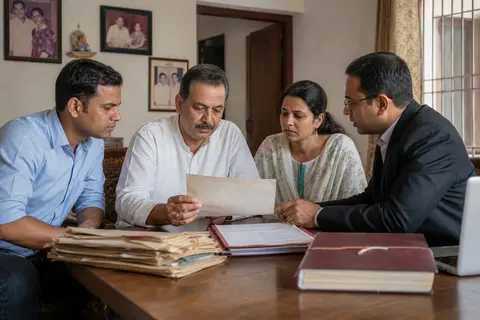
If the khata carries more than one name, you cannot sell the whole parcel on your own signature. Every co-sharer with a recorded interest has to join the conveyance, or you are selling an undivided share rather than the land the buyer thinks they are getting.
This sounds obvious and it still derails deals constantly, because families treat an informal division as settled. The brothers agreed years ago who farms which side. Nobody recorded it. On the record it is still one joint khata.
What to do before marketing:
- List every recorded co-sharer and confirm each is alive, traceable and willing.
- Where a co-sharer has died, work out who their legal heirs are, because their share has passed to those heirs whether or not anyone updated the record.
- Where the family has genuinely divided the land, consider completing a formal batwara so each share is separately recorded. It takes time, and it converts a deal that would need five signatures on the day into one you control.
- Where someone is abroad or cannot attend, a properly executed power of attorney for that specific transaction is the correct tool. Read our guide on why a power of attorney is not ownership first, because a POA used to sign a conveyance is fine and a POA used instead of one is not.
Find the missing cousin now. Finding them with a buyer’s bayana already paid is a different and much worse conversation.
Girdawari: who the record says is farming it
The girdawari is the crop inspection entry. It records what is grown and, in practice, who is in possession, so a mismatch against the jamabandi reads as a possession risk.
Buyers and their advisers read it for exactly that reason.
Two situations to check on your own land:
- Someone else’s name appears against cultivation. A relative farming it informally, or an old batai arrangement, can leave an entry that suggests a claim. It may be entirely benign. It still has to be explained, and it is better explained by you upfront than discovered by a buyer’s lawyer.
- The land shows as uncultivated for years. Not fatal, but expect questions, and expect a buyer intending to farm to price it differently.
Who can actually buy your land
A resident buyer with clean funds can buy clean agricultural land here. An NRI cannot buy it at all. That makes your pool narrower than for a residential plot, and it is where a farmland seller’s expectations most often need adjusting.
The difficulty people associate with farmland here is not the purchase. It is conversion: turning agricultural land into something you can build a colony or a factory on requires CLU, which is a separate process with its own approvals, and it is not something we provide. If a buyer’s plan depends on conversion, that is their risk to assess and their process to run, and it should be stated plainly rather than implied.
An NRI cannot buy agricultural land, a plantation or a farmhouse. This is a federal restriction and it is absolute, whatever anyone tells you about structuring around it. For you as a seller it has a direct commercial consequence: the NRI money that is active in Bhiwadi flats and plots is not available to you at all. Anyone proposing a workaround is proposing a transaction that can be unwound.
A buyer who wants a farmhouse rather than a farm is often your strongest bid in this belt, and that buyer will scrutinise the structure rather than the soil. See the farmhouse section below.
Charges, dues and access
Any one of these three will stall a farmland sale after the buyer has already committed: a lender’s charge on the holding, access that exists in practice but not on the record, and a boundary that has drifted from the recorded area. Settle them while you still control the timetable.
Loans against the land. Agricultural credit, including Kisan Credit Card borrowing, can create a charge on the holding. If there is a lender in the picture, get the position in writing and know what closing it requires before you agree a timeline.
Access, the rasta. A parcel with no recorded access is worth materially less and is harder to sell, whatever its size or soil. If your access is a path across a neighbour’s field on the strength of an old understanding, expect a careful buyer to treat that as a defect. Establish what is recorded.
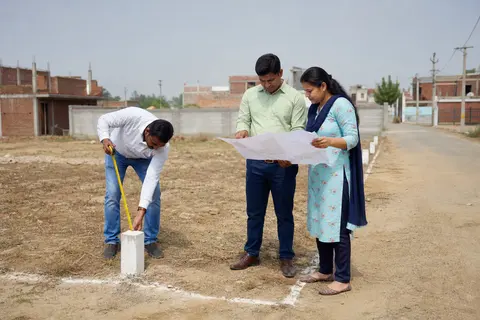
Boundaries on the ground. Old field boundaries move over decades. Where the recorded area and the physical possession diverge, resolve it before marketing, because a buyer who measures and finds a shortfall will either walk or reprice.
Selling a farmhouse specifically
A buyer paying farmhouse money is buying the structure rather than the soil, so the questions move to whether the construction was authorised, whether the electricity connection is sanctioned, and what the water source is. This is where sellers are most often caught out, because a farmhouse that has stood for twenty years feels settled in a way its paperwork may not be.
- Is the construction authorised? A structure standing on agricultural land is not automatically a legal building. If it was built without the permissions that applied, that is a defect the buyer inherits, and it is the first thing a careful buyer’s adviser will probe.
- Is the electricity connection sanctioned? A Sarkari Meter in the owner’s name is real evidence that the structure is recognised for supply. An informal or shared connection is a question mark, and getting a sanctioned connection later on an unauthorised structure can be difficult.
- What is the water source, and is it reliable? Borewell depth, quality and whether it runs through summer. A buyer paying farmhouse money will ask.
- Keep the build file. Bills, contractor details and anything documenting what was spent. Capital improvement you can evidence reduces your taxable gain; improvement you cannot evidence does not.
Tax: do not assume a farmland sale is tax free
A farmland sale is only tax free where the land is rural agricultural land as the Act defines it. Land close enough to a municipality is a capital asset and is taxed like any other property. Bhiwadi is exactly the place where that assumption breaks.
The Act behind that test was replaced recently, which matters if you are working from older advice. The Income-tax Act, 2025 has been in force since 1 April 2026, and section numbers quoted on older property pages are no longer the current ones. What did not change is the farmland test itself: rural agricultural land is excluded from the definition of a capital asset, so a gain on it is not charged to capital gains tax. Land that fails that test, principally because of its proximity to a municipality and the population of that area, is a capital asset, and a sale is taxed like any other property sale.
Bhiwadi has been urbanising for years and its municipal limits are not where they were. Land that was comfortably rural when it was bought may not be rural now.
Do not decide this yourself and do not let a buyer decide it for you. Have a chartered accountant apply the statutory test to your specific khasra and its distance from the relevant municipal limits. Getting it wrong in your favour means an assessment later; getting it wrong against yourself means paying tax you never owed. Note also that where the sale price is below the notified DLC value, the stamp-value rule at section 78 of the Income-tax Act, 2025, the former section 50C, deems the DLC value to be your sale consideration for computing the gain. A 10 per cent tolerance applies, so a DLC value up to 110 per cent of your declared price leaves the declared figure standing; beyond that the department computes the gain as though you had sold at the DLC rate. Look up your area on our DLC rate table before agreeing a price, and our guide to capital gains tax on a Bhiwadi sale sets out how the gain itself is computed.
The order to do this in
Clear the record first, price it last. Every step below is cheaper to do before a buyer is waiting than after.
Get the jamabandi into your own name
Complete the namantaran if it is still pending. A record naming your father or grandfather stops a serious buyer before anything else is discussed.
Identify every co-sharer
Confirm each is alive, traceable and willing, and work out the legal heirs of any who have died. Where the family divided the land informally, consider a formal batwara so each share is separately recorded.
Read the girdawari
Be ready to explain any cultivation entry that is not you, including an old batai arrangement. Explained by you upfront beats discovered by a buyer's adviser.
Confirm access and boundaries
Check the recorded rasta and walk the boundary against the record. A parcel with no recorded access is worth materially less, whatever its size.
Clear or document any charge
Agricultural credit can sit as a charge on the holding. Get the lender's position in writing and know what closing it requires before you agree a timeline.
For a farmhouse, gather the build file
Construction permissions, the sanctioned electricity connection, and the water source. A buyer paying farmhouse money will ask about all three.
Get the tax position assessed
Have a chartered accountant apply the rural agricultural land test to your specific khasra, rather than assuming the sale is tax free.
Then price it
Knowing which buyers are actually available to you, which for farmland is a narrower pool than for a residential plot.
Our guide on pricing and negotiating a Bhiwadi sale covers the rest of the sequence, and the documents a buyer will ask you to produce are set out separately.
How we work on these
We sell farmland and existing farmhouses in the Bhiwadi belt, buy and sell only. We do not build, and we do not take on conversion. If your land needs its record cleaned up before it can be sold properly, we would rather tell you that at the start and help you sequence it than take a mandate on a file that cannot close. Send us the khasra number and what you hold, and we will tell you where you actually stand.
Frequently Asked Questions About Selling Agricultural Land or a Farmhouse in the Bhiwadi Belt
Can I sell agricultural land in Rajasthan without converting it?
Yes. Selling agricultural land as agricultural land is an ordinary transaction, and a resident buyer with clean funds can buy it. Conversion, meaning CLU, only becomes relevant if a buyer intends to develop it for non-agricultural use, and that is their process to run rather than a precondition of your sale. We do not provide conversion services.
Can an NRI buy my agricultural land or farmhouse?
No. A non-resident Indian cannot acquire agricultural land, plantation property or a farmhouse in India by purchase. As a seller this matters commercially, because it removes a segment of buyers who are otherwise active in Bhiwadi flats and plots. Treat any proposed workaround as a transaction that can be unwound later.
My land is in joint names. Can I sell just my share?
You can sell your undivided share, but that is a different and much less liquid product than selling the parcel, and few buyers want it. To sell the land itself, every recorded co-sharer must join the conveyance, including the legal heirs of any co-sharer who has died. Where the family divided the land informally years ago, completing a formal batwara so each share is separately recorded is usually worth the time it takes.
Do I pay capital gains tax when I sell farmland?
Only if the land is a capital asset. Rural agricultural land is excluded from the definition, so a gain on it is not charged, but land that fails that test because of its proximity to a municipality and the population of the area is taxed like any other property. Bhiwadi has been urbanising for years, so land that was rural when it was bought may not qualify now. Have a chartered accountant apply the test to your specific khasra rather than assuming either answer.
What is girdawari and why does a buyer care?
Girdawari is the crop inspection entry in the revenue record, showing what is grown and, in effect, who is in possession. A buyer’s adviser reads it against the jamabandi. Where the ownership record says one thing and the cultivation record says another, that gap suggests a possible possession claim, so it is better explained by you at the outset than discovered later.
My farmhouse was built years ago without approvals. Can I still sell it?
It can be sold, but the position has to be disclosed, and it will affect both your price and your buyer pool. An unauthorised structure is a defect the buyer inherits, and it can make a sanctioned electricity connection harder to obtain. Establish what permissions did and did not exist before you market it, so the conversation happens on your terms.
The land is still in my late father’s name. What do I do first?
Complete namantaran, the mutation of the record into the names of the legal heirs, before you market the land. A buyer will see the record and will not proceed against a name that is not yours. Mutation takes time, so treat it as the first step rather than something to sort out once a buyer appears. Our guide to selling an inherited property in Bhiwadi covers what comes before and after that step, including which office holds the record for each property type and why every heir has to be party to the sale.
Sources Checked
- Apna Khata: the Rajasthan Revenue Department’s land-records portal, for the jamabandi, khasra and girdawari entries described above (checked August 2026)
- ePanjiyan: the Rajasthan registration portal, for the sale deed and the applicable circle rate (checked August 2026)
- Income-tax Act, 2025, in force from 1 April 2026, which replaced the Income-tax Act, 1961, on the exclusion of rural agricultural land from the definition of a capital asset and on the stamp-value rule at section 78 (the former section 50C). The statutory test for rural land turns on proximity to a municipality and population, so apply it to your own khasra with a chartered accountant rather than assuming. The Income Tax Department publishes a section comparison utility between the two Acts
- Restrictions on acquisition of agricultural land, plantation property and farmhouses by a non-resident are set under India’s foreign exchange framework, administered by the Reserve Bank of India
Continue Reading

Get a Realistic Valuation for Your Property
18+ years in this market. Real prices, verified paperwork, no pressure.
Choose what you would like to do next:
Done. Our team will contact you during working hours.