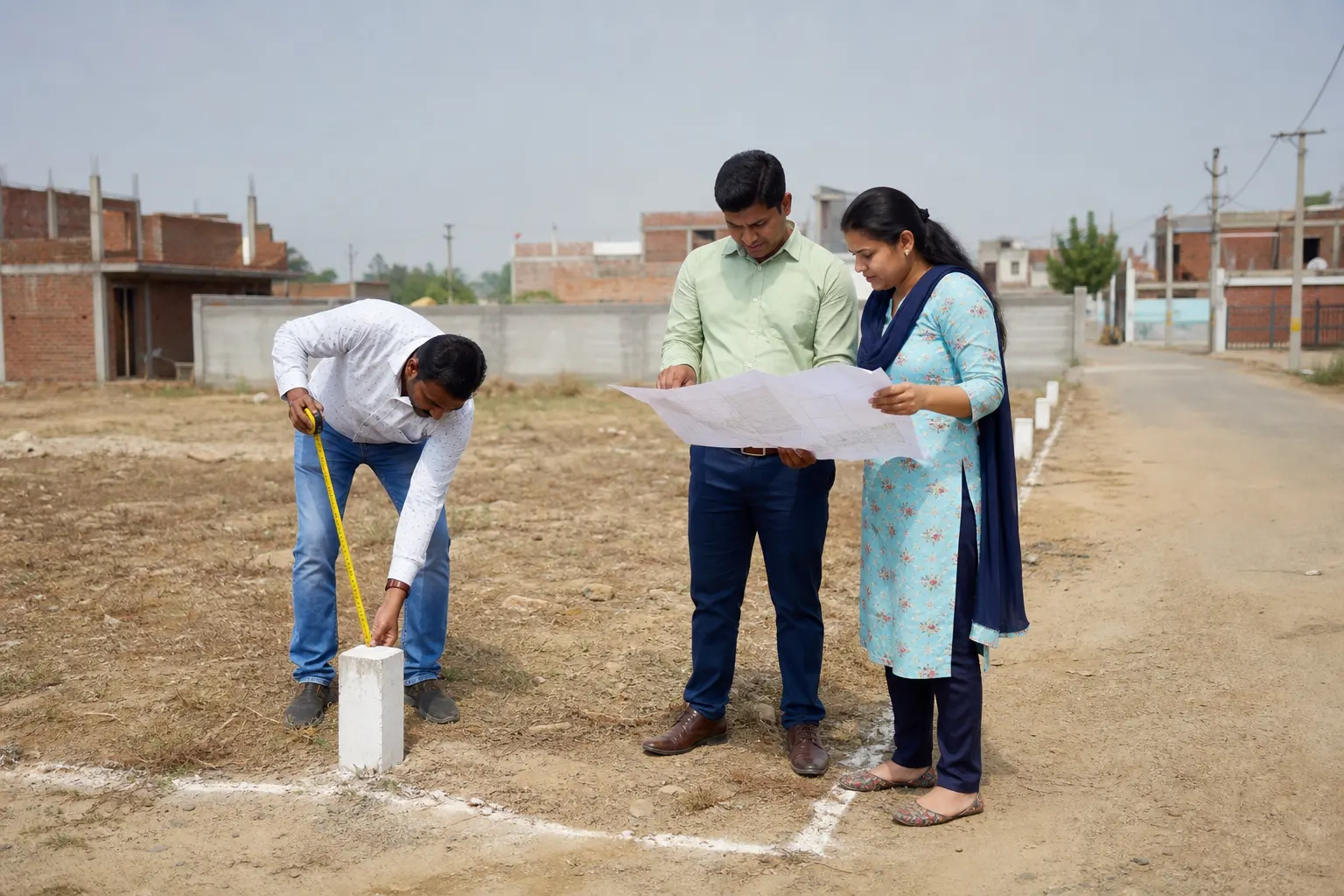
Key Answers in This Guide
- The boundary is checked on foot, and it is checked before the money: Every serious plot buyer walks the plot with the plan in his hand, and a mismatch found on that walk ends more deals in this belt than any document does.
- Conversion and sanction decide what the plot even is: A buyer paying a residential rate is paying for land he can legally build a house on, and he prices the certainty of that, not the intention of it.
- The khasra behind the plot, and reading your own record first: Colony records and revenue records are two different systems describing the same ground, and a buyer's lawyer reads both.
- Whether the colony has been handed over to BIDA: Behind every buyer question about roads, water and sewerage sits one question that answers them all: has the colony been handed over to BIDA, or is it still with the developer.
- The access road is a real question, not a formality: Buyers here ask about the approach road for a practical reason: a plot you cannot reliably reach is worth substantially less than the same plot with a settled approach, and the difference is not recoverable later.
- Dues follow the plot, so produce the clearances: Development charges, authority dues and anything else billed against the plot attach to the land rather than to you, which is why a buyer prices them into his offer whether or not you mention them.
In this guide
A flat buyer inspects a flat. A plot buyer inspects a file and a boundary, and both have to agree with each other.
That is why plot deals in this belt stall for reasons that never trouble a flat sale. There is no lift to test, no society to ask, and no occupancy certificate to weigh. What the buyer is buying is a defined piece of ground and the right to build on it, and every question he asks is aimed at one of those two things.
| What stalls the deal | What the buyer is really asking | Prepare it by |
|---|---|---|
| Boundaries that do not match the layout | Is the land I walked the land in the papers | Walking it yourself against the demarcation plan, before you list |
| Conversion or sanction still open | May this land legally be used and built on the way it is being sold | Producing the 90A order and the sanctioned layout, or disclosing that one is open and pricing accordingly |
| The khasra behind the plot | Does the revenue record tell the same story as the colony record | Pulling the jamabandi yourself and reading it against your deed |
| Handover of the colony | Who owes me the roads, the water line and the clearance | Establishing whether the colony sits with BIDA or still with the developer |
| The access road | Will I always be able to reach it | Establishing on paper how the road exists, not merely that it does |
| Dues that follow the plot | What do I inherit that the seller has not paid | Getting the clearance in writing from the office that actually bills it |
The boundary is checked on foot, and it is checked before the money
Every serious plot buyer walks the plot with the plan in his hand, and a mismatch found on that walk ends more deals in this belt than any document does.
The mismatches are ordinary rather than sinister. A neighbour’s boundary wall built a foot or two over. A corner stone that was moved during someone else’s construction and never replaced. A plot that was resized informally when the colony was laid out. A dimension in the deed that does not match what the tape says today. None of these means anybody cheated, and all of them mean the buyer is now unsure what he is paying for.
Do the walk yourself first, with the demarcation or site plan, before you show it to anyone. If the ground and the plan disagree, you want to know that while you still have time to get it resolved through the authority or a licensed surveyor. Finding out during a buyer’s visit costs you the buyer, because he does not know whether he is looking at a small clerical matter or the start of a dispute, and he is not going to fund the investigation to find out.
Conversion and sanction decide what the plot even is
A buyer paying a residential rate is paying for land he can legally build a house on, and he prices the certainty of that, not the intention of it.
Two separate questions sit here and sellers routinely blur them. Whether the land use was converted from agricultural to residential is one, and in a local file that conversion is the 90A order, with 90B appearing on older papers from the era when that provision governed urban conversions. Whether the colony layout was sanctioned is the other, and in this belt the sanction comes from BIDA, the Bhiwadi Integrated Development Authority, which absorbed the UIT’s role, so layout sanction, land use and building permission now route through one office. An older plot may hold a conversion issued in UIT Bhiwadi’s name from before that change, and that document is valid for its era.
A plot can sit inside a sanctioned colony while its own conversion history is untidy, or on converted land in a layout nobody ever approved. Sanction runs over khasra numbers and never over a colony name, which is why a buyer who is thorough asks whether the sanction covers the specific khasras your plot sits on rather than whether the colony is approved. Our BIDA plot vs developer plot guide sets out what the difference means for the buyer, and it is worth reading from the seller’s side, because it tells you which comparables your plot should be priced against. The authority’s own notices and contacts are on the BIDA site.
The local vocabulary carries the position, and buyers here use it fluently. A kacchi colony or a gram panchayat plot is approved at village level or not at all, without the 90A conversion. Lal dora or abadi land sits outside the formal municipal record. A pakki plot, converted and sanctioned, costs more and carries far less title risk. If you are selling a pakki plot, the file is the strongest argument you have and it should be in front of the buyer early rather than produced under pressure.
Conversion also decides which rate schedule the plot registers under, which is money rather than paperwork. The Bhiwari sub-registrar office notifies colony land per square metre and rural agricultural land per hectare, and land still recorded as agricultural is valued on the agricultural rate whatever has been built next door. A plot marketed as residential that the record still calls agricultural fails on two fronts at once, and the second one surfaces at the registry counter in front of your buyer.
If either question is open, say so at the start. An open position priced honestly finds a buyer who accepts it. The same position discovered by a lawyer after bayana produces a renegotiation you will lose, or a withdrawal, and either way the market now knows the plot has a question against it.
The khasra behind the plot, and reading your own record first
Colony records and revenue records are two different systems describing the same ground, and a buyer’s lawyer reads both. So should you, before he does.
Pull the jamabandi for the parent khasra on Apna Khata and read it against your deed: the khasra numbers, the recorded area, and whose names appear. Our Apna Khata walkthrough explains the columns. Two things to check specifically. Search Khairthal-Tijara district rather than Alwar, because Bhiwadi moved and a search against the old district returns nothing that looks exactly like a missing record. And check whether your own namantaran was completed when you bought, because a plot whose record still names the person you bought from is not a plot you can sell this month.
Where the land came to you through a patta or an allotment rather than a purchase, the same test applies to that document. An old patta with no subsequent record update leaves the chain incomplete, and the buyer’s lawyer will read the gap as the risk it is. Our guide to namantaran and mutation sets out which route applies to which kind of land.
Where the area in the record and the area in your deed differ, in bigha and biswa or in gaj, establish why before you quote a rate. Our land measurement units guide covers the conversions, and an unexplained difference in area is a discount waiting to be asked for.
Whether the colony has been handed over to BIDA
Behind every buyer question about roads, water and sewerage sits one question that answers them all: has the colony been handed over to BIDA, or is it still with the developer.
A plotted colony starts life owned and run by the developer. If the internal development is accepted, the colony is handed over to the authority, which in this belt means BIDA. Before that point the internal roads, the water line, the sewerage and the electricity are the developer’s responsibility and the developer’s to fund. After it, they are the authority’s. The transfer paperwork, the patta position and the namantaran route all read differently on the two sides of that line.
A seller who cannot say which side of the handover his own colony sits on has already told the buyer something. Establish it before you list. Our plot projects compared page records the handover position for the plotted colonies we track, and where we have not established it we say so rather than guess.
Handover is not a verdict on the colony. A project that has not delivered yet has not had time to be handed over, and that is the ordinary position rather than a hold-up. What it changes is who your buyer has to chase for the clearance in the next section, and how long that takes.
The access road is a real question, not a formality
Buyers here ask about the approach road for a practical reason: a plot you cannot reliably reach is worth substantially less than the same plot with a settled approach, and the difference is not recoverable later.
What matters is how the road exists on paper. A road in the sanctioned layout is one thing. A strip of land that everyone uses because it has always been used is another, and its width can be reduced by a single neighbour’s construction. Local speech separates a pakka road from a kaccha rasta, and the width in feet enters the conversation before the rate does.
Width also moves a figure that is not a matter of opinion. The Bhiwari sub-registrar office notifies its DLC schedule colony by colony and steps it by the width of the road the plot faces: a base rate for interior plots with no main-road frontage, a higher rate for frontage on a road up to 40 ft, then further steps for 41 to 60 ft, 61 to 99 ft, and 100 ft and above. Two plots in the same colony legitimately carry different DLC values, and the road is what separates them. Our DLC rate in Bhiwadi page carries the notified schedule for the office’s 67 colonies, and you can confirm your own on the Rajasthan ePanjiyan portal.
Read that as a stamp-duty floor and nothing else. A DLC rate is the minimum the sub-registrar computes duty on, not a valuation of your plot and not evidence of what your colony is worth. It reaches you as a seller through the buyer’s budget. Duty is charged on the higher of the agreed price and the DLC value, so where you price below the floor for your colony and band, the buyer’s duty is still worked out on the floor and his all-in cost does not fall as far as your discount suggests. He will notice, and the conversation moves to his costs instead of your plot.
If your plot has a settled, sanctioned approach, put the fact in front of the buyer early. It is one of the few plot attributes that improves a price rather than merely failing to reduce it.
Dues follow the plot, so produce the clearances
Development charges, authority dues and anything else billed against the plot attach to the land rather than to you, which is why a buyer prices them into his offer whether or not you mention them.
Which office issues the clearance follows from the handover question above. For a colony that has been handed over, it is BIDA. Before handover it is the colonizer who still runs the colony, and on an older layout the record may sit with the UIT. Settle that question first, because a request sent to the wrong office costs a fortnight before anyone tells you so.
Get the position in writing, and get it before you list rather than in the week of the registry. A clearance in hand is worth more than the amount it represents, because it removes an unknown from the buyer’s arithmetic, and unknowns are discounted more heavily than known amounts. The full seller’s file for a plot, including what the buyer’s side asks for, is in documents required to sell.
What a vacant plot needs that a flat does not
Two site-level items decide what a buyer assumes on the walk, because a plot in this belt is often unvisited for years.
Visible possession comes first. A plot with no boundary marking, deep vegetation and no sign of ownership invites the question of whether anybody else has been using it, and that question is expensive to answer. Clearing it and marking the corners costs little and removes the doubt before it is raised.
Encroachment comes second, however small it looks to you. A neighbour storing material, a temporary structure, a wall that crept. Deal with it before you market the plot. A buyer will not take on a dispute with a neighbour he has not met, and a small encroachment left standing gets read as a large one.
Pricing a plot is not pricing a flat
Frontage, road width, corner position, the size against what that colony actually trades in, and the legal position all move a plot’s rate, and none of them is condition or floor. Our pricing guide has the plot section, and plot projects compared carries the project-level rates we hold with the date each was checked.
One rule specific to plots: quote in the unit your buyer is using. Gaj and bigha both circulate here, and a rate quoted in the wrong unit produces a conversation about arithmetic instead of a conversation about the plot.
If the plot is industrial, the stalls are different ones
Everything above is written for a colony plot. A RIICO industrial plot is a different transaction, and the item that stalls it is not the boundary or the layout. It is whether the plot counts as utilised.
RIICO’s Rule 18 transfer charge turns on that single word. A utilised industrial plot transfers at half a per cent of the area’s allotment rate. A vacant one transfers at twenty per cent of it. The gap between those two figures is usually larger than anything you will negotiate on the price, and it is decided by the rule rather than by what the parties agree between themselves.
The definition is stricter than the market’s. A plot with a boundary wall, a watchman room or a block built to plinth level is still a vacant plot under the rule, whatever the seller calls it, and a finished building with no production running inside it is an unutilised plot rather than a utilised one. Establish which of the three you are actually selling before you quote, because the buyer’s side will work it out and will price the fee into his offer. Our RIICO transfer charges guide sets out the full fee table, and the RIICO plots buyer’s guide covers how a resale transfer moves through the office.
What we do on a plot mandate
We walk the plot, we read the record against the deed before it is listed, and we tell you which of the items above is going to be asked about. Where something is open we would rather price it into the listing than discover it with a buyer standing on the land.
What we do not do is certify title, resolve a boundary dispute, or take on land-use conversion work. A demarcation disagreement needs a surveyor and sometimes the tehsil, and a title chain needs an advocate. Our document verification page sets out exactly where our checking stops.
Frequently Asked Questions About Selling a Plot in Bhiwadi
My plot’s area in the record differs slightly from my deed. Is that a problem?
It is a question, and it becomes a problem only if nobody can explain it. Differences arise from unit conversion, from rounding in an older record, or from a genuine change at the colony stage. Establish the reason before you list, because a buyer who finds it unexplained will treat it as a risk and price it as one.
Should I get the plot demarcated before selling?
If there is any doubt about where the boundaries run, or if a neighbour has built recently, yes. It is cheaper than losing a buyer mid-visit, and a plot whose corners are marked and match the plan sells with less friction than one where everybody is estimating.
Who sanctions a plot layout in Bhiwadi, BIDA or the UIT?
BIDA, which absorbed the UIT’s role, so layout sanction, land use and building permission all route through it now. A plot from an earlier era may carry papers issued in UIT Bhiwadi’s name, and those remain valid for their time. The sanction itself runs over khasra numbers, so the question a buyer asks is whether it covers your khasras, not whether the colony is approved.
Does the DLC rate tell me what my plot is worth?
No. It is the floor the sub-registrar uses to compute stamp duty and nothing else. The schedule steps by road width, so two plots in one colony can sit in different bands, and a colony with a low notified rate is not a cheap colony. Price your plot against what comparable plots actually traded at, and treat the DLC value as the buyer’s minimum duty base.
Do I need to fence the plot?
Fencing is not required, but visible possession helps. Clearing the vegetation and marking the corners costs little and answers the question every plot buyer in this belt asks silently, which is whether anybody else has been using it.
A buyer is asking for the jamabandi. Is that reasonable?
Entirely, and you should have already read it yourself. It is a public record, his lawyer will pull it regardless, and a seller who produces it without being chased is a seller whose file is believed.
Continue Reading



Get a Realistic Valuation for Your Property
18+ years in this market. Real prices, verified paperwork, no pressure.
Choose what you would like to do next:
Done. Our team will contact you during working hours.