Key Answers in This Guide
- What namantaran actually does, and does not: Namantaran updates the government record so that it names you as the holder.
- First: which district are you searching?: Search under Khairthal-Tijara district, not Alwar.
- Which office handles your mutation depends on what you bought: The kind of property you bought decides the office, not the address it sits at.
- When the record does not name your seller either: Your namantaran cannot be made over a gap in the chain: if the record still names somebody your seller bought from, that older transfer has to be recorded before yours can be.
- Do it now, not later: Apply immediately after registry, while the seller is still contactable and cooperative.
- What to have ready: You need the deed, the identifiers for the property, and proof of who held it before you.
In this guide
The registry is done. The sale deed is in your hand, the stamp duty is paid, and everyone has gone home. Most buyers in Bhiwadi think that is the end of it.
It is not. The deed proves the transfer happened. Namantaran, which you will also hear called mutation, is what updates the government record so it actually names you as the holder. Until that is done, the record still points at the person you bought from, and every check anybody runs on that property, including the one your own buyer will run when you eventually sell, returns their name and not yours.
This guide is specific to this belt, because in Bhiwadi “get the mutation done” means four different things depending on what you bought, and sending someone to the wrong office is the most common reason it does not happen.
What namantaran actually does, and does not
Namantaran updates the government record so that it names you as the holder. It does not create ownership, which already passed on the registered sale deed.
As a record-keeping step it matters for property tax, for utility connections, for a loan against the property, and above all for your next sale. What it cannot do is prove title. A mutation entry with no valid deed behind it proves nothing, which is why the entry alone is never sufficient evidence of ownership. Our guide to what a jamabandi does and does not prove goes into that distinction in more detail.
Nothing in this depends on the deed being a sale deed. A property that moves inside a family on a gift deed, a partition or a relinquishment needs the same trip to the same office afterwards, and families skip it more often than buyers do because no money changed hands and the transfer feels finished. Our guide to gift deed stamp duty in Rajasthan covers what those instruments cost at the sub-registrar, and the record still has to be changed after any of them.
Two failures follow from skipping it, and both surface years later:
- You cannot sell cleanly. Your buyer pulls the record, sees somebody else’s name, and either walks or holds the price down until it is fixed.
- The gap gets harder to close over time. If the seller has since died, moved, or become uncontactable, a step that was routine becomes a negotiation with heirs.
First: which district are you searching?
Search under Khairthal-Tijara district, not Alwar. This is the single most common reason a Bhiwadi buyer’s record search comes back empty.
Bhiwadi sits in Khairthal-Tijara district, carved out of Alwar in 2023. Older deeds, older society papers and plenty of professionals still say Alwar out of habit. If you search Apna Khata under Alwar for a village that now maps to Khairthal-Tijara, you will find nothing and conclude something is wrong when nothing is.
The district changed. The parcels did not. So when an old document says Alwar and a current record says Khairthal-Tijara, that difference on its own is not a discrepancy. What must reconcile is the khasra number, the village and the holder’s name. If anyone waves away a genuine khasra mismatch by blaming the district change, do not accept it.
Which office handles your mutation depends on what you bought
The kind of property you bought decides the office, not the address it sits at. Revenue land is mutated at the tehsil, a UIT or BIDA colony plot is recorded by the authority, a society flat transfers through the society, and a RIICO plot transfers through RIICO. Sending someone to the wrong one is the usual reason the step never gets completed.
| What you bought | Record that matters | Where it is done | Key identifier |
|---|---|---|---|
| Farmland or a plot in a revenue village | Jamabandi | Tehsil, viewable on Apna Khata | Khasra number and village |
| Plot in a UIT or BIDA approved colony | The authority’s own file | The approving authority | Patta or allotment, colony and plot number |
| Flat in a society | Society membership and share certificate | Society office, plus municipal tax record | Flat and tower number |
| RIICO industrial plot | RIICO’s lease record | RIICO, as a transfer | Allotment and lease number |
| Anything in Dharuhera | Haryana revenue record | Haryana system, Rewari district, on the Jamabandi portal | Khasra, under Haryana |
1. Revenue land: agricultural parcels and land in revenue villages
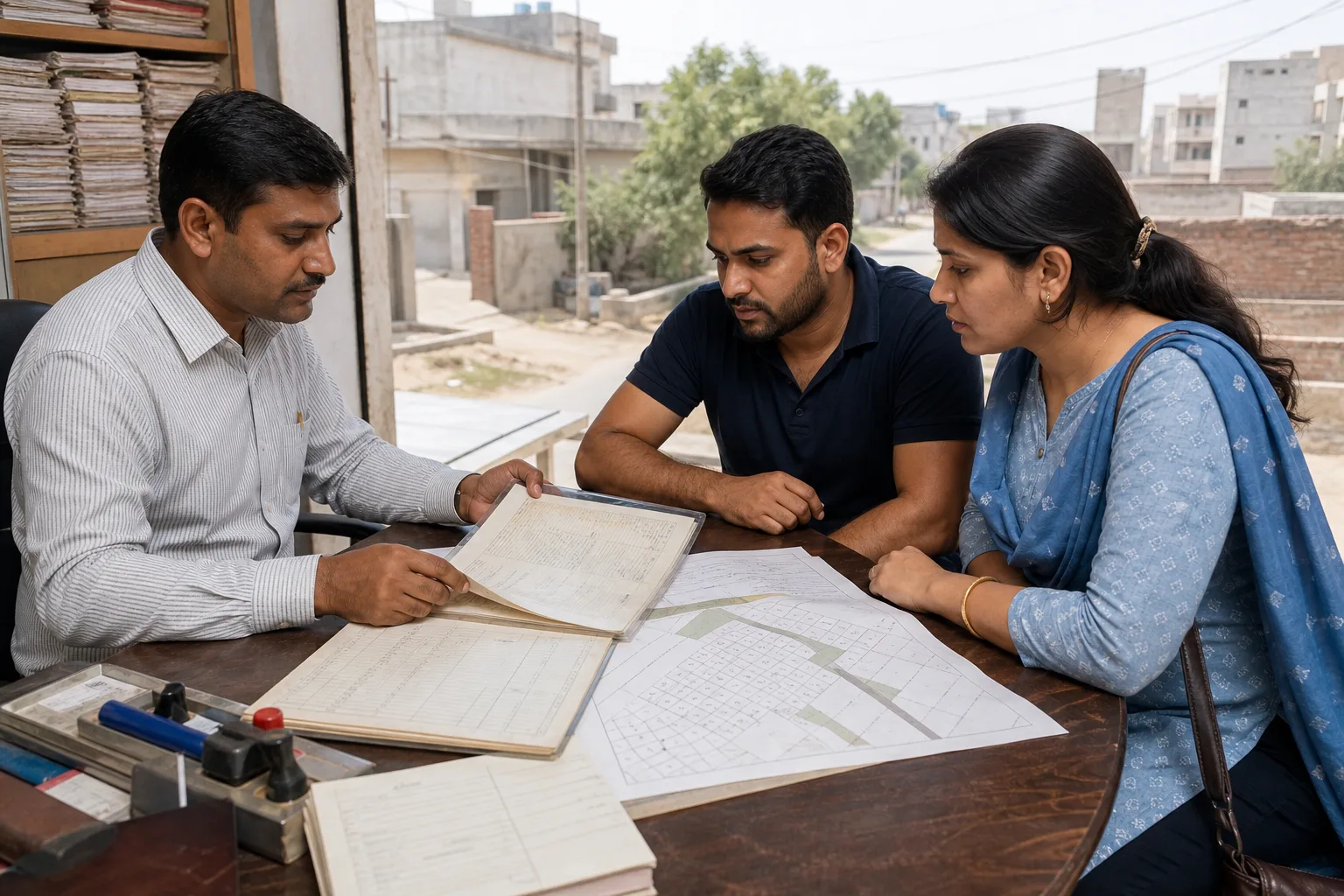
This is the classic namantaran. The record is the jamabandi, kept by the revenue department, and the entry is made at the tehsil level.
Revenue records in Rajasthan, including the jamabandi and the mutation entries made against it, are maintained under the Rajasthan Land Revenue Act, 1956 and the rules framed under it. The state publishes the record through Apna Khata, and registration of the deed itself runs through ePanjiyan, which is the same portal used to book the registry appointment.
You will need the registered sale deed, the khasra number, and the details of the seller as they appear on the current record. The application follows the sale deed, and the entry is made at the tehsil after the prescribed process.
Apna Khata is not only the screen you read afterwards. The portal carries mutation information and supports online mutation applications, so the application need not begin as a queue at a counter, and a pending entry can be followed on the same portal rather than by asking someone whether it has moved. Check the portal for the current route before you set out, because the screens change more often than the process behind them does. Our guide to what Apna Khata shows and what it does not walks through the jamabandi, the mutation trail and the girdawari entry by entry.
Relevant to you if you bought farmland, a farmhouse on agricultural land, or a plot in a colony that was never regularised into an urban record. Where this was skipped a generation ago, our guide to selling farmland with an unclear record picks up the consequences.
2. A plot in a UIT or BIDA approved colony
If you bought in an approved urban colony, the record that matters is held by the authority that approved the layout rather than by the tehsil. The transfer is recorded in the authority’s own file against your patta or allotment, and the property tax record follows from there.
This trips up buyers who have read a generic article, gone to the tehsil with a sale deed for a colony plot, and been sent away. Ask, before you go anywhere, which body holds the record for your specific colony. Our guide to verifying a project with RERA and BIDA sets out which authority does what in this belt.
The authority here is usually BIDA, the Bhiwadi Integrated Development Authority, which sanctions layouts, decides land use and approves building plans in its jurisdiction. Before BIDA the Urban Improvement Trust did that work, so older allotment letters, lease deeds and colony sanctions carry UIT’s name. That is not a defect in your papers and it does not mean the approval lapsed. It records when the approval was issued.
What you are asking the authority for is narrower than a jamabandi. It is the current record in the authority’s own file, showing you as the recorded holder against the colony and plot number, in place of the person you bought from. Ask for it in writing once the transfer is recorded, and settle the dues position at the same time, because lease money, transfer charges and other authority dues sit against the plot rather than against whoever ran it up. Our guide to a BIDA scheme plot against a developer plot sets out the document set each of those carries.
3. A flat in a society
For an apartment, there is usually no revenue mutation at all in the sense above. What you need is:
- the society’s own transfer, which records you as the member and reissues the share certificate or its equivalent in your name, against the society’s transfer charge
- the municipal property tax record updated to your name
Ask the society office for its transfer requirement in writing before you complete, because the charge and the paperwork vary and it is one of the costs buyers most often discover late. We set out what to ask a society before booking separately.
4. A RIICO industrial plot
Different again. A RIICO plot is held on lease, and a resale is a transfer through RIICO rather than a mutation at the tehsil. It runs on RIICO’s process, on RIICO’s terms, with RIICO’s transfer charges, and their approval is part of the transaction rather than a formality afterwards. Our guides to buying a RIICO industrial plot and to RIICO plot vs private industrial land set out how that differs from a freehold purchase.
Two consequences are worth having in front of you before you sign anything. A registered sale deed does not by itself move the plot in RIICO’s records, so a buyer holding a registered deed and no recorded transfer is in the same position as a colony buyer whose transfer was never filed. And the transfer fee is calculated on the prevailing allotment rate of the industrial area rather than on the price you and the seller agreed, which is why budgeting it off the sale consideration produces the wrong number. Our guide to RIICO transfer charges under Rule 18 sets out how the fee branches by the plot’s status and what each branch is charged on.
And if you bought in Dharuhera
Dharuhera is in Haryana, not Rajasthan. Apna Khata does not hold those records, the Rajasthan revenue system does not apply, and the mutation runs through the Haryana system for Rewari district. Buyers who transact on both sides of the state line, which many people in this belt do, routinely assume one process covers both. It does not.
The record you are looking for sits on Haryana’s Jamabandi portal, which publishes the state’s jamabandi and its sanctioned mutations, under Rewari district and the Dharuhera sub tehsil. ePanjiyan does not cover the registration on that side either. Our Dharuhera collector rate page sets out the rest of what changes once you cross the line, including the rate your registered value is tested against.
When the record does not name your seller either
Your namantaran cannot be made over a gap in the chain: if the record still names somebody your seller bought from, that older transfer has to be recorded before yours can be.
Pull the record while the deal is still live, not after registry. Read the holder’s name on it. If it is not your seller’s, ask why, and take the answer with the documents behind it rather than as an explanation. The reasons vary and each one leads somewhere different: an inheritance where the succession entry was never made, a purchase your seller made years ago and never recorded, a co-holder they did not mention, or a general power of attorney standing in for a deed that was never registered. Our guide to Apna Khata and what the record proves covers how to pull it and read it, and our guide to GPA arrangements in a property sale covers the last of those, which is the one that most often turns out not to be curable on the terms the seller is offering.
For a colony plot the same gap sits in the authority’s file rather than in the jamabandi. If your seller bought the plot and never had the transfer recorded with BIDA or with the UIT before it, the authority’s record still names an earlier holder, and closing that is part of your purchase rather than something to sort out afterwards.
The order is the whole point. A gap found before the bayana is a condition you can put on the deal, priced into what you pay or fixed by the seller before the money moves. The same gap found after registry is a favour you are asking of somebody who has already been paid.
Do it now, not later
Apply immediately after registry, while the seller is still contactable and cooperative. That is the single practical message of this guide.
The seller has no incentive to help once the money has cleared. If a signature, an identity document or an appearance is needed and the seller has moved on, you are relying on goodwill and you have nothing left to trade for it. And where a seller has died before the mutation was applied for, you are dealing with heirs who were not party to your transaction. The same problem arrives from the other side when a family comes to sell what it has inherited, and our guide to selling an inherited property sets out the order that work has to be done in.
We have seen files where the deed is twenty years old and the record still names a person nobody can locate. Every one of those started as a mutation somebody meant to get around to.
What to have ready
You need the deed, the identifiers for the property, and proof of who held it before you.
- The registered sale deed, original
- The khasra number, village and tehsil, or the colony and plot number for an urban plot
- Identity and PAN for you and the seller
- The previous record entry showing the seller as holder, so the chain is visible
- For a society flat, the society’s transfer paperwork and no-dues
- For a RIICO plot, the allotment and lease documents and RIICO’s transfer application
After it is done, check it yourself
Pull the record yourself and read your own name on it. Do not take anyone’s word that the mutation is complete.
For revenue land, that means opening Apna Khata, selecting Khairthal-Tijara district, your tehsil and village, and finding the khasra. For a colony plot, ask the authority for the updated record. For a flat, ask the society for the share certificate in your name and check the municipal tax record.
One qualification, and it comes from the Revenue Department rather than from us. The portal states on its own screens that the information there is for general information and that some mutations may not be updated immediately. So a screen that does not yet show your name is a question rather than a verdict. Allow for the lag, then go and ask the tehsil for the entry itself rather than assuming either way. What does not survive that qualification is an assurance: somebody telling you the mutation is done is not the same thing as a record that says so, and only one of the two is worth anything to your buyer in five years.
For a colony plot, a society flat or a RIICO plot there is no Apna Khata screen to check at all. The confirmation is the authority’s record, the share certificate, or RIICO’s own transfer record, in your name, in writing.
Where we help
We treat namantaran as part of the purchase rather than as the client’s problem after registry. We run it because a file we hand over with the record still naming the seller is a file that will cost that buyer money in five years. If you bought in this belt and never completed your namantaran, send us the khasra or the colony and plot number and we will tell you what state the record is actually in.
Frequently Asked Questions About Namantaran in Bhiwadi
What is namantaran and is it the same as registry?
No. Registry is the registration of the sale deed, which is what transfers ownership. Namantaran, or mutation, is the later step that updates the government record so it names you as the holder. Both are needed. A completed registry with no namantaran leaves the record still showing the seller, which is what your own buyer will see when you sell.
Which district do I select on Apna Khata for Bhiwadi?
Khairthal-Tijara. Bhiwadi was carved out of Alwar district in 2023, so searching under Alwar for a village that now maps to Khairthal-Tijara returns nothing. Old deeds and papers saying Alwar are not a defect: the district was renamed, the parcels were not. Confirm which district your specific village maps to at the time you search.
Do I need mutation for a flat in a society?
Not a revenue mutation in the land-records sense. For an apartment you need the society’s own transfer recording you as the member, with the share certificate or equivalent reissued in your name, and the municipal property tax record updated. Ask the society for its transfer requirement and charge in writing before you complete the purchase.
Is mutation proof of ownership?
No, and this is the most important limitation to understand. Ownership passes on the registered sale deed. Mutation is a record-keeping entry that reflects a transfer, so an entry without a valid deed behind it proves nothing. It matters for property tax, utilities, loans and your next sale, but it is not a title certificate.
What happens if I never do the mutation?
The record continues to name the seller. Practically, that means trouble with property tax and utility transfers, difficulty raising a loan against the property, and a serious problem when you sell, because your buyer will see somebody else’s name on the record. The longer it is left, the harder it becomes: sellers move, become uncontactable, or die, and then you are dealing with heirs who were never part of your transaction.
I bought a plot in Dharuhera. Is the process the same?
No. Dharuhera is in Haryana, so the Rajasthan revenue system and Apna Khata do not apply to it at all, and the mutation runs through the Haryana system for Rewari district. Many buyers in this belt transact on both sides of the state line and assume one process covers both. Check which state your property is in before you start.
The land record still shows the person my seller bought from. Can my mutation still be done?
Not until that earlier transfer is recorded. Mutation entries follow the chain, so a gap above you has to be closed before your own entry can be made, and the person who has to close it is usually your seller rather than you. Find this before you pay rather than after registry: pull the record while the deal is live, read the holder’s name, and if it is not your seller’s, ask for the explanation with the documents behind it. Pending succession, an unrecorded earlier purchase and a co-holder nobody mentioned are all common in this belt and often curable, but they are cheaper to cure as a condition of the deal than as a request afterwards.
How soon after registry should I apply?
Immediately. The seller has no incentive to cooperate once the payment has cleared, and if any signature, document or appearance is still needed, you want to ask for it while the relationship is fresh and the balance payment is recent. Applying late is how a routine step turns into a negotiation with people you have never met.
Sources Checked
- Rajasthan Land Revenue Act, 1956 and the rules under it: the framework under which the jamabandi and mutation entries are maintained. Full text is published on India Code
- Apna Khata: the Rajasthan Revenue Department’s portal where the updated record is published and where you confirm your own name appears (checked August 2026)
- ePanjiyan: the Rajasthan registration portal, for the registered sale deed that the mutation follows (checked August 2026)
- RIICO: for industrial plots, where a resale is a transfer on RIICO’s terms rather than a revenue mutation (checked August 2026)
- BIDA: the Bhiwadi Integrated Development Authority, which holds the record for a plot in a colony it or the UIT before it approved
- Haryana’s Jamabandi portal: the Haryana land record system, for anything in Dharuhera, under Rewari district
District mappings and portal screens change. Search under Khairthal-Tijara rather than Alwar, and follow the portal’s current interface rather than any screenshot.
Continue Reading

Want a Second Pair of Eyes on Your Paperwork?
18+ years in this market. Real prices, verified paperwork, no pressure.
Choose what you would like to do next:
Done. Our team will contact you during working hours.