Key Answers in This Guide
- The relationship table, as the department publishes it: These rates come from Rate of Stamp Duty & Registration (For Major Articles), published by the Registration and Stamps Department, Government of Rajasthan, and read directly from the department's own PDF rather than from any summary of it.
- The table is asymmetric by gender, and it is worth saying so plainly: Read the two halves of that table next to each other and the pattern is unmistakable.
- A gift is not the only instrument, and it is often not the cheapest: This is where most family-transfer content stops, and it is where the expensive mistakes actually happen.
- Which instrument is correct is a legal question, and we will not answer it: We can give you the rates with the source, and we have.
- What a gift deed does not do: Two limits catch families out, and both are worth knowing before you spend anything.
- What you pay on top of the stamp duty: The stamp duty in the tables above is not the whole demand at the counter.
In this guide
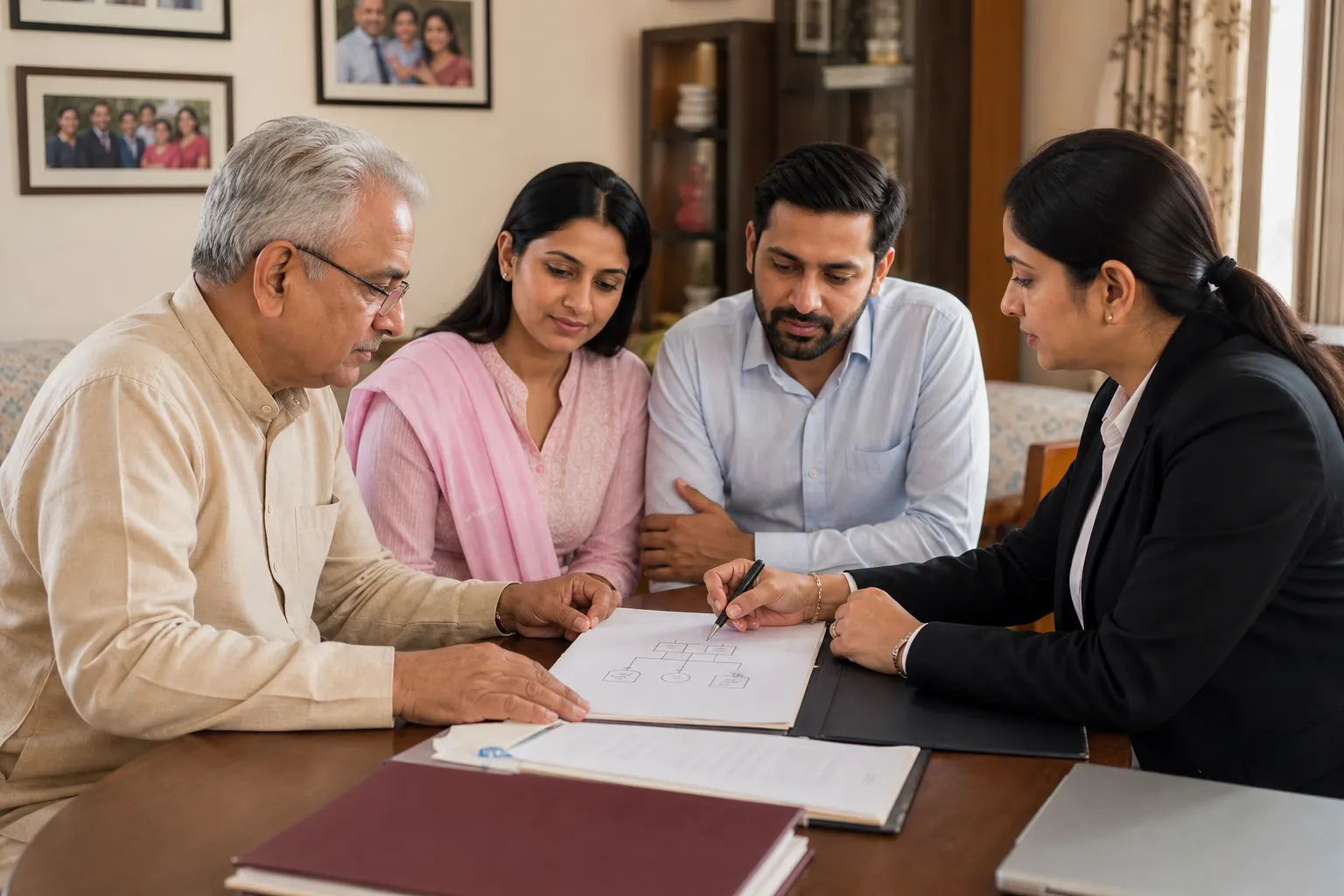
Families in Bhiwadi transfer property between themselves far more often than the market notices. A father putting a plot in his daughter’s name before her marriage, a son moving a flat into his mother’s name after his father’s death, a husband adding his wife to the record: these are ordinary transactions at the Bhiwari sub-registrar’s office on any working day, and the cost of doing them varies enormously depending on a single fact that has nothing to do with the property.
That fact is who receives it.
A gift deed, danpatra in the language the office actually uses, is charged in Rajasthan by the relationship between the person giving and the person receiving. The same flat, the same DLC value, the same office and the same day can cost nothing in stamp duty or it can cost 2.5 per cent, and the difference is whether the property is going to a daughter or to a son.
The relationship table, as the department publishes it
These rates come from Rate of Stamp Duty & Registration (For Major Articles), published by the Registration and Stamps Department, Government of Rajasthan, and read directly from the department’s own PDF rather than from any summary of it.
| Person receiving the gift (the donee) | Stamp duty |
|---|---|
| Wife | 0% |
| Daughter | 0% |
| Daughter-in-law | 0% |
| Grandson, granddaughter | 0% |
| Daughter’s son, daughter’s daughter | 0% |
| A widow, where the gift is executed by her mother, father, brother or sister | 0% |
| A widow, where the gift is executed by her father-in-law, mother-in-law, husband’s elder brother or husband’s sister | 0% |
| Husband | 2.5% |
| Son | 2.5% |
| Father | 2.5% |
| Mother | 2.5% |
| Brother | 2.5% |
| Sister | 2.5% |
The registration fee on a gift is 1 per cent of value, with one exception: where the donee is the wife, the registration fee is a flat ₹1,000 rather than a percentage.
That exception is worth pausing on, because on a Bhiwadi flat it is the difference between a few hundred rupees and several tens of thousands. On a flat valued at ₹40 lakh, a 1 per cent registration fee is ₹40,000. As a gift to a wife, the same registration costs ₹1,000.
Put the whole counter demand side by side for that one flat and the gap is wider than the duty rate alone suggests. The surcharge is budgeted here at 33 per cent of the stamp duty, the upper end explained further down, and the CSI fee at the top of its printed range.
| ₹40 lakh flat, gifted to | Wife | Daughter | Son |
|---|---|---|---|
| Stamp duty | ₹0 | ₹0 | ₹1,00,000 |
| Surcharge on the duty | ₹0 | ₹0 | ₹33,000 |
| Registration fee | ₹1,000 | ₹40,000 | ₹40,000 |
| CSI fee | ₹300 | ₹300 | ₹300 |
| At the counter | ₹1,300 | ₹40,300 | ₹1,73,300 |
The daughter column is the one families misread. Her stamp duty is zero like a wife’s, but the flat ₹1,000 registration fee belongs to the wife alone, so a gift to a daughter still pays the full 1 per cent.
The table is asymmetric by gender, and it is worth saying so plainly
Read the two halves of that table next to each other and the pattern is unmistakable. A gift to a wife is free. A gift to a husband is 2.5 per cent. A gift to a daughter is free. A gift to a son is 2.5 per cent. A gift to a daughter-in-law is free. A gift to a son is not.
This is the state’s policy rather than our reading of it, and the reason to state it directly is practical. Families arrive at the office having planned a transfer in one direction and discover the cost only at the counter. A family that intended to move a plot from a mother to a son, and could equally have achieved what it wanted by moving it from a father to a daughter-in-law, has a real financial decision in front of it that nobody told them existed.
We are not suggesting anyone construct a fictional transfer to chase a rate. Where a family genuinely has more than one honest way to reach the outcome it wants, the rate table is one of the facts it should hold before choosing, and today it usually does not.
A gift is not the only instrument, and it is often not the cheapest
This is where most family-transfer content stops, and it is where the expensive mistakes actually happen. A gift deed is one instrument. Rajasthan charges several others, and for some family situations a different instrument reaches the same outcome for less.
| Instrument | Stamp duty | Registration fee |
|---|---|---|
| Gift deed (danpatra) | by relationship, as above | 1%, or ₹1,000 flat where the donee is the wife |
| Partition (vibhajan) of ancestral property | 0% | 1%, capped at ₹1,000 |
| Partition of property that is not ancestral | 6% | 1%, capped at ₹1,000 |
| Relinquishment (haktyag) of ancestral property | ₹500 flat | ₹500 |
| Relinquishment in other cases | 6% | 1% |
| Settlement within the family | zero for listed beneficiaries, 1.5% for other defined family members | zero |
| Sale deed (vikray patra), the ordinary route | 6% | 1% |
The settlement rates come from notification F.4(2)FD/Tax/2024-92. The family exchange of jointly owned non-agricultural property, at 2 per cent duty and 0.25 per cent registration fee on the higher-valued property, comes from F.4(2)FD/Tax/2024-94. Both sit on the department’s own notification archive.
Look at what that table does to a real situation. A family holds ancestral agricultural land outside Tijara in the name of a grandfather who has died, and the three sons want it divided into three khasra-defined shares. Treated as gifts between them, the transfers are 2.5 per cent each. Treated as a partition of ancestral property, the stamp duty is zero and the registration fee is capped at ₹1,000. On land valued at ₹90 lakh, that is the difference between roughly ₹2.25 lakh in duty and nothing.
The rest of that table, the notification each rate comes from and what the legal tests behind words like “ancestral” and “listed beneficiary” actually decide, is set out in our guide to transferring property within the family in Rajasthan. Read it before you settle on the gift route, because on the numbers above the instrument matters more than the property does.
Which instrument is correct is a legal question, and we will not answer it
We can give you the rates with the source, and we have. We cannot tell you which instrument fits your family, and any property dealer who does is guessing with your money.
The reason is that the words in that table are legal terms with legal tests behind them. Whether a property is “ancestral” is not a matter of how long the family has owned it. It is a specific status under the personal law that applies to you, and getting it wrong means an instrument the office may accept today and a title a buyer’s lawyer questions in ten years. Whether a transaction is a genuine settlement within family as the notification defines it, whether relinquishment is available on these facts, whether a partition needs every co-sharer to be a party: these are questions for an advocate who has read your jamabandi or your society record.
What the rates let you do is arrive at that conversation informed. An advocate quoting you a route can be asked what it costs at the registry, and you will know whether the answer is right.
What a gift deed does not do
Two limits catch families out, and both are worth knowing before you spend anything.
A registered gift deed transfers the interest the giver actually held. It does not clean up a defect that was already in the chain. If the record shows an unresolved co-sharer, an outstanding development charge on a BIDA or UIT plot, or a khasra that does not match the site, a gift moves that problem to the new name rather than solving it. Our document verification guide covers what to read before any transfer inside a family, and it is the same reading a buyer would do.
A gift deed also does not update the record on its own. The deed is executed and registered at the sub-registrar. The record then has to be changed at whichever office maintains it, which is the tehsil for revenue land, the authority for a BIDA or UIT plot, the society for a flat, and RIICO for an industrial plot. That step is namantaran, and it is covered in our namantaran guide. A family that registers the deed and stops there holds a deed and an unchanged record, which is the position that causes trouble at the next sale rather than at this one.
What you pay on top of the stamp duty
The stamp duty in the tables above is not the whole demand at the counter. A surcharge is calculated on the stamp duty itself, and a copy, scanning and indexing fee applies per document.
The department’s rate sheet prints the surcharge as 30 per cent of the stamp duty, itemised as 10 per cent infrastructure, 10 per cent cow and 10 per cent natural disaster. Separately, the Rajasthan Finance Act 2026 raises the Section 3-A component from 10 to 13 per cent, which would make the stack 33 per cent if that is the same component the sheet calls infrastructure. We have not seen a document that settles which reading is current, so we budget on 33 per cent, the higher of the two, and tell you that your instrument-specific demand may be lower. The CSI fee is printed on the sheet as a range of ₹200 to ₹300.
Where the stamp duty is zero, as it is on a gift to a wife or daughter, the surcharge calculated on it is zero too, because it is a percentage of the duty rather than of the property. That is why a gift to a wife lands at roughly ₹1,000 plus the CSI fee rather than at any meaningful figure. Our registry charges guide carries the full stack with the current position on each component, and the property cost calculator will do the arithmetic for a sale deed.
Common questions
Does a gift deed have to be registered? A transfer of immovable property by gift is effected by a registered instrument. An unregistered paper describing a gift is not the same thing, and families who rely on one usually discover the difference when they try to sell. Take the question of what your specific transfer requires to an advocate before you draft anything.
Can a gift deed be cancelled later? This looks like a simple question and is not. It depends on the terms of the deed, on whether conditions were attached, and on facts about the parties. Ask an advocate, and ask before executing rather than after.
Is the 2.5 per cent charged on the DLC rate or on what the property is worth? Stamp duty in Rajasthan is charged on the DLC value, the auction value or the allotment value, whichever applies to the instrument. The DLC rate is the government’s minimum valuation for duty rather than a market price, and the two are different numbers. Our DLC rate page carries the notified schedule for the Bhiwari sub-registrar’s colonies.
On an older flat or house, that value is not the whole story. The same rate sheet allows depreciation on the construction component by its age: nothing up to 10 years, 20 per cent from over 10 up to 20 years, rising to 50 per cent beyond 50 years. The land is not depreciated. On a fifteen-year-old flat gifted to a son, the 2.5 per cent should fall on a value with the construction marked down by a fifth, on the office’s own assessment, so raise it at the assessment rather than after paying. Our guide to stamp duty depreciation on an older flat has the full table and a worked example.
We want to add my wife’s name to a flat I already own. Is that a gift? It may be a gift of a share, and it may be something else, depending on how the flat was bought and what the two of you intend. The rate for a gift to a wife is zero stamp duty and a ₹1,000 registration fee, which makes the question worth asking properly rather than assuming. Adding a joint owner also has consequences well beyond the registry, in loan eligibility, in succession and in how a future sale is taxed.
Is there any duty saving in gifting to a grandchild instead of a child? On the published table, yes: a gift to a grandson or granddaughter is zero, while a gift to a son is 2.5 per cent. Whether that route suits your family, and what it means for control of the property while the grandchild is a minor, is a legal and practical question rather than a rate question.
Where to check us
Every figure on this page comes from the Registration and Stamps Department’s published rate sheet for major articles and from the July 2024 notifications on the department’s own archive. The sheet is public and you should read it yourself before you transact: epanjiyan.rajasthan.gov.in. One honest limitation is that the sheet as published carries no notification number and no effective date on its face, so if a rate has moved since it was issued the sheet would not tell you. Confirm your own instrument’s demand on ePanjiyan or at the Bhiwari sub-registrar’s office before you pay.
If the transfer you are planning is a step towards selling rather than an end in itself, our sell property in Bhiwadi page covers what a buyer will want to see in the chain afterwards. Getting the family transfer right is usually the cheapest part of that work, and getting it wrong is the most expensive.
Continue Reading
Want a Second Pair of Eyes on Your Paperwork?
18+ years in this market. Real prices, verified paperwork, no pressure.
Choose what you would like to do next:
Done. Our team will contact you during working hours.