Key Answers in This Guide
- The five routes, with what each costs: The rate sheet is Rate of Stamp Duty & Registration (For Major Articles), Registration and Stamps Department, Government of Rajasthan.
- What that spread does to a real family: Take a family holding ancestral agricultural land near Tijara valued at ₹90 lakh, being divided between three brothers.
- The words in that table are legal tests, not descriptions: Here is where we stop giving advice, and the reason is not caution for its own sake.
- The record does not change by itself: This catches families more often than the rate does.
- Doing it before the sale, not during: Families almost always attempt this under time pressure, because the trigger was a buyer.
- Common questions: Is a family settlement the same as a partition?
In this guide
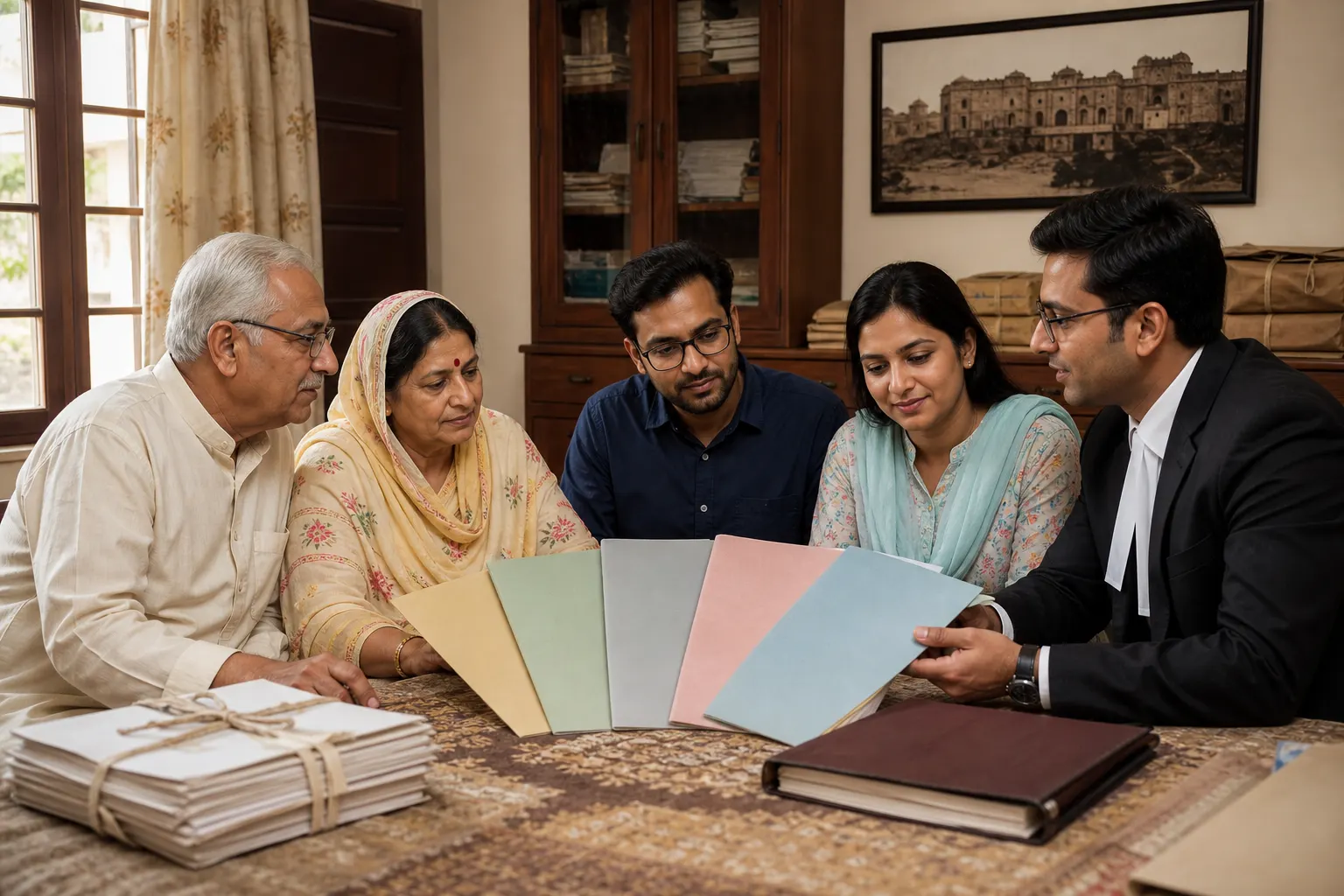
Most families in this belt hold property in a way that made sense to somebody who is no longer alive. Land is in a grandfather’s name, a plot is jointly held between three brothers who have long since gone separate ways, a house sits in a father’s name while the family that lives in it has changed twice.
Sooner or later somebody needs it fixed, usually because a sale is coming, a bank wants a clean record, or the family is dividing.
At that point the family discovers something that governs the cost far more than the property does: Rajasthan charges family transfers by the instrument used, and the instruments are not priced anywhere near each other. The same outcome, reached two different ways, can cost nothing or several lakh.
The five routes, with what each costs
| Instrument | Stamp duty | Registration fee | Source |
|---|---|---|---|
| Settlement within family | zero for listed beneficiaries; 1.5% for other defined family members | zero | notification F.4(2)FD/Tax/2024-92 |
| Partition (vibhajan) of ancestral property | 0% | 1%, capped at ₹1,000 | departmental rate sheet |
| Partition of property that is not ancestral | 6% | 1%, capped at ₹1,000 | departmental rate sheet |
| Relinquishment (haktyag) of ancestral property | ₹500 flat | ₹500 | departmental rate sheet |
| Relinquishment in other cases | 6% | 1% | departmental rate sheet |
| Exchange of jointly owned non-agricultural family property | 2% on the higher-valued property | 0.25% | notification F.4(2)FD/Tax/2024-94 |
| Gift (danpatra) | by relationship, 0% or 2.5% | 1%, or ₹1,000 flat where the donee is the wife | departmental rate sheet |
| Sale deed (vikray patra), the ordinary route | 6% | 1% | departmental rate sheet |
The rate sheet is Rate of Stamp Duty & Registration (For Major Articles), Registration and Stamps Department, Government of Rajasthan. The two notifications are on the department’s own notification archive, issued by the Finance Department in July 2024.
What that spread does to a real family
Take a family holding ancestral agricultural land near Tijara valued at ₹90 lakh, being divided between three brothers.
| Route | Stamp duty | Registration |
|---|---|---|
| Partition of ancestral property | ₹0 | up to ₹1,000 |
| Settlement within family, listed beneficiaries | ₹0 | ₹0 |
| Gift deeds between brothers, at 2.5% | ₹2,25,000 | ₹90,000 |
| Sale deeds between them, at 6% | ₹5,40,000 | ₹90,000 |
Same land, same three brothers, same office. The difference between the top of that table and the bottom is over six lakh rupees, and the surcharge sits on top of the duty in every row except the first two, where a percentage of zero is zero.
This is why the instrument is the decision and the property is not. It is also why families who handle it themselves, or who take the first route somebody at the office suggests, routinely pay several times what they needed to.
The words in that table are legal tests, not descriptions
Here is where we stop giving advice, and the reason is not caution for its own sake.
Every row above turns on a word with a specific legal meaning: ancestral, settlement within family, listed beneficiaries, defined family members, jointly owned non-agricultural. None of them mean what they sound like in ordinary speech.
“Ancestral” is the clearest example. Families use it to mean “we have had it a long time” or “it came from my father”. Neither is the legal test. Whether property is ancestral is a status under the personal law that applies to your family, and it depends on how the property devolved rather than on how long it has been held. A family that files a partition of ancestral property at zero duty on land that does not meet the test has not saved money; it has created a question in the chain that a buyer’s advocate will find, possibly years later, at the worst moment.
Similarly, the settlement notification and the exchange notification each define who counts. Being family in the ordinary sense is not the same as being a listed beneficiary or a defined family member within those notifications.
So the honest position is this. We hold the rates and we have cited them. The choice of instrument is a legal question and it belongs to an advocate who has read your jamabandi, your society record or your deed. A property dealer who selects the instrument for you is guessing with your title, and title problems are the expensive kind because they surface at resale rather than at registration.
What the rates give you is the ability to have that conversation properly. An advocate proposing a route can be asked what it costs at the registry, and you will know whether the answer is right.
The record does not change by itself
This catches families more often than the rate does.
Executing and registering an instrument at the sub-registrar is one step. Changing the record so it names the new owners is a separate one, at a different office, and it does not happen automatically. That step is namantaran, and which counter it happens at depends on what the property is:
| Property | Where the record lives |
|---|---|
| Agricultural and revenue land | tehsil, in the jamabandi |
| A BIDA or UIT colony plot | the authority |
| A society flat | the society’s own register |
| A RIICO industrial plot | RIICO, with its own permission layer |
Our namantaran guide covers the process itself, and the Apna Khata guide covers reading the revenue record online before you start, which is the cheapest way to find out what the record actually says rather than what the family believes.
A family that registers the instrument and stops has a deed and an unchanged record. It looks finished and it is not, and the discovery usually comes when a buyer’s lawyer reads the record or when a bank refuses to lend against it.
Doing it before the sale, not during
Families almost always attempt this under time pressure, because the trigger was a buyer.
That is the most expensive moment to start. The buyer has a bayana down and a date in mind, the family suddenly needs a legal opinion, the tehsil takes as long as it takes, and the pressure pushes everyone towards whichever instrument can be executed fastest rather than whichever one is correct and cheapest.
If you know the family holding is untidy, fix it before you go to market. It costs the same to do in a quiet month as in a panicked one, and it is the difference between a resale that closes and one that stalls. Our guide to why a Bhiwadi property has not sold covers the record problems that freeze a resale, and the documents required to sell guide covers what a buyer will ask for.
Common questions
Is a family settlement the same as a partition? They are different instruments with different rates and different legal requirements, even where the family outcome looks similar. That is the whole reason to take the choice to an advocate.
Can we do this on a stamp paper without registering it? A transfer of an interest in immovable property generally requires a registered instrument, and families relying on unregistered family arrangements usually discover the gap at the next sale. What your specific transaction requires is a legal question.
Is there any duty on a family settlement at all? Under notification F.4(2)FD/Tax/2024-92 it is zero for listed beneficiaries and 1.5 per cent for other defined family members, with the registration fee at zero. Whether your beneficiaries are listed is the question.
We are only removing one brother’s name. Which route is that? That sounds like relinquishment, which is a flat ₹500 on ancestral property and 6 per cent otherwise, which makes the ancestral question worth several lakh on its own. Do not decide it from this page.
Does GPA work as a family transfer? No, and this is worth saying flatly because it is common here. A general power of attorney is not a transfer of title. Our GPA guide covers what it is, what it is not, and why GPA property trades at a discount and stalls at resale.
Where to check us
The instrument rates come from Rate of Stamp Duty & Registration (For Major Articles), Registration and Stamps Department, Government of Rajasthan, at epanjiyan.rajasthan.gov.in. The settlement and exchange rates come from notifications F.4(2)FD/Tax/2024-92 and F.4(2)FD/Tax/2024-94, published on the department’s notification archive at epanjiyan.rajasthan.gov.in/public/circularnotification.
The rate sheet as published carries no notification number and no effective date on its face, which is a real limitation. The two notifications carry both, which is why they are named here rather than paraphrased.
What is deliberately absent from this page is any recommendation about which instrument you should use. That is not modesty. On ₹90 lakh of family land the choice is worth more than six lakh rupees and it decides whether your title survives a buyer’s advocate, and it is decided on facts about your family that belong in front of a lawyer.
If the family transfer is a step towards selling and you want to know what a buyer will ask for afterwards, tell us what the record currently says and we will tell you what still needs clearing before the property goes to market.
Continue Reading


Want a Second Pair of Eyes on Your Paperwork?
18+ years in this market. Real prices, verified paperwork, no pressure.
Choose what you would like to do next:
Done. Our team will contact you during working hours.