Key Answers in This Guide
- What the two towns have in common, which is most of the system: Every row of that table is a place where a buyer following Rajasthan guidance ends up at the wrong counter.
- The two routes, and why the question is which one you are in: On the Haryana side, as on the Rajasthan side, industrial land comes in two entirely different products, and they do not share a process.
- How to read the rate on the Haryana side: This is the part a buyer can do alone before spending anything, and almost nobody does.
- What actually differs between the two towns: Strip out everything they share and the differences come down to position.
- The regulator question, which catches residential buyers hardest: Worth stating here because it applies across everything on that side.
- The registry cost is not the same either: Rajasthan's stamp duty schedule, the category rebates, the surcharge stack and the DLC valuation basis are Rajasthan's.
In this guide
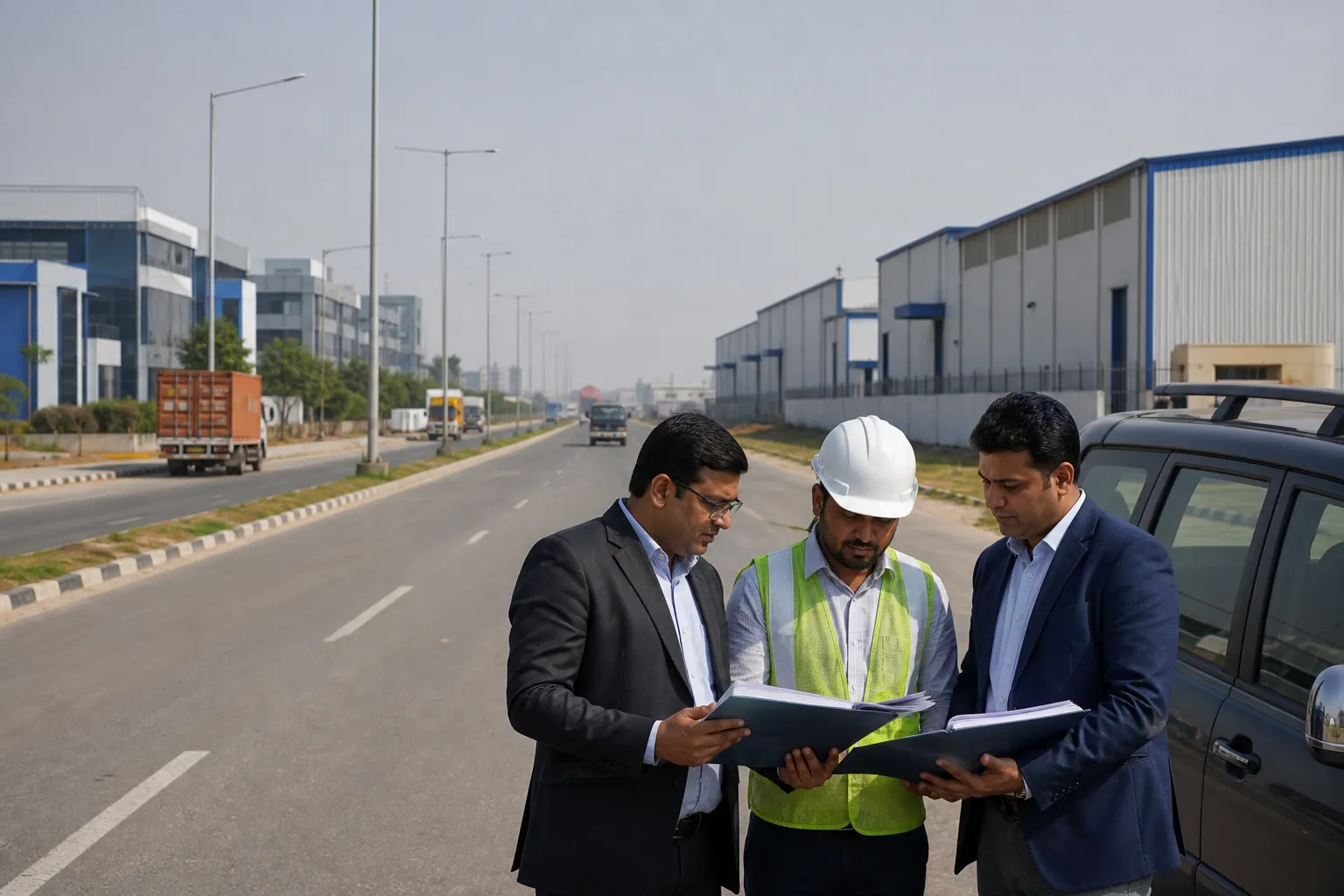
We work industrial property on both sides of the Rajasthan and Haryana line, which puts us in an unusual position for a Bhiwadi dealer: buyers ask us about Dharuhera and Bawal expecting a Rajasthan answer, and almost nothing about the Rajasthan answer transfers.
That is the first and most useful thing to say about this comparison. Dharuhera and Bawal are not two variants of the Bhiwadi belt. They sit in Rewari district, Haryana, under a different revenue system, a different industrial corporation, a different regulator and a different stamp duty schedule. A buyer who has read our RIICO material and applies it across the border will verify the right things at the wrong offices.
What the two towns have in common, which is most of the system
| The Rajasthan side, Bhiwadi belt | Dharuhera and Bawal | |
|---|---|---|
| Valuation floor for registry | DLC rate, Registration and Stamps Department | collector rate, published by the Urban Local Bodies Department, Haryana |
| Industrial estate authority | RIICO | HSIIDC, the Haryana State Industrial and Infrastructure Development Corporation |
| Real estate regulator | Rajasthan RERA | Haryana RERA, Panchkula bench |
| Revenue record | jamabandi, readable on Apna Khata | jamabandi too, but on the Haryana Jamabandi portal and at the Haryana tehsil office |
| Stamp duty | 6 per cent general, with category rebates | Haryana’s own schedule, which differs |
Every row of that table is a place where a buyer following Rajasthan guidance ends up at the wrong counter. The last row is the one that costs money rather than time, and it is covered below.
The two routes, and why the question is which one you are in
On the Haryana side, as on the Rajasthan side, industrial land comes in two entirely different products, and they do not share a process. We deal in both, and a stalled industrial deal in this belt very often traces back to a buyer who did not know which one they were looking at.
A government estate plot
Allotted by HSIIDC, the Haryana State Industrial and Infrastructure Development Corporation. At the Dharuhera end the estate is named in government filings as Industrial Estate, Dharuhera, District Rewari, and it is worth using that name rather than any Rajasthan equivalent: there is no RIICO Dharuhera, and asking for one at a counter marks you out immediately. An estate plot carries allotment terms, dues to the corporation, and a transfer permission layer: you are not simply buying land from a seller, you are stepping into an allotment with conditions attached. What those conditions are, what a transfer costs, and how long the permission takes are matters the allotment document and the corporation’s own office settle, and they should be read before a price is agreed rather than after.
Private industrial land or a built-up unit
This transfers on a sale deed like any other land. It carries no allotment terms and no corporation permission, which makes it simpler, and it carries none of the estate’s infrastructure guarantees either.
The questions that tell you which one you are in are the same on both sides of the border. Is there an allotment letter, and in whose name? Is there a lease deed or a conveyance? Are there outstanding dues to a corporation? Has a transfer been permitted before in this chain? Our RIICO plot versus private industrial land guide walks through that distinction in detail on the Rajasthan side, and the shape of the question is identical on the Haryana side even though the authority and the rules are not.
Where we are careful, deliberately, is in stating the per-route detail for Haryana. The rules, the transfer charges and the permission timelines on that side are things we confirm on the allotment document and at the corporation’s own counter for each specific transaction, and we would rather do that with you than publish a general answer that may not be your estate’s.
How to read the rate on the Haryana side
This is the part a buyer can do alone before spending anything, and almost nobody does.
Haryana publishes collector rates through the Urban Local Bodies Department’s property portal, by district and tehsil. For Dharuhera the schedule sits under Rewari district, and the same portal carries the other tehsils in that district. The rates in force are drawn from the Revenue Department’s own WebHALRIS data, and the documents on the portal include both final schedules and predictive or draft ones for the coming year, which is a distinction worth being careful about: a draft comparison column is a useful indication of the rate in force, and it is not a signed schedule.
We publish the Dharuhera position on our Dharuhera collector rate page, including exactly which document each figure comes from and what it does and does not prove. For Bawal, look up the same district on the same portal and read the schedule for that tehsil.
Where industrial land sits in the Dharuhera schedule
An industrial buyer reading the Dharuhera schedule for the first time usually looks for an industrial section and does not find one. The schedule is organised by village and colony, and its industrial land appears as lines headed INDUSTRIAL LAND under one village, Malpura, rated per acre rather than per gaj.
| Malpura line | Rate in force | Draft 2026 revision |
|---|---|---|
| Industrial land, sub-type Industrial | ₹2,16,00,000 per acre | ₹3,78,00,000 per acre |
| Industrial land, no sub-type given | ₹2,90,40,000 per acre | ₹2,90,40,000 per acre |
An acre is 4,840 gaj, so the two in-force lines work out to about ₹4,463 and ₹6,000 per gaj. Three things follow from that table. The schedule carries two industrial lines for the same village and does not say which plot falls on which, so the line your plot is valued on is a question for the Dharuhera tehsil office, settled before the stamp paper is bought. The draft would raise the first line by 75 per cent, and a draft is not in force until Haryana notifies it, so budget on the rate-in-force column. And neither figure is a price: industrial land does not trade at the collector rate any more than residential land does. Every line, including these two, is in the table on our Dharuhera collector rate page.
The critical point, and it is the same on both sides of the line: a collector rate is a valuation floor for stamp duty, not a market price. It tells you the minimum the state will value the transaction at. It does not tell you what industrial land trades for. Our guide to asking, negotiated and registered value covers why those three numbers differ, and the logic holds on either side of the border.
What actually differs between the two towns
Strip out everything they share and the differences come down to position.
Dharuhera sits at the top of the belt, closest to Gurgaon, on the NH-48 corridor, and directly across from the Bhiwadi industrial areas. For a manufacturer whose customers, suppliers or management sit in Gurgaon or Manesar, that proximity is the product. It is also the reason Dharuhera’s land is the most expensive of anything in this belt: our own plotted rate card runs ₹60,000 to ₹70,000 per gaj on the Dharuhera residential side, against ₹50,000 to ₹55,000 in Bhiwadi proper, ₹23,000 to ₹35,000 in the Honda zone at Tapukara and ₹13,000 to ₹30,000 on the Tapukara to Tijara stretch. Those are residential plot rates, quoted to show the gradient along the corridor, not industrial land prices.
Bawal sits further down, deeper into Rewari district. The trade is the ordinary one: land costs less and the Gurgaon proximity that Dharuhera sells is reduced. For a unit whose logistics run outward rather than towards the NCR, that trade can be the right one.
We are not going to give you a rate table comparing the two, because we would be quoting somebody else’s numbers for one of them. What we will do is check the current position on a specific requirement, in either town, and tell you where the figure came from.
The regulator question, which catches residential buyers hardest
Worth stating here because it applies across everything on that side.
A project in Dharuhera or Bawal is not registered with Rajasthan RERA. It is a Haryana project and it answers to Haryana RERA, whose Panchkula bench carries the Rewari district projects. A buyer who searches the Rajasthan RERA portal for a Dharuhera project, finds nothing, and concludes the project is unregistered has reached an unsafe conclusion from a search in the wrong register.
This is a live problem in this belt precisely because so many buyers approach Dharuhera from Bhiwadi. If you are checking a project on the Haryana side, check it with the Haryana regulator.
Check it project by project, and check the name as hard as the number. Four Dharuhera plotted projects sit on our own rate card, and the register does not treat them alike:
| Project | Registered name on the Haryana register | Number | Status |
|---|---|---|---|
| MGH Anandam | Anandam Estate; Anandam Awas | 49/2017; 45/2017 | lapsed |
| AMD City | Lotus Green City | HRERA-PKL-RWR-354-2022 | lapsed |
| Dwarkadish | Affordable Residential Plotted Colony | 325/2017 | lapsed |
| Tulip City | Tulip City | HRERA-PKL-RWR-304-2022 | registered |
Lapsed is not the same as never registered and it is not the same as unsafe, but it is a fact you want before you negotiate rather than after, and no portal listing will tell you. A third MGH Anandam number, 51/2017, circulates on listing sites and does not resolve on the Haryana register; if a seller quotes it, ask to be shown it on the portal.
The name trap is worse than the status trap. AMD City is registered as Lotus Green City, promoter AMD Estates Pvt. Ltd. Dwarkadish is registered against Dwarkadhis Buildwell Pvt. Ltd., while a differently named company, Dwarkadhish Projects Pvt. Ltd., holds an unrelated project, so a title search run against the wrong one misleads. And there are two separate projects in this belt trading under the Tulip name, one in Dharuhera and one on Alwar Bypass Road in Bhiwadi. The Dharuhera project is Tulip City in Sector 3, promoter Lord Venkateshwara Buildcon Pvt. Ltd., on the Haryana register. The Bhiwadi one is TCPL Tulip Garden, marketed locally as TCPL Tulip City: a delivered project on the Rajasthan side, where a completed and occupied colony carries no live RERA registration and none should be expected. Ask for the registration number and the district on the document rather than the marketing name on the hoarding. Our guide to verifying RERA and BIDA approval covers the verification habit; the register you apply it to changes with the state line.
The registry cost is not the same either
Rajasthan’s stamp duty schedule, the category rebates, the surcharge stack and the DLC valuation basis are Rajasthan’s. None of it governs a Dharuhera or Bawal purchase.
The Haryana Revenue Department’s own published position on stamp duty is:
| Male or general purchaser | Female purchaser | |
|---|---|---|
| Urban property | 7% | 5% |
| Rural property | 5% | 3% |
For an ordinary urban Dharuhera or Bawal purchase, that means a starting point of 7 per cent against Rajasthan’s 6 per cent, and a wider gender gap than Rajasthan’s one point. Source: revenueharyana.gov.in/faq, which is a departmental page rather than a notification, so read it there yourself before you budget from it.
Two figures we deliberately do not print. The joint-purchase rate, where a husband and wife buy together, and the registration fee. A figure of 6 per cent for joint purchase circulates widely and we have not found a government source behind it, so we are not going to repeat it. On the registration fee, the department’s own position is that duty, fee and service charge are computed through the HARIS system at the Sub-Registrar’s counter, which makes the counter the answer rather than a table.
Get both for your specific instrument before you budget the transaction. If we are handling the deal, that is one of the things we confirm as part of it.
What you should not do is carry a Rajasthan number across the border. A buyer who budgets a Dharuhera industrial purchase on our Rajasthan registry charges guide is budgeting the wrong system.
Common questions
Which is better for a manufacturing unit, Dharuhera or Bawal? It depends on where your logistics run. Dharuhera buys you proximity to Gurgaon and Manesar and you pay for it in land cost. Bawal costs less and gives that proximity back. Neither is better in the abstract, and a dealer who tells you one is has not asked what you make or who you sell to.
Can I buy on the Haryana side and register in Rajasthan? No. The property’s location decides the office, the valuation basis, the regulator and the stamp duty schedule.
Is a Haryana estate plot freehold? That depends on the instrument in your specific allotment, which is exactly why the allotment document is the first thing to read. Our freehold versus leasehold guide explains why that distinction changes what you actually own.
Do the Rajasthan scheme exemptions apply? No. RIPS and SSIPS are Rajasthan schemes. Whether Haryana offers an equivalent for your unit is a question for the Haryana industrial authority. Our RIPS exemption guide covers the Rajasthan side, which is a real consideration if the same requirement could be met on either side of the line.
Do you actually transact in Dharuhera, or just write about it? We work both the government estate product and private industrial land there, alongside the residential side. It is why this page names what we confirm per transaction rather than publishing a general process guide: on that side we would rather check your document than generalise from somebody else’s.
The short version
Dharuhera and Bawal share a system that is entirely different from the Bhiwadi belt’s, and differ from each other mainly in position on the corridor. The two things to establish before anything else are which land route you are in, estate allotment or private land, and which register and which stamp duty schedule govern you. Get those wrong and the price you negotiated is not the number you pay.
If you have a requirement on either side of the line, tell us the plot size, built-up area, power load, intended use and timeline and we will check the current position and tell you which side answers it better, including when that answer is the Rajasthan side.
Continue Reading


Discuss Your Industrial Requirement
18+ years in this market. Real prices, verified paperwork, no pressure.
Choose what you would like to do next:
Done. Our team will contact you during working hours.