
Key Answers in This Guide
- What the notification says: The rate comes from notification F.4(2)FD/Tax/2024-80, issued by the Finance Department, Government of Rajasthan, and available on the Registration and Stamps Department's own notification archive.
- What it is worth: Halving the stamp duty also halves the surcharge, because the surcharge is calculated on the duty rather than on the property.
- Why nobody tells the buyer: The concession sits in a notification rather than in the conversation, and none of the people in the room have a reason to raise it.
- The three questions that decide whether you are in it: We can give you the rate with its notification number, and we have.
- How to use this without getting it wrong: Put the question before the bayana, not after.
- Common questions: Is the 3 per cent charged on the DLC value or on the price I am paying?
In this guide
There is a particular kind of Bhiwadi transaction that happens constantly and that almost nobody prices correctly.
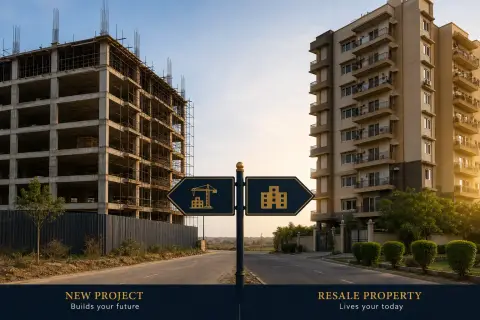
An investor buys a flat in a new society, off the launch, in his own name. Two years later, before he has ever lived in it and often before possession has properly settled, he sells it on to a family who actually want to live there. Nothing about it is unusual. In the societies along Alwar Bypass Road and in the newer towers this is a large slice of what changes hands.
That second sale, the conveyance after the first one, is charged differently in Rajasthan. Where it qualifies, the stamp duty is 3 per cent of market value instead of the ordinary 6 per cent.
What the notification says
The rate comes from notification F.4(2)FD/Tax/2024-80, issued by the Finance Department, Government of Rajasthan, and available on the Registration and Stamps Department’s own notification archive.
It provides for a subsequent conveyance of a qualifying unit in a multistorey building within three years, and reduces the stamp duty on that conveyance to 3 per cent of market value.
Three elements do the work in that sentence, and each one is a place where a buyer can be outside the concession without realising it: the unit has to be in a multistorey building of the kind the notification describes, the conveyance has to be a subsequent one rather than the first, and it has to fall within three years.
What it is worth
Halving the stamp duty also halves the surcharge, because the surcharge is calculated on the duty rather than on the property.
| On a flat valued at | Duty at 6% | Duty at 3% | Duty saved | Surcharge saved at 33% | Total |
|---|---|---|---|---|---|
| ₹25,00,000 | ₹1,50,000 | ₹75,000 | ₹75,000 | ₹24,750 | ₹99,750 |
| ₹40,00,000 | ₹2,40,000 | ₹1,20,000 | ₹1,20,000 | ₹39,600 | ₹1,59,600 |
| ₹60,00,000 | ₹3,60,000 | ₹1,80,000 | ₹1,80,000 | ₹59,400 | ₹2,37,600 |
On the mid row, which is an ordinary 2 BHK in this market, the difference is over a lakh and a half. That is more than most buyers negotiate off the price of the flat itself, and it turns on a fact that is already true or already false on the day they sign.
The registration fee is separate and is charged at 1 per cent, and the surcharge above is shown at 33 per cent, which is the higher of two readings we cannot yet settle. Our registry charges guide explains that position in full.
Why nobody tells the buyer
The concession sits in a notification rather than in the conversation, and none of the people in the room have a reason to raise it.
The seller does not care, because stamp duty is the buyer’s cost and his own sale price is unaffected. The builder is not a party to a resale. A dealer quoting “six per cent plus about a third” is quoting the standard case correctly, and the standard case is what almost every transaction is. The buyer, meanwhile, is budgeting from a calculator that asks for a value and a buyer category and knows nothing about how many times the flat has been conveyed or when.
So the concession survives mostly among people who have already used it once.
The three questions that decide whether you are in it
We can give you the rate with its notification number, and we have. We cannot tell you that your flat qualifies, because that is the notification’s wording applied to your documents, and it is the Sub-Registrar who applies it.
What we can do is tell you what to establish before you go, because arriving with these three answers is the difference between a useful conversation at the office and a guess.
Is this a subsequent conveyance, and what was the first one? You need the previous sale deed, the one by which your seller acquired the flat. Its date is the fact everything else hangs off. If your seller took the flat from the builder on a builder-buyer agreement and the conveyance was executed later, the date that matters is the date of the registered conveyance rather than the date he booked.
Does it fall within three years? Measured from that previous conveyance, not from booking, not from possession and not from the completion certificate. A flat bought at launch in 2022, conveyed in 2023 and being sold to you now in 2026 is outside three years even though the buyer thinks of it as a recent flat.
Is it a qualifying unit in a multistorey building? This is the element most likely to surprise a Bhiwadi buyer, because our market has a great deal of low-rise stock, builder floors and plotted development that a reader may not think of as different in kind. Our guide to builder floors and independent houses versus apartments covers the distinction as the market uses it. Whether your building is within the notification’s description is for the office.
How to use this without getting it wrong
Put the question before the bayana, not after.
The practical route is simple. Get a copy of the seller’s own purchase deed early, which you should be doing anyway as part of reading the chain. Note its registration date. Then take the property details and that date either to ePanjiyan or to the Bhiwari sub-registrar’s office and ask directly whether notification F.4(2)FD/Tax/2024-80 applies to this conveyance.
The reason to do it before the bayana is that the answer changes your total outlay by more than a lakh on an ordinary flat, and the total outlay is what you are actually negotiating. A buyer who learns on registration day that he is paying 6 per cent has lost nothing he was entitled to, but he has been carrying the wrong number through the whole negotiation.
The same visit is the right moment to ask about the other reliefs, since they stack differently. A woman buyer of a qualifying recent resale is asking about two mechanisms at once, and the office can tell you how they interact on your instrument. Our guide to registry charges guide covers the category rebates, and the depreciation allowed on older construction covers the opposite end of the age range.
Common questions
Is the 3 per cent charged on the DLC value or on the price I am paying? The notification expresses the rate against market value. In Rajasthan the value for duty is determined against the DLC, auction or allotment value as applicable, and the DLC rate is a minimum for valuation rather than a market price. Our DLC rate page carries the notified schedule for the Bhiwari sub-registrar’s colonies, and our guide to asking, negotiated and registered value explains why the three numbers differ.
My seller bought from the builder four years ago but has never taken possession. Does the three years run from possession? Possession is not the trigger in the notification, the conveyance is. Take the registration date of his deed to the office and ask on those facts.
Does this apply to a plot? The notification is about a unit in a multistorey building. A plot is a different instrument and the ordinary rate applies unless something else does.
If it applies, does the seller need to do anything? The duty is the buyer’s cost and the relief is applied on the instrument at the office. What the seller has to do is give you the previous deed early enough that you can ask the question, which is a reasonable thing to ask of any seller and a small flag if he resists.
Does it stack with the woman buyer rebate? They are both rate mechanisms, so how they interact on one instrument is exactly what to put to the Sub-Registrar rather than to assume in either direction.
Where to check us
The rate and the conditions on this page come from notification F.4(2)FD/Tax/2024-80, Finance Department, Government of Rajasthan, which is published on the Registration and Stamps Department’s notification archive at epanjiyan.rajasthan.gov.in/public/circularnotification. Read the notification itself before you rely on this page.
We hold the rate. We do not hold a departmental clarification on how the office applies the qualifying-unit test in practice, which is the one element of this concession where a Bhiwadi buyer is most likely to be surprised, and we would rather say so than write around it.
If you are buying a recent resale in a Bhiwadi society and want this checked against the actual deed before you commit, that is part of an ordinary purchase for us. Send us the society and the seller’s purchase date and we will take it to the office with you.
Continue Reading


Ready to Shortlist? Talk It Through With Us
18+ years in this market. Real prices, verified paperwork, no pressure.
Choose what you would like to do next:
Done. Our team will contact you during working hours.