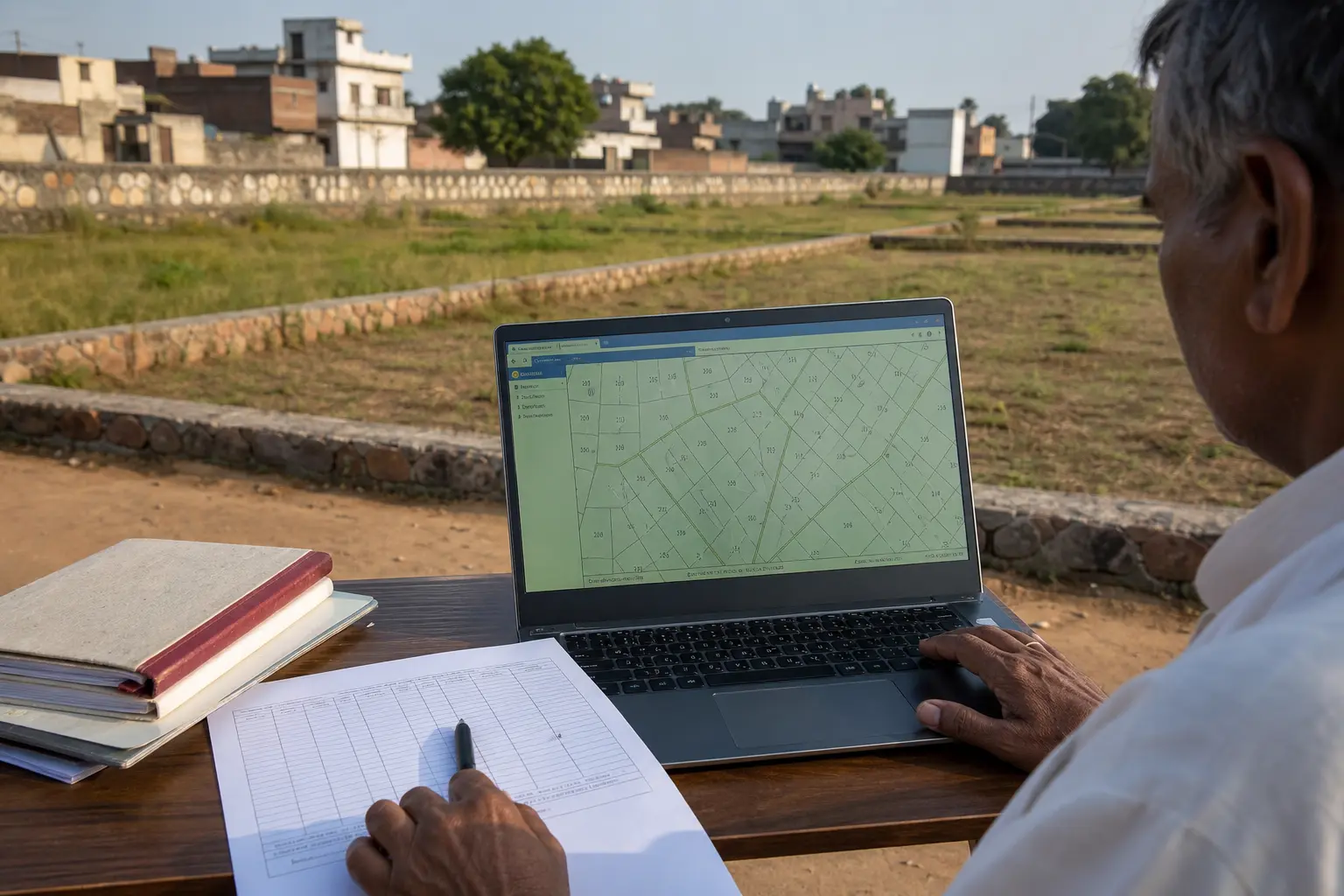
Key Answers in This Guide
- What Apna Khata Is and Who Runs It: Apna Khata is the Rajasthan Revenue Department's official online land-records portal, also referred to as E-Dharti, and it exists to let anyone view the government's revenue records for agricultural and other recorded land without visiting a tehsil office.
- The Record Types, In Plain Words: Four kinds of record concern a buyer on this portal: the Jamabandi, mutation entries, girdawari, and the Bhu-Naksha map, and each answers a different narrow question.
- When a Bhiwadi Buyer Should Check It: Check Apna Khata early, before token money moves, and mainly when the deal involves a plot or land rather than a flat in a registered project.
- What an Early Check Can Catch: An early Apna Khata check can surface four specific mismatches, and each one is a question to resolve before token money moves, not proof of fraud by itself.
- The Centrepiece: What Apna Khata Does Not Prove: Apna Khata is a preliminary land-record reference, and it does not by itself establish marketable title, physical boundaries on the ground, actual possession, absence of disputes or encumbrances, or the eligibility of your transaction.
- Certified Copies Versus Browser Printouts: A browser printout from Apna Khata is not a certified copy, and anything you need for court, official, or formal purposes must come through the official certification process instead.
In this guide
Every few weeks a buyer walks into our office with a printout from Apna Khata and asks us whether the plot they are eyeing is “clear”. We have been selling property in Bhiwadi since 2008, and that printout is one of the most useful things a buyer can bring us. It is also one of the most misunderstood. Buyers routinely treat a revenue record on a screen as a title certificate, and it is nothing of the sort.
This guide explains what Rajasthan’s official land-records portal actually shows, what an early check can catch before token money moves, and, most importantly, the hard list of things it does not and cannot prove.
One thing this article is not: a click-by-click walkthrough. Government portals redesign their screens more often than anyone updates guides about them, and we would rather tell you honestly what the records mean than describe buttons that may have moved by the time you read this. When you reach the point of actually pulling records for a specific khasra, follow the portal’s own current interface, or sit with us at our office and we will pull them together with you.
What Apna Khata Is and Who Runs It
Apna Khata is the Rajasthan Revenue Department’s official online land-records portal, also referred to as E-Dharti, and it exists to let anyone view the government’s revenue records for agricultural and other recorded land without visiting a tehsil office.
You reach it at apnakhata.rajasthan.gov.in. Navigation works through selecting a district, then a tehsil, then a village, after which you can look up the record you need. That structure matters more than any individual screen, because it tells you what the portal fundamentally is: a village-level revenue register moved online, not a property marketplace and not a title registry.
Understand the distinction between revenue records and title, because everything else in this article flows from it. Revenue records exist so the state knows who to assess for land revenue and what a parcel is being used for. Registration records, maintained separately by the Sub-Registrar under stamp and registration law, record the transactions by which ownership changes hands. Courts, when they decide ownership disputes, weigh many sources of evidence.
Apna Khata shows you only the first category. It is genuinely useful, freely accessible, and official. It is also, by the portal’s own admission, for general information, which we will come back to more than once because it is the single most ignored line on the entire site.
For a Bhiwadi buyer, this portal matters mainly for plots, agricultural parcels, and land underlying projects. If you are buying a flat in a RERA-registered project, the land records still matter, but they matter at the level of the developer’s title to the project land, which your lawyer examines through the title documents, not something you settle yourself with a browser.
The Record Types, In Plain Words
Four kinds of record concern a buyer on this portal: the Jamabandi, mutation entries, girdawari, and the Bhu-Naksha map, and each answers a different narrow question.
Buyers often use these words interchangeably. They should not, because each record has a specific job, and knowing the job tells you what the record can and cannot tell you.
Jamabandi: the record of rights
Jamabandi is the record of rights, the government’s revenue-record view of who holds a land account, called a khata. It carries the khata reference, the khasra numbers identifying the parcels within it, area details, and recorded cultivation or holding information. When we say “check whether the seller’s name appears in the revenue record”, the Jamabandi is what we mean. Read it as the answer to one question: whose name does the revenue department currently associate with this land? Not “who owns it”, not “who can sell it”. Whose name is recorded. Those sound like the same thing. They are frequently not, and the gap between them is where buyers get hurt.
Mutation: the name-change trail
Mutation, called namantaran locally, is the process by which the revenue record is updated after ownership changes through purchase, inheritance, or gift. Apna Khata provides mutation-related information and supports online mutation applications. For a buyer doing pre-purchase homework, mutation status is a freshness indicator. If your seller says they bought the land two years ago, you would expect the mutation reflecting that purchase to have moved through the system by now. If it has not, that is a question to put to them before any money moves.
And note the portal’s own caveat, stated on the site itself: some mutations may not be updated immediately. Online lag is normal, which cuts both ways. A missing entry is a question, not a verdict.
Girdawari: the seasonal use record
Girdawari is the seasonal record of crops and possession-related use, historically compiled by the patwari going field to field. For agricultural parcels around the Bhiwadi belt, it tells you what the record says the land was being used for season by season. Buyers of farmland or land proposed for conversion find it useful as background. What it does not do is prove who is physically standing on the land today, a point we will hammer in the limitations section.
Bhu-Naksha: the digitised map
Bhu-Naksha is the digitised land map showing plot boundaries as recorded. Seeing your prospective khasra drawn on a map, with its neighbours around it, is genuinely helpful for orientation, for spotting whether the parcel is where the seller says it is, and for checking rough shape and adjacency. Hold on to one phrase, though: boundaries as recorded. A line on a digitised map is the record’s opinion of where the boundary sits. Only physical demarcation on the ground, and where needed an independent survey, tells you where the boundary actually is. We have seen recorded maps and ground reality disagree, and when they disagree, the ground is where you live.
| Record | What it answers | What it does not answer |
|---|---|---|
| Jamabandi | Whose name the revenue record carries for this khata, and which khasras sit in it | Whether that person holds marketable title or can lawfully sell |
| Mutation | Whether the record has been updated after a claimed transfer | Whether the underlying transaction was valid |
| Girdawari | Recorded seasonal crop and possession-related use | Who is physically in possession today |
| Bhu-Naksha | Where the boundary sits as recorded | Where the boundary sits on the ground |
When a Bhiwadi Buyer Should Check It
Check Apna Khata early, before token money moves, and mainly when the deal involves a plot or land rather than a flat in a registered project.
Timing is the whole game here. A land-record check costs you nothing and takes little time, so it belongs at the very front of your process, before emotions and advances harden your position. Once you have paid a token, every red flag becomes a negotiation about getting your own money back. Before the token, every red flag is simply a question the seller must answer. We have written separately about token money and booking amounts, and the rule there applies squarely here: verify first, pay second.
Which deals call for the check? Any purchase of plots in Bhiwadi, any agricultural parcel, any land where the seller is an individual or family rather than a developer with a registered project, and any resale of land where the chain of holders matters. For flats in RERA-registered projects the developer’s title to the underlying land is examined during project registration and again by your lawyer, so your personal Apna Khata check adds less, though your lawyer may still consult the revenue records as part of their title work.
One practical note for our belt. Sellers here often quote khasra numbers from memory, from old family papers, or from a broker’s forwarded message. Ask the seller for the khasra number, the village name, and the tehsil in writing before you search. Searching with a wrong or approximate khasra number produces confident-looking results about the wrong parcel, which is worse than not searching at all. If the seller hesitates to put the khasra number in writing, treat that hesitation as information.
What an Early Check Can Catch
An early Apna Khata check can surface four specific mismatches, and each one is a question to resolve before token money moves, not proof of fraud by itself.
We want to be precise here, because both extremes are wrong. The buyer who ignores the portal walks past a free early-warning system. The buyer who treats every anomaly as proof of cheating burns good deals over clerical lag. Here is what the check can genuinely surface.
First, the seller’s name does not appear in the revenue record at all. Perhaps they are selling on behalf of a family member, perhaps the mutation from their own purchase never completed, perhaps there is a power of attorney in the picture, or perhaps something worse. Every one of those explanations changes what documents you need before proceeding, so you need the explanation before the token, in writing where possible.
Second, a different holder’s name appears. Sometimes it is the seller’s late father and the succession mutation is pending. Sometimes it is a co-holder the seller did not mention, which raises the question of whether every recorded holder is signing your agreement. Sometimes it is a stranger. Each requires a different response, and all of them require pausing.
Third, obviously stale mutation status after a claimed recent transfer. If the seller says they purchased in a particular year and nothing in the record reflects it, ask why. Delays happen, but “delay” is the seller’s claim to substantiate with their registered sale deed and their mutation application papers, not yours to assume.
Fourth, khasra numbers that do not match what the seller quoted. Mismatched khasras can mean an honest transcription slip, a parcel that was split or renumbered, or a seller showing you one piece of land while the papers describe another. That last pattern is one of the oldest tricks in land dealing, and it is exactly the kind of thing we listed among the common property mistakes buyers make when they verify papers and site separately instead of together.
In every case, the correct next step is the same. Put the discrepancy to the seller, ask for documents that explain it, and route those documents through your lawyer. Do not accept an oral explanation, do not accept “the record is always wrong, everyone knows”, and do not pay anything while the question stands open.
The Centrepiece: What Apna Khata Does Not Prove
Apna Khata is a preliminary land-record reference, and it does not by itself establish marketable title, physical boundaries on the ground, actual possession, absence of disputes or encumbrances, or the eligibility of your transaction.
This section is the reason we wrote this article. Read it twice if you read nothing else. The portal itself states that the online information is for general information, that some mutations may not be updated immediately, and that the displayed copy is not a certified or authorised copy for court or official use. In other words, the Revenue Department’s own portal tells you not to treat its screens as conclusive. Buyers who skip that line and treat a Jamabandi printout as a clean-title certificate are making an assumption the government never invited them to make.
Here is what buyers assume against what is actually true.
| What buyers assume | What is actually true |
|---|---|
| ”The seller’s name is in the Jamabandi, so they own it.” | A revenue entry records who the department associates with the khata. Marketable title is established through the title documents and their chain, examined by a lawyer, not through a revenue entry alone. |
| ”The record is online and official, so it is current.” | Online records can lag reality. The portal itself warns that some mutations may not be updated immediately. A transfer, a partition, or a succession may exist on paper and not yet on the screen. |
| ”The map shows the boundary, so I know what I am buying.” | Boundary on the map is not boundary on the ground. Only physical demarcation and, where needed, an independent survey settle where the parcel actually starts and ends. |
| ”Nothing negative appears, so there are no disputes.” | Apna Khata is not a litigation database. A pending civil suit, a family claim, or a stay order will not announce itself in a Jamabandi view. |
| ”Nothing negative appears, so there is no loan or charge on the land.” | Encumbrance verification runs through the registration records and your lawyer’s search, not through this portal. Absence of a note here proves nothing about mortgages or charges. |
| ”The record looks fine, so the deal itself is fine.” | Whether this seller can lawfully sell to you, in this manner, for this use, is a legal question about the transaction. The portal records land, not the eligibility of deals. |
| ”Someone’s name is recorded, so they must be in possession.” | Recorded holding and physical possession are different facts. Only a site visit tells you who is actually on the land, and possession disputes are among the ugliest a buyer can inherit. |
Notice the pattern running through every row. The portal answers “what does the revenue record currently say”, and buyers keep asking it “is this deal safe”, which is a question it was never built to answer. Treat it the way a doctor treats a preliminary report: useful for deciding what to investigate next, never a substitute for the investigation. Independent legal title review remains non-negotiable, on every land deal, for every buyer, including the ones buying from relatives and the ones in a hurry. Especially those two.
Certified Copies Versus Browser Printouts
A browser printout from Apna Khata is not a certified copy, and anything you need for court, official, or formal purposes must come through the official certification process instead.
This surprises people, so let us say it flatly. The copy displayed online is, by the portal’s own statement, not a certified or authorised copy for court or official use. Printing the screen does not change that. What you hold after printing is a convenient reference showing what the portal displayed on a given day, which is genuinely useful for your file and for framing questions, and legally is exactly that and nothing more.
Certified copies come through the official process, and when your lawyer or a bank or a court needs the record in a form that carries weight, that is the route. We will not describe the mechanics of obtaining one here, because procedures and interfaces change and we refuse to publish steps we have not walked through recently. Ask your lawyer which certified records your specific transaction needs, or ask us and we will point you to the current process at the time.
Our practical advice sits in the middle. Take the printout, date it, and keep it in your deal file, because it records what you saw and when you saw it, which is worth something if the record changes later. Just never let anyone, including yourself, promote that printout into evidence of title. It is a photograph of a noticeboard, not a certificate.
The District Point: Khairthal-Tijara, Not Always Alwar
Bhiwadi falls in Rajasthan’s Khairthal-Tijara district, carved out of Alwar in 2023, so older records and listings may still say Alwar, and you should confirm which district a specific village maps to on the portal at the time you search rather than assuming.
Because the portal navigates district first, then tehsil, then village, the district question is not trivia. Pick the wrong district and you simply will not find your village, and an anxious buyer who cannot find a village sometimes concludes the land does not exist or the seller lied, when the real explanation is administrative reorganisation.
Bhiwadi’s belt spent decades under Alwar district. Since the 2023 reorganisation it sits under Khairthal-Tijara, and the paperwork trail reflects both eras. Old sale deeds say Alwar. Old society papers say Alwar. Some listings and lawyers’ notes still say Alwar out of habit. None of that is a red flag by itself.
What it does mean is a small discipline: when you search, check where the specific village currently sits in the portal’s district and tehsil structure at the time of your search, and if you cannot find it under one district, check the other before drawing any conclusion.
It also means that when you compare an old document naming Alwar with a new record naming Khairthal-Tijara, the district difference alone is not a discrepancy. Khasra, village, and holder details are what must reconcile. If a seller or a broker tries to wave away a genuine khasra mismatch by blaming “the district change”, do not accept that. Reorganisation renamed the administrative container, not the parcels inside it.
Where This Fits in the Full Verification Sequence
Apna Khata is the first look, not the verification, and it sits alongside title review, registration and encumbrance checks, RERA verification where a project is involved, and a physical site inspection, none of which it replaces.
Think of buying land in Bhiwadi as a sequence, which we have laid out fully in how to buy property in Bhiwadi step by step. The land-record check slots in at the very beginning, in the shortlisting stage, where it filters out deals with obvious record-level questions before you spend money or emotional commitment. After that, the serious work begins, and each later step covers ground the portal cannot.
Your lawyer’s title review examines the chain of ownership through the actual title documents, which is where marketability is established. Registry-side checks and the encumbrance search reveal registered transactions and charges.
Where a project or a professional intermediary is involved, verify registrations independently: we have covered checking project RERA and BIDA approval and how to verify a Rajasthan RERA agent separately, and both checks run on official portals in minutes. A physical site visit, ideally with the papers in hand and the neighbours within talking distance, establishes possession and ground boundaries. And the full paper set you should demand from any seller is listed in our guide to documents required to buy property in Bhiwadi.
Notice what that sequence does. Every check verifies something the others cannot, and no single check, ours included, clears a deal alone. Apna Khata’s job in the sequence is to make sure the revenue record and the seller’s story agree before you invest in the expensive steps. When they agree, you proceed with more confidence. When they disagree, you have caught the problem at the cheapest possible moment.
We will add the dealer’s perspective, since we sit on this side of the table. A seller with clean papers welcomes every one of these checks, because each one moves their deal closer to closing. We have never seen a genuine seller object to a buyer checking the revenue record. Resistance to verification is itself a finding. Our list of questions to ask before buying includes several that flow directly from what the land record shows, and how a seller answers them tells you as much as the record does.
Questions Buyers Ask Us About Apna Khata
These are the questions we field most often at our desk, answered the way we answer them in person.
Is checking Apna Khata compulsory before buying a plot?
No law compels you. Prudence does. It is free, official, and catches record-level mismatches at the stage when walking away costs you nothing. We check it as a matter of routine on land deals we handle, and we would think poorly of any dealer who did not.
The seller’s name appears in the Jamabandi. Can I pay the token now?
Not on that basis alone. A matching name clears one preliminary question out of many. Title review, encumbrance search, possession check, and the document set all still stand between you and a safe token. Read the limitations table above once more before you transfer anything.
The seller’s name does not appear. Should I walk away?
Not immediately, and not silently. Ask for the explanation and the documents behind it, and put both in front of your lawyer. Pending succession, incomplete mutation, and family arrangements are all common and sometimes curable. What you must not do is proceed while the question stands unanswered.
Will the record tell me if the land is disputed or mortgaged?
No, and this is the misunderstanding that worries us most. Disputes live in courts and encumbrances live in the registration records. Absence of bad news on Apna Khata is not evidence of a clean deal. Only your lawyer’s independent search settles those questions.
One closing thought. The buyers who get hurt in land deals are almost never the ones who checked too little in one place. They are the ones who checked one thing, felt reassured, and stopped. Apna Khata is a fine place to start and a terrible place to stop. Start there, then finish the job, and if you want company for any part of it, our office in Bhiwadi is open and the records are only ever a few questions away.
Sources Checked
- Apna Khata: the Rajasthan Revenue Department’s official land-records portal described throughout this guide (checked July 2026)
- ePanjiyan: the Rajasthan registration portal for the separate Sub-Registrar transaction records referenced above (checked July 2026)
- Rajasthan RERA portal: for the separate agent and project checks referenced above (checked July 2026)
The portal’s screens and district mappings change; follow its current interface rather than any screenshot.
Want a Second Pair of Eyes on Your Paperwork?
18+ years in this market. Real prices, verified paperwork, no pressure.
Choose what you would like to do next:
Done — our team will contact you during working hours.