Key Answers in This Guide
- Start With Your Purpose, Not the Locality: There is no single best area in Bhiwadi; there is only the best area for your specific purpose, budget and timeline.
- For Families Who Want to Move In Soon: Alwar Bypass Road and Sector 51: End-users who need a livable home within months should look first at Alwar Bypass Road for value, or Sector 51 for newer construction.
- For Rental-Income Investors: Alwar Bypass Road Leads: If monthly rental income is the goal, Alwar Bypass Road has the strongest and most reliable tenant demand in Bhiwadi.
- For Plot Buyers Building Later: UIT Sectors, With Tapukara–Tijara at Entry Level: Buyers who want land ownership with clean titles should focus on Bhiwadi's UIT sectors; those on a smaller budget can consider the Tapukara–Tijara belt with extra diligence.
- For Industrial Buyers: Chopanki for MSMEs, Khushkhera for Scale: MSMEs needing mid-size plots and faster liquidity should look at Chopanki; companies needing larger footprints belong in Khushkhera.
- Commute and Lifestyle: The Trade-Offs Nobody Prices In: Every locality choice in Bhiwadi is quietly a commute and lifestyle choice, so map your daily routine before you map the price list.
In this guide
Ask ten people for the best area to buy property in Bhiwadi and you will get ten confident answers, most of them shaped by whatever that person happens to be selling. After working this market since 2008, we can tell you the truthful version: the best area depends entirely on what you want the property to do for you. A family moving in next month, an investor chasing rental income, someone buying a plot to build on in five years, and a factory owner scouting land all have different right answers, and sometimes those answers point to opposite ends of town.
This guide compares the localities we actually work in, with the pros and the limitations of each. All price figures are indicative; contact us for current rates, because ranges here move with inventory. Where a number appears, it comes from what we see closing on the ground, not from a portal listing that nobody transacted at.
Start With Your Purpose, Not the Locality
There is no single best area in Bhiwadi; there is only the best area for your specific purpose, budget and timeline.
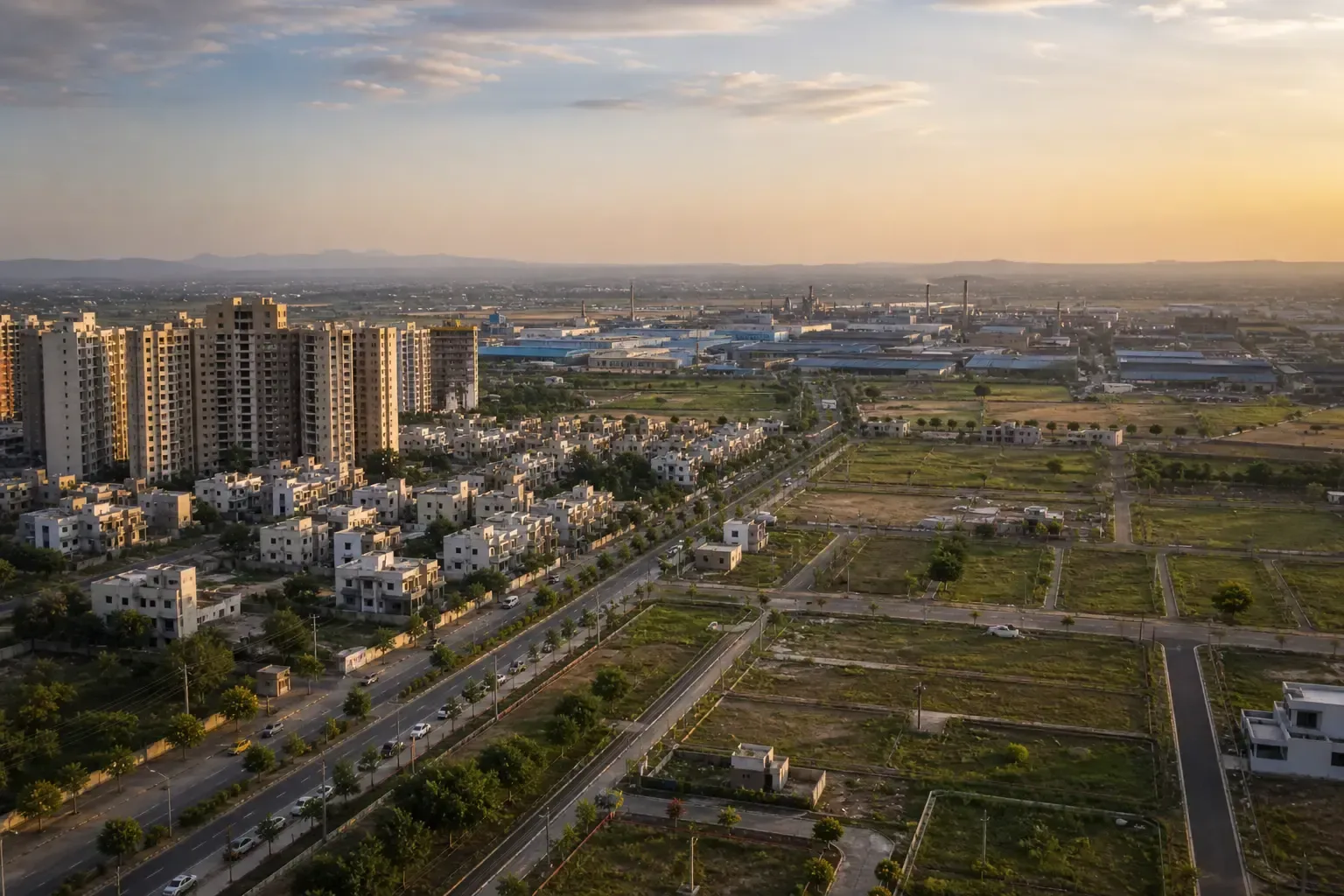
Bhiwadi is not one uniform market. It is an industrial town with distinct zones: an established residential corridor with deep ready-to-move supply, government-planned plotted sectors, a newer apartment belt, and RIICO industrial areas on the periphery. Each zone rewards a different kind of buyer and punishes the wrong one. A rental investor who buys in a half-built sector waits years for tenants. A family that buys purely on lowest price may land in a poorly maintained society. An industrialist who buys a residential plot near the factory instead of a RIICO plot inside it discovers that land use is not a formality here.
So before comparing localities, answer one question plainly: will you live in it, rent it out, hold the land, or run a business on it? Everything below is organised around that answer. For a broader picture of the market itself, our overview of property in Bhiwadi covers how the town is structured, and our infrastructure reality check separates what is actually built from what brochures promise.
Start from what you need the property to do; the locality mostly follows from it.
A family wanting to move in soon
Alwar Bypass Road or Sector 51. Weigh livability today against newer stock tomorrow.
Rental income from Bhiwadi's industrial workforce
Alwar Bypass Road, where tenant demand is the most reliable in town.
Buying a plot to build a home later
The UIT sectors, or the Tapukara-Tijara belt at entry-level budgets, with the heavier title diligence that discount demands.
Setting up an MSME unit
Chopanki for entry and liquidity; for a larger footprint, Khushkhera.
Pick the purpose first, then let inventory and verification decide the final property, not the other way around.
For Families Who Want to Move In Soon: Alwar Bypass Road and Sector 51
End-users who need a livable home within months should look first at Alwar Bypass Road for value, or Sector 51 for newer construction.
Alwar Bypass Road is Bhiwadi’s most established residential corridor. It has the deepest ready-to-move inventory in the city, functioning societies, and the strongest rental demand in town, with schools, hospitals and daily markets sitting within the corridor itself rather than a drive away. NH-48, the Delhi to Jaipur highway, is 5 to 10 minutes out, and the RIICO industrial areas of Bhiwadi and Chopanki are 10 to 15 minutes, which is why so many working families settle here first. Indicative prices: 1 BHK apartments at ₹16–24 L, 2 BHK at ₹23–40 L, 3 BHK at ₹35–55 L, and builder floors at ₹30–55 L. For a first-time buyer, this is usually where we start the conversation.
Its limitation is age. Older societies on this stretch vary widely in maintenance quality, so two buildings at the same price can offer very different living experiences. One society at ₹28 lakh for a 2 BHK may have a working lift, a funded maintenance account and clean common areas; another at the same figure may have none of those.
Inspect the society, not just the flat: ask to see the maintenance record, confirm the occupancy certificate exists, trace the title chain and check for pending society dues before any token money changes hands. Peak-hour traffic on the corridor is real, and new plotted supply is limited, so buyers wanting land rather than a flat mostly look elsewhere. Our page on flats on Alwar Bypass Road goes deeper into which checks matter here.
Sector 51 and the nearby pockets are the newer alternative. Societies here received possession in recent years, with visibly better construction quality and planning than the older stock. Alwar Bypass amenities remain 5 to 10 minutes away and NH-48 about 10 to 15, so the location cost of choosing newness is modest. Indicative prices sit a step higher: 2 BHK at ₹30–48 L and 3 BHK at ₹38–65 L. In exchange for the premium, a buyer gets modern society amenities, better build quality, and room to grow as the sector fills in.
Caveats: social infrastructure is still maturing in some pockets, and the resale market is thinner than in established areas, which matters if you may need to exit within a few years. When buyers ask us whether Sector 51 is better than Alwar Bypass Road, our answer is that they serve different people. Sector 51 rewards those who prioritise quality and newness; Alwar Bypass rewards those who want the lowest entry and the strongest rental demand. We work both belts daily and will say plainly which fits a given goal. Families comparing the two can see current options for Sector 51 alongside the wider stock of flats in Bhiwadi.
For Rental-Income Investors: Alwar Bypass Road Leads
If monthly rental income is the goal, Alwar Bypass Road has the strongest and most reliable tenant demand in Bhiwadi.
Bhiwadi’s rental market runs on its industrial workforce, and that workforce lives where daily life already works. Well-maintained 1 and 2 BHK units in known societies on Alwar Bypass Road rarely stay vacant, with yields typically in the 3–4%+ range in good societies. Entry is accessible too, with ready 1 BHK units starting around ₹16 lakh, indicative as always. Tenants here are factory supervisors, engineers, shop-floor staff and their families, and they value a working lift and a five-minute walk to the market far more than a clubhouse they will never use. That is why an older, well-run society often out-earns a newer, poorly run one.
Sector 51 also rents, but the trade is different: rental yield runs slightly lower than Alwar Bypass, while appreciation prospects look slightly better thanks to newer construction. An investor who cares more about long-term capital value than immediate cash flow may prefer it. One who wants the flat earning from month one should stay on the bypass corridor.
What we tell every rental investor: the society matters more than the locality. Maintenance record, occupancy certificate, title chain and pending society dues decide whether your unit attracts tenants or repels them. A flat in a society with dead lifts and unpaid dues will sit vacant on the busiest corridor in town. These checks appear in our full list of questions to ask before buying property in Bhiwadi, and they apply doubly to older stock.
For Plot Buyers Building Later: UIT Sectors, With Tapukara–Tijara at Entry Level
Buyers who want land ownership with clean titles should focus on Bhiwadi’s UIT sectors; those on a smaller budget can consider the Tapukara–Tijara belt with extra diligence.
UIT sectors are Bhiwadi’s plotted-development zone: government-planned sectors laid out by the Urban Improvement Trust, where land titles are among the cleanest in town and you own the ground beneath you rather than a share in a tower. Residential plots typically run 100 to 300 sq yd, indicatively at ₹18,000–35,000 per sq yd. Builder floors here run ₹30–55 L and independent houses ₹45 L to 1 Cr+; if you are torn between a house and a society flat, our independent house vs apartment guide weighs both. Depending on the sector, the main market is 5 to 15 minutes away and NH-48 about 10 to 20, so these are not remote farm plots; they sit inside the town’s daily life. You build at your own pace, on your own timeline, to your own plan.
Historically, plotted land in planned sectors has appreciated ahead of apartments in Bhiwadi, which is why land-bankers holding for the medium term also buy here. But the ledger has entries on both sides. A plot produces no rental income while you hold it, construction is entirely your responsibility, and plotted sectors offer fewer society-style amenities such as parks and gyms than group housing does. Development level varies sector to sector: some are fully built up with occupied houses on most plots, others are still filling in, with streets laid but neighbours sparse. Which sector is best depends on use. Built-up sectors suit someone building within a year; developing sectors offer a lower entry price for someone comfortable waiting.
Verification still matters even with UIT approval. Check the allotment chain from the original allottee to the current seller, confirm conversion status, and clear any pending UIT dues before registry. These are precisely the files where a missing link surfaces years later, at resale, when it is expensive to fix. Details and current sector-wise availability are on our UIT sectors page.
Further out, the Tapukara–Tijara belt offers entry-level plots riding on industrial employment in the Honda zone; most of our actual closings in this belt fall between ₹16,000 and ₹32,000 per sq yd, with Tapukara-proper residential plots at ₹20,000–35,000 per sq yd (partner-confirmed, July 2026; indicative, contact us for current rates). It suits patient buyers with smaller budgets who accept a longer development timeline and thinner surrounding infrastructure today. Title diligence is non-negotiable there; the discount exists for a reason. Our guide to plots in Bhiwadi compares plotted options across the belt, and our property in Tapukara guide covers that pocket in depth.
For Industrial Buyers: Chopanki for MSMEs, Khushkhera for Scale
MSMEs needing mid-size plots and faster liquidity should look at Chopanki; companies needing larger footprints belong in Khushkhera.
Chopanki is one of the most active RIICO industrial areas in the Bhiwadi belt. Mid-size plots of 500 to 4,000 sq m dominate, alongside some built-up factory units and sheds, and crucially it has a genuine year-round resale market, while fresh RIICO allotments open only episodically. That resale depth is Chopanki’s quiet advantage: a business that needs to exit or expand can actually transact, instead of waiting for the next allotment round. Auto components, light engineering, packaging and plastics units suit its power and road infrastructure. NH-48 is 10 to 15 minutes away, workforce housing in Bhiwadi town equally close, and the IMT Manesar side of Gurgaon about an hour.
Most deals here are resale transfers: RIICO transfer application, transfer charges, an updated site plan and dues clearance, typically closing in 6 to 10 weeks when the file is clean. Before committing, verify RIICO dues clearance, land-use compliance for your industry type, building-plan approvals on built-up units and any pending sub-division issues. See our Chopanki industrial plots page for the process in full.
Khushkhera is where the belt goes big: plots of 2,000 to 20,000+ sq m, a growing auto-component and engineering cluster, and corridor positioning toward Neemrana within the Delhi–Mumbai industrial corridor influence zone. Bhiwadi town is 20 to 30 minutes out, so workforce logistics take slightly more planning than in Chopanki. Resale supply is thinner, deal sizes are bigger, and larger plots involve extra diligence, including sub-division history, built-up coverage compliance and RIICO construction-timeline conditions, since RIICO requires utilisation of allotted plots within set periods.
Expect 8 to 12 weeks on a clean file. Realistic entry for land alone typically starts around ₹5 crore at current rates. Both areas currently trade indicatively at ₹25,000–40,000 per sq m, the belt-wide Bhiwadi industrial rate; contact us for current rates, since plot size, road width and corner position move the figure within that band. Larger requirements are covered on our Khushkhera industrial plots page.
Commute and Lifestyle: The Trade-Offs Nobody Prices In
Every locality choice in Bhiwadi is quietly a commute and lifestyle choice, so map your daily routine before you map the price list.
Buyers compare prices to the rupee and then ignore the twenty minutes they will drive twice a day for the next fifteen years. Think about where the household actually goes. If someone works in the Bhiwadi or Chopanki RIICO areas, Alwar Bypass Road puts the factory 10 to 15 minutes away and the school run inside the corridor; Sector 51 adds a few minutes each way but hands back a quieter evening in a newer society. If a family member commutes toward Gurgaon on the IMT Manesar side, that run is 45 to 60 minutes from the bypass corridor on a normal day, and it deserves a trial drive at 8 am before anyone signs anything.
Lifestyle cuts the other way. Established corridors offer convenience with congestion: the market is a walk away, and so is the traffic. Newer sectors offer space and calm with gaps: a chemist may still be a drive, and the street lights may arrive after you do. Plotted UIT sectors sit in between; daily life works, but you will not get a society gym or a managed park, because the trade you made was land ownership over shared amenities. None of these is wrong. What is wrong is buying calm when your life needs convenience, or paying for convenience your routine will never use. Match the belt to the week you actually live, not the weekend you imagine.
How to Shortlist in One Weekend
Two focused days on the ground will tell you more than two months of browsing listings from your sofa.
Most outstation buyers try to evaluate Bhiwadi through portal photos. Here is the routine we suggest instead, and it fits in one weekend.
Saturday morning, drive the belts, not the flats. Start on Alwar Bypass Road around 9 am when the corridor is working: watch the traffic, see the markets open, note which societies look maintained from the gate. Move to Sector 51 before lunch and compare the feel: newer buildings, quieter streets, fewer shops. After lunch, loop through two or three UIT sectors at different stages of build-up so you can see with your own eyes what “still filling in” means. If an industrial plot is the goal, do this same loop through Chopanki, and Khushkhera if your size demands it, on a working day instead, when the trucks and shifts show you how the area actually functions.
Saturday evening, shortlist three properties maximum, across not more than two localities. More than that and Sunday turns into a blur where every flat merges into the last one.
Sunday, inspect those three slowly. Walk the society, not just the unit: lifts, stairwells, parking, the state of the water tanks, the notice board, which tells you more about a society’s health than the brochure ever will. Talk to one resident in each society if you can; five minutes at the gate is worth an hour with a broker. Ask for the maintenance record and the occupancy certificate on the spot. A seller who hesitates on paperwork on day one will not improve by day thirty.
Before you come, run your numbers once through our property cost calculator so that stamp duty, registration and the other charges beyond the sticker price do not ambush you at the negotiation table. And tell us you are coming: we can line up the shortlist so the weekend is spent inspecting rather than searching.
Four Buyers, Four Right Answers: Worked Scenarios
Put a real budget against a real purpose and the locality question mostly answers itself.
These four composites mirror buyers we sit across every month. All figures are indicative.
A family with about ₹35 lakh, moving in this year. On Alwar Bypass Road, ₹35 lakh sits comfortably inside the 2 BHK band of ₹23–40 L, buying a good unit in a well-run society, and touches the very bottom of the 3 BHK band of ₹35–55 L, where choices will be older stock needing careful inspection. In Sector 51, the same money lands mid-band for a 2 BHK at ₹30–48 L, in newer construction. Our steer: a well-maintained 2 BHK beats a compromised 3 BHK at the same price. Take the space you can verify, not the extra room in a society that cannot fund its own lift repair.
A rental investor with about ₹20 lakh. This budget points squarely at a 1 BHK on Alwar Bypass Road, where the band runs ₹16–24 L and tenant demand from the industrial workforce is the most reliable in town. At yields typically in the 3–4%+ range in good societies, the unit earns from the first month if, and only if, the society is one tenants want to live in. Spend the diligence budget on the society’s maintenance record and dues position, and be willing to pay slightly more within the band for the building that rents itself.
A plot buyer with about ₹25 lakh. In the UIT sectors, at ₹18,000–35,000 per sq yd, this budget covers a 100 sq yd plot through the lower and middle stretch of that band. The choice inside the budget is between a smaller or less prime plot in a built-up sector versus a better-positioned plot in a sector still developing. If building is five years away, the developing sector’s lower entry works in their favour; if construction starts next year, pay for the built-up sector and the neighbours that come with it. The Tapukara–Tijara belt sits below UIT pricing for those stretching a thinner budget, with the extra title diligence that discount demands.
An MSME owner setting up a unit. In Chopanki, at the belt-wide rate of ₹25,000–40,000 per sq m, a 500 sq m plot, the smallest typical size, implies roughly ₹1.25 to 2 crore for land alone, and a 1,000 sq m plot roughly ₹2.5 to 4 crore, before transfer charges and construction. That is the realistic MSME entry point, with resale liquidity as the safety net. Businesses needing 2,000 sq m and beyond should look at Khushkhera, where entry for land alone typically starts around ₹5 crore, and budget the longer 8 to 12 week timeline and heavier diligence that larger RIICO files carry.
Mistakes People Make When Choosing a Bhiwadi Locality
Most locality regrets in Bhiwadi come from five avoidable errors, and every one of them is cheaper to prevent than to fix.
First, buying the locality’s reputation instead of the specific society. Alwar Bypass Road being the established corridor does not make every building on it a good buy; maintenance quality varies widely between societies at identical prices. The address does not maintain the lift.
Second, chasing the lowest per-square-foot number. The cheapest flat in town is usually cheap for reasons that surface after possession: dues, disputes, or a society nobody wants to rent in. Price per square foot is where analysis starts, not where it ends.
Third, ignoring exit liquidity. Newer belts and developing sectors can be excellent holds, but their resale markets are thinner today. A buyer who may need to sell within three or four years should weight established areas more heavily than one holding for a decade.
Fourth, treating verification as a formality because the seller seems decent. Occupancy certificates, allotment chains, UIT and RIICO dues, conversion status: these are not paperwork rituals, they are the difference between an asset and a problem. Our list of questions to ask before buying exists because we have seen each of these go wrong for someone.
Fifth, budgeting only the sticker price. Stamp duty, registration, transfer charges and society dues add up to a figure that changes which band you can really afford. Run the full number through the cost calculator before shortlisting, not after falling in love with a flat one band above your real budget.
Quick Comparison at a Glance
Match the locality to the job you need the property to do, then verify the specifics on the ground.
| Locality | Best for | Watch out |
|---|---|---|
| Alwar Bypass Road | First homes, rental income | Society maintenance varies; corridor traffic |
| Sector 51 & nearby | Quality-focused upgraders | Higher entry; thinner resale market |
| UIT sectors | Land ownership, building your own home | Sector development uneven; no income while holding |
| Tapukara–Tijara belt | Entry-level plot budgets | Longer timeline; strict title diligence needed |
| Chopanki | MSME industrial plots | Resale supply moves fast |
| Khushkhera | Large industrial footprints | Big ticket sizes; heavier diligence |
So, Which Area Should You Choose?
Choose the locality that matches your purpose, then let inventory and verification decide the final property, not the other way around.
If we had to compress 18 years of this market into one sentence: buyers who pick an area first and a purpose second usually regret it, and buyers who do it the other way round usually do well. A family should weigh Alwar Bypass Road against Sector 51 on livability today versus quality tomorrow. A rental investor should follow tenant demand. A plot buyer should pay for clean UIT titles rather than chase the cheapest land. An industrialist should size the plot to the business, not the budget alone.
Ranges shift, sectors fill in, and the real answer to “which is best this month” changes with what is actually available. Tell us your purpose and budget, and we will tell you where the real value sits right now, including when the answer is “wait”.
Frequently Asked Questions
Which is the best area to buy property in Bhiwadi?
There is no single best area; it depends on your purpose. Alwar Bypass Road suits ready flats and rental demand, the Tapukara-Tijara belt suits low-entry plots, and the right pocket turns on your budget, whether you want a flat or a plot, and the daily-life factors covered above.
Which area gives the cheapest entry in Bhiwadi?
The Tapukara-Tijara belt has the lowest plot entry, from around ₹13,000 a gaj, while entry flats start near ₹19 to 20 lakh. Cheapest is not automatically best; weigh the development stage and connectivity too.
Where is rental demand strongest in Bhiwadi?
Near the industrial employment clusters and along Alwar Bypass Road, where ready flats let most readily to the local workforce.
How do I judge an area on a site visit?
Visit in the monsoon if you can, look for water-logging tide marks, test the approach road, and ask residents about power and water supply, not just the sales office.
Discuss the Numbers With a Local Dealer
18+ years in this market. Real prices, verified paperwork, no pressure.
Choose what you would like to do next:
Done — our team will contact you during working hours.