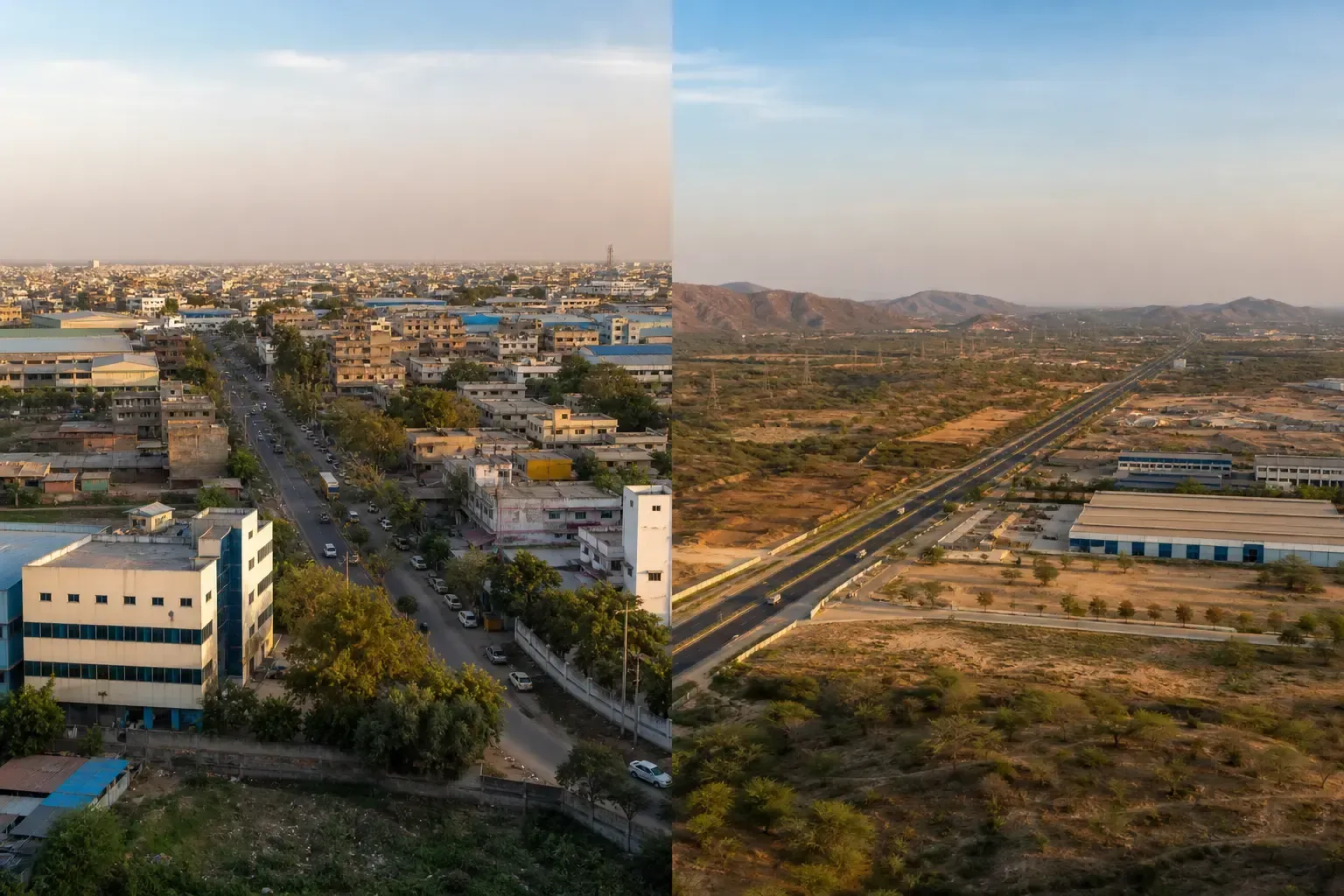
Key Answers in This Guide
- Where Do the Two Towns Actually Sit?: Bhiwadi sits on the Delhi NCR edge at the Rajasthan-Haryana border, while Neemrana lies further down NH-48 towards Jaipur, clearly outside daily NCR commuting range.
- How Do the Industrial Belts Compare?: Bhiwadi's industrial belt is larger, older, and more diversified, while Neemrana's zone is newer, more curated, and anchored by Japanese investment.
- What Does a Missing Vendor Base Cost an Operator in Practice?: A thin vendor base converts every small breakdown into a long-distance errand, and those errands quietly eat an operator's time, delivery schedule, and peace of mind.
- Which Town Has Deeper Residential Stock?: Bhiwadi has a far larger base of built and occupied housing, whereas Neemrana's residential market is thinner and leans heavily on plotted, speculative supply.
- How Does Thin Occupancy Show Up on an Actual Site Visit?: Occupancy leaves physical evidence everywhere, and one unhurried evening walk tells you more about a township's health than any sales presentation.
- What About Connectivity and the Namo Bharat Corridor?: Both towns share NH-48 today, and both sit in the planned Delhi-Gurugram-SNB-Alwar Namo Bharat corridor region, but that project remains a plan, not a running line.
In this guide
Anyone driving from Delhi towards Jaipur on NH-48 passes both towns within an hour of each other. Bhiwadi comes first, sitting right on the Haryana border where the NCR effectively ends. Neemrana appears further down the highway, announced by its famous fort on the hillside. Both are Rajasthan industrial towns in the Alwar belt, both have RIICO industrial areas, and both get pitched to investors as “the next big corridor story”. So buyers keep asking us the same question: Bhiwadi vs Neemrana, which one deserves my money?
We should be upfront before answering. Shivam Properties is a Bhiwadi dealer. We have worked only this market since 2008, we do not list Neemrana inventory, and we earn nothing if you buy there. That could make us biased, so this comparison sticks to structural facts you can verify yourself, and we will tell you plainly where Neemrana genuinely wins.
Where Do the Two Towns Actually Sit?
Bhiwadi sits on the Delhi NCR edge at the Rajasthan-Haryana border, while Neemrana lies further down NH-48 towards Jaipur, clearly outside daily NCR commuting range.
Geography decides more in real estate than any brochure admits. Bhiwadi touches Haryana directly. Gurgaon, Manesar, and the IMT belt are a practical daily commute for workers, factory owners, and service providers. People genuinely live in Bhiwadi and work across the border, and factories in Bhiwadi routinely serve customers in Gurgaon and Manesar the same day.
Neemrana is a different proposition. It sits deeper into Rajasthan along the same highway, past Shahjahanpur and near Behror. Delhi is reachable, but it is a proper highway journey, not a commute. That single fact shapes everything else in this comparison: who lives there, who rents there, and how quickly property resells.
Both towns fall within the broader Delhi Mumbai Industrial Corridor influence zone, so neither is off the national planning map. But influence zones are wide. What matters day to day is who is close enough to show up, and on that count Bhiwadi’s position at the NCR boundary is the stronger card.
How Do the Industrial Belts Compare?
Bhiwadi’s industrial belt is larger, older, and more diversified, while Neemrana’s zone is newer, more curated, and anchored by Japanese investment.
Bhiwadi’s industrial story runs across multiple RIICO areas: Bhiwadi itself, Chopanki, Khushkhera, the Tapukara belt around the Honda zone, and Salarpur. Together they form one of Rajasthan’s most established manufacturing clusters, with thousands of operating units across auto components, steel, packaging, electricals, and general engineering. This depth is exactly why manufacturers keep landing here; we have written separately on why manufacturers choose Bhiwadi over other corridor locations.
Neemrana took a different route. RIICO developed it later and marketed it internationally, and its Japanese investment zone became the headline. Several well-known Japanese manufacturers set up plants there, and the zone has a planned, orderly character that older Bhiwadi areas cannot match. Roads inside the newer Neemrana blocks look better than parts of Chopanki, and there is no point pretending otherwise.
Where Bhiwadi pulls ahead is ecosystem density. An established belt means vendors, job workers, transporters, tool rooms, and skilled labour already on the ground. A unit in Khushkhera or Tapukara can find a fabricator or a die maker within a few kilometres. Neemrana units often still source support services from the Bhiwadi side or from NCR. For a factory owner, that gap shows up in daily operating friction, not on any brochure. Buyers weighing sheds and industrial plots can see current options on our industrial property in Bhiwadi page.
What Does a Missing Vendor Base Cost an Operator in Practice?
A thin vendor base converts every small breakdown into a long-distance errand, and those errands quietly eat an operator’s time, delivery schedule, and peace of mind.
Ecosystem density sounds abstract until a machine stops at eleven in the morning. In an established belt, the sequence is short: phone a nearby mechanic or job worker, part goes out or a person comes in, and production resumes the same day or the next. In a thin belt, the same breakdown starts a chain of calls to workshops an hour or more away, a driver leaving with the part, a wait for the return trip, and often a second trip because the first fix was not quite right. Nothing dramatic happens; the unit simply loses a day here and half a day there, again and again.
Consumables and small fabrication tell the same story. Running a factory means a steady stream of minor needs: a bracket welded, a shaft turned, a bearing matched, packaging material topped up, a pallet repaired, a motor rewound. In Bhiwadi and its surrounding RIICO areas, these needs get met by walking distance markets and clusters of small workshops that exist because thousands of units feed them.
Where the unit count is lower, those support trades never reach critical mass. Operators end up keeping larger inventories of spares, sending staff on procurement runs, or building relationships with vendors sitting an hour up the highway. Each workaround is manageable; together they are a permanent tax on attention.
Labour behaves the same way. An established belt holds a floating pool of machine operators, fitters, electricians, and helpers who move between units as work rises and falls. Recruiting in such a belt means asking around; recruiting where the pool is shallow means arranging transport, offering premiums, or accepting whoever is available. Supervisors are harder still, because experienced supervisors settle where multiple employers exist, not where one departure means uprooting the family.
Transporters complete the picture. Return loads are the economics of trucking, and a belt with heavy daily despatch volume attracts transporters who can offer flexible, part-load, short-notice service because they know a return load exists. A quieter zone gets scheduled service on the operator’s timetable second and the transporter’s first. None of this appears in a plot brochure, and all of it appears in the operating expense sheet within the first year. Anyone comparing industrial land seriously should also read our RIICO industrial plots buyers guide, which walks through allotment, conversion, and due diligence questions that apply across the whole Alwar belt.
To be fair to Neemrana, this gap is a function of age, not of planning quality. The zone there is well laid out, and if unit density keeps rising over the years, support trades will follow, because they always do. The real question for an operator is not whether Neemrana will ever have an ecosystem; it is whether the business can afford to run without one in the meanwhile.
Which Town Has Deeper Residential Stock?
Bhiwadi has a far larger base of built and occupied housing, whereas Neemrana’s residential market is thinner and leans heavily on plotted, speculative supply.
Walk through Bhiwadi and you see a functioning town: completed group housing societies, occupied builder floors, independent houses, schools, hospitals, and markets that exist because tens of thousands of families already live here. Ready flats in Bhiwadi span budget to mid-segment, and plotted colonies range from old established sectors to newer approved townships. A buyer can inspect a finished flat, meet the neighbours, and move in within weeks.
Neemrana’s residential market is younger and visibly thinner. Housing demand there rides almost entirely on the industrial zone’s workforce, and a large share of what gets sold is plots in townships at varying stages of development, bought in expectation of future growth rather than for immediate use. Some of those projects will mature well; others have been “upcoming” for a long time. When most buyers in a market are investors waiting for other investors, end-user depth stays shallow, and shallow end-user depth is the single biggest risk flag we watch for in any market.
None of this means Neemrana housing is a bad idea forever. It means the residential side there is still a bet on future occupation, while Bhiwadi’s is backed by occupation that already happened.
How Does Thin Occupancy Show Up on an Actual Site Visit?
Occupancy leaves physical evidence everywhere, and one unhurried evening walk tells you more about a township’s health than any sales presentation.
Brochures cannot fake lived-in streets, so the most useful due diligence tool you own is your own eyes at the right hour. Visit after sunset on a weekday. In a genuinely occupied society, lights are on across most floors, two-wheelers and cars crowd the parking, pressure at the gate is real, and the guard maintains a proper visitor register because residents demand it. In a thinly occupied township, whole towers sit dark, the approach road is silent by eight, and the security cabin exists mainly to watch over unsold stock.
Daytime signals matter just as much. Look for a working school van route, an autowala who knows the colony by name, a functioning milk booth or kirana inside or beside the gate, pressed clothes hanging in balconies, water tankers only occasionally rather than daily, and a resident welfare association that actually collects maintenance. Ask the guard how many families live there, not how many units are sold; those two numbers diverge sharply in investor-heavy projects, and the guard usually knows the real one.
In a Neemrana township, add a few checks specific to plot-led supply. Count boundary walls and under-construction houses against total plots; a colony where most plots are still open fields after years of sales is telling you who its buyers were. Check whether internal roads, drainage, and streetlights are complete or perpetually in progress. See whether the promised amenities exist as buildings or as signboards. Speak to any family already living there and ask what they do for a doctor, a school, and daily vegetables; the length of their answers measures the ecosystem gap directly.
In a Bhiwadi society, the checks shift because supply is older and more built. Ask about maintenance dues and whether the lift and backup actually run. Inspect water supply arrangements, since parts of Bhiwadi depend on borewells and tankers and buildings manage this with varying competence. Check the age of the structure carefully and confirm the occupancy pattern floor by floor. Our locality-by-locality breakdown of where end users cluster is in best areas to buy property in Bhiwadi, and before comparing any two options you can work out the full landed cost of a purchase, including stamp duty and registration, with our Bhiwadi property cost calculator.
The principle underneath all of this: buy where the evidence of life is already visible, or price the absence of that evidence into your expectations and your holding horizon.

What About Connectivity and the Namo Bharat Corridor?
Both towns share NH-48 today, and both sit in the planned Delhi-Gurugram-SNB-Alwar Namo Bharat corridor region, but that project remains a plan, not a running line.
NH-48 serves both towns equally well as a highway. Beyond that, the connectivity conversation usually turns to the proposed Delhi-Gurugram-SNB-Alwar Namo Bharat corridor, where SNB stands for Shahjahanpur-Neemrana-Behror. If that corridor is built as planned, it would benefit the whole belt, and Neemrana’s name sits right inside the acronym.
Our position, as people who have watched infrastructure promises in this region for eighteen years: buy for what exists, treat announcements as upside. This corridor is planned, not sanctioned into steel and concrete on the ground, and timelines for such projects shift. If it comes, both markets gain. Until it does, Bhiwadi’s practical connectivity edge stands on something already real: the short road distance to Gurgaon, Manesar, and the rest of NCR’s job and customer base. Nobody in Bhiwadi is waiting for a train to justify their address.
Why Do Buyers Overpay Whenever a Corridor Makes News?
Corridor announcements compress years of hoped-for growth into a few weeks of buyer excitement, and the people who pay for that excitement are the ones who arrive last.
We have watched this cycle play out on NH-48 more than once, and it follows the same script every time. A project gets announced or re-announced in the papers. Dealers in the affected belt refresh their pitches overnight. Sellers who were flexible last month suddenly quote firm. Buyers who had been deliberating for a year decide in a weekend, terrified of missing out. Then the news cycle moves on, the project enters its long quiet phase of surveys and approvals, and the market goes back to being exactly what it was: a place whose property is worth what its current occupation supports.
The psychology is easy to understand and hard to resist. An announcement feels like inside information even when it is on the front page. It gives a buyer a story to tell themselves and their family, and stories are more persuasive than site visits. It also gives every seller in the belt a reason to anchor high, so the buyer who walks in during announcement season negotiates against inflated expectations on every side.
Our discipline rules for clients are simple. First, never let an announcement shorten your due diligence; the train, if it comes, will still be coming next month after you have checked the title. Second, value the property as if the project never happens, and treat the corridor as a free option on top; if the deal only makes sense with the train, it does not make sense.
Third, be suspicious of any pitch where the infrastructure story does more work than the property itself; a good plot in a good location survives the removal of the story. Fourth, remember that announced alignments and station locations shift, and a purchase made for a specific proposed station is a bet on a map that has not been finalised.
None of this is an argument against the Namo Bharat corridor, which we would welcome for the whole belt. It is an argument against paying today for a benefit that has not been built, in a market where the seller has already priced that benefit in twice.
Liquidity and Resale: Which Market Exits Faster?
Bhiwadi resells faster because its buyer pool is wider and includes genuine end users, while Neemrana exits depend more on finding the next investor.
Liquidity is the least glamorous and most important factor in this whole comparison. In Bhiwadi, a fairly priced flat or plot attracts several kinds of buyers: factory owners settling near their units, NCR workers wanting an affordable own home, local business families upgrading, and investors. Multiple buyer types mean a deal usually closes in a reasonable window.
Neemrana’s resale market is narrower. End users are fewer, so a seller is often waiting for another investor to arrive, and investor demand moves with sentiment and news cycles. In strong phases plots there move quickly; in quiet phases holding periods stretch. We have met more than a few Neemrana plot holders over the years who found buying easy and exiting slow.
Industrial property behaves a little differently. Well-located RIICO units in either town find takers, because operating businesses buy on need rather than sentiment. Even there, Bhiwadi’s larger unit count and NCR-adjacent position keep its transaction flow steadier.
What Does the Fort Economy Do, and Not Do, for Neemrana Property?
The fort gives Neemrana recognition, weekend footfall, and hospitality employment, but a tourism anchor does not by itself create the daily-life demand that residential property needs.
Neemrana Fort Palace deserves its fame. It put the town’s name in front of lakhs of Delhi and Gurgaon families who would otherwise never have heard of it, and that recognition genuinely helps the market; a place people have visited feels safer to invest in than a place they cannot picture. Around the fort, a small hospitality economy has grown: hotels, banquet venues, highway restaurants, and event businesses that serve the wedding and weekend crowd. This economy employs people, keeps the highway exits busy, and gives the town a second identity beyond its industrial zone.
What the fort economy does not do is generate resident households at scale. A weekend visitor sleeps one night and leaves; they do not enrol children in a school, rent a two-bedroom flat, or buy vegetables every evening. Hospitality staff are relatively few in number compared to factory workforces, and many commute from surrounding villages rather than renting in townships.
So tourism footfall, however healthy, translates into demand for hotel rooms and banquet lawns, not for housing stock. A buyer who hears “tourist destination” and mentally converts that into “housing demand” is making a category error that the market will eventually correct at their expense.
There is a narrower play where the fort economy does touch property: commercial frontage near the fort road and highway junctions, and land suited to hospitality or banqueting use. Those are specialised purchases with their own risks around licences, access, and seasonality, and they belong with buyers who understand the hospitality trade. For a regular residential or plot buyer, the summary is this: the fort makes Neemrana easier to talk about, and does very little to make it easier to live in.
Pick Bhiwadi if you want occupation-backed demand and easier exits; consider Neemrana if you have patient capital and want early exposure to a newer zone.
You are an end user buying a home near NCR jobs, or a manufacturer who needs vendors and labour around the plant from day one
Lean Bhiwadi. The demand is backed by actual occupation, not a forecast.
You value being able to sell without a long wait
Lean Bhiwadi. Deeper, occupied demand makes exits faster.
You have genuinely long patience and want early exposure to a planned industrial zone with marquee occupiers
Consider Neemrana, but size it as the higher-variance bet it is, not as a like-for-like alternative.
Either way, never buy on a corridor story alone. Check approvals, possession status and the actual construction around the site before you pay a token.
Bhiwadi vs Neemrana at a Glance
This table compresses the comparison into the factors that actually move a buying decision.
| Factor | Bhiwadi | Neemrana |
|---|---|---|
| Position | NCR edge, Haryana border, Alwar district | Further down NH-48 towards Jaipur |
| Industrial belt | Large, established, diversified (Chopanki, Khushkhera, Tapukara, Salarpur) | Newer planned RIICO zone, Japanese investment anchor |
| Residential stock | Deep built and occupied housing | Thin, largely plot-led and speculative |
| Daily NCR access | Practical commute and same-day logistics | Highway journey, not a commute |
| Demand drivers | Manufacturing, NCR spillover, end users | Industry plus tourism (Neemrana Fort Palace) |
| Namo Bharat corridor | In planned corridor region | In planned corridor region (SNB) |
| Resale liquidity | Wider buyer pool, steadier exits | Narrower, investor-dependent exits |
Who Should Pick Which Town?
Pick Bhiwadi if you want occupation-backed demand and easier exits; consider Neemrana if you have patient capital and want early exposure to a newer zone.
Bhiwadi suits the end user buying a home near NCR jobs, the manufacturer who needs vendors and labour around the plant from day one, and the investor who values the ability to sell without a long wait. Our detailed case, including the negatives, is in why invest in Bhiwadi, and current residential and plotted inventory sits under property in Bhiwadi and plots in Bhiwadi.
Neemrana suits a different buyer: someone with genuinely long patience, comfortable holding through quiet stretches, attracted by a planned industrial zone with marquee international occupiers and a tourism anchor in the Neemrana Fort Palace. If the Namo Bharat corridor materialises on its planned alignment, early Neemrana positions could reward that patience. That is a legitimate strategy; it is simply a higher-variance one, and it should be sized like one.
What we would caution against is buying Neemrana plots on a dealer’s corridor story alone, without checking approvals, possession status, and actual construction around the site. Those checks apply in Bhiwadi too, and our step-by-step guide on how to buy property in Bhiwadi covers the document and verification process that protects you in any Rajasthan market.
If You Do Choose Neemrana, How Do You Do It Well?
Patient capital succeeds in a young market only when the paperwork is airtight, possession is real, and the buyer has fixed their holding horizon before signing anything.
We would rather see a client buy Neemrana carefully than buy anywhere carelessly, so here is the playbook we would follow ourselves if we were putting patient money into that market.
Start with approvals, and accept nothing verbal. Confirm the township’s layout approval from the competent authority, confirm land-use conversion for the parcel, and confirm RERA registration where the project falls under it. Ask for these as documents you can hold and have checked by a lawyer, not as assurances across a table. In young markets, the gap between “approval applied for” and “approval granted” is where buyers get hurt, because sales teams routinely present the first as the second.
Next, insist on possession you can stand on. A registered sale deed for a demarcated plot, with physical possession you can fence today, is a fundamentally different asset from an allotment letter, a booking in a future phase, or an agreement on a plot that exists only in the layout drawing. If the seller cannot walk you to your exact corners, you are buying paper, and paper in a slow market is the hardest thing of all to resell.
Then read the construction activity around the site, because it is the most reliable indicator available. Are labourers actually present on weekday mornings? Are materials stocked and moving, or has the same sand heap sat there through two monsoons? Are earlier phases handed over and occupied, or handed over and dark? Visit twice, weeks apart, and compare what changed. A developer’s real pace is visible on the ground long before it becomes visible in their correspondence.
Finally, fix your horizon and your sizing before you sign. Decide in advance that this money can sit for many years without being needed, because a forced sale in a thin market is where the real damage happens. Keep the position small enough that a long wait does not disturb the rest of your finances, and write down for yourself what evidence of progress you expect to see by when. Patient capital is a strategy; capital that merely became stuck is not.
Three Buyers, Three Decisions: How the Choice Actually Plays Out
Work the comparison through a real buyer’s constraints and the answer usually stops being close.
Consider first a unit operator, someone running a components business who needs a shed and land for expansion. Their daily reality is vendors, job work, labour, and despatch. For them the ecosystem argument settled earlier in this article is close to decisive: the belt with the die makers, the transporters, and the labour pool wins on operating cost every single month, and Bhiwadi’s Khushkhera, Chopanki, and Tapukara areas offer exactly that. Neemrana enters their shortlist only if a specific anchor customer sits inside that zone, or if their process genuinely needs the newer infrastructure there and they have priced in the support-service gap with open eyes.
Consider next a first-home family, a couple working in Gurgaon or Manesar who want to stop paying rent. Their constraints are commute, schools, and the certainty of moving in. Speculative plot townships have nothing to offer this family; they need a finished flat or floor in a functioning society, which means the decision is not really Bhiwadi versus Neemrana at all, since only one of the two can hand over keys into a lived-in neighbourhood at their budget. Their real comparison is between localities within Bhiwadi, and sometimes between Bhiwadi and Dharuhera on the Haryana side, a choice we have compared separately in Bhiwadi vs Dharuhera.
Consider finally a long-horizon investor with surplus funds and genuine patience. This is the only profile for whom Neemrana is a serious contender, and even here the fair framing is portfolio-shaped rather than either-or. Such an investor might hold their core position in occupation-backed Bhiwadi assets that they can exit when needed, and take a smaller, deliberately sized position in Neemrana as the higher-variance leg, bought strictly through the playbook above. What they should not do is invert that ratio because a corridor headline made the speculative leg feel safe. Variance does not disappear because a train was mentioned in the newspaper.
What Eighteen Years on This Corridor Teach You
Markets on this highway reward occupation and punish stories, and that pattern has repeated often enough since 2008 for us to treat it as a rule.
Working one corridor for eighteen years means the same lessons keep arriving in different costumes. Belts get talked up on expressway news, special zone announcements, and master-plan leaks, and the record shows which purchases from each wave aged well. The pattern is unglamorous and consistent: property backed by people actually living and working nearby held its ground through every quiet phase, and property backed mainly by a story needed the story to keep being retold.
We have also learned that quiet phases are where markets show their true character. Every market on this highway has had slow years; Bhiwadi certainly has, and we say so plainly in our other guides. The difference is what a slow year looks like on the ground. In an occupied market, rents keep getting paid, shops stay open, and a fairly priced property still finds its buyer, just more slowly. In a speculative market, a slow year means silence: no transactions, no construction, sellers and buyers both waiting for the other to blink. Buyers who have only seen a market in its noisy phase have not really seen it.
A third lesson is about sellers’ behaviour. When we meet someone who bought a plot in a young township years ago and now wants out, the conversation is rarely about the plot; it is about the years of maintenance letters, the phases that did not launch, and the difficulty of even finding a broker who works that pocket. Illiquidity is not a number on a page; it is the experience of making calls that do not get returned. Sparing our clients that experience is worth more than any commission, which is why this article keeps returning to occupation and exits rather than to excitement.
None of this makes us prophets, and we would distrust any dealer who claims to be one. It makes us record keepers. The record says: on this corridor, buy what is real, treat what is promised as a bonus, and size your patience realistically.
Talk to Someone Who Works This Corridor Daily
An honest local dealer will compare markets with you before selling you anything, and that conversation costs nothing.
If you are weighing these two towns, come sit with us. We will show you what Bhiwadi offers against your budget and purpose, and if your profile genuinely points to Neemrana-style patient plotting, we will say so and you can decide with clear eyes. Call or WhatsApp Shivam Properties, tell us whether you are buying to live, to run a unit, or to invest, and we will map the options this week.
Frequently Asked Questions
Is Bhiwadi or Neemrana a better investment?
They serve different buyers, and this comparison is qualitative; we do not invent prices for either. Bhiwadi has deeper existing supply and employment, Neemrana is further down NH-48. Future appreciation cannot be guaranteed for either.
Do you deal in Neemrana?
No. We transact in the Bhiwadi, Tapukara and Dharuhera belt; Neemrana is comparison-only for us.
How far is Neemrana from Bhiwadi?
About 53 km by road from our office down NH-48, a little over an hour’s drive, so it is a separate market rather than a neighbouring pocket.
Which is closer to Gurgaon and the airport?
Bhiwadi is closer to Gurgaon and IGI Airport; Neemrana sits further along the Jaipur side.
Discuss the Numbers With a Local Dealer
18+ years in this market. Real prices, verified paperwork, no pressure.
Choose what you would like to do next:
Done — our team will contact you during working hours.