Key Answers in This Guide
- The two asset classes in plain terms: Residential property in Bhiwadi means flats and plots bought by families and small investors, while industrial property means RIICO leasehold plots bought almost entirely by operating businesses.
- Ticket size and the entry barrier: Residential lets you enter this market in the mid teens of lakhs, while industrial demands crores for a meaningful plot, and that gap filters who each asset is really for.
- Liquidity: how fast can you exit?: Residential sells faster because the buyer pool is wide and sentiment-driven, while industrial moves in fewer, larger, need-driven transactions.
- Who eventually buys from you: Your residential buyer is an end-user family; your industrial buyer is an operating business, and each pays for completely different things.
- Income character while you hold: Residential can produce rent from the first month, while industrial income comes from a business operating on the land or leasing it, which is a different game entirely.
- Verification: what each file actually contains: A residential purchase file is a title story; an industrial purchase file is a compliance story, and the second is longer, stricter, and far less forgiving of shortcuts.
In this guide
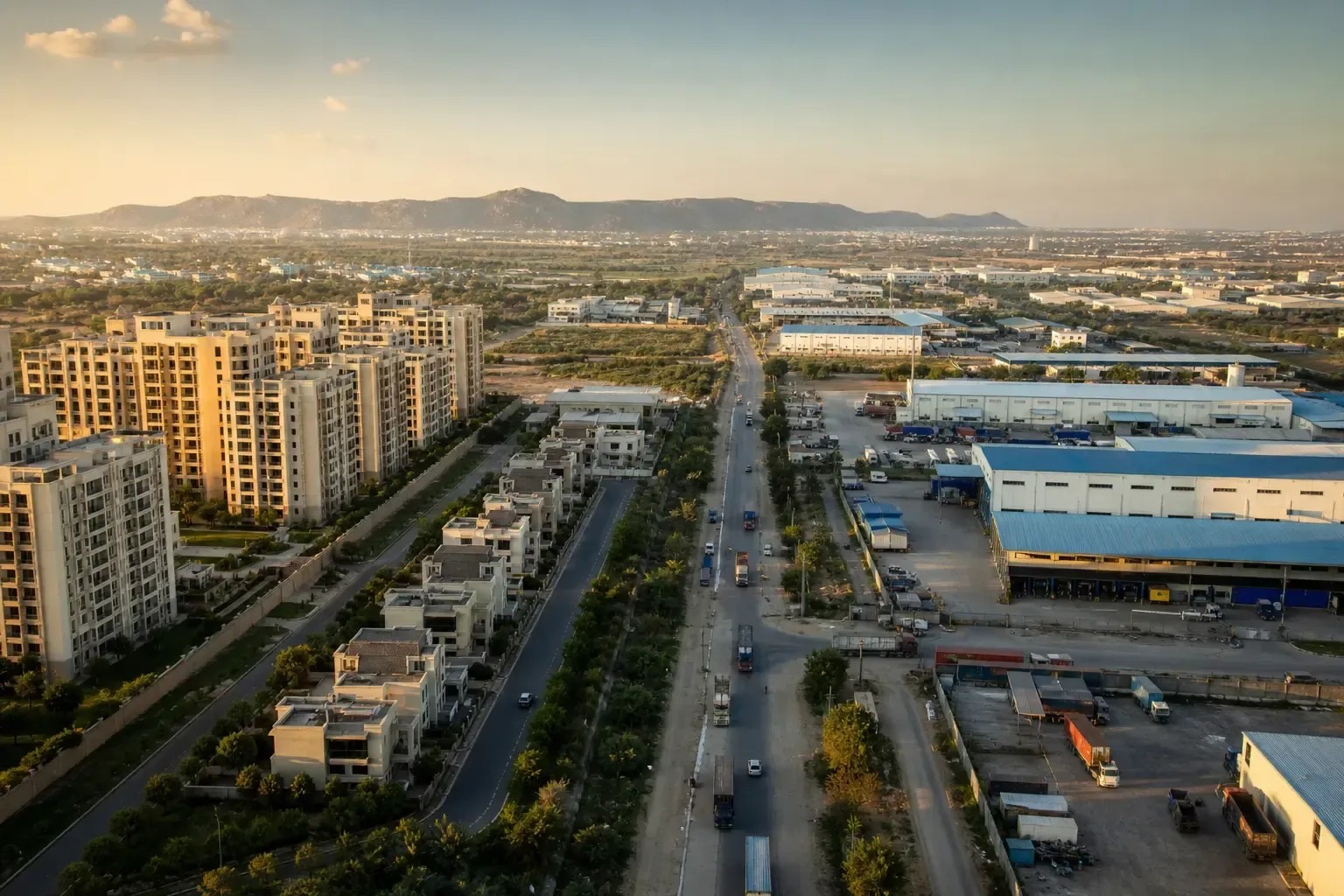
Bhiwadi is one of the few markets in India where an investor with real capital can seriously weigh a flat against a factory plot in the same conversation. The town runs on manufacturing, residential demand follows the factories, and both asset classes trade actively within a few kilometres of each other. Yet almost nobody publishes a straight comparison of the two, because most dealers work only one side of the market and talk up whatever they sell.
We have handled sale and purchase transactions in both since 2008, with industrial as our specialty, so this comparison comes from files we have actually closed, and we have no reason to push you toward either side.
The two asset classes in plain terms
Residential property in Bhiwadi means flats and plots bought by families and small investors, while industrial property means RIICO leasehold plots bought almost entirely by operating businesses. That single sentence already contains most of the decision, and the rest of this guide unpacks it.
On the residential side, ready flats start from roughly ₹16 to ₹23 lakh at entry level. Those figures are indicative rather than quotations, so contact us for current rates before you build a budget around them. The buyer pool is wide: salaried families, factory managers posted to the belt, NRIs parking money, and first-time investors.
Supply is equally wide, from budget societies to larger gated projects, and the gap between a well-run society and a poorly run one is enormous, which is why we walk every project we list on our flats in Bhiwadi page before recommending it. You can see the full spread of everything we handle, residential and industrial together, on our property in Bhiwadi hub.
On the industrial side, plots across the belt trade around ₹25,000 to ₹40,000 per square metre depending on the specific RIICO area, and because industrial plots are large, realistic entry tickets for sizeable plots run into crores. The active zones each have their own character: Chopanki is the MSME heartland with mid-size plots and a lively resale market, Khushkhera holds the large plots, the Tapukara and Honda zone draws units connected to the automotive ecosystem, and Salarpur rounds out the belt. Our industrial property in Bhiwadi page covers the full market zone by zone.
Notice what is missing from the industrial description: individual investors. They exist, but they are a small minority, and the next sections explain why.
Ticket size and the entry barrier
Residential lets you enter this market in the mid teens of lakhs, while industrial demands crores for a meaningful plot, and that gap filters who each asset is really for. A ₹20 lakh flat is accessible to a huge population of buyers. Run the arithmetic on industrial and the picture changes fast: at ₹25,000 to ₹40,000 per square metre, even a 2,000 square metre plot works out to somewhere between ₹5 crore and ₹8 crore before stamp duty, transfer charges, and transaction costs. That is not an entry ticket. That is a commitment.
The money barrier is only half of it. The knowledge barrier matters just as much, and it is the one that actually protects people. To buy a flat competently you need a society visit, a title check, a look at the builder’s record, and a sense of which projects are well run. Any careful buyer can learn this in a few weekends of site visits.
To buy an industrial plot competently you need to understand the allotment chain from RIICO to the current holder, confirm that dues are clear, verify the use conditions attached to the plot, and know what transfer permission involves and how long it takes. None of that is visible from the road. A plot with a good frontage and a neat boundary wall can carry a compliance gap that takes months to surface, and buyers who do not know what to ask never find out until it is their problem.
That knowledge barrier keeps casual money out of industrial, which is partly why the segment behaves so differently. It is also why the few individual investors who do well in industrial tend to be people who either ran businesses themselves or bought their first plot alongside someone who did.
There is a third barrier worth naming: financing. Home loans for ready flats are a routine, competitive product in this belt. Funding an industrial land purchase as a pure investor is a different conversation entirely, and most such deals we see are substantially self-funded. If your plan depends on borrowing power, that alone points you toward residential.
Liquidity: how fast can you exit?
Residential sells faster because the buyer pool is wide and sentiment-driven, while industrial moves in fewer, larger, need-driven transactions. When you list a decent flat in a known society, dozens of families and small investors are potential buyers, and someone usually falls in love with the location, the floor, or the view. Sentiment is a real force in residential pricing. Buyers stretch their budget for a corner unit, a park-facing balcony, or simply a society where a relative already lives. As a seller, sentiment works in your favour.
When you list an industrial plot, sentiment leaves the room. Your buyer is a business that needs that size, in that zone, with that road access, for a specific operation, and they will not pay a rupee for charm. Such buyers exist, and in active resale pockets like Chopanki’s MSME plots they appear regularly, but they buy on need and they negotiate on numbers. A plot that is slightly the wrong size for the enquiries currently in the market can wait, and wait, while smaller and larger plots around it change hands.
We have watched this asymmetry play out for eighteen years, and one pattern repeats. Residential sellers who price sensibly usually close within a reasonable window, because the next buyer is always somewhere in the pipeline. Industrial sellers, even with clean papers and fair pricing, sometimes wait for the one operator whose requirement matches their plot.
When that operator arrives, the deal moves quickly and at full weight, because need-driven buyers do not haggle endlessly once the plot fits. But nobody can tell you in advance whether that buyer arrives in two months or eighteen.
This matters most when you are forced to sell. Medical need, a business emergency, a family settlement: forced sales happen to everyone eventually. A residential asset can usually absorb one with a modest price concession. An industrial plot sold under time pressure can cost you real money, because a thin buyer pool recognises a motivated seller. If your capital may need a quick exit, that difference should weigh more heavily than any appreciation story.
Who eventually buys from you
Your residential buyer is an end-user family; your industrial buyer is an operating business, and each pays for completely different things. A family pays for the society’s condition, the school run, the neighbours, and the feel of the place. A manufacturer pays for power availability, plot dimensions, road width for trucks, proximity to their supply chain, and a clean compliance file. We have written separately about why manufacturers choose Bhiwadi, and every reason in that piece is a reason your eventual industrial buyer will or will not pay your price.
Understanding your exit buyer changes how you should buy today, and this is where investors make their most fixable mistakes.
In residential, buy what a family will want in ten years, not what looks cheap today. That means preferring established societies with functioning maintenance, because a family on a site visit notices peeling paint and a dead lift long before they notice your interior work. Location matters as much as the project; our guide to the best areas to buy property in Bhiwadi maps which pockets hold family demand.
In industrial, buy what a factory will need. Regular plot shapes, because machinery layouts hate odd angles. Adequate road access, because a plot a truck cannot comfortably reach is worth less than its neighbour regardless of the rate per square metre. Established RIICO areas rather than fringe land, because your buyer’s bankers, consultants, and compliance officers all prefer addresses they recognise.
And above everything, sorted paperwork, because an operating business evaluating your plot will put your file in front of a lawyer before they put a rupee on the table, and any gap they find becomes either a price cut or a walked deal.
One more pattern from our files: industrial buyers frequently arrive through referral rather than portals, a unit owner mentioning to a supplier that the plot next door is available. This is why a dealer embedded in the industrial belt matters more on this side. Residential buyers find you. Industrial buyers have to be found.
Income character while you hold
Residential can produce rent from the first month, while industrial income comes from a business operating on the land or leasing it, which is a different game entirely. In well-run Bhiwadi societies we have observed residential rental yields of roughly 3 to 4 percent and sometimes better, supported by the steady stream of factory staff and managers who need housing near the RIICO areas. Tenant demand here is unusually stable for a town this size, precisely because it is tied to industrial employment rather than to a single office corridor or a college.
Rental figures are provided only for general investment research. We assist with property sales and purchase enquiries, not rental transactions.
Industrial land held by a non-operator typically produces no income at all until sale. Over a five-year hold, the residential investor collects something every month and watches the asset pay part of its own way. The industrial investor pays their dues, keeps the file in order, and waits. If the eventual sale rewards that wait, the mathematics can work out. If life interrupts the wait, all the return was hypothetical.
The buyers who do well holding industrial either run their own unit on the plot or have the scale and network to structure long arrangements with operators. Both paths demand involvement; there is no industrial equivalent of handing keys to a tenant and collecting rent by bank transfer. A flat that pays you something every month and a plot that pays you nothing for years suit very different temperaments, and temperament, more than capital, predicts which investors regret their choice.
You want a home to use, or modest rental income, on a lower entry budget
Lean residential. A deeper, more familiar buyer and tenant pool, and a far lower entry price.
You are buying for business use and can handle a specialised market with its own approvals and a narrower buyer pool
Lean industrial RIICO property, at larger ticket sizes.
Neither is universally better; match it to your use, budget and risk appetite.
The comparison at a glance
| Factor | Residential | Industrial |
|---|---|---|
| Entry ticket | From roughly ₹16 to ₹23 lakh for ready flats (indicative) | Around ₹25,000 to ₹40,000 per sq m; large plots run into crores |
| Tenure | Mostly freehold | RIICO leasehold with transfer permission and use conditions |
| Buyer pool | Wide: families, investors, NRIs | Narrow: operating businesses |
| Liquidity | Faster, more transactions | Slower, fewer and larger deals |
| Income while holding | Rent possible from well-run societies | Usually none unless you operate or structure a lease |
| Financing | Routine home-loan product | Largely self-funded in practice |
| Verification burden | Title, society, and project checks | Allotment chain, dues, NOCs, use conditions |
| Sentiment in pricing | High; families buy on feel | Low; businesses buy on need |
| Management burden | Light: society matters, tenant handling | Ongoing compliance discipline |
| Who it suits | First-time and mid-scale investors | Operators and experienced large-capital investors |
Verification: what each file actually contains
A residential purchase file is a title story; an industrial purchase file is a compliance story, and the second is longer, stricter, and far less forgiving of shortcuts. Since verification is where industrial deals live or die, it deserves more than a paragraph.
For residential, the checks are familiar to anyone who has bought property in India. Chain of title to the present seller. Registered sale deed. Society dues cleared. Encumbrance status. Project approvals if the building is newer. Occupancy and possession status. It is real work, but the documents are standard and a competent local check closes the file in a bounded amount of time.
For industrial, start with the fact that RIICO plots are leasehold, not freehold. You are not buying land outright; you are buying the leasehold rights to industrial land, and those rights come with conditions attached. That changes everything downstream:
- The allotment chain. The plot began life as a RIICO allotment to an original allottee. Every transfer since then should have happened with proper permission. Your job, or your dealer’s, is to trace that chain link by link and confirm no transfer in the history was informal, disputed, or incomplete. A break in the chain years before your seller acquired the plot can still surface as your problem.
- Dues. Leasehold land carries ongoing obligations, and arrears travel with the plot, not with the person who ran them up. Confirming that all dues are clear before money moves is non-negotiable.
- Use conditions. Industrial plots are allotted for industrial use, and the conditions attached to a specific plot shape what can lawfully happen on it. A buyer whose intended operation does not fit the plot’s conditions has bought a problem, however good the price looked.
- Transfer permission. Transferring a RIICO plot is a process with requirements, not a same-week formality. Both sides of the deal need to understand what that process asks of them and build it into their timelines. Deals structured by people who assume industrial transfers work like flat registrations run into avoidable friction.
- NOCs and the paper trail. Depending on the plot’s history and the deal’s structure, no-objection certificates and supporting documents enter the file. A seller who cannot produce them promptly is telling you something about the state of their records.
None of this is a defect in the system. It is how organised industrial land works, and it is exactly what keeps RIICO areas orderly and keeps industrial addresses bankable for the businesses that buy them.
But it means the verification file for an industrial deal is several times thicker than for any flat, and mistakes in that file are expensive in the way residential mistakes rarely are. Before committing serious money to either asset, an independent read on pricing helps too; our note on property valuation in Bhiwadi explains how we approach fair value on both sides of the market.
Risk profile: what actually goes wrong
Residential risk is mostly about overpaying or picking a badly run project, while industrial risk is about paperwork gaps, liquidity droughts, and concentration. A mediocre flat purchase in Bhiwadi usually costs you returns, not capital: a society that management let slide, or a peak price paid in a quiet pocket, ending in a disappointing sale. Painful, recoverable.
A flawed industrial purchase is a different order of trouble. A gap in the allotment chain or dues discovered after purchase can tie your capital up while it gets resolved, and resolution in such matters is measured in patience, not weeks. Even a clean industrial holding carries the liquidity risk described earlier: nothing wrong with the asset, simply no matching buyer this season.
Concentration is the quieter industrial risk, and the one investors most often underweight. The capital that buys one large plot in Khushkhera could buy several residential units spread across different projects and localities. With several units, one bad society, one difficult resale, or one vacant period dents your portfolio. With one plot, any single problem is the whole portfolio’s problem. Diversification is boring advice, and it is also the advice that has aged best across both kinds of buyer we see in this belt.
Set against all of that, industrial has one risk-side strength residential cannot match: its demand is anchored in production, not in sentiment cycles. Residential sentiment in any NCR-adjacent market runs hot and cold. Industrial demand in Bhiwadi runs on order books.
Three buyers, three answers
Worked through carefully, the same market gives opposite answers to different buyers, and seeing the decision through three real profiles makes the abstractions concrete. These are composites of enquiries we handle every month, using only the figures already discussed.
The first-time investor with about ₹30 lakh. Industrial is simply not on their menu, and pretending otherwise would mislead. At belt rates of ₹25,000 to ₹40,000 per square metre, ₹30 lakh does not reach a viable industrial plot, and stretching toward the segment through borrowing or partnerships multiplies risk for someone still learning the market.
Their real decision sits inside residential: a ready flat from the ₹16 to ₹23 lakh entry band with money left for registration, interiors, and a buffer, or a residential plot for pure appreciation. That is a genuine dilemma with real trade-offs, and we have compared flats versus plots in Bhiwadi at length for exactly this buyer. Either way they get freehold tenure, a wide exit market, and mistakes that cost returns rather than capital. That is where a first portfolio belongs.
The operator who needs around 2,000 square metres. This buyer is not really choosing between asset classes at all; they are choosing between zones, plots, and files. At ₹25,000 to ₹40,000 per square metre, their land budget is roughly ₹5 to ₹8 crore depending on where in the belt they land, and the per-metre rate matters less than fit: Chopanki if a mid-size MSME plot with active resale supply matches their scale, Khushkhera if they need room to grow into a larger footprint, the Tapukara side if their operation connects to the automotive ecosystem.
For them, the verification burden described above is not a deterrent, it is the work, and their advantage over any pure investor is that the land starts earning its keep the day their unit starts running. Operators are the natural owners of industrial property, and everything about how this market is structured confirms it.
The large-capital investor weighing both. Someone deploying several crores can genuinely go either way, and this is the one profile for whom the real answer is “it depends on involvement.” Spread across residential, their capital buys a basket of units in strong societies: monthly income potential, easy staggered exits, diversification across projects, and light management. Concentrated into industrial, the same capital buys one or two serious plots with exposure to the manufacturing engine and a need-driven exit market, in exchange for no holding income, a thicker compliance file, and patience at exit.
If they have business experience, time for the paperwork, and no need to touch the money for years, industrial exposure is defensible and can be excellent. If they want their capital working quietly in the background of a busy life, residential at scale fits better. Most people in this bracket, pressed for candour, describe the second life.
Our honest take: most investors should not buy industrial
If you are a first-time or mid-scale investor, you almost certainly belong in residential, and we say that as a firm whose specialty is industrial. Industrial property in Bhiwadi rewards two kinds of buyers: operators who will run a unit on the land, and experienced investors with large capital, long horizons, and the patience to wait for the right business buyer at exit. If you do not recognise yourself in either description, the sensible advice is to start with residential, where the entry ticket is smaller, the exit is easier, and the mistakes are cheaper.
We could earn better fees steering everyone toward crore-plus industrial deals. We do not, because a buyer pushed into the wrong asset class becomes a distressed seller in a few years, and in one town reputation outlasts any commission. The investors we steered into residential early often return years later, with more capital and experience, ready to buy industrial properly. That sequence is the pattern behind most of the successful mixed portfolios we see today.
None of this makes industrial a bad asset. For the right buyer it is the strongest thing this market offers, anchored by real manufacturing demand rather than speculation. It simply suits fewer people than the size of its numbers suggests.
The mixed-portfolio thought for larger capital
Investors with capital in the several-crore range do not have to choose; a residential base plus a well-verified industrial holding uses this market’s full character. The residential portion gives monthly-income potential, easy liquidity, and diversification across units. The industrial portion gives exposure to the engine that drives everything else here: the factories. When one segment cools, the other rarely cools for the same reason, because families and manufacturers buy on different logic, on different timelines, for different needs.
Sequencing matters more than the split. Build the residential base first, because it is liquid enough to fund the industrial move when the right plot surfaces, and right plots surface on the market’s schedule, not yours. Then buy industrial slowly, once, and well: an established zone, a regular plot, a clean file, and a price checked against real comparable transactions rather than asking rates.
If you are weighing this decision with real money on the table, talk to us before you shortlist anything. We work both sides of this market daily, we will tell you plainly which side your capital and temperament belong on, and we will show you specific options rather than categories. Call or WhatsApp us, and bring your numbers.
Frequently Asked Questions
Should I buy residential or industrial property in Bhiwadi?
It depends on your purpose and budget. Residential suits end-use and modest rental income; industrial RIICO property suits business use and larger tickets. The comparison above sets out the differences.
What is the entry price for industrial land in Bhiwadi?
The RIICO belt runs roughly ₹25,000 to ₹40,000 a square metre depending on the area, and because plots are large the realistic ticket for a usable plot runs into crores. Residential entry is far lower. Contact us for current rates before you budget.
Do the same checks apply to both?
The title and approval discipline applies to both, but industrial adds land-use, pollution consent and NOC checks specific to the intended activity.
Discuss the Numbers With a Local Dealer
18+ years in this market. Real prices, verified paperwork, no pressure.
Choose what you would like to do next:
Done — our team will contact you during working hours.