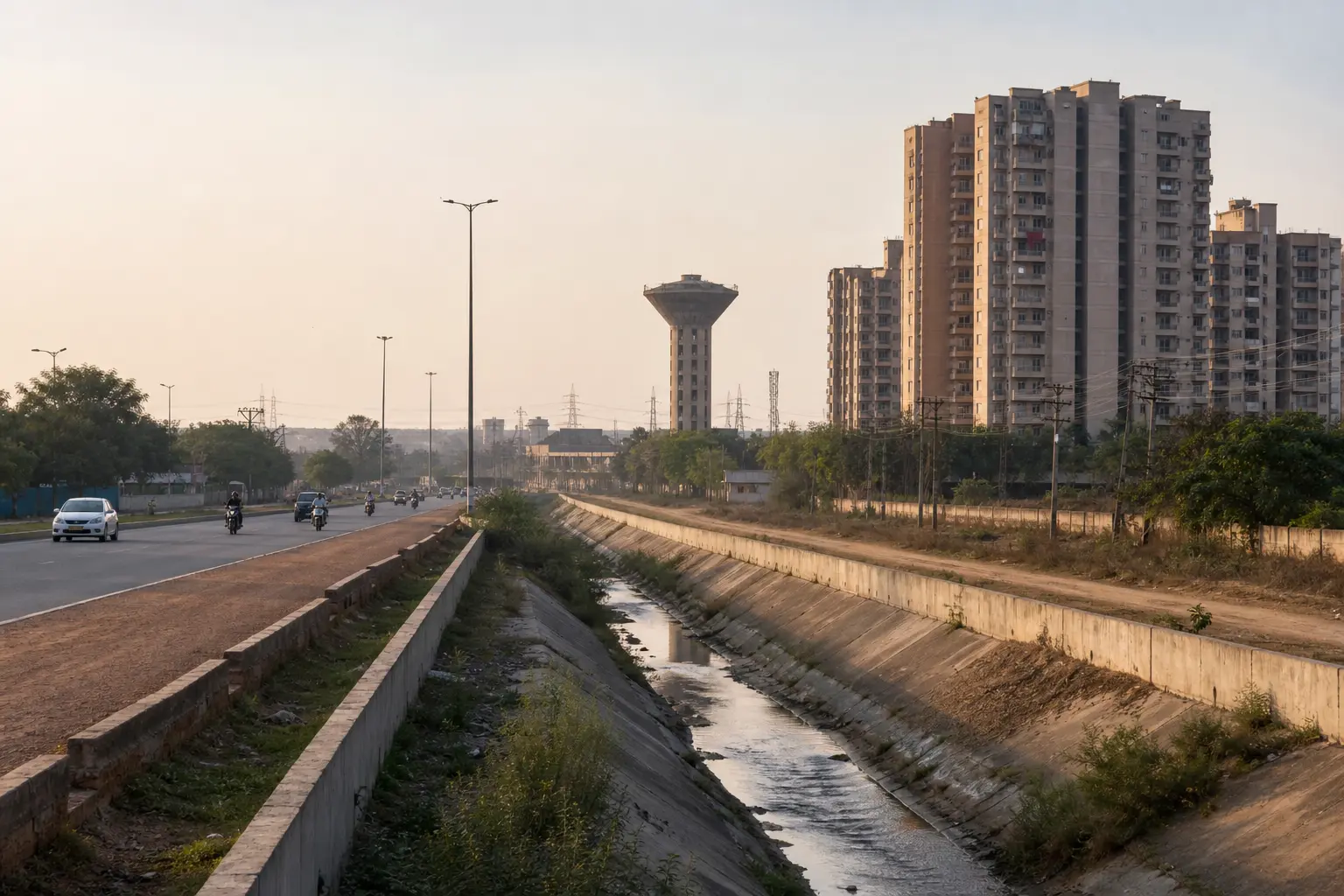
Key Answers in This Guide
- What genuinely works in Bhiwadi: Bhiwadi's core strengths are real: NH-48 access, a large established industrial employment base, and a deep stock of functioning residential societies.
- Infrastructure status board: what is operational, announced or only proposed: Every infrastructure claim you hear in a Bhiwadi sales pitch belongs in one of four buckets, and the bucket matters more than the project name: operational, under construction, approved, or merely proposed.
- The monsoon waterlogging and the border drainage issue: Bhiwadi's most documented infrastructure problem is monsoon waterlogging, worst on the Bhiwadi-Dharuhera stretch, tied to a long-running drainage dispute between Rajasthan and Haryana.
- Road quality varies street by street: Main corridors in Bhiwadi are generally in usable shape; internal roads in older colonies and some approach roads are not, and the variation is sharp.
- Dust and air quality in an industrial belt: Bhiwadi has a genuine air quality problem, and it has been documented at the highest level: IQAir's World Air Quality Report for 2021 ranked Bhiwadi the most polluted city in the world by PM2.5 concentration.
- Water supply differs society by society: There is no single answer to "how is the water in Bhiwadi"; supply arrangements differ society by society, and that difference should shape your shortlist.
In this guide
Search for Bhiwadi property online and you will find two kinds of pages: glossy promotion that mentions no problems at all, and angry forum threads that mention nothing else. Neither helps a buyer. We are Shivam Properties, a dealer working only the Bhiwadi market since 2008, and this article is our attempt at the third kind of page: the full picture, problems included, written by people who live with this town’s infrastructure every day.
You will read here about waterlogging, drainage disputes, dust, patchy roads and uneven water supply, and why, knowing all of it, we still sell here with a clear conscience. Both halves are true at once.
What genuinely works in Bhiwadi
Bhiwadi’s core strengths are real: NH-48 access, a large established industrial employment base, and a deep stock of functioning residential societies. These are not marketing lines; they are the reasons the town exists.
Connectivity first. Bhiwadi sits just off NH-48, which puts Gurgaon, IGI Airport and the Jaipur side within a straightforward highway drive, and the highway holds up well for the bulk of the route.
Employment second. RIICO’s industrial estates, from the original Bhiwadi area through Chopanki, Khushkhera and the Tapukara belt, house thousands of operating units. People with factory salaries need homes near their factories, and that demand has run for decades. We have covered the demand side in detail in why invest in Bhiwadi.
Housing third. Bhiwadi has completed societies where families have lived for ten and fifteen years, with occupation certificates, functioning RWAs and resale markets. Whatever you read about the town’s problems, lakhs of people go about ordinary life here without drama. Browse our property in Bhiwadi page and you will see how established the stock actually is.
Now the hard part.
Infrastructure status board: what is operational, announced or only proposed
Every infrastructure claim you hear in a Bhiwadi sales pitch belongs in one of four buckets, and the bucket matters more than the project name: operational, under construction, approved, or merely proposed. Sellers routinely quote a proposed project as though it were an operational one. This board is how we keep the categories straight, with the source that backs each row and the date we last checked it:
| Project | Status | Source | Last checked |
|---|---|---|---|
| NH-48 highway access (Gurgaon, IGI, Jaipur side) | Operational | Daily use; existing highway | July 2026 |
| RIICO industrial estates (Bhiwadi, Chopanki, Khushkhera, Tapukara belt) | Operational | RIICO estates with thousands of running units | July 2026 |
| Delhi-Gurugram-SNB-Alwar Namo Bharat corridor | Listed by NCRTC under Phase 1; the current official corridor information reviewed does not confirm a station named Bhiwadi | NCRTC corridor listings | July 2026 |
| Rajasthan-Haryana joint border drain and treatment upgrades | Announced, not delivered | State-level announcements after NGT proceedings | July 2026 |
| BIDA master planning for the Bhiwadi-Khushkhera-Tapukara region | BIDA publishes master-plan and sector-plan resources for the region; buyers should check the current plan, applicable amendments and the exact parcel before relying on any broad land-use classification | BIDA master-plan listings | July 2026 |
Read the board the way we do. Operational rows can be priced into a purchase today. Announced and proposed rows should cost you nothing extra: if a seller loads a premium onto the price because of them, they are selling you the risk while keeping the reward. The sections below unpack the rows that affect daily life the most, starting with the one buyers ask about least and should ask about most: drainage.
The monsoon waterlogging and the border drainage issue
Bhiwadi’s most documented infrastructure problem is monsoon waterlogging, worst on the Bhiwadi-Dharuhera stretch, tied to a long-running drainage dispute between Rajasthan and Haryana. This one you should understand properly, because it is real, it is old, and it is locality-specific.
Bhiwadi’s natural slope carries excess water towards the Haryana side. In heavy monsoon spells, rainwater, at times mixed with untreated discharge, collects along the border stretch near Dharuhera. Haryana-side residents have protested repeatedly over the years, the matter has gone before the National Green Tribunal, and the two state governments have discussed it at chief minister level. A joint drain along the highway and improved treatment arrangements have been announced to settle it permanently. We call those announced, not delivered, because that is the correct status: verify progress on the ground before you factor any of it into a purchase.
What this means for a buyer is simpler than the interstate politics. Some pockets of Bhiwadi drain quickly after rain and some hold water for hours or days. Low-lying stretches near the border and a handful of internal roads are the trouble spots; plenty of societies on higher ground barely notice a heavy shower. Locality selection is the entire difference, which is why our guide to the best areas to buy property in Bhiwadi treats drainage as a first-order factor, not a footnote.
Here is how the issue shows up on a site visit, and how it hides. Visit a low-lying pocket in February and you will see nothing wrong: dry roads, clean approach, a convincing sample flat. Visit in a wet August week and the picture changes: water at the society gate, two-wheelers taking the longer route, tide marks on ground-floor shopfronts.
Those tide marks, silt lines and algae stains are the off-season evidence; they survive long after the water recedes, and we point them out to clients on winter visits precisely because the season is hiding the problem. Most buyers visit in the dry months and see the town at its best; closing that gap costs nothing except asking residents how the street was last monsoon.
Locality variation is genuinely sharp. Two societies fifteen minutes apart can have opposite monsoon experiences because one sits a few metres higher or drains towards a working nullah instead of a choked one. Even within a society, towers near the campus low point see parking-level water that towers near the gate never do. None of this appears in a listing; all of it appears in five minutes with a guard or a ground-floor resident.
Road quality varies street by street
Main corridors in Bhiwadi are generally in usable shape; internal roads in older colonies and some approach roads are not, and the variation is sharp. Nobody who drives here daily would claim otherwise.
The highway and the principal town roads carry heavy industrial traffic and get periodic attention. Step off them into older colonies and you will find stretches that are broken, patched or unpaved, and approach roads that turn rough after every monsoon. A society can have excellent towers and a miserable last two hundred metres, and you will drive that stretch twice a day for years.
Truck movement is part of daily life here. Certain routes see constant heavy vehicles, which affects both road wear and commute timing. None of this is unusual for an industrial belt, but a buyer comparing Bhiwadi to a purely residential suburb should know what they are comparing.
On a site visit, road quality has a specific failure mode: the dealer routes you along the best roads. Every dealer in this town, including us, knows the smooth way to reach any society, so deliberately take a different way in, or leave by another route. Watch traffic composition too: a freshly carpeted road that doubles as a truck route at shift-change hours is still a poor daily drive, because you will share it with loaded vehicles exactly when you commute.
Seasonally, roads here run a cycle residents know by heart: monsoon opens the potholes, the months after monsoon are the worst driving of the year, and patchwork arrives later, with internal colony roads at the end of the queue. Ask residents how long the current surface has lasted. By locality, corridors with newer planned development tend to have better internal roads, because someone with money at stake maintains the approach, while older colonies have narrow lanes never designed for today’s car ownership, so even an intact surface comes with a parking problem. Neither is disqualifying; both belong in your comparison.
Dust and air quality in an industrial belt
Bhiwadi has a genuine air quality problem, and it has been documented at the highest level: IQAir’s World Air Quality Report for 2021 ranked Bhiwadi the most polluted city in the world by PM2.5 concentration. We are not going to soften that. It was reported globally, and buyers deserve to see it stated plainly by a local dealer rather than discovering it after booking.
Context matters, though. Bhiwadi sits inside the NCR airshed, where winter air is poor across the whole region, from Delhi to Gurgaon to Faridabad. Local reporting has attributed much of Bhiwadi’s particulate load to road and construction dust, with industry and vehicles adding the rest. So air quality varies by season and pocket: winters are worst, monsoon months far better, and a society away from furnace clusters and unpaved stretches breathes easier than one beside them.
We will not quote you a current AQI number in an article, because those numbers change daily and quoting a flattering day would be exactly the kind of selective framing we are writing against. Check a live monitor yourself for the specific locality, in the specific season, before you decide.
What does the air problem look like on the ground, as opposed to in a ranking? Mostly, it looks like dust. Run a finger along a parked car or balcony railing near an unpaved stretch and you will feel the difference between pockets immediately. Ask residents how often they wipe surfaces, whether they keep windows shut in winter, whether households run air purifiers as routine; small domestic questions map this problem better than a single monitor reading, because dust is intensely local.
Season shapes everything here. Winter is the hard season, as across NCR, when still air holds particulates down; summer brings dust on hot winds; monsoon washes the air and gives the town its cleanest months, a small irony given that monsoon is also when drainage peaks. If someone in your family has asthma or another respiratory condition, weigh this section above every other, visit in winter deliberately, and be clear with yourselves about what you observe.
Pocket selection helps more than people expect. Distance from industrial clusters and unpaved roads, tree cover, and whether internal roads are paved and swept all move the daily experience. None of it moves the regional winter haze; what it moves is the everyday dust load, and everyday dust is most of what a household lives with.
Water supply differs society by society
There is no single answer to “how is the water in Bhiwadi”; supply arrangements differ society by society, and that difference should shape your shortlist. Some societies run primarily on borewells, some depend on tankers to fill gaps, and supply timings, pressure and hardness vary accordingly.
Groundwater in this belt tends to be hard, so many households run RO units as standard. Societies with well-managed storage and treatment deliver a normal daily experience; societies with failing borewells or erratic tanker schedules do not, and residents will tell you which is which if you ask. This is one of the specific items in our list of questions to ask before buying property in Bhiwadi: ask about the water source, the timings and the monthly water cost, in writing where possible.
Water is the hardest issue on this list to inspect visually, which is exactly why buyers miss it. Everything looks fine on a visit: taps run, the sample flat has pressure, nobody volunteers trouble. Evidence here is behavioural, not visual. Tanker traffic at the gate is the loudest signal; if you see tankers on an ordinary weekday, ask a resident, not the seller, whether that is routine or an exception. Inside homes, white scale on taps tells you about hardness, and the yearly RO servicing cost residents actually pay converts hardness into the most practical unit available: money.
Seasonally, summer is the stress test. Borewell yields dip when the water table is lowest and demand highest, so a society that manages comfortably in January can be rationing timings in June. If you cannot visit in peak summer, ask residents specifically about May and June: cuts, tanker frequency, any extra water charge. Vague answers to precise questions are themselves information. Between societies, the difference usually comes down to management rather than geography: the campus that maintains its borewells, cleans its tanks and budgets for tankers before shortage arrives has no water problem to speak of. That is a maintenance question wearing a water costume, which brings us to the next section.
Maintenance separates good societies from bad ones
The gap between Bhiwadi’s best-run societies and its worst-run ones is wider than the gap in their prices, and maintenance is the reason. Two societies built in the same year, at similar cost, can look a decade apart today purely because one RWA collected dues and spent them properly and the other did not.
Signs of a well-run society are boring and visible: working lifts, painted common areas, a maintained STP, clean tanks, security staff actually present. Signs of a badly run one are equally visible if you look past the sample flat. Buyers routinely skip this check and regret it, which is why weak maintenance features prominently in our article on common property mistakes in Bhiwadi.
Maintenance is also the multiplier on every other problem in this article. Good management cannot fix regional air or interstate drainage, but it decides whether the campus pumps out standing water in hours or days, whether the borewell fails suddenly or gets replaced on schedule, whether internal roads are resurfaced or left to crumble. Much of what varies between localities is simply who is running the place, and with what money.
On a visit, spend ten minutes on the parts of the campus nobody stages: basement parking for seepage stains, the lift cabin for its certificate and AMC sticker, the STP for when it last ran. Ask what share of residents actually pay maintenance, because a beautiful society with poor collections is a deferred problem, and a plain-looking one with high collections is quietly fine.
Why a property dealer publishes this
We publish the problem list because buyers who know the problems choose the right property and stay happy, and hiding problems only manufactures unhappy customers. This is self-interest, plainly stated.
Our business since 2008 has run on referrals within one town. A family that buys a flat on a waterlogging-prone stretch without being warned does not blame the rain; they blame the dealer, and they tell twenty people. A family shown the same flat with a plain warning, who chose a better-drained pocket instead, sends us their relatives. Everything in this article is something we would say to your face during a site visit anyway; writing it down means you hear it before you travel, not after.
There is a second reason. Every issue listed here is already known to the market and reflected in Bhiwadi’s prices. You are paying Bhiwadi rates precisely because the town has this profile. Informed buyers can judge that trade fairly. Uninformed buyers cannot.
There is a third reason, about how a one-town business works. In a market this size, we meet our buyers again: they return years later to sell or upgrade, and their children come to us when they buy. Every concealment has a fixed expiry date, the first monsoon, the first summer, the first winter; nothing in this article stays hidden past a year of residence, so pretending otherwise buys a dealer one commission and costs them a reputation. Publishing the problem list openly advertises that we hold the locality knowledge behind it, and the buyers who read this page and still call are exactly the buyers we want.
How these problems affect resale value and your negotiation
Every issue in this article eventually turns into a price, and knowing how the market prices each one is worth real money on both the buying and selling side. Most infrastructure articles skip this part; a dealer sees it daily.
Start with the buying side. Visible, locality-specific weaknesses like a rough approach road or a known waterlogging stretch are already discounted in asking prices, but unevenly. As a buyer, the useful move is not to demand a further discount for a problem the price already reflects; it is to check whether the price genuinely reflects it, by comparing against a similar flat in a better-drained pocket.
Some issues negotiate well and some do not. Society-level problems with a fix, like a failing borewell or a weak RWA, are negotiable, because you are taking on a repairable risk and can fairly ask to be paid for it. Structural locality problems, like sitting on the low side of the drainage slope, are permanent and known to the market; choose a different pocket rather than buy the problem cheap. Money off for a problem that will still be there in twenty years is not a bargain, it is a smaller mistake.
Now the resale side, where infrastructure quietly does its work. When you sell, your buyer will run some version of the checklist below, or their dealer will. Flats in well-drained pockets with paved approaches, reliable water and a functioning RWA sell faster and closer to asking; flats where the visit surfaces a surprise, standing-water stains, tanker queues, a dead lift, sell slowly, and the extra months on market are themselves a price cut in disguise. Dues paid into a well-run society partly come back as resale value; skipped maintenance is a debt that lands on whoever owns the flat when the lift finally fails.
All of this is why we push buyers to budget the full picture, not just the ticket price: registration, interiors, maintenance, water costs, an RO unit, possibly an air purifier for winter. Work your numbers through our Bhiwadi property cost calculator before you shortlist, so the infrastructure conversation happens against a realistic budget rather than a hopeful one.
What has changed over eighteen years in this market, and what has not
Eighteen years in one market teaches you which problems a town outgrows and which ones it keeps, and Bhiwadi has done some of each. This is our experience talking, not a data table; treat it accordingly.
What improved, in our observation. Housing stock, first: in 2008 much of what we sold was plots and under-construction promises; today the town has a deep base of completed, occupied societies with resale histories, which changes the risk of buying here entirely. Market cleanliness, second: RERA pushed out much of the loose paperwork and casual promising of the early years. Everyday amenities, third: schools, hospitals, banking and shopping filled in steadily, and errands that once meant a trip towards Gurgaon or Alwar are now local.
What has not improved the way we hoped. Drainage is the hard headline: the border waterlogging issue was a known problem when we started and remains one today, with the fix still in the announced column. Internal roads in older colonies run the same cycle of damage and patchwork they always have. Air quality, third: dust and winter haze are, if anything, more discussed now than then, partly because measurement improved, and no season since has changed our advice to respiratory patients. Under all three sits the same thread: Bhiwadi added homes and factories faster than it added the systems that serve them.
Our practical lesson from eighteen years: bet on what improves with private money and local incentive, be patient about what depends on interstate coordination. Societies, amenities and market practice improved because individual actors gained from improving them; drainage, colony roads and regional air need coordination between bodies with different incentives, and that has moved slowly for two decades. Put announced public works in the “bonus if delivered” column and society-level quality in the “this decides my daily life” column.
Inspect before you buy: a practical checklist
Do not take our word or anyone else’s; run these checks yourself before booking anything in Bhiwadi.
- Visit during or just after rain if you possibly can. One monsoon visit tells you more about drainage than fifty brochures. If timing does not allow it, ask residents for phone photos of the street from last monsoon; almost everyone has them.
- Read the walls for water history. Tide marks, silt lines on kerbs, algae stains on pillars and damp patches in basement parking are last monsoon’s record, visible in any season.
- Drive the approach road, not just the highway. Check the last stretch to the society gate, ideally after rain, and note who maintains it. Enter and exit by different routes, because dealers route visitors along the best roads, ourselves included.
- Ask three residents about water. Source, timings, pressure, tanker frequency, monthly cost, and specifically about May and June, the stress months. People at the gate or in the lift will tell you the truth in two minutes.
- Check for scale and ask about RO costs. White deposits on taps reveal hardness; the yearly RO servicing cost residents pay converts hardness into a number you can budget.
- Ask for society maintenance records. Collection rates, recent expenditure, AMC status on lifts and pumps. A refusal to show records is itself an answer.
- Walk the unstaged areas. Basement parking, the STP, the terrace tanks, the back gate. Sample flats are prepared for you; these places are not.
- Drive your actual commute at rush hour. From the flat to your factory or the highway, at the time you would really travel, with the truck traffic that will really be there.
- Check a live air quality reading for the locality in the season you visit, and remember winter readings will be worse than what you see in July. If anyone in the family has a breathing condition, make one winter visit non-negotiable.
These checks fit inside one weekend visit, two if you add the winter air check. Pair them with the process in how to buy property in Bhiwadi and you will be better prepared than most buyers this market sees.
Known problems, priced in, avoidable by pocket
Nothing in this article is a secret; Bhiwadi’s problems are known, reflected in its prices, and, crucially, locality-specific. Waterlogging hits some stretches and spares others. Water supply is a society-level question, not a town-level one. Air quality varies by season and pocket. Road condition changes street by street. The skill in buying here was never pretending the problems do not exist; it is knowing which pockets avoid them, and that is local knowledge accumulated over years of site visits, not something a portal listing can show you.
That knowledge is what we actually sell. Corridors like the Alwar Bypass Road side behave differently from the border stretch, and within every corridor some societies handle monsoon, water and maintenance far better than their neighbours. If you want the frank locality-by-locality version of this conversation, mapped against your budget and your commute, call us or walk into the office. We will tell you which pockets we would put our own family in, and which ones we would not, and exactly why.
Sources Checked
- NCRTC: Namo Bharat corridor listings, incl. Delhi-Gurugram-SNB-Alwar (checked July 2026)
- BIDA: master-plan resources for the region (checked July 2026)
- CPCB National AQI portal: live air-quality data for the RIICO Ind. Area III, Bhiwadi station
- Status-board rows above each carry their own source and last-checked date.
Frequently Asked Questions
Is Bhiwadi’s infrastructure good?
It is mixed, and this page says so honestly. NH-48 access and the industrial estates work well, while drainage, some internal roads, dust and water supply are genuine weak points that vary sharply by pocket. Your location within the town decides your experience more than the town’s average.
Does Bhiwadi have a water-logging problem?
Yes, in specific low-lying pockets, worst on the Bhiwadi-Dharuhera stretch and tied to a long-running interstate drainage dispute. Higher-ground societies often barely notice it, so check your specific pocket in the wet season.
Is air quality a concern in Bhiwadi?
Bhiwadi has recorded poor air quality in independent monitoring, which is typical of an industrial belt and varies by season and location. Treat it as a real factor and check current readings on the official CPCB station.
Will the RRTS fix Bhiwadi’s connectivity?
The Delhi-Alwar RRTS is still pre-construction, so treat it as a future possibility, not a current benefit, and do not pay a premium for it today.
Ask Us About Any Specific Locality
18+ years in this market. Real prices, verified paperwork, no pressure.
Choose what you would like to do next:
Done — our team will contact you during working hours.