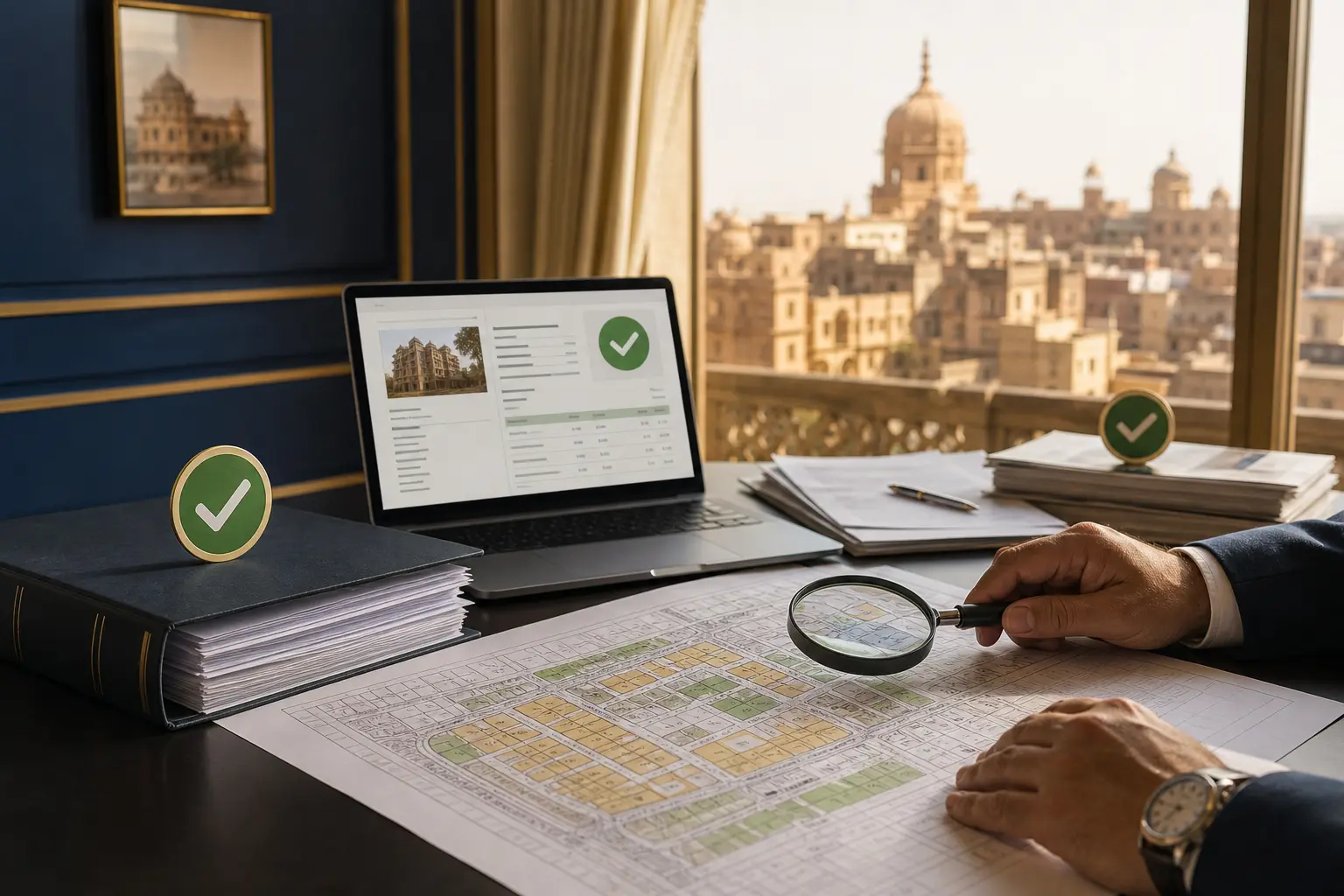
Key Answers in This Guide
- Why a "RERA Approved" Stamp on a Brochure Means Nothing: A brochure claim is marketing; only the entry on the official Rajasthan RERA portal is proof.
- How to Look Up a Project on the Rajasthan RERA Portal: Go to the official portal at rera.rajasthan.gov.in, open the project search, and match the registration number, promoter name, and project details against what you were told.
- Reading a Project Record Field by Field: Most buyers open the record, see a green status, and close the tab.
- What Each RERA Status Means for You as a Buyer: Only an active, current registration gives you the Act's protections; lapsed, suspended, or revoked statuses are red signals, not paperwork technicalities.
- How a RERA Complaint Actually Works: If a registered promoter breaks their commitments, you can file a complaint through the Rajasthan RERA portal itself, and the authority can hear it and pass orders; knowing this exists changes how sellers treat you.
- What RERA Does Not Protect: RERA is built around under-construction projects sold by promoters; resale flats, most completed buildings, and small developments largely sit outside it.
In this guide
Many brochures in Bhiwadi carry the words “RERA approved” in bold type. Some of those claims are accurate. Some refer to a registration that has since lapsed. A few refer to nothing at all. We have been selling property in Bhiwadi since 2008, and the habit that separates careful buyers from regretful ones is simple: they check approvals themselves, on government portals, before paying a rupee. This guide shows you how, for the two approvals that matter most here: RERA registration and BIDA sanction.
Why a “RERA Approved” Stamp on a Brochure Means Nothing
A brochure claim is marketing; only the entry on the official Rajasthan RERA portal is proof. RERA does not “approve” projects the way the word suggests. It registers them. Registration means the promoter has filed project details, land documents, sanctioned plans, and a promised completion date with the regulator. It is not a certificate of quality, and it is not permanent. A registration can lapse when its validity ends, or be suspended or revoked by the authority. A brochure printed three years ago does not update itself when that happens.
Marketing material here has its own vocabulary, and buyers should read it with suspicion. “RERA applied” means not registered. “RERA in process” means not registered. Some brochures quote the RERA number of the promoter’s earlier project in another town against a fresh launch that had no registration of its own. Only the portal could tell you that.
So treat every approval claim as a claim to be tested. Ask the seller for the RERA registration number in writing, so there is a record of what they claimed. If they hesitate or circle a vague number, that hesitation is your answer. A genuine number costs a promoter nothing to share, and we list it among the first questions to ask before buying property in Bhiwadi for exactly this reason.
How to Look Up a Project on the Rajasthan RERA Portal
Go to the official portal at rera.rajasthan.gov.in, open the project search, and match the registration number, promoter name, and project details against what you were told. The exercise takes ten minutes and costs nothing. Here is the sequence we walk buyers through:
- Open rera.rajasthan.gov.in directly. Type the address yourself rather than following a link from the builder’s website or a WhatsApp forward.
- Find the project search section. You can filter by district, project name, promoter name, registration number, or project status. For Bhiwadi projects, searching by the promoter’s name often works better than the project name, because marketing names and registered names sometimes differ.
- Open the project’s record and read it slowly. Check that the promoter’s legal name matches the entity named in your booking documents. A project registered under “XYZ Developers LLP” but sold to you by “XYZ Buildhome Pvt Ltd” needs an explanation before it needs your money.
- Note the registered completion date. This is the promoter’s own commitment to the regulator, and it is usually more honest than the possession date quoted verbally.
- Use the promoter and agent search on the same portal to confirm the builder, and any broker channel involved, is registered too.
Take dated screenshots of what you find; a record of the portal entry at the time of booking is useful evidence if a dispute arises later. And repeat the lookup before each major instalment, not only at booking. A registration that was active when you booked can lapse mid-construction, and the portal will show it long before the builder’s office admits it.

Reading a Project Record Field by Field
Most buyers open the record, see a green status, and close the tab. That wastes the best free due-diligence tool in Rajasthan. Every field on a RERA project record answers a specific buyer question, and reading them together tells you more than any sales conversation will.
Start with the registration number itself. Rajasthan numbers follow a recognisable pattern, along the lines of RAJ/P/2025/4124, with the year of registration inside the number. Match every character against what the seller quoted. A number one digit off from a real project is a classic trick, because a lazy search “confirms” a project exists.
Next, the promoter details. This section names the legal entity behind the project. Read it against your booking form, the bank account you are asked to pay into, and the letterhead of every document you receive. All three should point at the same entity. When they do not, money can flow into a company that never signed a commitment to you, and unwinding that later is a lawyer’s project, not a phone call.
The project type and status fields tell you what was registered and where it stands. A plotted development registered as such cannot quietly become a group housing project; if the site plan you were shown does not match the registered project type, one of the two documents is decorative.
The declared completion date is the promoter’s written promise to the regulator. Compare it with the possession date in the sales pitch. When the verbal date is earlier than the registered date, the sales team is selling optimism. When the registered date has passed and the status still shows an ongoing project, ask what extension was taken and why, and expect a documented answer.
Project records also carry the legal and land documents the promoter filed, including sanctioned layouts and approvals. You do not need to read every page like an advocate would, but open them, and confirm the sanctioned layout attached to the registration matches the brochure map. A brochure can show a park where the sanctioned plan shows a commercial block. The sanctioned plan wins, every time.
Progress updates filed on the record show how construction has moved against the promise. Updates gone quiet for a long stretch, while the builder’s Instagram stays busy, deserve a site visit with your own eyes.
Finally, look at the promoter’s other projects listed on the portal. A promoter with completed projects delivered near their declared dates is a different risk from a first-time entity with one live registration and no history. Neither is a verdict on its own, but together with the rest of the record it shapes how much of your money should move before you see walls.
What Each RERA Status Means for You as a Buyer
Only an active, current registration gives you the Act’s protections; lapsed, suspended, or revoked statuses are red signals, not paperwork technicalities. The Rajasthan portal lets you see projects across statuses, and each one tells you something different. More usefully, each status has a correct buyer response.
An active registration for an ongoing project means the promoter can legally advertise, book, and sell units, and that you can approach the authority if commitments are broken. Your playbook here is the normal one: verify the record fields, link payments to construction stages, keep your paper trail current.
Completed indicates the project has reached its declared completion. Here your attention shifts from RERA to the handover documents: completion or occupancy paperwork, conveyance of common areas, and, for a resale unit inside it, the title chain. Do not treat “completed on RERA” as proof that an individual seller within that project owns their flat. Those are separate questions.
Lapsed means the registration validity expired without completion or extension, and a promoter should not be selling fresh units against it. If your shortlisted project shows lapsed, freeze. Do not book, and do not release any further payment until the portal shows the registration restored or extended. If you have already booked in a project that lapses mid-way, gather your receipts and agreement, take dated screenshots of the status, and speak to a lawyer rather than accepting the builder’s verbal reassurance.
Suspended and revoked are the most serious: the authority has acted against the project, and buying into it means buying into someone else’s regulatory problem. At the shortlist stage these are not negotiation opportunities, whatever discount appears alongside them. For an existing allottee, the sensible sequence is legal advice first, collective action with other buyers where possible, and a formal complaint on record, because individual verbal follow-up with a promoter in regulatory trouble achieves nothing.
Whatever the status, do not accept verbal assurances that “renewal is filed” or “it will clear next month.” Wait until the portal itself says so. A promoter who cannot get their own registration in order is telling you how the rest of the project is run.
How a RERA Complaint Actually Works
If a registered promoter breaks their commitments, you can file a complaint through the Rajasthan RERA portal itself, and the authority can hear it and pass orders; knowing this exists changes how sellers treat you. We are dealers, not advocates, so take the fine detail from a lawyer. But the shape of the mechanism is worth understanding before you buy.
Complaints are filed online through the portal’s grievance section, with details of the complainant, the respondent, and the grievance. Broadly, matters go down one of two routes: complaints about a promoter’s conduct and compliance go before the authority, while claims for interest or compensation, the money side of a delayed project, go before an adjudicating officer under the Act. Orders can be appealed to the Appellate Tribunal, so a first decision is not necessarily the end of the road.
Two practical points. First, the complaint stands on paper: written commitments, dated screenshots, payment receipts, and the agreement for sale are what it is built from. A buyer whose entire case is “the sales manager promised me on the phone” starts from nothing. Second, a complaint is a remedy, not a plan. It takes time and energy even when it succeeds, and the whole point of the verification habits in this guide is to avoid ever needing one.
What RERA Does Not Protect
RERA is built around under-construction projects sold by promoters; resale flats, most completed buildings, and small developments largely sit outside it. This surprises many buyers, and it matters a great deal in Bhiwadi, where a large share of transactions are resale.
When you buy a ready flat from an individual owner rather than from the builder, that transaction is between two private parties. No promoter is making promises about construction, so the machinery of RERA has little role. Projects already completed before the Act’s requirements applied to them, and very small projects below the thresholds set in the Act, also fall outside mandatory registration.
None of this makes such purchases unsafe. It means your protection comes from a different place: title verification, document scrutiny, and a properly drafted sale deed rather than a regulator’s oversight. The two routes carry different risks, a trade-off we unpack in our comparison of a new project versus a resale property in Bhiwadi.
Understand also what RERA never checks, even for registered projects. It does not certify that the title is clean, that no family disputes hang over the plot, or that a resale seller actually owns what they are selling. Nor does it guarantee a project will finish, only that a framework exists when one does not. Those checks are yours, and skipping them is among the most common property mistakes we see buyers make in Bhiwadi.
BIDA’s Role: Who Approves Layouts and Land Use in Bhiwadi
BIDA, the Bhiwadi Integrated Development Authority, is the planning body for the Bhiwadi region, and its sanction of a layout or building plan is a separate check from RERA registration. Bhiwadi’s planning history has two chapters. The Urban Improvement Trust, UIT Bhiwadi, handled the town’s planning for years. The state government later constituted BIDA as an integrated authority for the wider area, absorbing the UIT’s role, with jurisdiction over the Bhiwadi, Tapukara, and Khushkhera belt often called Greater Bhiwadi. Land use conversion, layout sanctions, and building permissions here now route through BIDA.
Why does this matter? RERA asks whether the promoter has registered the project with the regulator. BIDA sanction asks whether the colony’s layout, the land use, and the building plans are legal in the first place. A project can quote paperwork for one while being weak on the other. Older properties may carry a sanction in the UIT’s name rather than BIDA’s, which is normal for their era; what matters is that a competent authority sanctioned them at the time.
There is a third body worth naming for completeness. Industrial plots and some older planned sectors trace back to RIICO, the state industrial development corporation, and properties with a RIICO lineage carry their own allotment and transfer paperwork. If a seller’s story mixes up which authority governs their plot, that confusion is itself a warning; a genuine owner knows whose stamp sits on their file.
In practice, we split the two checks like this: RERA is checked from your phone, on the portal, before you visit the site a second time. BIDA sanction is checked on paper, from the seller’s file, before you pay a token.
Approved Colonies Versus Unapproved Colonies
Buy in a sanctioned, approved layout; an unapproved colony can look identical on the ground and still leave you without legal roads, services, or a clean registry. Bhiwadi’s growth has produced both kinds. In an approved colony, the layout plan is sanctioned, plots correspond to that plan, and civic services have a legal basis. In an unapproved colony, plots are carved and sold on agricultural or unconverted land without sanction. Prices there look tempting, which is precisely how buyers get drawn in.
The ground itself gives you signals. Roads in an unapproved colony are often narrower than any sanctioning authority would pass, laid in patches rather than to a plan. Electricity arrives through a tangle of informal connections. Plot boundaries are marked with loose stones or a single course of bricks rather than measured demarcation. Plots sell well below the approved colonies nearby, and the seller is often a local aggregator rather than a named developer with a file. None of these signs is conclusive alone; three together mean you ask for the sanction before you ask the price.
Now the document side. A sanctioned layout plan is a specific thing: a drawing of the whole colony, approved and stamped by the authority, showing numbered plots with dimensions, the road network with widths, and areas reserved for parks and services. When a seller shows you one, do three things:
- Confirm the sanction stamp and reference on the plan itself, so you are looking at the approved drawing and not a marketing rendering.
- Find your exact plot number and match its dimensions against what you are being sold; a plot sold as 200 square yards that the plan shows as 166 is a conversation to have before registry, not after.
- Stand on the site with the plan in hand and check that the roads and open spaces around your plot exist where the drawing says. A park that has quietly become four more plots tells you how the coloniser treats approvals.
For land purchases, ask whether land use conversion was obtained, and ask to see that order, not just hear about it. If the seller cannot produce the layout sanction, assume it does not exist. This document sits alongside the title papers on our standard list of documents required to buy property in Bhiwadi.
RERA, BIDA, RIICO and the Registry: Which Authority Checks What
No single authority verifies everything about a Bhiwadi property; each one answers a different question, and a complete check touches all of them. Buyers often assume that one government stamp covers the lot. It does not, and sellers sometimes exploit exactly that assumption by waving whichever approval they do have as though it answered every question. Keep this map in mind:
| Authority | What it actually covers | The question it answers |
|---|---|---|
| Rajasthan RERA | Registration of projects and of agents | Is this project registered with the regulator, and is the dealer a RERA-registered agent? |
| BIDA | Planning, layout sanction, land use and local development in Bhiwadi | Is this colony or layout approved, and is the land use what the seller claims? |
| RIICO | Allotment, transfer and permitted use of plots in RIICO industrial areas | Is this industrial plot’s allotment and transfer chain clean, and is my intended use permitted? |
| Revenue and registration authorities | Land records (Jamabandi), mutation and registered sale deeds | Do the government’s own records show this seller as the owner? |
| Your independent lawyer | Property-specific title opinion across all of the above | Can this specific seller legally pass clean ownership to me? |
A residential flat purchase mainly runs through the first two rows plus the last two. An industrial purchase adds RIICO in the middle, and for that chain of checks our RIICO industrial plot buyer’s guide walks through allotment, transfer and dues in detail. Notice that the lawyer sits in the last row on purpose: every authority above them confirms its own slice, and only a title review joins the slices into an opinion about your specific deal.
Warning Signs of a Project Heading for Trouble
Stalled projects rarely stall suddenly; they broadcast warnings for months, and buyers who visit sites and read records catch them early. Everything here is pattern, not law. Treat each sign as a reason to dig, not a verdict.
Watch the labour, not the hoarding. A site genuinely moving has consistent labour strength across visits, material stacked for the next stage, and visible change month on month. A site kept barely alive has a handful of workers in one corner while three towers stand silent. Visit twice, a few weeks apart, without informing the sales office; the difference between the escorted tour and the unannounced Tuesday morning is information.
Watch the discounts. When a project starts offering schemes that get sweeter every month, or sudden broker commissions that everyone in the market hears about, the promoter is pulling cash forward. Sometimes that is ordinary business. Combined with slow site progress, it is often the sound of a project funding yesterday’s construction with tomorrow’s bookings.
Watch the paperwork tempo. Demand letters arriving on time while agreed documentation keeps getting delayed is a bad ratio. So are possession dates that move in small, repeated slips rather than one honest revision, and a sales office whose staff changes so often that nobody remembers what you were promised.
Watch the record. Registered completion dates passing without visible urgency, progress updates going stale on the portal, and a promoter’s other projects showing the same drift all rhyme. Projects usually fail slowly, in public, in front of buyers who did not want to see it.
None of this means avoiding under-construction property altogether. It means staging your payments against construction rather than a calendar, and walking away while walking away is still cheap.
What We Have Seen Go Wrong Since 2008
Eighteen years of Bhiwadi files repeat the same handful of failures, and almost every one traces back to a skipped check. A few patterns, with identifying details removed.
Buyers end up holding receipts for plots in colonies that were never sanctioned, purchased because the rate was well below market and the coloniser was a familiar local face. Years later they hold possession of land they can occupy but struggle to sell at a fair price, because every serious buyer’s lawyer asks for the same sanction they never asked for themselves. The discount they celebrated at purchase resurfaces, with interest, at resale.
Bookings get made against one entity’s RERA registration while payments flow to a different, related company, discovered only when the buyer tries to get their builder-buyer agreement executed. Buyers pay large components in cash to “save” on stamp duty, then discover the unrecorded portion simply does not exist in any dispute. Families buy resale flats on the strength of a photocopied registry, never tracing the chain, and meet a second claimant to the same flat.
And there are the quiet successes. Buyers who verified the record, matched the plot to the sanctioned plan, paid through banking channels against milestones, and kept every message in writing had transactions so uneventful that there is nothing to narrate. That is the goal. Good property purchases make boring stories.
What to Do When a Project Is Not Registered
Walk away from any under-construction project that should be registered and is not, whatever discount is on offer. A promoter selling units without required registration is already operating outside the law, and the discount is the price of that risk being transferred to you. You lose the regulator as a forum, and resale becomes harder because the next buyer’s lawyer will spot the same gap.
The honest exceptions are the categories discussed above: resale units, completed properties, and genuinely exempt small developments. For those, absence from the portal is expected, and your energy should go into title and document checks instead. If you are unsure which category a property falls in, ask an experienced dealer before accepting the seller’s explanation. Our step-by-step guide on how to buy property in Bhiwadi shows where this check sits in the overall sequence.
Title Verification Is a Separate Check, Not a Substitute
RERA and BIDA checks tell you the project is legal; title verification tells you the seller can actually pass ownership to you, and you need both. Title work means tracing the ownership chain through past sale deeds, checking for encumbrances and mortgages, and confirming no disputes are pending on the property. A lawyer does this from registry and revenue records, and the modest fee is the best money in the entire transaction.
We are property dealers, not a law firm. For the legal opinion itself, engage your own advocate and let them examine the chain before you sign anything. Budget for this alongside stamp duty when you work out registry charges in Bhiwadi, and for the full picture of what a purchase costs beyond the quoted price, run your numbers through our Bhiwadi property cost calculator before you commit.
Run Your Shortlist Past Us Before You Book
If you have shortlisted a flat, plot, or house anywhere in Bhiwadi, bring it to us and we will walk it through every check in this guide with you. We will pull up the RERA record together, read the layout sanction, flag anything that needs a lawyer’s eye, and tell you plainly if we would not buy it ourselves. Shivam Properties does this for buyers across flats in Bhiwadi and every other segment of property in Bhiwadi. Send us the project name on WhatsApp, and give yourself the ten minutes of verification that most buyers skip.
Sources Checked
- Rajasthan RERA portal: project, promoter and agent registrations (checked July 2026)
- BIDA: master-plan and sector-plan resources for the Bhiwadi-Khushkhera-Tapukara region (checked July 2026)
- Apna Khata: Rajasthan land records: Jamabandi, mutation, Bhu-Naksha (checked July 2026)
Portal interfaces and registrations change; re-verify on the official site on the day you rely on them.
Frequently Asked Questions
How do I check if a Bhiwadi project is RERA registered?
Search the project or promoter on the Rajasthan RERA portal and match the promoter name and registration number letter for letter against what the sales office tells you.
Does RERA registration mean a project is safe or approved?
No. It confirms the project is registered and its details were declared; it is not a safety certificate or an approval. The correct term is RERA-registered, never RERA-approved. Verify the promoter and title separately.
What is the difference between RERA and BIDA?
RERA is the real-estate regulator for registration and buyer protection; BIDA handles area development, master planning and sanctions for the Bhiwadi region. Both matter, for different things.
Should the agent also be RERA registered?
Yes. Check the agent’s own Rajasthan RERA registration, which is separate from the project’s; our guide on verifying a RERA agent explains how.
Want a Second Pair of Eyes on Your Paperwork?
18+ years in this market. Real prices, verified paperwork, no pressure.
Choose what you would like to do next:
Done — our team will contact you during working hours.