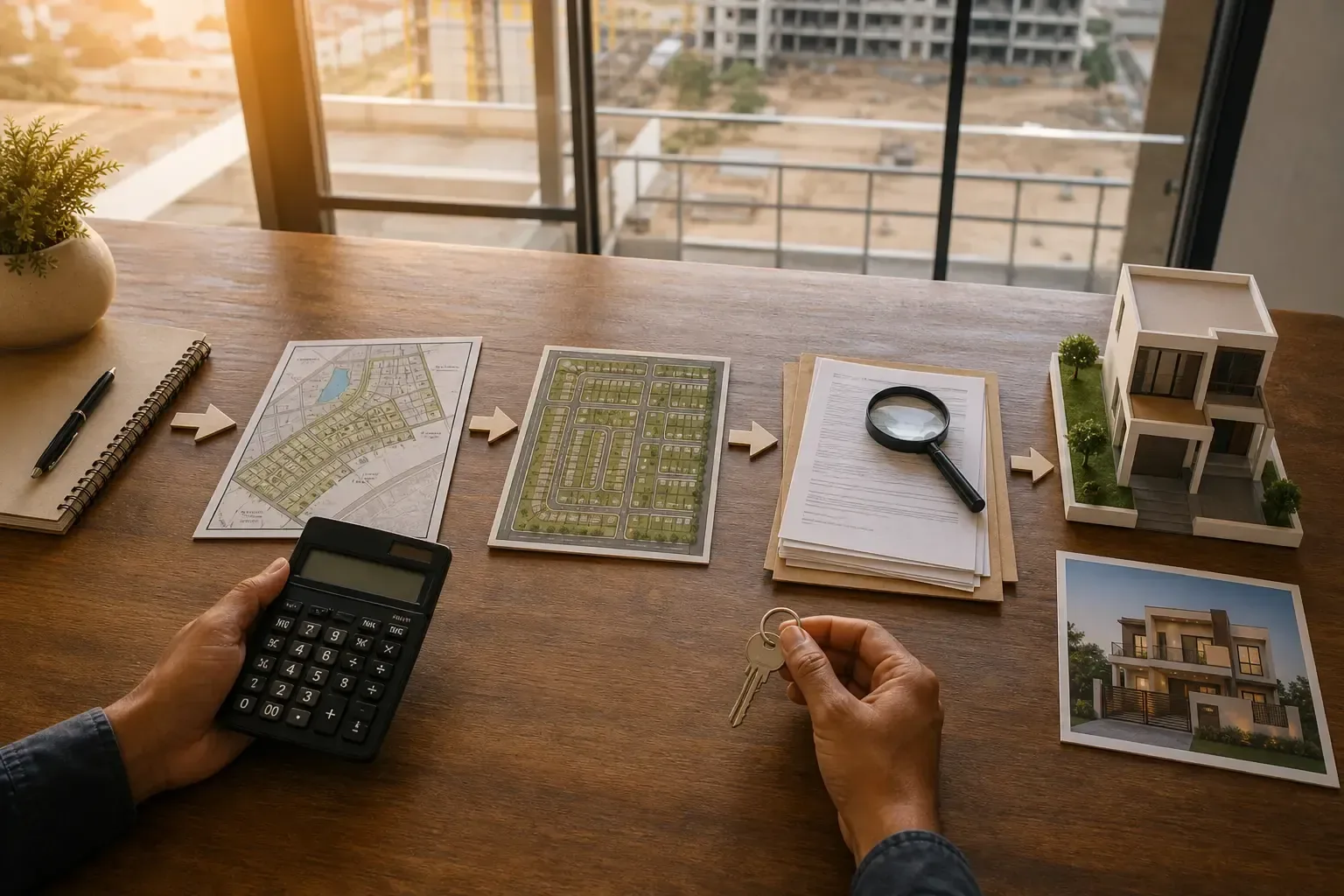
Key Answers in This Guide
- Your Bhiwadi Buying Journey at a Glance: The safest sequence keeps large payments behind independent verification.
- Step 1: Define your budget and your purpose: Fix your total budget including registry and brokerage costs first, and decide whether you are buying for end-use or investment, because the two lead to different properties.
- Step 2: Choose the property type and locality: Match the property type to your purpose before you shortlist anything: flats for convenience and rental, plots for flexibility and self-construction, villas for space, industrial for business.
- Step 3: Shortlist and do site visits properly: Visit every shortlisted property in person, in daylight and again in the evening if you can, and treat the visit as an inspection rather than a tour.
- Step 4: Verify the papers before you talk price: Never negotiate on a property whose title chain, approvals, and dues you have not verified, because a discount on a defective title is not a discount.
- Step 5: Negotiate against real closings, not listing prices: Anchor your offer to what comparable properties have actually closed at in that society or sector, because asking prices in Bhiwadi routinely sit well above closing prices.
In this guide
Buying property in Bhiwadi follows a clear sequence, and buyers who respect that sequence close faster, pay less, and sleep better. Skip a stage, and you either overpay or inherit someone else’s paperwork problem. We have walked buyers through this process since 2008, working only the Bhiwadi market, and the same nine stages apply whether you are buying a 2BHK flat, a residential plot, or an industrial shed in a RIICO area.
This guide goes stage by stage, and within each stage it covers what actually happens, what buyers routinely forget, and where a local dealer earns their fee. Read it once end to end before your first site visit, then come back to the relevant section as you reach each stage. Buyers who know the next step before it arrives negotiate from a stronger position at every stage, because nothing surprises them.
Your Bhiwadi Buying Journey at a Glance
The safest sequence keeps large payments behind independent verification. Use this map as your transaction checklist, then open the detailed stage below when you reach it.
- Plan
Set the real budget
Count the price, stamp duty, surcharge, registration, brokerage and a cash buffer. Start with the all-in cost calculator.
- Choose
Match property to purpose
Decide end-use or investment first, then choose flat, plot, house or industrial property and the localities that fit.
- Inspect
Shortlist and walk the site
Visit the actual property in daylight and at a working hour. Inspect the approach, surroundings, services and physical condition.
- Independent check
Verify title and approvals
Have your own lawyer review the title chain, conversion, approvals, encumbrances and dues. Check RERA and BIDA separately.
- Price evidence
Negotiate from real closings
Compare recent transactions and the property’s condition. A portal asking price is an opening position, not proof of market value.
- Payment checkpoint
Document token and bayana
Keep the token small and write its adjustment, refund and forfeiture conditions. Pay a meaningful advance only after verification under a signed agreement. See the payment sequence.
- Finance
Complete the loan checks
If financing, finish the bank’s legal and technical review inside the agreement’s time window. Treat a rejection as a warning, not an inconvenience.
- Ownership transfer
Execute the registered sale deed
Complete ePanjiyan formalities, pay the applicable government charges and register the sale deed at the correct Sub-Registrar Office. Review the Rajasthan registry process.
- Complete
Take possession and update records
Collect the originals, keys and no-dues evidence, record the handover, and apply for mutation so the relevant record is updated.
Step 1: Define your budget and your purpose
Fix your total budget including registry and brokerage costs first, and decide whether you are buying for end-use or investment, because the two lead to different properties. The price on the listing is never the price you pay. On top of the negotiated value, Rajasthan adds stamp duty, registration fee, and a surcharge, and there is brokerage on closing. Budget for the all-in figure, not the sticker.
Purpose matters just as much. An end-user should weight daily life: commute to the office or factory, schools, markets, water supply, society maintenance. An investor should weight rentability and resale liquidity instead. In Bhiwadi, a flat that rents easily to a factory manager is not always the flat a family would pick for itself. If investment is your angle, growth here is driven by the industrial base rather than speculation, and we have covered that reasoning separately in why invest in Bhiwadi.
What buyers forget at this stage, again and again, is the money after the money. Registry charges are the big one, but there is also loan processing, minor legal costs, shifting, and the first round of repairs or furnishing that almost every resale property needs. Families who commit their entire sanctioned loan amount plus their full savings to the purchase price end up living in a bare flat for a year. Keep a buffer, and treat the property price as one line in a larger total.
Our Bhiwadi property cost calculator exists for exactly this reason: put in a price and see the all-in figure before you fall in love with anything.
One more distinction worth settling early: the amount a bank will sanction and the EMI you can actually live with are two different numbers. Banks sanction against income on paper. Your real ceiling is the EMI that leaves your household breathing room after school fees, fuel, and the occasional emergency. Decide that number yourself, at home, before any dealer or banker suggests one to you. Buyers who arrive with a firm all-in ceiling make faster, calmer decisions, and sellers can sense the difference.
Step 2: Choose the property type and locality
Match the property type to your purpose before you shortlist anything: flats for convenience and rental, plots for flexibility and self-construction, villas for space, industrial for business. Bhiwadi has all four in volume, which is unusual for a town its size.
Flats in Bhiwadi suit buyers who want a lock-and-leave home or rental income with society security and shared maintenance. Plots in Bhiwadi suit buyers who want to build at their own pace, though a plot demands more verification effort because there is no builder or society standing behind the title. Villas sit between the two. On the industrial side, RIICO areas like Chopanki, Khushkhera, Salarpur, and the Honda zone around Tapukara have their own allotment and transfer rules, and mixing up residential and industrial processes is a common newcomer mistake.
Locality selection is where local knowledge pays. Two societies a kilometre apart can differ sharply on water, maintenance quality, and occupancy levels, and only ground visits reveal which is which.
Within residential, there is a second fork most buyers face: a new builder project or a resale property from an individual owner. Each has its own price behaviour, negotiation style, and risk profile, and we have compared them honestly in new project vs resale property in Bhiwadi. In short, resale gives you certainty and a motivated individual seller; a new project gives you fresh construction and builder payment plans, with delivery risk attached if it is still under construction. Decide which side of that fork you are on before shortlisting, because mixing the two in one shortlist makes every comparison muddy.
On localities themselves, sector by sector character matters more than any single amenity. Some pockets of Bhiwadi are dense with occupied, functioning societies; others have towers that look complete from the road but run at low occupancy, which shows up later as weak maintenance and thin resale demand. We have mapped this ground reality area by area in best areas to buy property in Bhiwadi, and reading it before your visits will save you at least one wasted weekend.
Step 3: Shortlist and do site visits properly
Visit every shortlisted property in person, in daylight and again in the evening if you can, and treat the visit as an inspection rather than a tour. Photographs flatter. Portals show the best angle of the best flat in the building, taken years ago.
On a flat visit, check seepage marks on ceilings and behind wardrobes, run the taps, ask neighbours about water timings and lift breakdowns, and look at the notice board for maintenance disputes. On a plot visit, confirm the plot on the ground matches the plot on the map: walk the boundaries, check for encroachment, and see whether the access road actually exists or only appears in the layout plan. Carry the papers you have and compare dimensions on site.
Three to five serious visits usually beat fifteen casual ones. Our full inventory across types is on the property in Bhiwadi page if you want a starting shortlist.
Here is what an inspection visit looks like when it is done well. You arrive with a written list of checks, not a vague intention to “get a feel”. You open every tap and flush every toilet, because plumbing problems hide until water moves. You look up at ceiling corners and down at skirting for damp lines.
You ask the seller direct questions and note whether the answers come easily: how long have you owned it, why are you selling, what are the monthly maintenance and the water timings, has the society ever had a dispute with the builder. Hesitation on simple questions is information.
Talk to at least one neighbour without the seller standing beside you. Neighbours volunteer what sellers omit: the lift that fails every monsoon, the borewell dispute, the parking fights. Guards and society office staff are equally useful, and a five minute chat at the gate often tells you more than the visit itself. When we accompany buyers on visits, this is half of what we do: we know which societies have history, and we ask the questions a polite outstation buyer hesitates to ask.
The evening revisit matters more than buyers expect. Daylight shows the flat; evening shows the neighbourhood. You see which floors have lights on, which tells you real occupancy. You see the actual traffic on the approach road, how the market area feels, and whether the street lighting works. In an industrial town, you also learn what the air and noise are like when the factories are running shifts. Ten minutes at 7 pm answers questions no brochure will.
Step 4: Verify the papers before you talk price
Never negotiate on a property whose title chain, approvals, and dues you have not verified, because a discount on a defective title is not a discount. This stage is where deals should die, and the good ones survive it easily.
The core checks in Bhiwadi are:
- Complete title chain from the original allotment or sale to the current owner, with each transfer registered
- Approved building plan and, for newer projects, RERA registration
- Occupancy certificate for constructed property, or conversion and layout approval for plots
- No-dues certificates: society maintenance, electricity, water, property tax
- Loan status, and a foreclosure plan if the seller has a running mortgage on it
For resale flats, the occupancy certificate and society no-dues matter most in practice. For plots, the title chain and approved layout matter most. For RIICO industrial units, transfer permission from RIICO is a separate step that many buyers discover late. We keep a full checklist with explanations on the documents required to buy property in Bhiwadi page. Read it before your first visit, not after your token.
Verification in practice is less dramatic than it sounds. You collect photocopies of the full document set from the seller, sit down with someone who reads these papers daily, and trace the story: who first owned this property, how did each transfer happen, and does every link have a registered document behind it. Gaps are where problems live.
A transfer done on a notarised paper instead of a registered deed, a missing succession document after an owner passed away, a general power of attorney doing the work a sale deed should have done. None of these is automatically fatal, but every one of them must be surfaced and resolved before money moves, because fixing them after registry is somewhere between expensive and impossible.
For project approvals, do not take anyone’s word, including ours. RERA registration and local building approvals can be checked from your own phone, and we have written a plain walkthrough of how to do it in RERA and BIDA verification for Bhiwadi property. A seller or dealer who welcomes that independent check is telling you something good. One who discourages it is telling you something too.
A running home loan on the seller’s side deserves its own note, because it is common and manageable when handled openly. The seller’s bank holds the original documents, so the deal has to be structured so the loan is closed and the papers released as part of the transaction, usually with your payment or your bank’s disbursement clearing their outstanding directly.
What you must never do is hand over a large token against a mortgaged property on a loose verbal plan. The sequence of who pays whom, when, and against which document should be written into the agreement in Step 6.
One more point from experience: our default advice to most buyers is ready-to-move over under-construction. A completed property carries no delivery risk and no GST on the purchase, and you verify what exists rather than what is promised. Browse ready-to-move properties in Bhiwadi if that logic suits you.

Step 5: Negotiate against real closings, not listing prices
Anchor your offer to what comparable properties have actually closed at in that society or sector, because asking prices in Bhiwadi routinely sit well above closing prices. Sellers list with a cushion. Portals record the cushion, not the deal.
A dealer who works only this market knows recent closings street by street, and that is the honest basis for an offer. Push on genuine weaknesses: pending maintenance dues, an old kitchen, a floor nobody wants. Do not manufacture defects; sellers see through it and dig in. Also settle the brokerage terms clearly at this stage. The standard structure here is about one percent from the buyer and one percent from the seller, negotiable, payable on closing, and we have laid the whole thing out on the brokerage charges in Bhiwadi page so there are no surprises.
Beyond the number, negotiation is mostly about reading the seller’s situation, and this is where sitting across the table for years teaches you things portals cannot. A seller who has already booked their next home, taken a job transfer, or carried an empty flat for months negotiates very differently from one who listed casually to test the market.
Neither will announce which one they are, but the signals leak: how quickly they return calls, whether they bring up the registry date themselves, how they react to a firm written offer. Part of a dealer’s real work is knowing which kind of seller you are facing before you make your first offer.
A few pieces of craft that hold up deal after deal. Make one serious, defensible offer rather than a chain of small hopeful ones; a well reasoned number backed by comparable closings gets engagement, while lowball fishing gets silence. Give your offer a shelf life, politely: you are visiting other properties and the offer stands for a defined period, which is honest pressure rather than a bluff, provided it is true.
Trade on terms, not only price. A seller stuck on their number will often concede elsewhere: a faster or slower registry date to suit them, the modular kitchen and fittings staying, pending society dues cleared from their side. Sometimes the terms are worth more than the last round of haggling.
Silence, used sparingly, is also a tool. After you state your number and your reasons, stop talking. Buyers who keep justifying an offer talk themselves upward. And know your walk-away before the conversation starts, because the strongest position in any negotiation is being genuinely willing to take the next property on your shortlist. In our experience, buyers who came in with three visited alternatives almost always closed on better terms than buyers who had emotionally committed to one flat.
Step 6: Token and agreement to sell
Pay a token only against a written agreement to sell that records the price, the timeline, the payment schedule, and what happens if either side backs out. A token on a handshake is how buyers lose money in every market, and Bhiwadi is no exception.
The agreement should name the exact property, list what stays with it, fix the date for registry, and state that the balance is payable at registration. If you need a home loan, write the sanction into the agreement as a condition with a reasonable window. Keep the token proportionate. It should signal seriousness, not transfer half the risk to you before the papers are fully cleared.
Because this document does most of the legal work between handshake and registry, it deserves a closer look. These are the clauses that actually protect a buyer, in plain language:
- Full identification of the property: the exact flat or plot number, floor, tower or khasra reference, and super or carpet area as the sale deed will describe it, so there is no ambiguity about what is being sold
- Total sale consideration and a payment schedule: token paid now, any interim payment, and the balance at registry, each tied to a date and a mode of payment through banking channels
- The registry date, with a short written procedure for extending it by mutual consent, so one busy fortnight does not turn into a dispute
- A loan contingency if you are borrowing: if the bank declines the loan or declines this property within a stated window, the token comes back and the agreement ends cleanly
- A title condition: the seller warrants the title is clear, and if verification or the bank’s legal check surfaces a defect the seller cannot cure, the token is refundable
- Symmetric default terms: what the seller forfeits if they back out or sell to someone else, mirroring what you forfeit if you walk away without cause. One-sided agreements that only punish the buyer are common, and worth pushing back on
- An inclusions list: fittings, fixtures, kitchen, wardrobes, air conditioners, whatever was agreed to stay, written down item by item
- Vacant possession at registry, and the seller’s responsibility for clearing society dues, utility dues, and property tax up to the handover date
Pay the token itself through a bank transfer or cheque, never in cash, and take a signed receipt that references the agreement. Both parties sign every page, two witnesses sign, and each side keeps an original. Notarisation adds evidentiary weight and costs little. None of this is exotic drafting; it is standard protection that takes an hour to do properly, and we sit with both sides through it on every deal we handle so the document reflects what was actually agreed, not a template nobody read.
Step 7: Arrange the home loan, if you need one
Apply for your loan immediately after the agreement, because the bank’s own legal and technical verification takes time and your registry date depends on it. Banks sanction the loan first, then disburse at registry, handing over the demand draft when the sale deed is signed.
Shop two or three banks rather than accepting the first quote. Each bank quotes its own exact rate based on your profile, so compare offers in writing instead of relying on advertised numbers. A useful side effect: the bank’s lawyer independently checks the title before sanctioning, which is a free second opinion on your Step 4 work. If the bank refuses the property, take that refusal seriously.
That second opinion deserves emphasis, because it is the cheapest legal audit you will ever get. The bank is about to put its own money against this property for fifteen or twenty years, so its empanelled lawyer traces the same title chain you did in Step 4, and its valuer physically visits the property to confirm it exists, matches the papers, and supports the price.
If either report comes back negative, do not treat it as bank bureaucracy to be routed around by trying another lender. Ask for the specific objection, in writing if possible. Sometimes it is a curable gap the seller can fix before registry. Sometimes it is the deal-killer your own check missed, and the bank just saved you.
Practically, the process runs in two tracks. Your personal file: identity and address proof, PAN, income documents such as salary slips and bank statements for salaried buyers, or returns and financials for the self-employed. And the property file: the agreement to sell plus the seller’s document set from Step 4.
Buyers who hand over both files complete on day one get sanctioned weeks earlier than buyers who drip-feed papers on request. Keep the seller informed of the bank’s progress too; a seller who can see the loan moving stays patient, and a seller kept in the dark starts entertaining other offers.
Understand the disbursement mechanics before registry day so nothing rattles you in the moment. In a resale purchase, the bank typically prepares a demand draft or banker’s instrument in the seller’s name and releases it at or immediately after the deed is signed and registered, and the original registered deed then goes to the bank as security for the life of the loan. You keep certified copies. If the seller has their own running loan, the two banks coordinate closure and release of documents, and your dealer’s job is to keep that choreography on schedule.
Step 8: Stamp duty and registration at the sub-registrar
Registry is where the property legally becomes yours, and in Rajasthan the government charges come to roughly nine percent of the sale value for a male buyer. The components: stamp duty at about 6 percent for a male or joint purchase, about 5 percent if the property is registered in a woman’s name, plus 1 percent registration fee, plus a 30 percent surcharge charged on the stamp duty amount (source: Rajasthan ePanjiyan).
Concretely, on a ₹40 lakh purchase with a male buyer: stamp duty of about ₹2.4 lakh, a surcharge of about ₹72,000 on that stamp duty, and a registration fee of about ₹40,000. Total government cost lands near ₹3.5 lakh, over and above the price you pay the seller. Registering in the wife’s name trims the stamp duty by a full percentage point, and many Bhiwadi families do exactly that. Rates and slabs get revised, so check the current figures on our registry charges in Bhiwadi page before you fix the date.
On the day itself, both parties appear at the sub-registrar’s office with witnesses, original documents, and photographs. The deed is signed, biometrics are taken, the bank releases the draft if there is a loan, and the registered deed follows.
Since registry day is the one appointment nobody wants to repeat, here is the fuller picture. Before the day, the sale deed is drafted, the stamp duty is paid through the prescribed channel, and a slot is arranged at the sub-registrar’s office. The deed is the permanent record, so read it fully before the day, however dry it feels: names and spellings exactly as on ID, the property description, the consideration amount, and the payment details all have to be right, because correcting a registered deed later is a genuine headache.
Who attends: the buyer, the seller, and two witnesses, all present in person with original government photo ID. If any party cannot attend, a registered power of attorney holder can appear in their place, and that POA must be specifically checked in advance, not produced as a surprise at the counter.
What to carry: originals and photocopies of the ID documents, PAN cards, passport photographs of all parties, the payment instruments or proof of payments made, and the complete property document set. Carry more copies than you think you need; a missing photocopy is the most common reason a registry appointment stretches into the afternoon.
Inside, the sequence is mundane and reassuring. Documents are checked at the counter, the parties sign the deed, photographs are taken, and thumb impressions and biometrics are recorded to tie each person to the document. The sub-registrar verifies that the parties understand and consent to the transaction. If there is a loan, the banker attends with the draft and hands it over against the signed deed. Then everyone waits while the record is processed, which is most of the time you spend there.
Expect the visit to consume the better part of a day, keep the whole day free, eat before you go, and treat every delay as normal, because it is. The registered deed is returned after processing, and if a bank financed the purchase, the original goes to the bank and you keep certified copies.
We attend registry with our buyers as standard practice. Not because the procedure is difficult, but because a familiar face who knows the office, the sequence, and the paperwork keeps a long day calm, and catches the small errors, a misspelt name, a missing photo, before they cost anyone a second visit.
Step 9: Possession and handover
Take physical possession on the day of registry or immediately after, with keys, original documents, and utility transfers all closed out in one sweep. Collect every original: registered sale deed, prior chain documents, occupancy certificate, and all no-dues certificates.
Then transfer the utilities. Electricity and water connections go into your name, the society records you as the new owner, and property tax records get updated. Do a final walkthrough before the seller hands over, checking that fittings agreed in the agreement are still in place.
Do the walkthrough with the agreement’s inclusions list in hand, item by item, before the last payment logic completes and the keys change hands. Sellers rarely strip a flat out of malice, but movers make mistakes, and the geyser or the fans that were agreed to stay have a way of leaving with the truck. Note meter readings for electricity and water on handover day so there is a clean line between the seller’s dues and yours.
After possession, one task remains that buyers postpone for years and should not: mutation, meaning the update of the local municipal and revenue records to show you as the owner. Registry makes the property legally yours; mutation makes the government’s day-to-day records agree. It matters for property tax billing and it smooths every future transaction, including your own eventual resale. Do it in the same season as the purchase, while the file is still on your desk and the process is fresh.
Then organise the documents themselves: originals in one safe place, a full scanned set in your email or cloud storage, and a note of where everything is that your family can find. Every year we meet sellers who lost months of their own sale hunting for papers a scanner would have preserved in an afternoon.
Buying from outside Bhiwadi: NRI and outstation buyers
You do not need to live in Bhiwadi to buy here safely; with honest ground support and, where needed, a registered power of attorney, the entire process runs with one or two visits or none at all. A large share of our buyers live in Delhi, Gurgaon, Jaipur, or abroad, buying for family, for a future return, or as an investment in the industrial belt.
The process is the same nine steps with the geography handled differently. Shortlisting happens over WhatsApp and video calls: we walk the property live on camera, including the unflattering corners, the staircase, the meter room, and the view from every window, because a video tour that only shows the drawing room is a brochure, not a visit. Documents move as scans for verification, and the same title checks from Step 4 apply with no shortcuts. Most outstation buyers then make one trip for final site visits on a shortlist of two or three, and a second trip for registry.
For NRIs, residential and commercial property is open to buy, while agricultural land is restricted, and the money must flow through proper banking channels from your NRE or NRO account.
If travelling for registry is impractical, the POA route works: you execute a power of attorney in favour of a trusted person, typically a family member, specifically authorising the purchase and registration. A POA executed abroad needs attestation at the Indian consulate and the prescribed formalities on arrival in India, so start that paperwork early rather than the week before registry. The same discipline you would apply to a seller’s POA applies to your own: specific, current, and registered, not a vague general authorisation.
Two habits make remote purchases go well. First, insist on written updates at every stage, with documents attached, so your file grows in your inbox as the deal progresses and you are never relying on a phone summary. Second, keep your own independent checks: verify RERA and approvals yourself online, and let your bank’s legal team do its work. We manage the same arrangement in reverse for owners selling from outside India through our sell property in Bhiwadi service, and the principle is identical in both directions: distance is not the risk; skipped verification is.
Patterns we have seen since 2008
Most bad property outcomes in Bhiwadi trace back to one of a handful of repeating mistakes, and every one of them is avoidable with sequence and patience. After seventeen years in one market, the file of cautionary tales sorts itself into patterns.
The token before verification is the most common. A buyer likes a flat, feels the pressure of “two other parties are interested”, and pays a token on the spot with papers unseen. Weeks later the title check surfaces a problem, and now the buyer is negotiating for their own money back instead of walking away clean. The defence is boring and absolute: no token until the document set has been checked. A genuine seller will hold a property a few days for a serious buyer; a seller who cannot wait for verification has answered your question.
The discount that was the warning is its second cousin. A price meaningfully below the market for that society is not luck; it is information. Sometimes the explanation is innocent, a genuinely urgent seller, and those deals are the good ones. Sometimes the explanation is a title gap, unpaid dues, a dispute in the family, or a building problem the neighbours all know about. Cheap is a reason to verify harder, not faster.
Buying the promise instead of the property fills another shelf: under-construction purchases made on brochures, where the delivered flat, the delivered date, or both fell short of the launch presentation. Bhiwadi has seen good deliveries and painful ones, which is exactly why our default advice leans ready-to-move, where you inspect what exists. The same pattern shows up smaller in resale, buyers crediting promised repairs or promised dues clearance that never got written into the agreement. If it matters, it goes on paper.
And the pattern on the happy side of the ledger: the buyers who did well here were rarely the cleverest negotiators. They were the ones who followed the sequence, kept a buffer, verified before paying, wrote everything down, and were willing to walk away once. Sequence beats cleverness in this market, every year we have worked it.
Where to start
Start by telling a local dealer your budget, purpose, and timeline, and let the shortlist come to you instead of drowning in portal listings. That is the whole service: matching real requirements to real inventory and real closing prices, then carrying the deal through paperwork and registry.
Shivam Properties has worked only the Bhiwadi market for eighteen years. Our office is on Alwar Bypass Road, opposite MVL Coral and adjacent to V Square Mall, open daily from 10 am to 6 pm. Share your requirement through the buy property in Bhiwadi page or walk in, and we will put a shortlist in front of you that is worth visiting.
Frequently Asked Questions
What are the steps to buy property in Bhiwadi?
Shortlist and visit, verify the title and papers with your own lawyer, agree the price and written terms with a small documented advance, then register the sale deed at the sub-registrar and pay the balance at that stage. The stages above expand each step.
How long does buying property take?
For a prepared buyer with clean papers, a few weeks: a few days for verification and a lawyer’s review, then registration. Pressure to close in a single day is a warning sign, not efficiency.
What documents do I need to buy?
The title chain, the seller’s registered deed, the approvals and, for a flat, the occupancy certificate and society no-dues. Our documents guide lists the full set.
Can an outsider buy property in Bhiwadi?
Yes, anyone eligible to buy property in India can buy here. The same title and registration checks apply regardless of where you are from.
Want a Second Pair of Eyes on Your Paperwork?
18+ years in this market. Real prices, verified paperwork, no pressure.
Choose what you would like to do next:
Done — our team will contact you during working hours.