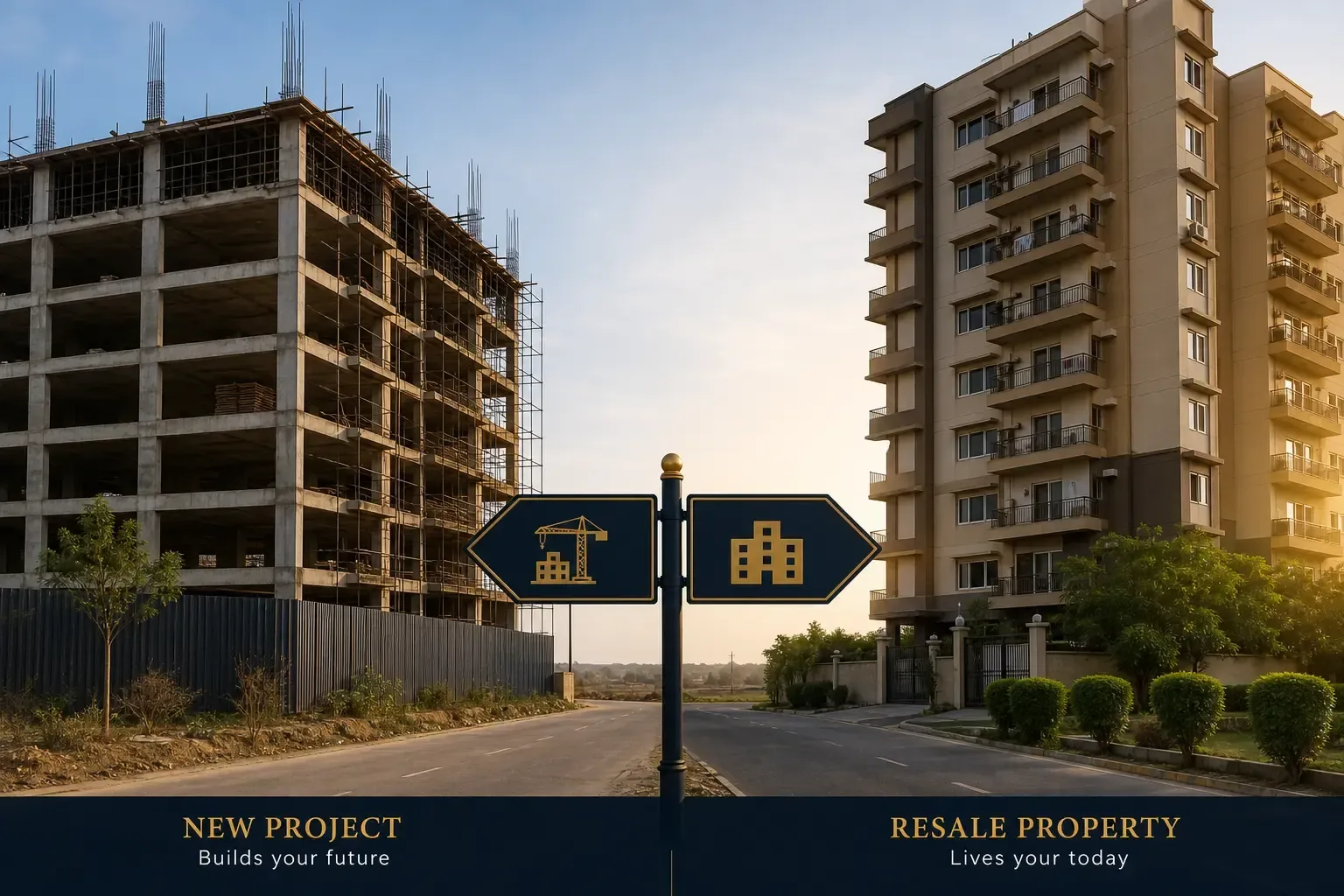
Key Answers in This Guide
- What "new" and "resale" actually mean here: A new purchase means you buy directly from the builder as the first owner; a resale purchase means you buy from an existing owner, and either one can be a ready flat.
- Price and negotiation work differently on each side: Resale prices bend to the individual seller's situation, while builder prices bend to inventory pressure, so negotiation is personal on one side and structural on the other.
- What you can inspect before paying: Resale lets you inspect the actual unit, the actual society and the actual neighbours; a new booking sells you specifications and promises.
- The cost stack: GST versus transfer charges: Registry costs apply to both, GST applies only to under-construction builder purchases, and society transfer charges apply only to resale.
- A worked example of the registry cost, same for both: On a ₹30 lakh purchase, a male or joint buyer pays about ₹2.64 lakh in registry costs and a woman buyer about ₹2.25 lakh, whether the seller is a builder or an owner.
- New versus resale at a glance: Four things separate the two paths in practice: what you can inspect before paying, whether GST or a society transfer charge lands on top, which paperwork stack you have to verify, and what the main risk is if you get it wrong.
In this guide
Resale buys you a flat you can inspect and a society with a track record. New from a builder buys you an untouched unit, and if it is still under construction, GST on top of the price and a delivery date you have to trust. Registry charges are identical on both paths, so the real cost gap sits in the add-ons: GST on one side, society transfer charges on the other. We have worked only the Bhiwadi market since 2008, and a very large share of the transactions we close here are resale. This guide sets out where the two paths actually differ, and how to check each one.
What “new” and “resale” actually mean here
A new purchase means you buy directly from the builder as the first owner; a resale purchase means you buy from an existing owner, and either one can be a ready flat. New does not automatically mean under construction. Builders in Bhiwadi often hold unsold ready units years after completion, and buying one of those is still a fresh-from-builder deal. Equally, resale does not mean old. An owner who got possession last year can sell you a nearly new flat as a resale.
There is a separate question hiding inside this one: should you buy something ready or something still being built? That is a timing question, not an ownership question, and we have covered it in full on our ready to move properties page. This article stays on the ownership axis, builder as seller versus individual owner as seller, because the costs, paperwork and risks differ sharply between the two.
Price and negotiation work differently on each side
Resale prices bend to the individual seller’s situation, while builder prices bend to inventory pressure, so negotiation is personal on one side and structural on the other. An owner selling a Bhiwadi flat has a story: a job transfer, a loan to close, an NRI tired of remote ownership. Motivated sellers negotiate meaningfully, and in resale the gap between asking price and closing price can be real money. You are dealing with one person whose urgency you can read.
Builders negotiate differently. Rate cards look rigid, but builders discount through other doors: waived charges, festive schemes, flexible payment plans, or quiet per-square-foot cuts when a tower is moving slowly. Slow inventory softens a builder faster than any bargaining skill. Neither side is automatically cheaper; in our experience the best resale deals beat the best builder deals, but the averages land closer than most buyers expect. What you pay us as buyers is the same either way, and our brokerage charges page sets that out plainly.
What you can inspect before paying
Resale lets you inspect the actual unit, the actual society and the actual neighbours; a new booking sells you specifications and promises. This is the single biggest practical difference. Walk into a resale flat and everything is testable. Run the taps and judge the water pressure. Check the walls for seepage marks in a corner the owner did not repaint. Talk to the neighbours about maintenance collection and whether the lift actually gets serviced. Nothing is hypothetical.
Book new from a builder and you are trusting a sample flat and a specification sheet. Even in a completed project with unsold stock, the society has no lived-in track record yet: no history of how the maintenance agency performs, no proof of how the building behaves through a monsoon.
Bhiwadi punishes carelessness here, because society maintenance quality in this town varies enormously; two societies on the same road can be different worlds inside. We keep a list of the questions that expose this on our guide to questions to ask before buying, and most of them only have real answers in a resale.
The cost stack: GST versus transfer charges
Registry costs apply to both, GST applies only to under-construction builder purchases, and society transfer charges apply only to resale. Start with what is common. Rajasthan registry charges hit every purchase on the transaction value: stamp duty of around 6 percent for male or joint buyers and around 5 percent for women buyers, plus 1 percent registration fee, plus a 30 percent surcharge calculated on the stamp duty amount. New or resale makes no difference to this layer, and the full working with examples sits on our registry charges guide.
Above that common layer the two paths diverge. Buy under construction from a builder and GST applies on top of the price. Buy a completed unit, whether unsold builder stock with a completion certificate or any resale from an owner, and GST does not apply, because a completed property is not treated as a supply of construction service. On the resale side a different cost appears instead: society or maintenance-agency transfer charges for moving the membership and records into your name. Amounts vary from society to society, so confirm the figure in writing before you commit rather than trusting a verbal number.
A worked example of the registry cost, same for both
On a ₹30 lakh purchase, a male or joint buyer pays about ₹2.64 lakh in registry costs and a woman buyer about ₹2.25 lakh, whether the seller is a builder or an owner. Working it through makes the structure clear. Stamp duty at 6 percent of ₹30 lakh comes to ₹1,80,000. The 30 percent surcharge on that stamp duty adds ₹54,000. Registration fee at 1 percent adds ₹30,000. Total: ₹2,64,000. Register in a woman’s name and stamp duty drops to 5 percent, or ₹1,50,000, the surcharge becomes ₹45,000, registration stays ₹30,000, and the total falls to ₹2,25,000. These figures are illustrative arithmetic on an assumed value, not a quotation for any specific property.
Two things follow from this example. First, the woman-buyer concession is worth real money on any transaction size, and it applies identically to new and resale, so factor it into whose name goes on the registry regardless of which path you choose.
Second, since this layer is fixed, the actual cost gap between the two paths comes entirely from the add-ons: GST on an under-construction builder purchase on one side, society transfer charges on the other. When buyers compare a builder’s quoted price against a resale asking price, we always ask them to compare the all-in figures, not the sticker prices, because the sticker comparison flatters whichever side has more hidden add-ons.
New versus resale at a glance
Four things separate the two paths in practice: what you can inspect before paying, whether GST or a society transfer charge lands on top, which paperwork stack you have to verify, and what the main risk is if you get it wrong.
| Factor | New from builder | Resale from owner |
|---|---|---|
| Seller | Builder company, first sale | Individual existing owner |
| What you inspect | Sample flat and specifications | The actual unit, society and neighbours |
| GST | Applies if under construction | Does not apply |
| Society transfer charges | Not applicable | Payable, varies by society |
| Registry charges | Same for both, on transaction value | Same for both, on transaction value |
| Key paperwork | Builder-buyer agreement, RERA file | Title chain, prior registries, society NOC |
| Condition | Untouched, but unproven | Lived in, wear visible, faults visible too |
| Negotiation | Schemes and inventory pressure | Individual seller’s urgency |
| Main risk | Builder delivery and track record | Title defects and hidden dues |
You are a first-time buyer who wants to know exactly what daily life will look like
Lean resale. A functioning society with working lifts and stable water is a known quantity; you can repaint a wall rather than gamble on an unproven project.
You prize certainty over a brand-new unit
Lean resale. What you inspect is what you get, with no possession-date risk.
You want an untouched unit and can verify the builder
Lean new. Check the RERA status and delivery history first; where a builder has a proven Bhiwadi record and schemes sweeten the price, new rewards you.
Either way, judge the society's track record first, then ask whether the unit there is a builder sale or an owner sale.
Paperwork: builder file versus title chain
A new purchase runs on the builder’s regulatory file; a resale runs on the chain of ownership, and each demands a different kind of checking. Buying new, your protection is the builder-buyer agreement and, for under-construction projects, RERA registration, which gives you a registered project plan, promised delivery dates and a complaint route with teeth. Checking that file properly is a skill of its own, and our RERA and BIDA verification guide walks through it step by step. Bhiwadi buyers should never skip this, because the builder’s actual delivery record matters more than any brochure, and the next section sets out how to check it.
Buying resale, RERA is not your shield; the paper trail is. You need every previous registry in the chain, confirmation that the seller’s ownership is clean and undisputed, a no-dues and no-objection certificate from the society, and clearance of any old loan on the property before or at registration. Then the society transfer completes the handover. None of this is difficult, but every item must actually be verified, not assumed. Our checklist of documents required to buy property covers both stacks in detail.
Checking a builder’s track record before buying new
Before booking new, verify the builder’s delivery history in Bhiwadi itself, because this market has already taught that lesson at buyers’ expense. The 2012 to 2015 period is the reference point locals use. Projects launched with confident timelines, collected bookings, and then delivered late, delivered partially, or stalled. Families who had planned possession dates around school admissions and job moves carried the cost for years. None of this means new projects are unsafe today; RERA changed the market meaningfully. It means the builder’s record is the first thing to check, not the last.
Checking is practical work, not paperwork alone. Ask which projects the builder has already delivered in or around Bhiwadi, then go and stand in one. Walk the common areas of a project they handed over five years ago and see how it has held up, because that is a preview of your own building’s future. Talk to residents there about whether promised amenities actually arrived and how the builder handled snags after possession.
On the regulatory side, find the project on the Rajasthan RERA portal, compare the promised completion date against reality, and look for complaints on record. Our RERA and BIDA verification guide, linked earlier, shows exactly where to click and what each field means. A builder with a clean, boring delivery record is worth paying slightly more for; a builder you cannot verify is not worth any discount.
Verifying a resale seller and the title, step by step
On the resale side your entire protection is verification, so treat the title chain and the seller’s identity as the deal itself, not as formalities. Start with the chain of registries. Every prior sale of that unit should exist as a registered document, and the names should connect without gaps: builder to first owner, first owner to second, and so on down to the person in front of you. A missing link is not a small defect; it is the whole question. Where the property has passed through inheritance, ask how, and expect documentation rather than a family explanation.
Then verify the seller as a person. Match the identity documents against the name on the registry exactly. If the seller lives abroad and someone local is signing on a power of attorney, examine that POA carefully and insist the arrangement is legally solid before any token money moves. Speaking of token money, keep it modest, pay it against a written receipt that names the property and the agreed price, and never hand over a large advance to reserve a deal that has not been verified.
Confirm any running home loan on the property and structure the payment so the loan closes and the bank releases the papers as part of the transaction, not on a promise. Finally, get the society’s no-dues certificate and NOC before registration, not after, because pending maintenance dues have a way of becoming the buyer’s problem once the seller has been paid. Every document named here appears with explanations on the documents checklist linked in the paperwork section above, and our resale flat checklist runs the same ground in the order you will actually do it.
The middle path: unsold ready stock from the builder
Ready unsold units bought from the builder sit between the two paths: new condition, no GST once the project holds completion, but a society that is still unproven. Bhiwadi has a steady supply of this category. A project finishes, some towers sell out, and the builder holds the remainder, sometimes for years. Buying one of these gets you first-owner status and an untouched flat without the construction wait, and because the transaction happens after completion, GST does not enter the picture. Price behaviour is builder-style: schemes and inventory pressure rather than personal urgency.
What you do not get is the lived-in evidence a resale offers. If most of the project is empty, there is no maintenance track record to inspect and no neighbours to question, and a largely unsold project raises its own question: why has the market not absorbed it? Sometimes the answer is innocent timing. Sometimes it is pricing, location, or a builder reputation that locals already know. Where a completed project has healthy occupancy in the sold towers, this middle path can be genuinely attractive, because you can inspect the occupied portions almost like a resale while still buying new. We flag which of the ready projects we work with fall into this category when buyers ask.
Condition, age and the honest trade-off
New gives you an untouched flat with everything at zero hours; resale gives you visible wear in exchange for visible truth. Nobody has used the fittings in a new unit and the paint is fresh. Against that, a resale flat carries its age openly. Fittings may need replacement, the kitchen may need work, and you should budget something for refreshing the unit. What you gain is that nothing is hidden. Seepage, cracked tiles, a lift that struggles: in a resale these have already shown themselves, and the price can reflect them. In a new project the faults have simply not surfaced yet, and the first monsoon is the real inspection.
Financing: banks lend on both, with one difference
Home loans are available on new and resale purchases alike, but a resale loan lives or dies on a clean title chain. For a new purchase in an approved project, banks often have the project pre-vetted, which makes disbursal smooth. For resale, the bank’s legal team examines the entire ownership chain before sanctioning, and any gap, missing registry or unclear inheritance stalls the file. This is not a reason to avoid resale. In practice the bank’s scrutiny works in your favour, because a property a bank refuses to fund is a property you should not buy either. Get the documents assembled early and the timelines are comparable.
Timelines: how each deal actually moves
Resale deals move as fast as the paperwork allows, while new purchases move at the builder’s pace, which is either immediate or measured in construction quarters. With a resale, once price is agreed, the clock is set by document assembly and, where a loan is involved, the bank’s legal check on the chain. Sellers with papers already in order close quickly; sellers who need to close an old loan, obtain a society NOC, or coordinate signatures from family members add weeks. Nothing in a resale is inherently slow, but every missing paper pauses the deal.
Buying ready stock from a builder can be the fastest route of all, since the builder’s documentation is standardised and there is no individual seller to coordinate. Buying under construction is the opposite: money goes out in instalments over the construction schedule, and possession arrives when the project does. That schedule is a promise, and RERA gives the promise teeth, but a buyer who needs to move in by a fixed date should never rely on an under-construction timeline alone.
If you have a hard date, a school admission or a job relocation, let the calendar make the first cut: rule out under-construction stock and compare only completed inventory, whether new or resale.
Three buyers, three right answers
Watch how the choice plays out for typical Bhiwadi buyers, because the right answer depends on their situation, not on the properties. Take a family relocating for a factory posting in one of the RIICO areas. They need a functioning home within a couple of months, a school nearby, and no surprises. For them a resale flat in an established society is usually the better fit: they can inspect everything, talk to future neighbours, and know what the maintenance bill and water situation actually are before committing. Wear on the fittings is a repainting budget, not a risk.
Now take an investor buying to hold. They care about entry price, exit liquidity, and carrying cost, not about the colour of the kitchen. For them the calculation is deal by deal. A motivated resale seller can hand them an entry price no builder scheme matches, but a builder clearing ready stock in a project with strong occupancy can do the same in a different month. They should be comparing all-in numbers across both paths every time, and the moment either side stops negotiating, the other side becomes the market.
Third, take an NRI buying from abroad through family visits. Distance changes the risk profile. They cannot inspect repeatedly, cannot chase a society office for a transfer, and cannot attend multiple registry appointments easily. For them a clean, standardised transaction matters more than the last rupee: either ready builder stock with straightforward documentation, or a resale where a trusted dealer has done the physical verification and the paperwork is complete before they fly in. What they should avoid is a complicated resale with an untidy chain managed remotely, because unwinding a problem from another country is miserable.
Where buyers lose money on both paths
Most losses in this comparison come from process mistakes, not from picking the wrong category. On the new side, the classic error is treating the sample flat as the product. Buyers fall for the furnished sample, skip the RERA file, never visit the builder’s delivered projects, and discover the gap between specification and reality at possession. A second error is booking under construction with money that was actually needed on a fixed date, then living with the stress of a slipping timeline.
On the resale side, the recurring mistake is paying substantial token money before verification, on the logic that the flat might slip away. A deal that cannot survive a week of document checking is a deal you were lucky to lose. Buyers also routinely forget the society layer: they verify title carefully, then discover unpaid maintenance dues or a society that drags the transfer for months.
And on both paths, buyers who negotiate hard on price often forget to negotiate on inclusions, from parking allocation to fittings, which is where several quiet lakhs live. A structured process catches all of this, which is why we keep pointing buyers to a written sequence instead of instinct.
Our Bhiwadi answer: judge the society, not the label
In this market the society’s track record usually matters more than whether the flat is new or resale. A resale flat in a well-run society, with regular maintenance collection, working lifts and stable water supply, protects its owners better than a brand-new unit in a project whose upkeep collapses within five years. The label on the transaction fades quickly; the quality of the society decides everything that follows.
So invert the usual process. Shortlist societies first, using their maintenance record and resident feedback, and only then ask whether the available unit there is a builder sale or an owner sale. Our flats in Bhiwadi page lists the ready projects we currently transact in.
When you are ready to move from reading to doing, the full sequence from shortlist to registry is laid out in our guide on how to buy property in Bhiwadi, and we are happy to walk any specific new-versus-resale comparison with you unit by unit. Bring us the two options you are torn between, and we will tell you what each one really costs and really risks.
Frequently Asked Questions
Is a resale flat cheaper than a new one?
Usually yes per square foot, because an older flat costs less than a fresh launch while renting for a similar amount. That gap is also why resale tends to show the better rental yield.
What extra checks does a resale flat need?
The full title chain, society dues cleared in writing, any existing loan closed, and the transfer charge confirmed. Our resale flat checklist puts these in the order you will actually work through them.
Do new projects still need RERA verification?
Yes. Confirm the project’s RERA registration and the promoter’s record before any payment; registration is not the same as a safety guarantee.
Ready to Shortlist? Talk It Through With Us
18+ years in this market. Real prices, verified paperwork, no pressure.
Choose what you would like to do next:
Done — our team will contact you during working hours.