Key Answers in This Guide
- Why resale needs its own checks: A new flat from a builder has one seller and a short, clean paper trail.
- The resale document set at a glance: Before the detail, here is the resale-specific paperwork in one view.
- The title chain: every link, not just the last: The single most important resale check is the chain of title: an unbroken line of ownership from the original allotment to the person selling to you now.
- Encumbrance and any existing loan: A resale flat can carry a charge you inherit if you are not careful, so establish that it is free of one, or that the one it has is being cleared as part of the sale.
- Society records, share certificate and transfer: A flat in a society is not just four walls; it is a membership, and that membership has to transfer to you cleanly.
- No-dues clearance in writing: Get a written no-dues certificate covering maintenance, water, electricity and property tax before you pay, because unpaid dues on a resale flat can become your problem the day you take possession.
In this guide
Buying a resale flat in Bhiwadi needs a different checklist from buying a fresh one, because a resale flat comes with a history: previous owners, an existing loan perhaps, society dues that may or may not be cleared, and a title chain that has to hold at every link. This page is that checklist, built around the checks that are specific to resale, so you verify the things a brand-new purchase never makes you think about.
Our partner reports that title tends to be clear across the builder projects, societies and resale flats they transact in this market. That is a fair starting point, not a substitute for checking: “tends to be clear” describes the market, and you are buying one specific flat, whose specific papers you still confirm. Everything below is how you do that confirmation.
Why resale needs its own checks
A new flat from a builder has one seller and a short, clean paper trail. A resale flat has at least two past transactions and often more, an owner who may still be repaying a loan against it, and a running account of maintenance and utility dues that transfers to you if you do not check it. The building itself is no longer new, so its condition and its completion paperwork matter in a way a launch brochure never tested.
None of this makes resale a worse buy. Resale flats are often better value and let out at a better yield, which we cover in rental yield in Bhiwadi, and the trade-offs against a fresh launch are set out in new project vs resale property in Bhiwadi. It simply means the due diligence is about history, and history has to be read carefully.
The resale document set at a glance
Before the detail, here is the resale-specific paperwork in one view. Each row is a document to obtain, read and, where noted, have a professional verify:
| Document | What it establishes | Red flag | Your independent check |
|---|---|---|---|
| Full chain of past sale deeds | Unbroken ownership up to today’s seller | A missing or unregistered link in the chain | Lawyer reads every deed for continuity |
| Current seller’s registered sale deed | The seller legally owns what they are selling | Name mismatch with ID or society records | Match names across deed, ID and bills |
| Encumbrance certificate | No undisclosed mortgage or lien on the flat | An open charge the seller did not mention | Encumbrance search at the sub-registrar |
| Bank loan-closure NOC and original papers | Any existing loan is cleared and papers released | Seller vague about an open home loan | Confirm the NOC is in the file before full payment |
| Share certificate or society membership | The society recognises the seller as the owner | Not on the society rolls, or in another name | Written confirmation from the society office |
| No-dues certificate (maintenance, water, power, tax) | Nothing outstanding transfers to you | A verbal or undated assurance | Written, dated clearance from the society or authority |
| Occupancy certificate for the building | The building is legally fit to live in | No occupancy certificate on an occupied building | Lawyer confirms the occupancy-certificate status |
| Transfer charge quote (builder or society) | The one-time cost to put the flat in your name | The project will not state a figure | Get the exact amount in writing |
The sections below work through the rows that carry the most risk.
The title chain: every link, not just the last
The single most important resale check is the chain of title: an unbroken line of ownership from the original allotment to the person selling to you now. A new flat has almost no chain; a resale flat’s chain is its whole legal foundation.
Ask for and read, with a lawyer, the full set of past documents: the original allotment or builder-buyer agreement, every sale deed since, and the current seller’s own registered sale deed proving they own what they are selling. Each transfer should be properly registered and each link should connect to the next without a gap. A missing deed, an unregistered transfer, or a name that does not carry through from one document to the next is exactly the kind of break that surfaces years later as a dispute.
Match the names too. The name on the current sale deed, on the society records, on the electricity and tax bills and on the seller’s identity documents should all be the same person. A mismatch is not automatically fraud, but it is always a question you get answered in writing before you proceed. We keep the document-by-document detail in our guide to the documents required to buy property in Bhiwadi, which applies to resale with the chain history added on top.
Encumbrance and any existing loan
A resale flat can carry a charge you inherit if you are not careful, so establish that it is free of one, or that the one it has is being cleared as part of the sale.
Check whether the flat is mortgaged. Many resale sellers are still repaying a home loan taken against the very flat they are selling, which means the original property documents are sitting with their bank and there is a lien on the property. This is common and manageable, but it changes the transaction: the sale has to route the payment so the seller’s loan is closed, the bank issues a no-objection certificate and releases the original documents, and only then is the title genuinely clean in your hands. Never pay the full price to a seller whose loan is still open and whose bank still holds the papers.
An encumbrance check at the sub-registrar establishes what charges are registered against the property. You can understand the registration system on the official Rajasthan portal, ePanjiyan, and your lawyer will read the encumbrance position as part of the title work. The point for you as a buyer is simple: confirm the flat is either unencumbered or being made so at registration, in writing, with the bank’s NOC in the file.
Society records, share certificate and transfer
A flat in a society is not just four walls; it is a membership, and that membership has to transfer to you cleanly.
Ask the society or the maintenance office for the seller’s standing. You want to see the share certificate or membership record in the seller’s name, confirmation that the flat is on the society’s rolls correctly, and the society’s own process and paperwork for transferring membership to a new owner. A well-run society will have a clear procedure; a disorganised one is itself a small warning about how the building is managed, which affects your life there every day.
This is separate from inspecting the building and the society physically, which deserves its own walk-through: the water, the lifts, the maintenance standard, the monsoon behaviour of the pocket. We set that out in what to check in a housing society before booking a flat, and for a resale you do both, the paper check here and the physical check there.
No-dues clearance in writing
Get a written no-dues certificate covering maintenance, water, electricity and property tax before you pay, because unpaid dues on a resale flat can become your problem the day you take possession. This is one of the most common and most avoidable resale surprises.
The outgoing owner should clear every running account and the society or authority should confirm, on paper, that nothing is outstanding. Maintenance arrears, an unpaid electricity bill, pending property tax to the local urban body, any special society levy: all of it should read zero in writing, dated close to your purchase. A verbal “everything is paid” is not a clearance. If any dues are genuinely pending, they are either cleared before registration or adjusted against the price in the agreement, never left vague.
Transfer charges: ask the exact figure and get it in writing
Budget for a transfer charge, and pin down the number early. Each builder and each society in this market sets its own transfer charge, and there is no single market figure, so the only reliable amount is the one the specific project quotes you in writing. Ask what it costs to transfer this flat into your name, who levies it, and when it is paid.
It is a one-time cost rather than a recurring one, but an unexpected transfer bill at the last moment is an unpleasant surprise, and in some projects it is not small. Fold it into your total acquisition budget alongside registration and stamp charges, because together they lift your real outlay above the sticker price, and, if you are buying to let, they quietly lower your true yield.
The building’s completion and occupancy status
A resale flat is in a building that is supposed to be legally complete and fit to occupy, so confirm that it actually is. Ask whether the building has its completion certificate and, importantly, its occupancy certificate, the document that certifies the building is legally fit for people to live in.
This matters even on resale, and sometimes especially on resale, because an older building that has been occupied for years may still have gaps in its completion paperwork that nobody addressed while families quietly moved in. We explain the difference and why the occupancy certificate is the one that governs your legal right to live there in completion certificate vs occupancy certificate. If the building lacks an occupancy certificate, that is not a detail to wave away; it is a question for your lawyer before you commit.
Physical condition and the age of the building
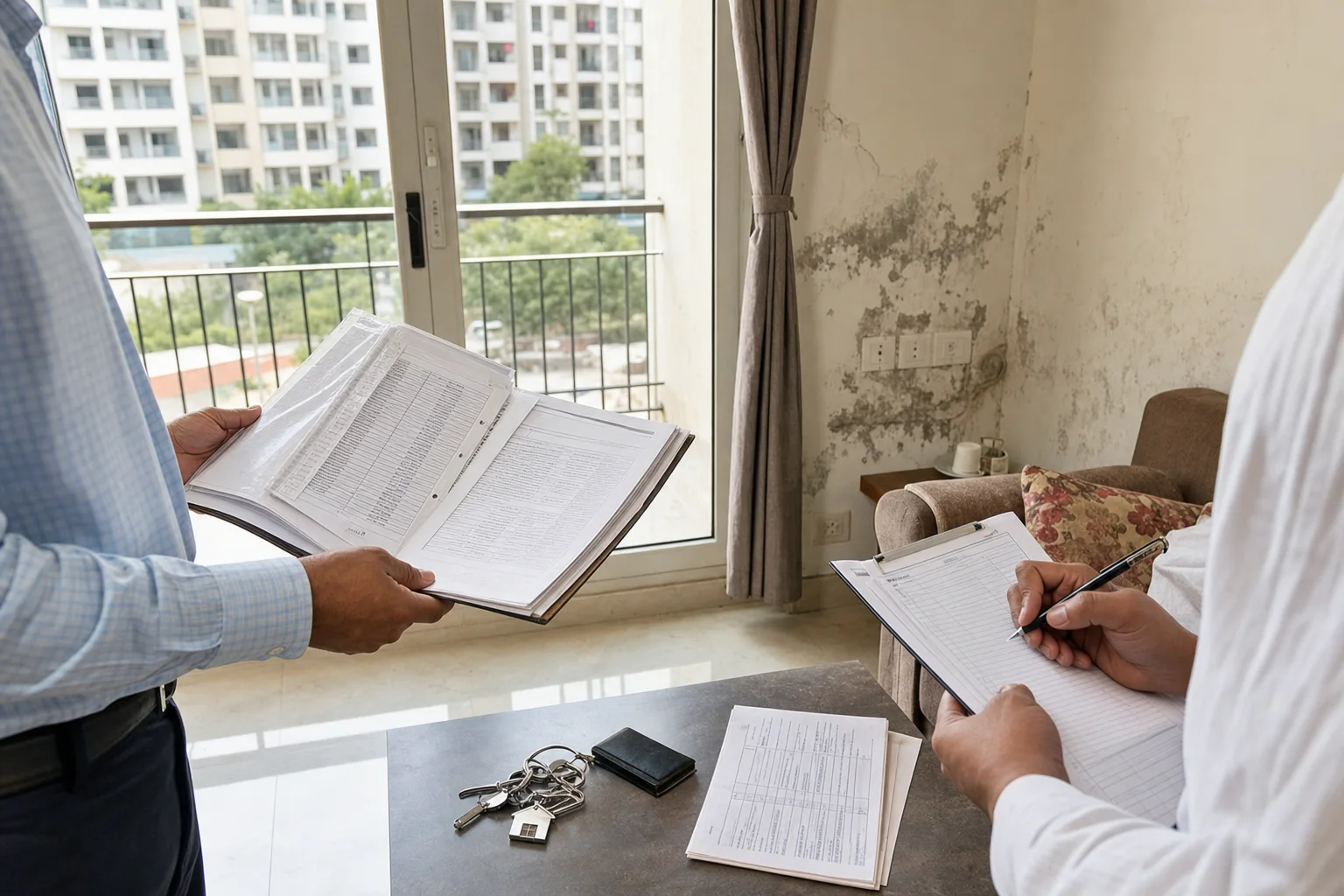
Now the flat itself, as a physical object with some years on it. Walk it properly and look for what age brings: seepage and damp patches on ceilings and walls, the state of the plumbing and wiring, the condition of fittings, water pressure on the actual floor the flat is on, and how the common areas and lifts have been maintained.
An older flat is not a worse buy, but it may need work, and that work is a real cost you factor into the price rather than discover after moving in. Ask how old the building is and form a view of its remaining useful life and what upkeep the near future holds. A ten-year-old society that has been well run can be an excellent buy; the same age poorly maintained is a stream of future bills. The physical truth is only visible on the site visit, which is why we walk resale flats with buyers rather than relying on photographs.
Getting the resale price right
A resale flat has no fixed launch price, so the number is negotiable and the risk is overpaying on emotion or a seller’s optimistic quote. Anchor the price to what comparable flats in the same society have actually sold for at registry, not to what a listing hopes to get. The registered value of recent deals in the building is the honest benchmark, and it is usually well below the asking figure.
Adjust for the flat’s own facts: its floor, its condition and the work it needs, any dues being cleared, and the transfer charge you will pay on top. A flat needing ₹2 lakh of repairs is worth ₹2 lakh less than an identical one that does not, and that belongs in the price rather than as a surprise afterward. We walk through how real valuation works, and how to spot an inflated one, in property valuation in Bhiwadi. For a resale buyer, the discipline is the same as everywhere on this page: price against verified evidence, not against a hopeful quote.
Check the dealer and any agent handling the deal
A resale deal usually runs through a dealer or agent, so the person in the middle is part of your due diligence. Ask whether the agent holds a Rajasthan RERA agent registration, and confirm it on the official record rather than taking the claim at face value. A registered agent is accountable in a way an unregistered one is not.
We explain how to check an agent’s registration, and why “RERA-registered agent” is a different thing from “RERA-approved property”, in how to verify a Rajasthan RERA agent. The broader question of choosing someone who represents your interest, not just the fastest commission, is covered in how to choose a property dealer in Bhiwadi. On a resale, where the paperwork is denser and the seller may have their own pressures, the quality of the person walking you through it matters more, not less.
Money, tax and the payment sequence
Handle the money in the right order, and know the tax points that attach to a resale purchase.
Sequence the payment so that a token or advance is small and documented, the bulk is paid at or around registration, and, where the seller has a loan, part of the consideration goes directly to close that loan and release the papers. The staging protects you: you are not handing over large sums against a title that is not yet clean in your name. We set out the general payment discipline in how to buy property in Bhiwadi, and it applies with extra care on resale because of the existing-loan and dues angles.
On tax, a resale purchase above a threshold value carries a tax-deduction-at-source obligation on the buyer, and the seller has their own capital-gains position; the exact current rate, threshold and procedure are things to confirm with a qualified chartered accountant or on the income-tax portal rather than to assume from a general article. Treat the tax step as real and get it right, because it is the buyer’s responsibility to deduct and deposit correctly where it applies.
How a clean resale purchase runs, in order
The checks above are easier to hold together when you see the order they fall in. A sound resale purchase runs roughly like this.
Shortlist and visit
Form a view of the flat, the society and a fair price against recent registered deals.
Ask for the full paper set
The title chain, the seller's sale deed, society records, and clarity on any existing loan.
Independent title review
Put the papers in front of your own lawyer, and get the society to confirm membership and no-dues in writing.
Agree price and terms in writing
Fix who clears any dues and the transfer charge, and record them in an agreement to sell with a small, documented advance, not a large cash sum.
Close any seller loan
If the seller has a loan, structure the payment so the loan is closed, the bank issues its NOC, and the original papers are released.
Register and transfer
Register the sale deed at the sub-registrar, paying the balance at that stage, and complete the society transfer into your name.
The sequence exists to protect you: at no point are you paying large sums against a title that is not yet verified or not yet clean. The general version of this flow is in how to buy property in Bhiwadi; the resale version simply adds the loan-closure and dues steps.
Red flags that should slow you down
Some findings are not deal-breakers on their own but each is a reason to stop and get an answer in writing before you go further.
A seller reluctant to share past title documents, or who offers only photocopies of a partial set. A name that does not carry cleanly through the chain or across the society and utility records. An existing loan the seller is vague about. Dues the society will not confirm as cleared. A building without a clear occupancy certificate. A transfer charge the project will not state precisely. Pressure to pay a large advance quickly, before the paperwork is verified. None of these means walk away automatically; each means pause, ask, and get the answer documented, because resale problems are almost always visible in the paperwork before they become disputes. A seller with clean papers rarely minds you checking them; reluctance to let you verify is itself the signal worth reading.
The independent check you should never skip
Everything above points to one non-negotiable step: have an independent lawyer, someone you engage and pay, read the full title chain and the society and loan paperwork before you pay a significant sum. Not the seller’s lawyer, not the society’s assurance, not our word or anyone else’s. A property-specific title review is the only thing that actually protects you, and no checklist, this one included, replaces it.
We can shortlist genuinely title-clear resale flats, walk them with you, and lay out the papers honestly; site visits run every Saturday and Sunday. What we do not do, and what no dealer should claim to do, is certify title in place of your own lawyer. Use this checklist to know what to ask for, then let a professional confirm that what you were shown holds together. For the wider view of buying safely in this market, our flats in Bhiwadi page brings the current options and the trust checks together in one place.
What this checklist is and is not
This is a buyer’s due-diligence guide for resale flats in the Bhiwadi market, not legal advice for your specific purchase. The market observation that title tends to be clear here comes from our partner’s transactions and describes the general picture, not any particular flat. Every document, due, charge and certificate named above is something to confirm in writing for the actual flat you are buying, dated close to your purchase, and read by your own lawyer. The reliable version of every point on this page is the one you have verified for yourself, on paper, before the money moves.
Ready to Shortlist? Talk It Through With Us
18+ years in this market. Real prices, verified paperwork, no pressure.
Choose what you would like to do next:
Done — our team will contact you during working hours.