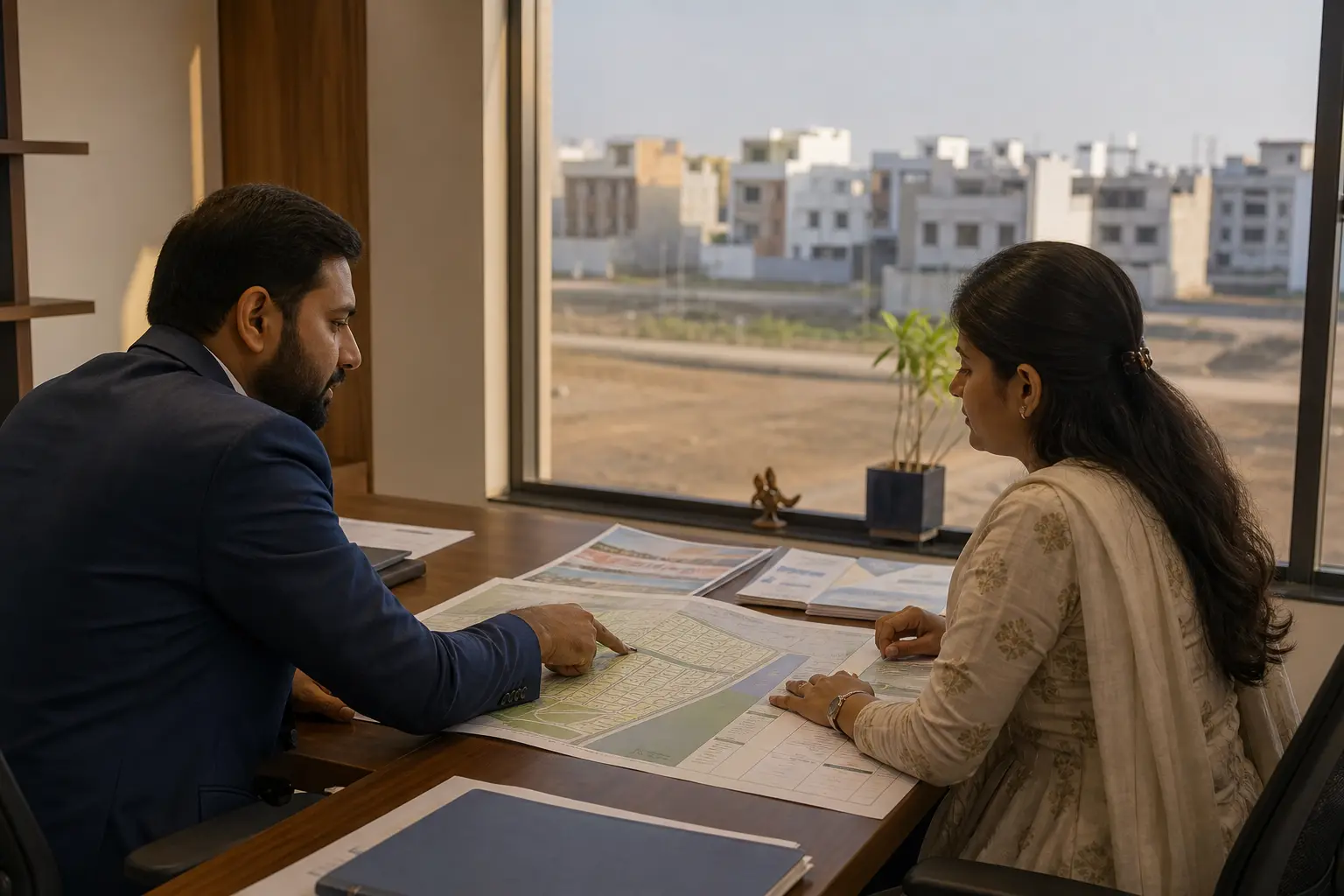
Key Answers in This Guide
- Start with a physical, verifiable presence: The single fastest filter: a dealer with a real office and years of visible history in
- Test their local depth with specific questions: Ask questions only a genuinely local dealer can answer, and watch whether the answers
- Ask these questions before you commit: Four questions separate an advisor from a lead reseller: how they price, what they
- Check RERA agent registration where it applies: For deals in RERA-registered projects, an agent facilitating the sale should hold a
- Fee transparency: disclosed brokerage versus hidden margin: A trustworthy dealer states their brokerage openly, typically around 1% from the buyer
- Red flags worth walking away from: Pressure, bait listings, vagueness on paperwork, hidden fees, and the absence of a
In this guide
In Bhiwadi, the dealer you pick matters more than the portal you browse. A good local dealer saves you from a bad title, a stalled society, or an overpriced plot; a careless one just forwards your number to five people and disappears. Here is how to tell them apart, from someone who has worked only this market since 2008.
Most buyers spend weeks comparing flats and about ten minutes choosing the person who will guide them through a lakhs-sized decision. That ratio is backwards. Properties in Bhiwadi are broadly similar within a budget band; dealers are not. Two dealers can show you the same flat in the same society, and one of them will check the title chain, flag the pending maintenance dues, and negotiate the price down, while the other will simply collect their cut and stop taking your calls. This guide gives you a working method to find the first kind.
Start with a physical, verifiable presence
The single fastest filter: a dealer with a real office and years of visible history in Bhiwadi is far less likely to burn you than a phone number behind a portal listing.
Anyone can make a website. Far fewer have an office you can walk into and a history you can check. Before you trust a dealer with a lakhs-sized decision:
- Find the office on Google Maps and read the reviews, not just the star rating, but what people say about paperwork and follow-through.
- Check how long they have worked Bhiwadi specifically. A dealer who “covers all NCR” rarely knows which Bhiwadi society had a maintenance war or which RIICO plot has a clean allotment chain. Local depth beats geographic breadth every time in property.
- Confirm they actually close deals here, not just list them. Ask for the kind of properties and areas they handled recently.
Now let us turn that checklist into actual craft, because “check the office” means little if you do not know what you are checking for.
How to actually inspect a physical office. Visit without an appointment, during a weekday afternoon. You are not there to be sold to; you are there to observe. Does the office look like a place where work happens, with files, site maps of local societies, and a person who can answer questions when the owner is out? Or is it a bare room with a desk that could be vacated overnight? Ask how long they have been at that address. An office that has stayed put for years in the same market is a form of collateral: the dealer has a reputation tied to a place people can find. Someone who operates only over WhatsApp has nothing at stake if a deal goes sour. Notice also who walks in while you are sitting there. Offices of established dealers get repeat visitors, sellers dropping off papers, old clients asking about a resale. That footfall tells you more than any pitch.
How to read Google reviews beyond the stars. Star ratings are easy to inflate and easy to tank, so read the text instead. Look for reviews that mention specifics: a registry that went smoothly, documents that were verified before token, a dealer who advised against a purchase. Generic five-star reviews posted in a cluster within a few days of each other usually mean a review drive, not a happy client base. Pay special attention to how the dealer responds to negative reviews. A defensive or abusive reply tells you exactly how a dispute with you would go. A calm, factual response, even to an unfair review, tells you the person can handle friction, and property deals always involve friction somewhere. Finally, check the dates. A profile with reviews spread across many years shows a business that has served people continuously, not one that appeared last season.
Test their local depth with specific questions
Ask questions only a genuinely local dealer can answer, and watch whether the answers are specific or vague.
Local depth is the entire value of a dealer, so test it directly. You do not need to be an expert yourself; you only need to ask questions where a vague answer exposes a vague dealer. Try these:
- “Which societies in my budget have had maintenance or RWA disputes?” Every town has a few, and a dealer working the ground knows them by name. Someone reselling portal leads will dodge with “all societies here are fine.”
- “What did a comparable flat in this society actually sell for recently?” Not the asking price, the closing price. A dealer who closes deals knows the gap between the two; a listing forwarder only knows what sellers wish for.
- “Which sectors or belts are seeing genuine end-user demand versus investor churn?” The answer should come with reasoning: proximity to industrial employment, road access, water supply, the practical things families weigh.
- “Who handles registry work in your deals, and where does it happen?” A dealer who has stood in the sub-registrar’s office dozens of times answers without hesitation.
None of these questions require you to know the answers in advance. What you are grading is texture. Real knowledge sounds specific, includes trade-offs, and occasionally includes “I don’t know, let me check.” Fake knowledge sounds smooth and universally positive. For a fuller set of questions to carry into any property conversation, see our guide on questions to ask before buying property in Bhiwadi.
Ask these questions before you commit
Four questions separate an advisor from a lead reseller: how they price, what they verify, what they charge, and what happens after the deal.
The answers tell you whether you are dealing with an advisor or a lead reseller:
- “How do you arrive at a price?” A real dealer prices from deals they personally closed, not from portal asking prices. If the number has no basis, neither does the advice.
- “What will you verify before I visit a property?” The right answer includes title chain, dues, approvals and, for flats, occupancy certificate and RERA status. See our documents checklist for the full list.
- “What do you charge, and when?” Brokerage should be payable on a closed deal, not upfront. Our brokerage-charges guide explains the conventional rates so you can benchmark any quote.
- “What happens after the deal?” Registry support through stamp duty and possession, and reachability afterwards, is the difference between a transaction and a relationship.
Do not treat these as a script to race through. Ask one, then stay quiet and listen. Buyers who talk too much in the first meeting give a weak dealer all the material needed to mirror their hopes back at them. Buyers who ask and listen learn who they are dealing with.
Check RERA agent registration where it applies
For deals in RERA-registered projects, an agent facilitating the sale should hold a Rajasthan RERA agent registration, and you can verify this yourself on the official RERA portal.
Rajasthan’s RERA framework does not only cover builders. Agents who facilitate sales in RERA-registered projects are themselves required to register as real estate agents with the authority. This gives you a verification lever most buyers never use: the Rajasthan RERA website maintains a public directory of registered agents, and you can search it to confirm whether the person or firm you are talking to appears there. It takes a few minutes and costs nothing.
Two caveats so you use this check correctly. First, the requirement attaches to sales in registered projects, so a dealer working purely in older resale properties or plots outside RERA’s project ambit may legitimately operate without it; absence of registration is not automatically damning in those segments, though presence is always a good sign of a dealer who takes compliance seriously. Second, be precise about what registration means. A RERA-registered agent has registered with the authority and is subject to its rules; that is meaningful accountability, but no regulator “approves” or endorses any agent’s quality. Anyone marketing themselves as “RERA-approved” is either careless with words or hoping you are. The correct phrase is RERA-registered, nothing more, and even that is a floor, not a substitute for the checks in this guide.
While you are in a verifying mood, verify the property too. Our guide on RERA and BIDA verification in Bhiwadi walks through checking a project’s own registration and approvals, which matters even more than the agent’s status.
Fee transparency: disclosed brokerage versus hidden margin
A trustworthy dealer states their brokerage openly, typically around 1% from the buyer and 1% from the seller, negotiable; a dangerous one claims to be “free” while loading a hidden margin into your price.
Bhiwadi’s brokerage convention is simple and has been stable for years: roughly 1% of the deal value from the buyer and 1% from the seller, and yes, it is negotiable, especially on larger deals. Any dealer should be able to state their fee in one sentence in the first meeting. Our brokerage-charges guide covers the convention in detail.
The red flag is not a dealer who charges; it is a dealer who pretends not to. “No brokerage from you, sir” sounds generous until you understand where the money actually comes from. In that model, the dealer quotes you a price above what the seller will accept and pockets the difference. The margin is invisible, unlimited, and paid entirely by you. A disclosed 1% on a 40 lakh flat is 40,000 rupees for known work. A hidden margin on the same flat can be two or three times that, and you will never see it, because it is buried inside the number you thought was the seller’s price.
Worse, hidden margin corrupts the advice itself. A dealer earning a disclosed percentage has some interest in closing a fair deal; a dealer earning the spread has a direct interest in keeping you away from the seller and away from the truth about the price. The moment someone refuses to let you speak to the owner, or grows evasive when you ask “what is the seller actually asking?”, assume the answer is margin. Insist on a deal where the seller’s price and the dealer’s fee are two separate, visible numbers. Any dealer who resists that structure has told you what you needed to know.
Upfront fees deserve their own warning. Brokerage is earned when a deal closes. “Registration charges” or “processing fees” demanded before you have even shortlisted a property are how buyers lose small amounts to people they never hear from again.
Red flags worth walking away from
Pressure, bait listings, vagueness on paperwork, hidden fees, and the absence of a findable office: any one of these is reason enough to walk.
- Pressure and false scarcity. “Book today or lose it” is a sales tactic, not market reality.
- Showing sold listings as bait. Live, currently-available inventory only.
- Vague on paperwork. If a dealer is uncomfortable discussing title and approvals, that is your answer.
- No physical office or verifiable history. In any Indian property market, a dealer you can physically find is your first safety filter.
- “No brokerage” with no explanation of how they earn. As covered above, free usually means hidden, and hidden usually means expensive.
- Reluctance to put anything in writing. A dealer confident in a property’s papers will happily let you photograph documents and consult a lawyer. Discomfort with scrutiny is a verdict.
- Answering every question with a benefit. Ask about maintenance disputes and hear about the clubhouse; ask about the title and hear about the view. Deflection as a conversational habit means deflection at deal time too.
None of these red flags require proof of bad intent. You are not running a court; you are allocating trust. When a signal is bad, the correct response is to leave politely and talk to someone else. Bhiwadi is not short of dealers.
Match the dealer to your deal
Residential and industrial property are different professions in Bhiwadi; pick a dealer who actually works in your segment.
Residential and industrial are different skills. A great flats dealer may know nothing about RIICO allotment; an industrial specialist may not track which society is family-friendly. If you are buying an industrial plot or factory, pick someone who lives in that world. Most industrial deals close before they ever reach a portal, so network access matters as much as knowledge.
The differences run deeper than inventory. Residential work is about people: which societies function well, where schools and markets sit, how a family will actually live in a place, how to read a seller’s real motivation. Industrial work is about process: RIICO allotment conditions, transfer procedures, conversion and land-use questions, plot dues, power sanction, the compliance trail a factory buyer inherits along with the land. A residential dealer improvising in industrial can miss a transfer condition that costs the buyer months; an industrial specialist improvising in residential can miss the soft, human information that decides whether a family is happy in a society. When you interview a dealer, ask what share of their recent deals sits in your segment. A truthful “mostly residential” or “mostly industrial” is useful; a claim of equal mastery in both should raise your eyebrows, because in practice almost nobody splits their days that way.
Buying direct from the seller versus through a dealer
Going direct is genuinely fine in a few situations; in the rest, a good dealer earns their fee in verification, pricing, and process, not in showing you a door.
Let us be straight about this, because a dealer writing “you need a dealer” convinces nobody. There are situations where going direct makes sense. If you are buying from a close relative or a friend whose ownership history you personally know, if you are an experienced local buyer who has done registries before and can read a title chain, or if the deal is a straightforward builder purchase in a RERA-registered project where the developer’s own documentation team handles process, a dealer adds less. In those cases, save the fee and simply be disciplined about the paperwork; our step-by-step guide on how to buy property in Bhiwadi covers the full process either way.
For everyone else, understand what a good dealer actually adds, because it is not the introduction. Sellers can be found on any portal. What you are paying roughly 1% for is the work around the introduction: pricing grounded in closed deals rather than asking prices, so you neither overpay nor insult a seller with a fantasy offer; verification of the title chain, dues, and approvals before your emotions attach to a property; negotiation by someone who does it weekly and is not emotionally invested in this particular house; a filter against the sellers and properties a local dealer already knows to avoid; and hands-on management of token, agreement, stamp duty, and registry, where a first-time buyer makes the most expensive mistakes. Direct buyers most often go wrong in exactly two places: they price off portal listings, and they discover a paperwork problem after paying the token. Both are precisely where a competent dealer front-loads the work.
The comparison, plainly stated: direct saves you around 1% and costs you insurance. Whether that trade is good depends on your experience, not on the dealer’s marketing or on this article.
What “no pressure” looks like in practice
No pressure is not a slogan; it is a set of observable behaviours, starting with a dealer who lets a property fail your inspection.
Every dealer in India claims to be no-pressure. Ignore the claim and watch the behaviour. Operationally, no pressure looks like this:
- You set the pace. After a site visit, the dealer waits for you to call back. One follow-up is service; daily calls asking “sir, decision?” is pressure wearing a polite voice.
- Deadlines come with reasons you can verify. Sometimes urgency is real, a seller genuinely has another offer. A no-pressure dealer tells you the reason and accepts that you might still say no. A pressure merchant manufactures urgency for every property, every time.
- Negative information arrives unprompted. The flat is on a lower floor and the society has had water complaints in summer; a straight dealer says so before you ask. If every property you are shown is flawless, you are being sold, not advised.
- “Don’t buy this one” is a sentence they can say. The strongest operational test: does the dealer ever steer you away from a property they could earn on?
- Your lawyer is welcome. A no-pressure dealer treats independent legal review of documents as normal, because it is.
- Silence is respected. If you disappear for three weeks to think, the relationship is intact when you return.
Pressure is not always loud. It also lives in small manipulations: showing you a bad property first so the next one shines, quoting a fictional “other buyer visiting tomorrow,” or making you feel a refusal would be rude after so many site visits. You owe a dealer courtesy, never a purchase.
After the token: where the real service begins
A good dealer’s work does not end at the token; it runs through agreement, payment schedule, stamp duty, registry, and handover, and they remain reachable after all of it.
Many buyers judge a dealer by everything that happens before money moves. In truth, the period between token and registry is where dealers earn or destroy their reputation, because this is when the buyer is most committed and most exposed.
Here is what the after-token phase should look like with a professional. The token amount is documented, not handed over loose: a receipt or an agreement to sell that records the price, the payment schedule, the time allowed for the buyer’s remaining checks, and the conditions under which the token is refundable. The dealer then keeps the file moving: chasing the seller for pending documents, coordinating any loan formalities with the bank’s legal and valuation teams, getting the stamp duty calculation right, booking the registry appointment, and standing with both parties at the sub-registrar’s office on the day. Small things matter here: witnesses arranged, photographs and identity documents in order, the exact payment mode agreed so nobody stands at the registry counter arguing about a demand draft.
Then comes handover: physical possession, original documents delivered, electricity and water connections transferred, society records updated with the new owner’s name. Weeks later, the registered sale deed has to be collected and handed to you. A dealer who treats the token as the finish line abandons you across all of this, and this is exactly the stretch where an abandoned buyer feels it most. When you interview a dealer, ask them to walk you through their last deal from token to handover, step by step. Fluency in that narrative is experience; fumbling is a warning.
One more test that costs nothing: ask for the number of a past client whose registry they handled. A dealer with a genuine service record will have people happy to take that call.
Patterns we have seen since 2008
Eighteen years in one market teaches you that the same few mistakes and the same few virtues repeat in every cycle.
Working a single market for eighteen years does not make anyone a prophet, but it does make the patterns hard to miss. A few that repeat, cycle after cycle:
Buyers regret hurried decisions, almost never careful ones. In nearly two decades we cannot recall a client who regretted taking an extra fortnight to verify documents. We can recall plenty who regretted a token paid in a weekend of excitement.
The cheapest quote is often the most expensive deal. When one price sits well below every comparable, there is a reason, and the reason is rarely a generous seller. Dues, disputes, or a documentation problem usually surface later, at the buyer’s cost.
Paperwork problems announce themselves early, in small ways. A seller slow to produce one document is usually slow to produce all of them. Delay is data.
Relationships outlast transactions. The buyers who came through references, a brother, a colleague, a factory neighbour, have always outnumbered those who came through advertising. That is not a boast; it is the economics of a small market. In a town like Bhiwadi, a dealer who burns a client loses not one client but a whole circle of them, which is precisely why the physical, long-standing, findable dealer is structurally safer: their incentives point the same direction as yours.
Markets swing; process does not. Bhiwadi has seen quiet years and busy years since 2008. The verification steps that protect a buyer are identical in both. Dealers who loosen their process in hot markets are the ones whose clients call lawyers in cold ones.
The honest test
The strongest single signal of a trustworthy dealer is a willingness to lose a sale by telling you not to buy.
A trustworthy dealer will sometimes tell you not to buy: that the price is wrong, the society is risky, or nothing currently fits your budget. That single willingness to lose a sale is the strongest signal you will find. It is the standard we hold ourselves to, whether you are buying or selling in Bhiwadi.
Everything else in this guide, the office visit, the review reading, the RERA directory check, the fee questions, the after-token expectations, exists to help you find the dealer who passes that one test. Use the checklist, trust the specific over the smooth, and remember that in property, the person guiding you matters more than the portal that found you.
Want a straight, no-pressure conversation about your requirement? Tell us what you are looking for. We will tell you plainly what your budget actually buys, and what to watch out for.
Verify Before You Pay, We Will Help
18+ years in this market. Real prices, verified paperwork, no pressure.
Choose what you would like to do next:
Done — our team will contact you during working hours.