Key Answers in This Guide
- What an Agreement to Sell Is: An agreement to sell is a contract between the buyer and the seller.
- What a Sale Deed Is and Why Registration Matters: The sale deed, called registry in everyday Bhiwadi language, is the instrument that actually transfers ownership from the seller to you.
- The Timeline: Token to Agreement to Sale Deed to Mutation: A normal Bhiwadi resale purchase runs in this order.
- Where Token, Booking Amount and Brokerage Sit in This Sequence: Three payments confuse buyers, so here is each one placed on the timeline.
- What Can Go Wrong: Most Bhiwadi property disputes trace back to one of a few patterns.
- Stamp Duty and Registration Costs at the Sale-Deed Stage: The big statutory costs land at registration, and you should budget for them at the very start, because they change what you can afford.
In this guide
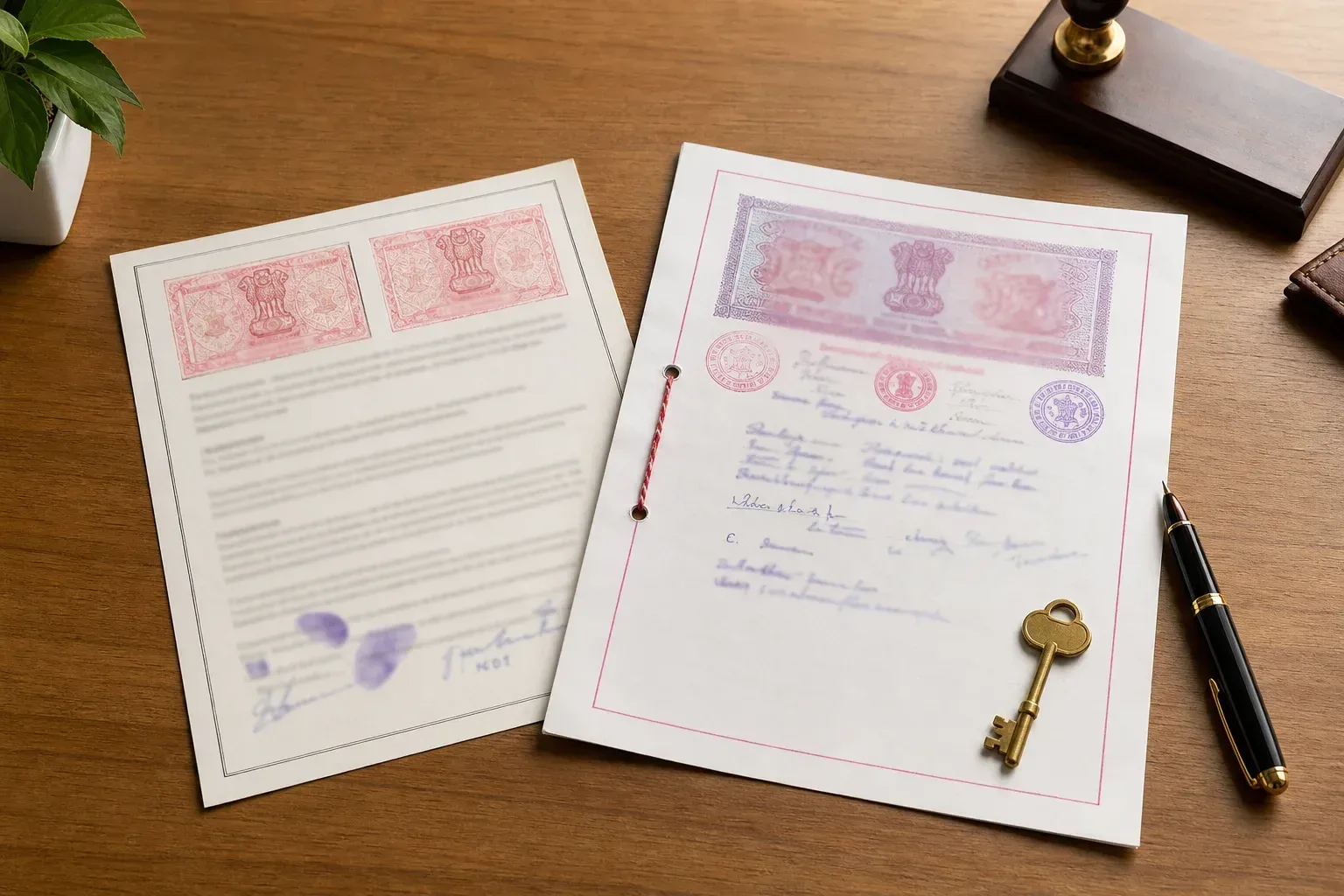
The agreement to sell is a promise. It records that the seller will transfer the property to you in future, at an agreed price, on agreed conditions. The sale deed, registered at the Sub-Registrar office, is the transfer itself; until it is registered, ownership has not moved to you.
Buyers in Bhiwadi mix these two documents up all the time. Some pay most of the price on an agreement to sell and assume the deal is done. Some treat the sale deed as a formality and skip reading it. Both mistakes cost money, and sometimes the property itself. This article explains what each document does, when each is signed, where your money sits at each stage, and where an independent property lawyer must step in.
One thing before the detail. We are a property dealer, not a law firm. Shivam Properties has closed Bhiwadi deals since 2008, and we check documents before we put a property in front of you. That check is preliminary. It never replaces a title and agreement review by an independent property lawyer for the specific property you are buying. We will repeat this because it matters more than anything else on this page.
What an Agreement to Sell Is
An agreement to sell is a contract between the buyer and the seller. It says: the seller agrees to sell this specific property to this specific buyer at this price, and the sale will complete by a certain date if certain conditions are met.
Under Indian law, an agreement to sell does not transfer ownership. It creates a right to demand the transfer. If the seller backs out without cause, you can sue for specific performance, meaning a court may order the seller to complete the sale, or you can claim damages. Specific performance is discretionary and depends on the facts and the applicable law; it is not automatic. That is a real legal right, but it is a right to fight for the property, not the property itself.
This matters in practice. After you sign an agreement to sell, the seller is still the owner on paper. The land record still shows their name. If they are dishonest, they can attempt to sell to someone else, mortgage the property, or create other claims on it. A well-drafted agreement, proper due diligence before signing, and a short gap between agreement and sale deed all reduce this risk. They do not remove it. Ownership moves only when the sale deed is registered.
What a good agreement to sell should contain
An agreement to sell for a Bhiwadi flat, plot, or house should record, at minimum:
- Full identity of both parties. Names, parentage, addresses, PAN and Aadhaar references as applicable. If the seller holds through a power of attorney, the agreement must say so and the POA must be examined by your lawyer.
- Complete property description. Plot or unit number, sector or scheme, area in exact terms, boundaries, and the project or colony name. Vague descriptions create disputes later.
- Total sale price. The full figure, in words and numbers. Nothing kept verbal.
- Payment schedule. How much has been paid as of signing, how much is due at the sale deed, and any instalments in between, with dates.
- Money already paid. The token money and booking amount you have paid so far, acknowledged in writing as part of the price. See our page on token money, booking amount and brokerage for how these amounts work before the agreement stage.
- Time for completion. The date by which the sale deed will be executed and registered. Also what happens if either side delays.
- Condition of title. A statement that the seller has clear, marketable title, that the property is free of encumbrance, and that the seller will hand over all original documents at the sale deed.
- Who pays what. Stamp duty, registration fee, and cess are normally the buyer’s cost in Rajasthan. Society dues, pending electricity and water bills, and property tax up to the handover date are normally the seller’s. Write it down either way.
- Default clauses. What happens to your money if the seller backs out, and what happens to your money if you back out. A common structure is that the seller refunds double the advance if they default, and forfeits the advance if the buyer defaults. Whatever the structure, it must be in the document, not in conversation.
- Possession terms. Whether possession passes at the sale deed or at some other point, and in what condition.
- Loan condition, if you need one. If your purchase depends on a home loan, the agreement should say the advance is refundable if the bank rejects the loan for reasons of the property’s title or valuation. Without this clause, a loan rejection can cost you your advance.
If a seller or their dealer resists putting any of these in writing, treat that as a warning. Our page on common property mistakes in Bhiwadi covers what happens when buyers accept thin, one-page agreements.
Should the agreement to sell be registered or notarised?
In common Bhiwadi practice, an agreement to sell is executed on non-judicial stamp paper and often notarised. Notarisation confirms the identity of signatories and the date; it does not make the document a transfer of ownership, and it does not verify that anything written in it is true.
Some buyers choose to register the agreement to sell at the Sub-Registrar office as well. Registration of the agreement gives it a public record and can strengthen your position if a dispute arises. It still does not transfer ownership. Whether to register the agreement, and how much stamp duty applies to it in your case, is exactly the kind of question your own lawyer should answer for your specific deal. Do not take a dealer’s word on it, including ours.

What a Sale Deed Is and Why Registration Matters
The sale deed, called registry in everyday Bhiwadi language, is the instrument that actually transfers ownership from the seller to you. It is signed by both parties, witnessed, stamped with the applicable duty, and presented at the Sub-Registrar office, where both parties appear, are photographed, give thumb impressions, and the document is entered in government records.
The Registration Act makes registration compulsory for a sale of immovable property of this kind. An unregistered sale deed does not transfer title. This is the single most important legal fact in the entire buying process. A stack of receipts, a notarised agreement, and full payment together do not make you the owner. Only a registered sale deed does.
Registration does three things for you:
- It completes the transfer. From the date of registration, you are the owner in law.
- It creates a public record. Anyone searching the Sub-Registrar’s records will find your deed. This protects you against a later claim that the seller sold the same property twice.
- It anchors everything downstream. Your home loan disbursement, mutation of the land record into your name, electricity and water connection transfers, and any future resale all rest on the registered deed.
A sale deed should contain the same core facts as the agreement to sell, now stated as completed: the parties, the full property description, the total consideration and confirmation that it has been received, the chain of the seller’s title, delivery of possession, handover of original documents, and the seller’s covenant that the title is clear and that they will assist with any future formality. Read the deed before the registration appointment, not at the counter. Better, have your lawyer read it. The step-by-step registration process, slot booking, and what happens at the office are covered in our guide to registry charges in Bhiwadi.
The Timeline: Token to Agreement to Sale Deed to Mutation
A normal Bhiwadi resale purchase runs in this order. Timelines vary with loans and paperwork, but the sequence does not change.
Token (sai)
A small, usually refundable amount holds the property off the market while papers are checked. Insist on a written receipt.
Document verification
Title chain, land record, encumbrance and dues, cleared by your own independent lawyer, not just the dealer.
Bayana (agreement to sell)
Both sides sign and the booking amount is paid, with a mohlat window set to arrange the loan. From here both sides are bound.
Sale deed (bainama)
Stamp duty and registration fee paid, then the deed is executed and registered at the Sub-Registrar. Ownership transfers here.
Mutation (namantaran)
The revenue record is updated to your name. Only now is the record-side change complete.
Step 1: Shortlist and site visits. You see properties, compare prices, and pick one. No money changes hands. Our full walkthrough is in how to buy property in Bhiwadi.
Step 2: Token money. You pay a small amount to hold the property while documents are checked. The token takes the property off the market for an agreed short period. Insist on a written receipt that names the property, the total agreed price, the token amount, and the refund condition if documents fail verification.
Step 3: Document verification. This is where the deal is really won or lost. The seller’s title chain, the current land record, encumbrance status, and dues are checked. For plots and independent houses, pull the record yourself through Apna Khata, the Rajasthan land records portal, and match the seller’s name against it. The full list of papers to demand is in documents required to buy property in Bhiwadi. A dealer’s verification at this stage is a first filter. Your independent lawyer’s title report is the real clearance. Pay for it before you pay anything more to the seller.
Step 4: Agreement to sell and booking amount. Once the lawyer clears the title, both sides sign the agreement to sell. At or around signing, you pay the booking amount, a larger part-payment of the price. The token already paid is adjusted into it. From here, both sides are contractually bound.
Step 5: Loan processing, if applicable. The bank does its own legal and technical verification of the property and sanctions the loan. The bank’s check protects the bank, not you; it is a useful second opinion, not a substitute for your own lawyer.
Step 6: Sale deed execution and registration. On the agreed date, the balance price is paid, usually by banker’s cheque or bank transfer, with the loan portion disbursed by the bank at or around registration. Both parties appear at the Sub-Registrar office, the deed is registered, and the seller hands over original documents and possession as agreed.
Step 7: Mutation. After registration, you apply to have the land or municipal record updated to your name. Mutation is a revenue and tax record, not proof of ownership by itself, but you need it for property tax, resale, and clean records. For land, the updated entry will reflect on Apna Khata. Do not skip this step or postpone it for years.
Step 8: Utility transfers and society records. Electricity, water, and the RWA or society record move to your name against the registered deed.
The gap between agreement and sale deed is usually a few weeks to a couple of months, driven mostly by loan timelines. Keep it as short as your finances allow. A long gap between agreement and registration is a long window of avoidable risk.
Where Token, Booking Amount and Brokerage Sit in This Sequence
Three payments confuse buyers, so here is each one placed on the timeline.
Token money comes first, before any agreement is signed. It is a holding payment. It should be small relative to the price, it should have a written receipt, and its refund terms should be explicit: refundable if title verification fails, adjustable into the price if the deal proceeds. Paying a large token before your lawyer has seen a single document is the most common early mistake we see.
Booking amount comes at the agreement to sell stage. It is a part-payment of the sale price, made under the protection of a signed contract that spells out default consequences. The token merges into it. Between the agreement and the sale deed, further instalments may follow if the payment schedule says so.
Brokerage is the dealer’s fee, separate from the price. It is typically settled at or around the sale deed, when the transaction the dealer facilitated actually completes. Agree the brokerage percentage and who pays it, buyer, seller, or both, before you pay any token, and get it in writing. Our page on token money, booking amount and brokerage covers customary Bhiwadi ranges and receipt formats.
Two payment rules that protect you at every stage:
- Pay by bank transfer or cheque wherever possible, into the seller’s own account, and keep every receipt. Cash payments weaken your legal position and can create tax problems for you.
- Never let your total payment run far ahead of your legal position. Before the agreement, you should have paid only a token. Before the registered deed, you should not have paid amounts that would ruin you if the deal collapsed and you had to litigate.
What Can Go Wrong
Most Bhiwadi property disputes trace back to one of a few patterns. All of them come from confusing the promise with the transfer.
Paying heavily on an agreement alone
A buyer pays 70 or 80 per cent of the price on the agreement to sell, then the seller stalls the registration. The buyer is not the owner. Their remedy is a suit for specific performance or refund, which takes time and money, while the seller holds both the property and most of the price. Structure your payments so the bulk moves at registration, not before.
No sale deed at all
Some old Bhiwadi-area deals, especially in unapproved colonies, were done entirely on agreement, receipts, and possession. The occupant has lived there for years and believes they own it. They do not, in the way the law recognises, and they discover this when they try to sell, mortgage, or pass the property to heirs. If you are offered such a property, the price will look attractive. Do not buy a property where the seller cannot execute a registered sale deed in your favour. Whatever regularisation route may or may not exist for a given colony is a question for a lawyer, not a reason to pay first.
Unregistered POA and “agreement plus POA” deals
A structure you will still meet in the market: instead of a sale deed, the seller gives you an agreement to sell, a general power of attorney, and possession, and calls it a sale. Courts have made clear that this structure does not transfer ownership. It was historically used to dodge stamp duty and to trade property with unclear title. If a seller pushes an agreement-plus-POA deal instead of a registered sale deed, walk away, whatever the discount. A genuine POA situation, for example an owner living abroad who authorises a relative to execute the sale deed, is different, but the POA itself must be examined and verified by your lawyer, including whether it is properly executed, registered where required, still in force, and whether the principal is alive.
Same property sold twice
Because the agreement to sell leaves the seller as owner, a dishonest seller can sign agreements with two buyers. The buyer who reaches a registered sale deed first, without notice of the other deal, is usually in the stronger position. Shorten the agreement-to-registration gap, and consider registering the agreement itself on your lawyer’s advice.
Undervaluation pressure
A seller or middleman may propose writing a lower price in the sale deed to cut stamp duty, with the balance in cash. Refuse. The duty is charged on the DLC value anyway if that is higher, the cash component has no legal protection, you inherit a capital-gains problem on resale, and undervaluation is an offence. A clean deed at the real price is cheaper than the consequences.
Skipping the lawyer because “everything is checked”
The dealer has seen the papers, the bank has done legal verification, the seller seems genuine. None of these is your lawyer. The dealer’s check is preliminary and the dealer is not a legal professional. The bank’s lawyer works for the bank and only to the depth the bank needs. An independent property lawyer, engaged and paid by you, reviewing the title chain, the agreement draft, and the sale deed draft, is the one professional in the deal whose only job is protecting you. For a few thousand rupees of fees on a purchase of many lakhs, it is the best money in the transaction.
The list of questions that flush out these problems early is in questions to ask before buying property in Bhiwadi.
Stamp Duty and Registration Costs at the Sale-Deed Stage
The big statutory costs land at registration, and you should budget for them at the very start, because they change what you can afford.
In Rajasthan, stamp duty on a sale deed is roughly 6 per cent for male buyers and 5 per cent for female buyers. It is charged on the higher of your actual deal value and the DLC value, the government’s minimum rate for that area, also called the circle rate. On top of the duty, you pay a registration fee of 1 per cent and a surcharge of 30 per cent of the stamp duty amount.
Example, clearly hypothetical: a male buyer purchases a flat for Rs 40 lakh, and the DLC value for the unit is Rs 38 lakh. Duty is charged on Rs 40 lakh, the higher figure. Stamp duty is about Rs 2.4 lakh, the registration fee about Rs 40,000, and the cess about Rs 48,000, roughly Rs 3.28 lakh in all. If the buyer were female, the duty drops to about Rs 2 lakh and the total to roughly Rs 2.8 lakh. Rates and concessions change with state budgets, so confirm the current figures before you fix your registration date; our registry charges in Bhiwadi page tracks them.
Three practical points:
- If the property will be in a woman’s name, or jointly with a woman, the duty saving is real money. Decide ownership structure before the agreement to sell is drafted, because the agreement should name the actual intended buyer or buyers.
- These costs are over and above the price and are almost never financed by a standard home loan. Keep them liquid.
- The agreement to sell should state who bears these costs. In Bhiwadi practice it is the buyer, but write it down.
Why You Still Need an Independent Lawyer
Here is the honest division of labour in a Bhiwadi deal.
A good property dealer in Bhiwadi finds you the right property, tells you what the market price is, collects the seller’s documents, does a first-pass check for obvious problems, coordinates the bank, and manages the registration logistics. That is real work and it filters out many bad deals before you ever see them.
A lawyer does what a dealer cannot. They read the full title chain and confirm the seller can legally sell. They search encumbrances. They examine any POA, inheritance, court order, or company resolution in the chain. They draft or vet the agreement to sell so the default, refund, and timeline clauses actually protect you. They vet the sale deed before you sign it. They tell you when to walk away.
Engage the lawyer before you pay token money, or at the latest before you sign the agreement to sell, not on the morning of registration. Pick a lawyer with property practice in the Bhiwadi and Alwar-district area, engaged and paid directly by you, not one supplied by the seller. If a dealer discourages you from involving a lawyer, that tells you everything you need to know about the dealer.
We say this as a dealer: our document check protects the quality of what we list. Your lawyer’s review protects you. You need both, and they are not interchangeable.
Document Comparison at a Glance
| Document | When signed | What it legally does | Red flag | Independent check |
|---|---|---|---|---|
| Token receipt | Before anything else, to hold the property | Records a holding payment and its refund terms; no rights over the property | No written receipt, or the refund condition left verbal | Receipt names the property, price, token amount and refund condition |
| Agreement to sell | After title verification clears | Binds both sides to complete the sale on stated terms; ownership stays with seller | Seller resists putting price, schedule or default clauses in writing | Lawyer’s title report cleared before signing; every rupee paid so far acknowledged in the document |
| Sale deed (registered) | On completion, at the Sub-Registrar office | Transfers ownership to you from the date of registration | Seller offers a POA and possession instead of a registered deed, or proposes undervaluing the deed | Lawyer vets the draft before the registration appointment; terms match the agreement to sell |
| Mutation entry | After registration | Updates revenue and municipal records to your name; supports tax and future resale | Mutation left unfiled for years after registration | Updated entry reflects on Apna Khata for land |
Terms you meet along the way, from bayana to registry to jamabandi, are explained in the Bhiwadi property glossary.
Buyer Checklist
Before token:
- Agree total price, and get brokerage terms in writing.
- Take a written token receipt naming the property, price, amount, and refund condition.
- Engage your own property lawyer.
Before signing the agreement to sell:
- Lawyer’s title report in hand and clear.
- Seller’s name matches the land record; for land, verified on Apna Khata.
- All original documents sighted, not photocopies alone.
- Agreement contains price, schedule, completion date, default clauses, and loan condition if needed.
- Every rupee paid so far is acknowledged inside the agreement.
Before the sale deed:
- Read the deed draft; have your lawyer vet it.
- Confirm current stamp duty, registration fee, and cess, and keep the funds ready.
- Confirm the seller will hand over all originals and vacant possession at registration.
- Reconfirm no new encumbrance was created after the agreement.
After registration:
- Collect the registered deed and all originals.
- Apply for mutation immediately.
- Transfer electricity, water, and society records.
- Keep the deed, receipts, and lawyer’s report together permanently.
Frequently Asked Questions
Does an agreement to sell make me the owner?
No. It gives you an enforceable right to have the property transferred to you on the agreed terms. Ownership passes only when the sale deed is registered at the Sub-Registrar office.
Can I skip the agreement to sell and go straight to the sale deed?
Legally, yes, if both sides are ready to complete immediately. In practice the agreement stage exists because verification, loan sanction, and fund arrangement take time, and both sides want binding terms during that gap. Skipping it makes sense only in a genuine same-week cash completion, and even then your lawyer should vet the deed first.
Is a notarised agreement to sell enough proof that I own the property?
No. Notarisation only authenticates signatures and date. A notarised agreement, even with full payment and possession, does not transfer ownership. Only a registered sale deed does.
What happens to my token and booking amount if the deal falls through?
It depends entirely on what is written. A proper token receipt makes the token refundable if title verification fails. A proper agreement to sell states what happens on each side’s default; commonly the seller refunds double the advance if they back out, and the buyer forfeits the advance if they do. If nothing is written, you are left negotiating or litigating from a weak position, which is why every payment needs paper.
Who pays stamp duty and registration charges in Bhiwadi?
By prevailing practice, the buyer pays stamp duty, roughly 6 per cent for men and 5 per cent for women on the higher of deal value and DLC value, plus the 1 per cent registration fee and the 30 per cent surcharge on the duty. The agreement to sell should still record this expressly.
The seller is offering a power of attorney and possession instead of a registered sale deed. Is that safe?
No. An agreement-plus-POA arrangement does not transfer ownership, and courts have rejected it as a mode of sale. Insist on a registered sale deed. If the true owner cannot appear, a properly executed and verified POA authorising someone to sign the sale deed on their behalf can work, but only after your lawyer examines that POA.
My dealer has checked all the documents. Do I still need a lawyer?
Yes. A dealer’s check, including ours, is a preliminary filter by a market professional, not a legal opinion. Only an independent property lawyer can give you a title report and vet the agreement and deed for your specific purchase. Budget for the fee; it is small against the price of the property.
This article is general information about how property transactions work, not legal advice for any specific property; consult an independent property lawyer before you sign or pay anything.
Shivam Properties has worked Bhiwadi transactions since 2008 and is a Rajasthan RERA-registered agent, RAJ/A/2026/21898. We will show you the property, share every document we hold, and stand with you at the Sub-Registrar office. Your lawyer signs off on the paper. That is how a clean Bhiwadi deal gets done.
Verify Before You Pay, We Will Help
18+ years in this market. Real prices, verified paperwork, no pressure.
Choose what you would like to do next:
Done — our team will contact you during working hours.