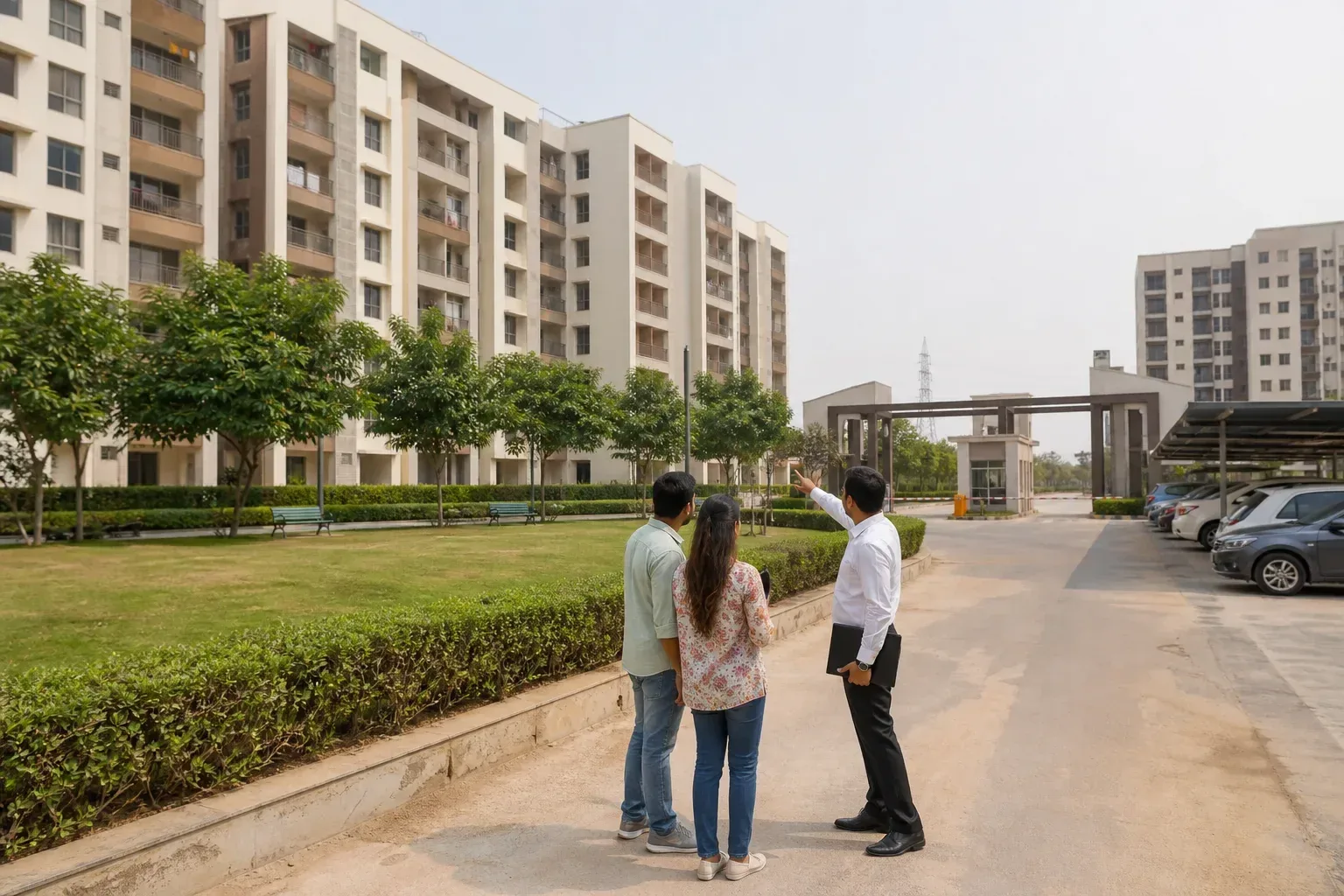
Key Answers in This Guide
- Physical Condition: Walk the Whole Society, Not Just the Flat: Lifts are the single most telling piece of society infrastructure.
- Essential Services: Water, Power, Sewerage, Waste: Services are where daily life is actually lived.
- Society Management: Money, Rules, and Who Runs the Place: The management layer is the hardest to see on a walk and the most decisive over ten years of living.
- Occupancy and Environment: Who Lives Here, and What Surrounds It: Occupancy is the single strongest predictor of a society's future, because occupied flats fund maintenance and empty ones do not.
- Location Access: How the Society Connects to Your Life: A society can be excellent internally and still fail you on access.
- Documents and Charges: What to Verify on Paper: Physical inspection tells you how the society lives.
In this guide
Inspect the society as hard as you inspect the flat. The flat decides how your rooms look; the society decides how your days go and what your resale fetches. Occupancy levels, water supply, power backup and the health of the maintenance system predict your daily life better than any brochure.
Most buyers in Bhiwadi spend an hour inside the flat and ten minutes in the society. Reverse that ratio. A well-kept flat inside a failing society is a bad buy. An average flat inside a well-run, well-occupied society is usually a safe one. This guide gives you the full checklist: what to look at, what to ask, and what to verify on paper before you pay a booking amount.
We have dealt in Bhiwadi property since 2008. The complaints that come back to us after possession almost never concern the flat itself. They concern the lift that stays broken, the water tanker bill, the maintenance dispute, the empty tower next door. Every item below exists because some buyer somewhere skipped it.
The society you are buying into matters more than the flat you are buying, because you can renovate a flat but you cannot renovate a society alone.
If you are still deciding between an apartment and independent land, read flats vs plots in Bhiwadi first. If you have settled on a flat, browse the current options on our flats in Bhiwadi page, then bring this checklist to every visit.
Physical Condition: Walk the Whole Society, Not Just the Flat
Start outside the flat. The common areas tell you how the society is run, because common areas are what maintenance money actually buys.
Entrance and boundary
Look at the main gate first. Is there a functioning boom barrier or gate that actually closes? Is the guard cabin manned? Is there a visitor register or entry app in use? A gate that stands open all day with no guard tells you security is a line item on paper, not a practice.
Walk the boundary wall where you can. Check for broken sections, gaps, or places where the wall is low enough to climb. In societies that back onto open land, which is common on Bhiwadi’s expanding edges, the rear boundary matters as much as the front gate.
Lifts
Lifts are the single most telling piece of society infrastructure. Check:
- How many lifts serve each tower, and how many are working today. Ask residents, not the guard.
- The lift interior. Scratched panels and broken buttons are cosmetic. A missing inspection certificate, a jerky ride, or doors that hesitate are not.
- Whether there is a service contract with the lift company. Ask the maintenance office for the AMC status.
- What happens during a power cut. A lift with no backup traps people. Ask specifically whether the lift runs on the generator.
If you are looking at a flat on the fourth floor or above, a dead lift is not an inconvenience; it changes whether elderly parents can live with you. Treat lift condition as a core criterion, not a detail.
Staircases and corridors
Take the stairs from the ground floor to the flat at least once. You will see what the lift hides: paan stains, broken railings, missing lights, stored junk, locked fire doors. Corridors and staircase landings are shared space; their condition reflects both the maintenance budget and the residents’ habits.
Check corridor lighting. Visit once after dark if you can. Dark corridors signal either unpaid electricity dues or a society that has stopped caring.
Parking
Parking disputes are among the most common society conflicts in India. Verify:
- Whether the flat comes with an allotted parking slot, and whether that allotment is in writing.
- Whether the slot is covered, open, or stilt, and what you are being charged for it.
- Whether visitors have anywhere to park.
- Whether the driveways are clear or choked with double-parked cars. Choked lanes on a normal weekday afternoon mean the society has more cars than slots, and the problem only grows.
Ask the seller to show you the exact slot. Do not accept “parking is available” as an answer. Parking allotment and its charges should appear in your paperwork; our guide to documents required to buy property in Bhiwadi covers where it fits.
Seepage and structural condition
Seepage is the most expensive defect to fix and the easiest to hide behind fresh paint. Look for it in the places paint cannot reach:
- Ceiling corners of the top-floor corridors and the flat itself, especially below terraces.
- Walls shared with bathrooms and kitchens, on both sides.
- The basement or stilt ceiling, directly below overhead plumbing lines.
- External walls, viewed from outside. Vertical stain trails below windows and along drain pipes show where water travels every monsoon.
Bhiwadi’s monsoon is short but intense. A society that leaks will show its history in stains even in dry months. Also scan external walls for wide cracks, exposed rebar, or patches of fallen plaster. Hairline plaster cracks are normal in older buildings; structural cracks that run diagonally from window corners are not, and you should ask a structural engineer to look before proceeding.
Common areas and amenities
Check every amenity the seller or builder mentions. Is the park maintained or overgrown? Does the community hall open, or is it locked and used for storage? If there is a gym, do the machines work? If there is a swimming pool, is there water in it and a maintenance log for it?
Unused amenities are not free. Their upkeep sits inside your maintenance bill whether you use them or not. A society with a modest, working set of amenities is often a better buy than one with an ambitious, dead set.
Fire safety equipment
Walk each floor lobby and look for fire extinguishers, hose reels, and fire exit signage. Check the extinguisher tags for a refill date; an extinguisher last refilled years ago is decoration. Ask whether the fire pump room is functional and whether the society holds a current fire NOC where applicable. Most buyers never ask; the ones who need the answer only find out during an emergency.
Essential Services: Water, Power, Sewerage, Waste
Services are where daily life is actually lived. A society can look immaculate and still run out of water by evening.
Water source and supply hours
Ask three questions, and ask them of residents, not the sales office:
- Where does the water come from? Municipal supply, society borewell, tankers, or a mix?
- How many hours a day does water run in the taps, and at what times?
- How often do tankers come, and who pays for them?
Tanker dependence is the key warning sign. A society that buys tanker water regularly has a structural shortfall, and tanker costs land in the maintenance bill or as separate collections. Ask to see a recent maintenance bill; tanker charges, if any, will usually appear on it.
Also ask about water quality. Borewell water in parts of the region runs hard, which scales geysers, taps and washing machines. Ask whether the society has a treatment or softening plant and whether it actually runs. Residents will tell you; look at the taps in an occupied flat if you get the chance, since hard water leaves white scale you can see.
Water pressure
Turn on taps during your visit, ideally on an upper floor and during morning hours when demand peaks. Weak pressure on the top floors means undersized pumps or overhead tanks, and that does not fix itself. If the flat you are viewing is vacant and disconnected, ask a resident on the same floor about pressure.
Power cuts and backup
Bhiwadi’s power situation has improved over the years, but cuts still happen, and industrial-area load can affect supply patterns. Ask residents:
- How often does power go, and for how long?
- Does the society have generator or inverter backup for common areas: lifts, water pumps, corridor and gate lights?
- Is there power backup to individual flats? If yes, how many kilowatts per flat, and what is the per-unit backup rate?
Backup billing matters. Diesel-generated units cost several times grid units. A society that gives generous backup at a high per-unit rate can produce surprising monthly bills. Get the backup tariff in writing or on a sample bill.
Also check the electrical rooms if you pass them. Panels hanging open, cables in puddles, or meters bypassed with loose wiring are all signs of neglected, and unsafe, infrastructure.
Sewerage and drainage
Sewerage is invisible until it fails. Check:
- Whether the society connects to a municipal sewer line or runs its own septic system or treatment plant. If it runs its own, ask who maintains it and how often it is serviced.
- Whether ground-floor residents report backflow during rains. Ask them directly; ground-floor flats suffer first when drains fail.
- The state of storm drains around the towers. Blocked or silted drains before the monsoon mean waterlogged driveways during it.
Visit after rain if the season allows. Standing water in the basement, stilt parking, or approach road is the clearest possible evidence, and it costs you nothing to observe.
Waste collection
Ask how garbage is handled. Daily door-to-door collection, chute, or a common collection point? Walk to the collection point and look at it. An overflowing, stinking garbage corner near a tower tells you about both the maintenance contractor and the society’s oversight of that contractor. Ask whether wet and dry waste are separated; societies that manage this generally manage everything else too.

Society Management: Money, Rules, and Who Runs the Place
The management layer is the hardest to see on a walk and the most decisive over ten years of living.
Maintenance amount and what it covers
Ask for the current maintenance rate, usually quoted per square foot per month, and ask exactly what it covers: security, housekeeping, common electricity, lift AMC, water, backup, or some subset. Two societies with the same headline rate can deliver very different service if one includes water and backup and the other bills them separately.
As a hypothetical example, a 1,200 sq ft flat at Rs 2 per sq ft per month means Rs 2,400 monthly; the same flat at Rs 3.50 means Rs 4,200. Over a year that gap is more than Rs 21,000. Know the number before you book, not after.
Ask for a copy of a recent maintenance bill from an existing resident; it tells you more truth than any sales conversation.
Pending dues on the flat
If you are buying resale, the seller may owe the society money: maintenance arrears, penalty interest, backup charges, sinking fund contributions. These dues attach to the flat in practice; societies routinely refuse services or transfer formalities until arrears clear. Demand a no-dues certificate from the society or maintenance agency before you pay the balance amount. Make clearing of dues the seller’s obligation in the agreement. This is standard practice on every resale we handle, and skipping it is one of the common property mistakes in Bhiwadi that costs buyers real money.
Who actually runs the society
Find out which of three situations you are entering:
- Builder-maintained: the developer or their agency still runs maintenance. Common in newer projects. Service quality depends entirely on the builder’s continued interest, and handover to residents can be contentious.
- RWA or registered society: residents have formed an association or cooperative society and taken over. Ask when it was registered, when the last elections were held, and whether accounts are audited and shared.
- Nobody, effectively: the builder has walked away and residents have not organised. These societies decay fastest. You will spot them by dead lifts, dark corridors and ad-hoc collections.
Ask a resident: “Who do you call when something breaks, and does it get fixed?” The answer, and the tone of the answer, tells you which situation you are in.
Complaint process
A functioning society has a visible complaint channel: a maintenance office with posted hours, a helpdesk number, an app, or at minimum a register. Ask how a complaint about, say, a corridor light gets logged and how long it typically takes to close. Vague answers mean there is no process, only escalation by shouting.
Security in practice
Beyond the gate check you did earlier, ask:
- How many guards per shift, and is there night patrolling?
- Are there CCTV cameras, and do they record? Ask to see the monitor at the guard room; blank screens beside mounted cameras are common.
- Is there an intercom or app-based visitor approval system, and do residents actually use it?
- How are domestic staff and delivery entries handled?
Security is a habit, not equipment. A society where the guard stops you and asks your purpose during your inspection visit is telling you something good.
Society rules
Ask for the society’s rules or bye-laws, or at least the commonly enforced ones. Relevant ones for a buyer:
- Rules on renting out flats, including any restrictions on bachelor tenants or company leases. This directly affects your rental plans, and rental demand in Bhiwadi is real because of the industrial workforce.
- Pet rules, if you have pets.
- Renovation rules: permitted hours, debris handling, interior-work deposits.
- Rules on use of terraces and common areas.
You are not looking for a society with no rules. You are looking for one whose rules are written, known, and evenly applied.
Occupancy and Environment: Who Lives Here, and What Surrounds It
Occupancy is the single strongest predictor of a society’s future, because occupied flats fund maintenance and empty ones do not.
Occupied versus vacant units
Estimate occupancy yourself; do not rely on claimed figures. Methods:
- Count balconies with signs of life: clothes drying, plants, coolers, curtains.
- Visit at 7 to 9 pm and count lit windows against total windows on a tower face.
- Look at the parking area at night; residents’ cars come home.
- Ask the guard how many flats in the tower are occupied. Guards usually know exactly.
A society where most flats are occupied has a working collection base for maintenance, natural security from neighbours’ eyes, and a functioning resale market. A society that is mostly sold but mostly empty, held by investors, struggles on all three. In Bhiwadi this distinction matters more than in metro markets, because occupancy tracks the industrial employment base; areas near active industrial zones fill up, and speculative pockets far from jobs stay dark. Our page on living in Bhiwadi explains how the town’s residential demand follows its factories.
Ongoing construction
Check whether towers within the same society are still under construction, and whether adjacent plots are about to be. Living beside active construction means years of dust, noise, material trucks and labour movement. It also means the society’s amenities may be shared with, or delayed for, future phases. Ask which phases are complete, which are pending, and what the developer’s stated timeline is; then discount that timeline based on their track record.
Noise and industrial proximity
Bhiwadi is an industrial town, and that is precisely why its rental and occupancy demand exists. But proximity cuts both ways. During your visit:
- Stand in the flat with windows open for ten minutes and listen. Highway noise, factory hum, generator drone.
- Note wind direction and what lies upwind. Some industrial units emit odours; residents will tell you honestly if you ask.
- Check the approach road for heavy vehicle traffic. A society whose access road doubles as a truck route to industrial units has a permanent traffic and safety issue.
Visit at different hours. A location that is quiet on Sunday morning can be loud on Tuesday at shift change.
Immediate neighbourhood
Walk 200 metres in each direction from the gate. What you find, open plots used for dumping, a liquor shop at the gate, a well-kept market, a school, shapes daily life more than anything inside the boundary wall.
Location Access: How the Society Connects to Your Life
A society can be excellent internally and still fail you on access.
Daily-needs access
Time these from the society gate, by actually travelling them, not by map estimates:
- Nearest daily-needs market or grocery cluster.
- Schools you would actually use, at school-run hours, because school-time traffic is its own phenomenon.
- The nearest hospital with a functioning emergency ward. Know this before you need it.
- Your own or your tenant’s likely workplace, at commute hours.
Main road and transport
Check how the society connects to the main road network: the Alwar bypass, NH-48 access, and the internal RIICO roads. Measure the last-mile stretch specifically. A society 500 metres off a good road via a broken kutcha stretch is, in practice, a society on a broken road. Ask about shared autos, bus points, and cab availability at the gate; households with one vehicle depend on these daily.
Monsoon access
Ask residents one specific question: “Could you drive in and out during last year’s heaviest rain?” Low-lying approach roads that flood cut a society off for hours or days each monsoon and drag on resale value permanently. Waterlogging history is local knowledge; residents, guards and nearby shopkeepers all have it, and none of them are selling you a flat.
Documents and Charges: What to Verify on Paper
Physical inspection tells you how the society lives. Paper tells you whether your ownership and costs are clean. Cross-check everything below; our full guide to documents required to buy property in Bhiwadi goes deeper on the title side.
RERA registration
For under-construction projects, RERA registration is mandatory, and the project’s RERA page discloses approvals, timelines, and the sanctioned plan. Look the project up on the Rajasthan RERA portal and read the disclosures yourself; compare the promised completion date against what you see on the ground. For completed resale societies, the original project’s RERA record, where one exists, still tells you what was sanctioned versus what was built.
Occupancy Certificate
The Occupancy Certificate confirms the building is legally fit to occupy. A completed flat being sold without an OC is a red flag: it can complicate utility connections, bank lending and future resale. For ready flats, ask to see the OC or completion certificate for the tower. If the seller cannot produce it and cannot explain why, walk away or price the risk with professional legal advice. Our ready to move properties in Bhiwadi page explains why OC-backed ready inventory is the lowest-risk segment for end users.
Society registration and share/membership record
If an RWA or cooperative society exists, ask for its registration details and confirm the seller is a member in good standing. On transfer, you will apply for membership in your name; a seller who is not on the society’s records, or is in dispute with it, will slow or block your transfer.
Dues, utilities and the no-dues certificate
Before final payment, collect:
- Society no-dues certificate covering maintenance, sinking fund, backup and penalties.
- Latest paid electricity bill, and confirmation the meter and connection will transfer cleanly.
- Latest paid water bill where billed separately.
- Property tax receipts, current.
Every unpaid bill you miss becomes your bill after possession.
Parking and transfer charges
Get the parking allotment in writing, as covered earlier. Then ask the society or maintenance agency, in writing, what transfer charges apply on resale: societies commonly levy a transfer fee when a flat changes hands. Know the amount before you negotiate the price, and settle in the agreement who pays it. Also ask about any interest-free maintenance security or sinking-fund deposit the original owner paid, and whether it transfers to you.
Unfamiliar terms in society paperwork, sinking fund, CAM, IFMS, super area, are all defined in our Bhiwadi property glossary.
Never pay a booking amount before you have seen the OC status, the RERA record where applicable, and a written statement of maintenance rate and pending dues.
The Single Best Hour: An Evening Occupancy Walk
If you can give society inspection only one hour, give it this one: a weekday evening, roughly 7 to 9 pm, unannounced.
In that hour you will see, without asking anyone:
- Real occupancy, from lit windows and parked cars.
- Whether the lifts work at peak use.
- Whether corridors and grounds are lit.
- Whether the guard is at the gate and checking entries.
- Noise levels when the society is full and the factories are running shifts.
- Whether children play in the park, the most honest sign of a society families trust.
Talk to two or three residents during this walk. Ask what they would change about the society. People answer that question honestly, and their first complaint is usually the society’s real weakness. No sales visit at 11 am will ever show you what this hour shows you.
An unannounced evening visit tells you more about a society than every brochure and every sales conversation combined.
Summary Checklist Table
| Area | What to check | Why it matters |
|---|---|---|
| Entrance and boundary | Working gate, manned guard cabin, intact boundary wall | First layer of security and the society’s discipline on display |
| Lifts | Working count, AMC status, generator backup | Daily usability, especially above the third floor |
| Staircases and corridors | Lighting, cleanliness, clear fire exits | Shows real maintenance quality behind the lobby polish |
| Parking | Written allotment, covered/open status, driveway congestion | Prevents the most common society dispute |
| Seepage and structure | Stains on top floors, basements, external walls; crack patterns | The costliest defects to fix later |
| Fire equipment | Extinguisher refill dates, hose reels, pump room, fire NOC | Safety that only matters when it is too late to check |
| Water | Source, supply hours, pressure on upper floors, tanker dependence | Daily comfort and a hidden recurring cost |
| Power | Cut frequency, backup coverage and per-unit rate | Comfort plus a bill that can surprise you |
| Sewerage and drainage | Municipal vs own system, backflow history, storm drains | Ground-floor livability and monsoon resilience |
| Waste | Collection method, state of collection point, segregation | Hygiene and contractor oversight |
| Maintenance | Rate, inclusions, sample bill, collection health | Your fixed monthly cost and the society’s fuel |
| Dues | Seller’s arrears, no-dues certificate | Arrears effectively follow the flat |
| Management | Builder vs RWA vs nobody, complaint process | Decides whether problems get fixed for the next decade |
| Security | Guards per shift, working CCTV, visitor process | Practice, not equipment |
| Rules | Renting, pets, renovation, common areas | Affects your plans, especially rental income |
| Occupancy | Lit windows, night parking count, guard’s estimate | Strongest predictor of maintenance health and resale |
| Environment | Construction nearby, noise, industrial proximity, truck routes | The part of the purchase you cannot renovate |
| Access | Market, school, hospital timings; last-mile road; monsoon history | Daily convenience and permanent value factor |
| Documents | RERA record, OC, society registration, transfer charges, parking in writing | Clean ownership and no post-possession surprises |
Frequently Asked Questions
Why does the society matter if the flat itself is in good condition?
Because you own the flat but you live in the society. Water hours, lift uptime, security, cleanliness and monthly costs are all society-level outcomes. At resale, buyers judge the society first; a good flat in a decaying society sells slowly and cheaply, while an ordinary flat in a well-run, well-occupied society finds buyers.
How do I check real occupancy in a society?
Visit on a weekday evening between 7 and 9 pm and count lit windows against total windows on a tower face. Cross-check with the night parking count and ask the guard, who usually knows the exact figure. Clothes on balconies, plants and curtains confirm daytime signs of life. Never rely on the seller’s stated percentage.
What is an Occupancy Certificate and why should I insist on it?
The Occupancy Certificate is the authority’s confirmation that a building was completed per sanctioned plans and is legally fit to occupy. A ready flat sold without one is a red flag: it can affect utility connections, home-loan approval and resale. Ask to see the OC for the tower before booking, and take legal advice before touching any property that lacks one.
Who pays pending maintenance dues when I buy a resale flat?
In practice, unpaid dues follow the flat: societies withhold services and transfer formalities until arrears clear. Protect yourself by obtaining a no-dues certificate from the society before final payment and by making clearance of all dues the seller’s contractual obligation in the sale agreement.
What ongoing charges should I confirm before booking?
Confirm the maintenance rate and what it includes, the power-backup tariff per unit, any separate water or tanker charges, sinking-fund contributions, parking charges, and the society’s transfer fee on resale. Ask for a resident’s recent bill; it shows the real monthly outgo better than any quoted rate.
Does Bhiwadi’s industrial base help or hurt a housing society?
Both, depending on distance and direction. The industrial base drives Bhiwadi’s rental and occupancy demand; societies within a reasonable commute of active industrial zones fill up and stay occupied. But a society directly on a truck route, or downwind of odour-emitting units, pays for that proximity in noise and air quality. Visit at shift-change hours and ask residents.
How many visits should I make before booking?
At least three: a daytime visit for physical inspection and documents, a weekday evening visit for occupancy, lifts, lighting and noise, and if the season allows, a visit during or just after rain for drainage and approach-road behaviour. Add a morning visit to test water pressure at peak demand if the flat is on an upper floor. Prepare for these visits with our list of questions to ask before buying property in Bhiwadi, and if you want a second pair of experienced eyes on any society, a property dealer in Bhiwadi who has watched these societies since 2008 can tell you which ones hold up.
Ready to Shortlist? Talk It Through With Us
18+ years in this market. Real prices, verified paperwork, no pressure.
Choose what you would like to do next:
Done — our team will contact you during working hours.