Key Answers in This Guide
- Can an NRI Actually Buy Property in Bhiwadi?: That boundary matters more in Bhiwadi than in a metro, because a lot of cheap land on the fringe of the Tapukara and Tijara belt is still agricultural on paper.
- How to Fund the Purchase: This is where NRI rules are strict, and getting it wrong creates problems years later when you try to sell or repatriate.
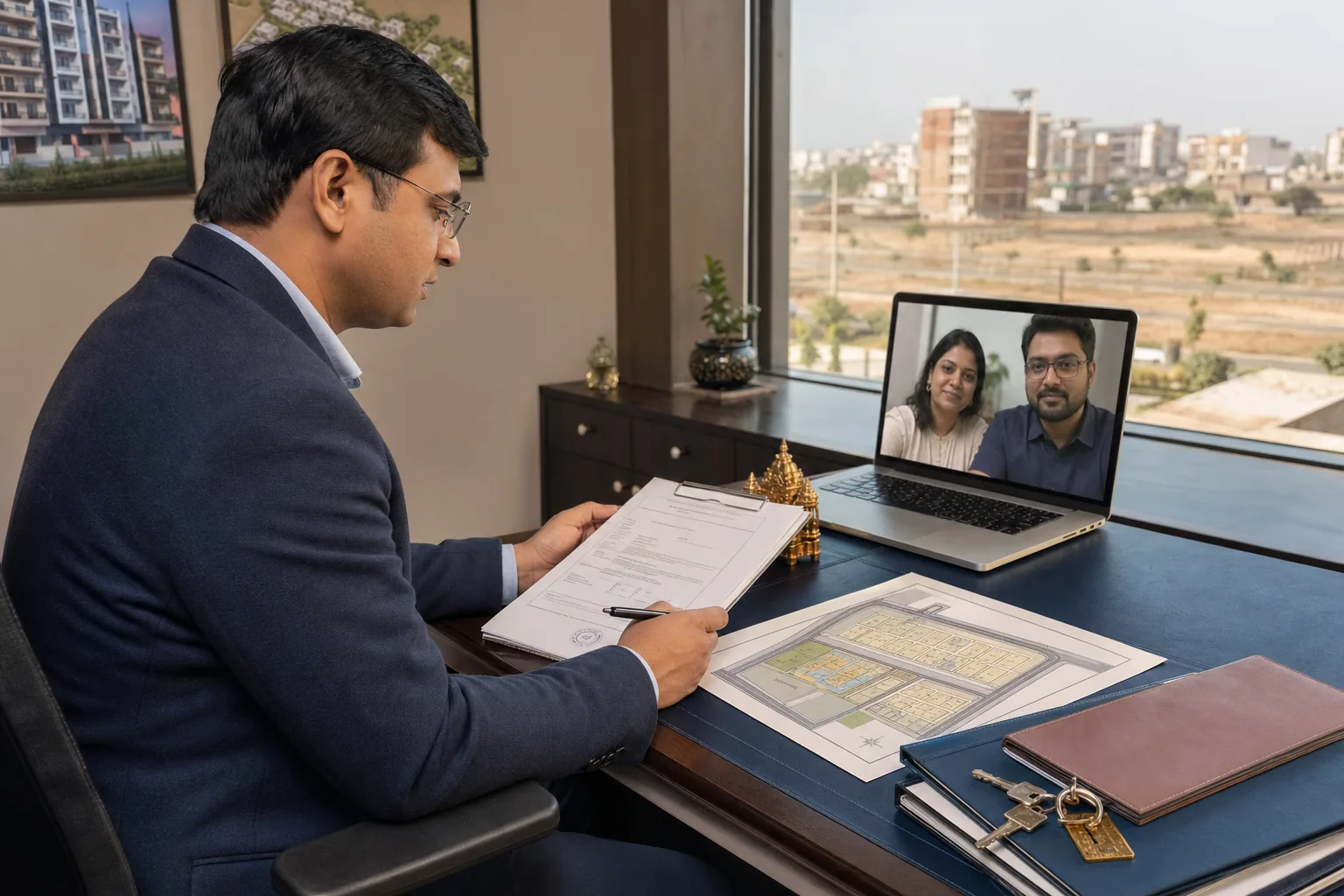
- Buying Without Flying Down: Power of Attorney: Most NRIs cannot take leave to sit in a sub-registrar's office in Bhiwadi on the day of registration.
- Tax: What You Owe in India: Owning Indian property as an NRI creates Indian tax obligations, and there are two directions to think about.
- Getting Your Money Back Out: Repatriation: Repatriation is the question every overseas investor eventually asks: when I sell, can I send the proceeds home?
- Documents an NRI Should Keep Ready: Registration and banking will ask for a fairly standard set.
In this guide
If you hold an Indian passport and live abroad, or you are an Overseas Citizen of India, you can buy property in Bhiwadi with far less friction than most people expect. The Reserve Bank of India gives NRIs and OCIs a general permission to acquire residential and commercial immovable property in India, so you do not need to write to anyone for approval before you buy. What trips people up is not eligibility; it is the practical chain of funding, remote paperwork, tax and repatriation. This guide walks that chain end to end for a Bhiwadi purchase, so a buyer sitting in Dubai, London or New Jersey knows exactly what to line up.
One thing to say plainly at the start. We assist with property sales and purchase enquiries in Bhiwadi. We are not your tax adviser or your lawyer, and the rules below carry real financial consequences, so treat this as an informed starting map and get the specifics confirmed by a chartered accountant and a property lawyer for your own situation. The rules also change from time to time; the figures here reflect the position as we understand it in 2026.
Can an NRI Actually Buy Property in Bhiwadi?
Yes, within one clear boundary. Under the Foreign Exchange Management Act and RBI’s Master Direction on Acquisition and Transfer of Immovable Property in India, a person resident outside India who is a citizen of India, and an Overseas Citizen of India, can acquire any immovable property in India other than agricultural land, a plantation property or a farmhouse. Residential flats, residential plots that are not classified as agricultural land, and industrial property all sit on the allowed side of that line.
That boundary matters more in Bhiwadi than in a metro, because a lot of cheap land on the fringe of the Tapukara and Tijara belt is still agricultural on paper. If a plot’s land use has not been converted, an NRI cannot buy it, and frankly a resident buyer should be cautious about it too. The safe categories for an NRI are RERA or BIDA registered flats, developed residential township plots with a clear non-agricultural title, and RIICO industrial plots. Verifying that status is the single most important check, and it is covered on our RERA and BIDA verification guide and the documents required to buy property in Bhiwadi.
You also do not need to be physically present in India to own property here, and you do not need a resident co-owner. You can buy in your sole name, jointly with another NRI, or jointly with a resident Indian relative. What you cannot do is skip the banking channel, which is the next section.
How to Fund the Purchase
This is where NRI rules are strict, and getting it wrong creates problems years later when you try to sell or repatriate. All payment for the property must move through normal banking channels in Indian rupees. In practice that means the money comes from one of three account types:
- NRE account (Non-Resident External): rupee account funded by your foreign earnings, freely repatriable.
- NRO account (Non-Resident Ordinary): rupee account for income earned in India, with limited repatriation.
- FCNR account (Foreign Currency Non-Resident): a foreign currency deposit, or an inward remittance from abroad.
You cannot pay the seller in foreign currency, you cannot hand over cash brought in from abroad, and you cannot use traveller’s cheques. Every rupee should be traceable to one of those accounts or to a direct inward remittance, because the source of funds decides how much you can send back out later.
If you need financing, Indian banks and housing finance companies do lend to NRIs. An NRI home loan is sanctioned in rupees, disbursed to the seller or builder rather than to you in cash, and repaid through your NRE or NRO account or from rent the property earns. Loan-to-value, tenure and rate depend on the lender and your profile abroad. For the all-in cost including the loan, add stamp duty and registration to the property price and run the numbers on our Bhiwadi property cost calculator, then read the exact charges on the registry and stamp duty guide.
Buying Without Flying Down: Power of Attorney
Most NRIs cannot take leave to sit in a sub-registrar’s office in Bhiwadi on the day of registration. The normal solution is a Power of Attorney, or PoA, where you authorise a trusted person in India, usually a close family member, to sign and complete specific steps on your behalf. Done properly, this is routine. Done carelessly, it is one of the biggest risks in the whole process, so read this section slowly.
First, prefer a Special Power of Attorney over a General Power of Attorney. A special PoA authorises named acts for one specific transaction, for example presenting a particular sale deed for registration on a particular property. A general PoA hands over broad powers and is far riskier if trust ever breaks down. Give away only the authority the transaction actually needs.
Second, the PoA has to be legally valid across borders. If you execute it abroad, it should be signed in front of, and attested by, the Indian Embassy or Consulate in your country of residence, or apostilled where that applies. After it reaches India, it generally has to be stamped, and adjudicated or registered as required, within three months of receipt, so that it is admissible for the property registration. Your lawyer in India will tell you the exact stamping route for Rajasthan.
Third, understand what a PoA is not. Following the Supreme Court’s ruling in the Suraj Lamp case, a Power of Attorney is not itself a transfer of ownership. Title passes only through a properly registered sale deed. A PoA is the instrument that lets your representative execute and register that deed for you; it is never a substitute for it. Anyone offering you a property on a “GPA basis” instead of a registered sale deed is offering you a problem, not a shortcut.
Once the PoA is in place, the buying sequence is the same one every buyer follows, which we set out step by step in how to buy property in Bhiwadi. Your representative attends the site visits and the registration; you approve each stage remotely.
Tax: What You Owe in India
Owning Indian property as an NRI creates Indian tax obligations, and there are two directions to think about.
When you buy from a resident seller, and the property value is fifty lakh or more, you as the buyer must deduct tax at source of one percent under section 194-IA and deposit it with the income tax department. This is standard for any buyer, resident or NRI.
When an NRI is the seller, the rule is different and much heavier. The buyer of a property from an NRI must deduct TDS under section 195, at the capital gains rate rather than a flat one percent. For a long-term holding that base rate is twenty percent plus surcharge and cess; a short-term sale is taxed at slab rates. This will matter to you on the day you eventually sell, and it matters when you buy from an NRI seller, because the deduction responsibility sits with you. The seller can apply to the department for a lower or nil deduction certificate where the actual gain is smaller than the default deduction implies.
On top of that, rental income from the property is taxable in India, and capital gains arise when you sell. India has Double Taxation Avoidance Agreements with many countries, so tax paid in India can often be set against your liability at home, but that relief has to be claimed correctly. The authoritative reference for rates, TDS and forms is the Income Tax Department portal, and this is exactly the kind of detail a chartered accountant should confirm for your country of residence. If you are weighing the investment case on the rental side, our rental yield in Bhiwadi guide shows the gross numbers before any of this tax comes out; those figures are for investment research only, since we assist with sales and purchase, not rental transactions.
Getting Your Money Back Out: Repatriation
Repatriation is the question every overseas investor eventually asks: when I sell, can I send the proceeds home? The short answer is usually yes, within limits, and the limits depend on how you funded the purchase in the first place. That is why the funding discipline earlier in this guide matters so much.
If you bought the property using foreign funds routed through your NRE account or by inward remittance, you can generally repatriate the sale proceeds up to the amount you originally brought in, for up to two residential properties. Amounts beyond that, or proceeds sitting in an NRO account, fall under the annual scheme that allows remittance of up to one million US dollars per financial year from your NRO balance, subject to conditions and to filing Form 15CA and a chartered accountant’s Form 15CB. The exact treatment of your case belongs with your bank’s NRI desk and your accountant, but the principle to carry with you is simple: money that came in cleanly through banking channels goes back out cleanly, and money that did not is where people get stuck.
Documents an NRI Should Keep Ready
Registration and banking will ask for a fairly standard set. Having these ready before you start removes most of the delay:
- Passport, and your OCI card if you are an Overseas Citizen of India.
- PAN card. You need an Indian Permanent Account Number for the transaction and for tax; apply in advance if you do not have one.
- Overseas address proof and recent photographs.
- Power of Attorney, attested as described above, if you are not attending in person.
- NRE, NRO or FCNR account details and the remittance or payment trail.
- Property documents for the specific purchase, verified against the documents checklist: title chain, approvals, and for a resale flat the occupancy certificate and a no-dues clearance.
Joint Ownership, Gift and Inheritance
Buying outright is not the only way an NRI comes to own property in Bhiwadi. You can hold a property jointly, and you can acquire one by gift or inheritance, each with its own rules.
On joint ownership, you can buy together with another NRI or OCI, or with a resident Indian relative. The co-owner’s share and the funding split should be clear in the deed, because it affects both tax and later repatriation. Adding a resident relative as a joint holder is sometimes done for convenience on the ground, but it is a legal and financial decision, not a formality, so structure it deliberately.
On gift and inheritance, an NRI or OCI can acquire immovable property in India by inheritance from a resident, and by inheritance or gift from another NRI or OCI, within the same non-agricultural boundary that applies to purchase. Inheritance is also one route through which an NRI can end up holding agricultural land that could not have been bought directly, though selling that on carries its own restrictions. If your Bhiwadi interest is an inherited plot rather than a fresh purchase, the verification and title work still apply, and the tax on any eventual sale still applies, so treat it with the same care as a bought property.
Common Mistakes NRIs Make
The failures we see are rarely about eligibility and almost always about process. The recurring ones are worth naming so you can avoid them:
- Buying agricultural land by accident. Cheap fringe land in the Tapukara and Tijara belt is often still agricultural, which an NRI cannot buy. Confirm the land-use classification before any money moves.
- Funding outside banking channels. Paying in foreign cash, or through an informal transfer, breaks the repatriation trail and creates a problem you only discover years later when you try to sell and send the money home.
- Accepting a GPA deal instead of a registered sale deed. A Power of Attorney does not transfer title. If someone offers a property on a general-power-of-attorney basis rather than a registered sale deed, walk away; our note on common property mistakes in Bhiwadi covers why this fails.
- Handing over a broad general PoA. Give your representative a special power for the specific transaction, not open-ended authority over all your affairs.
- Forgetting TDS on the sale. When you eventually sell as an NRI, the buyer must deduct TDS under section 195 at the capital gains rate. Plan for it rather than being surprised by it.
- Not having a PAN in place. You need an Indian PAN for the transaction and for tax. Applying for it late is a common source of delay.
Why NRIs Look at Bhiwadi Specifically
Bhiwadi’s pull for an overseas buyer is not glamour; it is arithmetic. Entry prices are a fraction of Gurugram or south Delhi, the belt runs on more than 2,700 working industries which underpins genuine rental demand, and the location sits inside the wider Delhi NCR growth story. For an NRI who wants an India-based asset without a metro-sized cheque, a Bhiwadi flat or an industrial plot is a rational entry point. The trade-off is that it is a working industrial town, not a lifestyle destination, and a smaller market means verification and local knowledge count for more, not less. The honest investment case, including the risks, is laid out in why invest in Bhiwadi, and the full landscape of what to buy is on the property in Bhiwadi hub.
The single biggest advantage you have as a remote buyer is a trustworthy person on the ground who does the verification you cannot do from abroad. That is the part we do: confirming a title and RERA or BIDA status before you commit a rupee, sending you real photos and video from the site, and walking your representative through the registration. Tell us your budget and what you are trying to achieve, from wherever you are, and we will match it against what actually exists in this market.
Can an NRI buy property in Bhiwadi without RBI permission?
Yes. RBI gives NRIs and OCIs a general permission to acquire residential and commercial immovable property in India, so no separate approval is needed before you buy. The only excluded categories are agricultural land, plantation property and farmhouses. Confirm a specific plot’s land-use status before proceeding.
Can an NRI buy a plot in Bhiwadi, or only a flat?
An NRI can buy a residential plot as long as it is not classified as agricultural land, as well as flats and industrial property. This is a real distinction in the Tapukara and Tijara belt, where some cheap land is still agricultural on paper and therefore off limits until its land use is converted. Verify the classification first.
Do I need to be in India to register the property?
No. If you cannot travel, you appoint a trusted person in India through a special Power of Attorney, attested by the Indian Embassy or Consulate where you live, or apostilled, and then stamped in India as required. That representative signs and completes the registration on your behalf while you approve each step remotely.
How much TDS applies when I buy from an NRI seller?
When the seller is an NRI, the buyer must deduct TDS under section 195 at the capital gains rate, which is twenty percent plus surcharge and cess for a long-term holding, not the flat one percent that applies when the seller is a resident. The seller can obtain a lower-deduction certificate from the income tax department where the actual gain is smaller. Always confirm the current rate with a chartered accountant.
Can I send the sale proceeds back abroad later?
Usually yes, within limits tied to how you funded the purchase. Proceeds up to the amount you originally brought in through your NRE account or inward remittance are generally repatriable for up to two residential properties, and further amounts fall under the annual one million US dollar NRO scheme, subject to Form 15CA and 15CB. Fund the purchase cleanly through banking channels and repatriation is straightforward; fund it any other way and it becomes difficult.
Is rental income from my Bhiwadi property taxable?
Yes. Rental income earned in India is taxable in India, and capital gains arise when you sell. Double Taxation Avoidance Agreements can offset this against your liability in your country of residence, but the relief must be claimed properly, so use a chartered accountant familiar with NRI taxation.
Ready to Shortlist? Talk It Through With Us
18+ years in this market. Real prices, verified paperwork, no pressure.
Choose what you would like to do next:
Done — our team will contact you during working hours.