Key Answers in This Guide
- 1. The planned RRTS corridor could change everything: Treat the RRTS as a possible bonus on top of a purchase that already makes sense without it, never as the reason to buy.
- Location and connectivity: measure it, do not quote it: "Bhiwadi is X km from Gurgaon" is a meaningless sentence until you fix both ends of the journey, and the only reliable way to assess connectivity is to time your own actual route at your own actual hours.
- 2. 2,700+ industries pay the rent: Industrial employment is the single most durable reason to invest here, because it creates housing demand that exists whether or not any new infrastructure arrives.
- The anatomy of demand: why this market is built differently: Bhiwadi demand starts with salaries paid by factories, not with investor sentiment, and that changes how the market behaves in both good years and bad ones.
- 3. Entry price vs. NCR alternatives: Bhiwadi is the last NCR-adjacent market where a first-time investor with ₹23–40 lakh can buy a real, occupiable asset rather than a fractional promise.
- What portal benchmarks say about Bhiwadi prices: Portal-listed asking prices, as of July 2026: major listing portals showed a broad Bhiwadi
In this guide
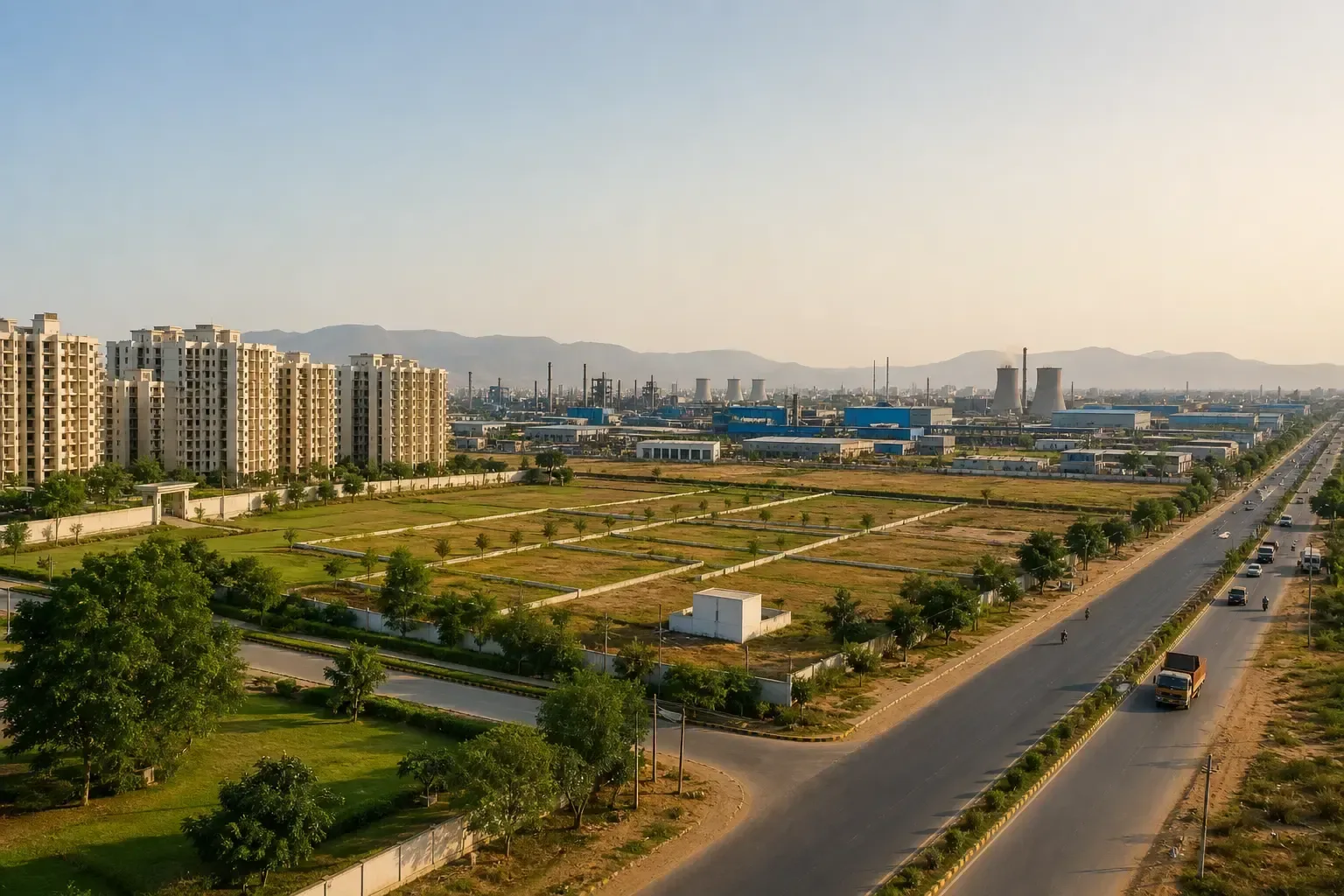
Bhiwadi has quietly become one of the stronger real estate stories on the Delhi-NCR edge. Entry prices still start around ₹23 lakh, and several pockets have seen sharp double-digit listing-price growth in recent years (portal-listed rates vary by locality and portal, ask us for actual closing comparisons in the pocket you are considering). That entry point is something Gurgaon or Noida cannot offer a small investor anymore. For a buyer who wants something relatively sasti (budget-friendly) that is still Dilli se pass (close to Delhi), this belt is one of the few honest options left on the NCR edge.
After 18 years of closing deals in this market, here is our view on why (and where) Bhiwadi makes sense right now.
1. The planned RRTS corridor could change everything
Treat the RRTS as a possible bonus on top of a purchase that already makes sense without it, never as the reason to buy.
The planned Delhi–Gurugram–SNB–Alwar Namo Bharat (RRTS) corridor, taken up in phases, would substantially shorten commutes across this industrial belt if built as planned. Note the framing carefully: no official station list confirms a Bhiwadi station today, so treat corridor benefit as regional, not doorstep. To be clear: this is a future-impact story, not a done deal. But infrastructure-led appreciation typically arrives in stages, when plans firm up, during construction, and again at commissioning, which is exactly why early positioning matters.
Our working rule after watching two decades of NCR infrastructure announcements: buy the property, not the press release. If a project only makes sense assuming the corridor gets built on schedule, it does not make sense yet. We have written a separate, blunt piece on what is actually on the ground versus what is on paper here: Bhiwadi infrastructure reality check. Read it before any dealer, including us, quotes you a price “because RRTS is coming”.
Location and connectivity: measure it, do not quote it
“Bhiwadi is X km from Gurgaon” is a meaningless sentence until you fix both ends of the journey, and the only reliable way to assess connectivity is to time your own actual route at your own actual hours.
Distance claims in brochures float anywhere from 40 to 70 km for the same journey depending on which edge of which city the writer picked. We use two fixed origin points for every comparison: Bhiwadi Mod for regional access and Alwar Bypass Road for residential connectivity. Run these five journeys yourself on a working day before you buy:
| Journey | Route used | Road distance | Normal time (12 PM) | Peak time (9 AM) | Checked |
|---|---|---|---|---|---|
| Alwar Bypass Road to Cyber City, Gurugram | NH-48 | 54.6 km | 1 hr 27 min | 1 hr 30 min | 23 July 2026 |
| Bhiwadi Mod to IGI Airport T3 | NH-48 | 56.9 km | 1 hr 27 min | 1 hr 26 min | 23 July 2026 |
| Bhiwadi Mod to Dharuhera bus stand | Bhiwadi-Dharuhera road | 9.1 km | 17 min | 17 min | 23 July 2026 |
| Alwar Bypass Road to Rewari Junction | Via Dharuhera | 23.1 km | 45 min | 41 min | 23 July 2026 |
| Bhiwadi Mod to Neemrana | NH-48 south | 57.2 km | 1 hr 6 min | 1 hr 5 min | 23 July 2026 |
Every row was measured live on Google Maps on the date shown, midday against 9 AM, from the stated origin. Notice what the numbers say. Cyber City is not “45 minutes away”: it is about an hour and a half from the residential side of town, either time of day. Dharuhera is genuinely next door at 17 minutes. Rewari Junction, the nearest major railhead, is a realistic 41 to 45 minutes.
The morning peak barely moved any journey on our check date, because NH-48 carries the load both ways; monsoon days and evening returns into Gurgaon can behave worse, so test the hour that matters to your own routine before you buy. Third-party distance sites contradict each other so badly (we found the same airport journey quoted at 45 km and 117 km) that we publish only our own dated checks, and we will re-run these rows periodically.
What holds qualitatively: Bhiwadi sits just off NH-48, the highway carries the bulk of every Delhi-side journey, and the last stretch into your specific locality is where times diverge, which is why the origin point matters. For what daily life looks like once you are here, schools, the ESIC hospital, Genesis Mall and the rest, see our guide to living in Bhiwadi.
2. 2,700+ industries pay the rent
Industrial employment is the single most durable reason to invest here, because it creates housing demand that exists whether or not any new infrastructure arrives.
Bhiwadi is not a speculative township in the middle of nowhere. It is an industrial city, Honda, Hero MotoCorp, Shree Cement and thousands of MSMEs operate across RIICO industrial areas like Bhiwadi, Chopanki, Khushkhera and Tapukara. Factory managers, engineers and workers need housing, which is why rental demand here is real: in well-run societies on Alwar Bypass Road and in Sector 51 we have observed rental yields around 3–4%+, higher in some pockets.
One clarification before we go further. We are a sale-only dealership. We do not manage rentals, find tenants, or take rental mandates. When we quote yield figures, we quote them as investment research, because yield is the clearest way to judge whether a locality has real occupier demand or only speculative buyers passing units to each other. A pocket where tenants actually pay rent is a pocket where your exit buyer will exist later. That is the only reason rental data appears on this page.
The anatomy of demand: why this market is built differently
Bhiwadi demand starts with salaries paid by factories, not with investor sentiment, and that changes how the market behaves in both good years and bad ones.
It helps to trace the chain link by link, because most NCR-edge markets cannot complete it.
A factory sets up in a RIICO industrial area. It hires a plant head, supervisors, quality engineers, machine operators and support staff. Those people need to live within a practical commute of the plant gate, because a shift that starts at 8 am does not wait for traffic from Gurgaon. Some rent flats near Alwar Bypass Road. Some buy plots in UIT sectors and build over time. Their families need schools, clinics and markets, which pull in shopkeepers, teachers and doctors, who in turn need housing of their own. Every link in that chain is a person with a salary and a reason to be physically present in Bhiwadi.
Now compare that with a speculation-driven market. There, the chain runs the other way: a developer announces a township, investors buy expecting other investors to buy after them, and prices hold only as long as fresh money keeps arriving. Nobody in the chain actually needs to live there. When sentiment turns, there is no floor under prices, because there was never an occupier at the bottom of the pyramid. Several NCR corridors learnt this the hard way in the last cycle, and parts of Bhiwadi itself did too, which we cover further down.
The practical consequence for an investor is simple. In an employment-anchored pocket, a bad year means slower price movement and a longer wait to sell, but the flat still has a tenant and the plot still has a neighbour building a house. In a sentiment-anchored pocket, a bad year means no tenant, no buyer, and a maintenance bill on an empty tower. Same city, completely different risk. This is why our locality advice keeps circling back to the same question: who works within fifteen minutes of this address, and where do they sleep tonight?
None of this guarantees appreciation, and we will not pretend it does. What it guarantees is a use for the asset while you wait, and a reason for the next buyer to exist. Those two things matter more to final outcomes than any launch-day discount.

3. Entry price vs. NCR alternatives
Bhiwadi is the last NCR-adjacent market where a first-time investor with ₹23–40 lakh can buy a real, occupiable asset rather than a fractional promise.
| Market | Typical 2 BHK entry | 10-min reality check |
|---|---|---|
| Gurgaon (new sectors) | ₹1.2 Cr+ | Out of reach for most investors |
| Faridabad / Ghaziabad | ₹55–80 L | Older stock, saturated |
| Bhiwadi | ₹23–40 L | Industrial demand + RRTS upside |
Remember that the sticker price is not the full outgo. Stamp duty, registration, and in some projects transfer or development charges sit on top. Before comparing markets, run your actual all-in number through our Bhiwadi property cost calculator so you are comparing complete costs, not brochure prices.
What portal benchmarks say about Bhiwadi prices
Portal-listed asking prices, as of July 2026: major listing portals showed a broad Bhiwadi asking-price average around ₹4,000 per sq ft, with locality-level figures ranging from roughly ₹1,350 to ₹6,000 per sq ft. Underneath that single city-wide number the spread is enormous, and a blended average tells you almost nothing about the pocket you are actually considering.
| Portal asking price (₹/sq ft) | |
|---|---|
| Sector 24 (premium) | ~₹6,000 |
| City-wide average | ~₹4,000 |
| Alwar Bypass Road | ~₹2,750 |
| Alwar–Bhiwadi Road | ~₹2,500 |
| Tijara side (entry) | ~₹1,350 |
Source: SquareYards and 99acres live listings, checked July 2026. Figures are advertised asking prices, not closing prices; ask us for actual closing comparisons in your pocket.
Treat every portal figure as what it is: an advertised asking price. Four different numbers exist for any property here, and confusing them costs money:
| Price type | What it actually is |
|---|---|
| Advertised asking price | What the seller or portal listing hopes for; the ceiling, not the market |
| Negotiated price | What a real buyer and seller settle at, usually below asking |
| Government (DLC) valuation | The rate stamp duty is computed on; a floor for registration, not a market price |
| Registered transaction value | The consideration actually recorded in the sale deed |
Portals publish the first number. Registry data reflects the last. The gap between them varies by locality and by how long a listing has sat unsold. When someone quotes you “the Bhiwadi rate”, ask which of the four they mean.
Our own quotes to buyers are based on recent closings we have handled or seen registered, and where we cite a portal figure we date it, as above. For what sits on top of any of these prices, work through the full cost stack in our guide to stamp duty and registry charges in Bhiwadi.
One administrative note buyers increasingly ask about: Bhiwadi falls in Rajasthan’s Khairthal-Tijara district, carved out of Alwar district in 2023. Older documents, and plenty of current listings, still say Alwar. Both refer to the same place; your deed and revenue records will follow the current district.
4. Where we would put money right now
Stay inside pockets with existing occupancy and clear titles; the four belts below cover the sensible range from smallest budget to largest.
- Alwar Bypass Road: best mix of ready-to-move supply and rental demand; see our flats in Bhiwadi price bands
- UIT sectors: plotted development with clear titles
- Tapukara–Tijara belt: the widest spread of entry prices we deal in, from Chanderlok City at the low end to Terra City and Lifestyle City a step up, see our plot project rate card for exact numbers. This is also where most of our own plot deals close, precisely because entry price is lowest here.
- RIICO industrial plots: for larger budgets, the highest-appreciation asset class here; current belt-wide rates and worked examples are on our industrial property page
For a street-level comparison of these pockets, including the ones we would avoid, our guide to the best areas to buy property in Bhiwadi goes locality by locality.
Entry strategy by capital level
Your budget decides your asset class here, and forcing the wrong asset class onto your budget is the most common mistake in this market.
Bhiwadi is really three markets stacked on top of each other, and each budget band opens a different door. These bands come straight from the price ranges we deal in every week.
Around ₹20–25 lakh. This budget puts you at the entry line: either a compact ready flat at the very bottom of the ₹23 lakh band, or a plot in the Tapukara–Tijara belt where our lowest per-square-yard rates sit. Our steer at this level is usually the plot, provided the title and approvals are clean, because a bottom-band flat often sits in an older tower where maintenance and society health become your problem. A plot has no maintenance bill, no lift breakdown, and no builder dependency while you hold it. The trade-off is that it produces no rent. Weigh both sides with our flats vs plots in Bhiwadi comparison before deciding.
Around ₹40 lakh. Now the choice is real. This budget reaches a proper 2 BHK in an occupied society on Alwar Bypass Road, or a larger, better-located plot in a UIT sector. The flat gives you a tenant from an established rental pocket and a wider resale audience later, because end-users dominate demand at this price. The plot gives you land in a planned sector with clear paperwork. If you need the asset to produce something while you wait, take the flat in a good society. If you can hold quietly for years without needing income from it, the UIT plot is the cleaner asset.
₹1 crore and above. At this level the conversation changes from residential to industrial. RIICO industrial plots are the asset class we would examine first for larger budgets, because the buyer of an industrial plot is a business with a commercial reason to pay, not a household stretching a home loan. The paperwork is different, the allotment and transfer rules are different, and the due diligence is heavier, which is exactly why casual money stays out and why the asset class has behaved the way it has. Read our residential vs industrial property comparison before committing, and talk to us about which RIICO belt fits your timeline.
Whatever the band, one rule holds: do not stretch into the next band with borrowed money just because the asset above looks better. A comfortably held ₹23 lakh plot beats a stressfully held ₹40 lakh flat every time, because the stretched buyer becomes a forced seller, and forced sellers set the worst prices in this market.
Who has actually made money here
The winners across 18 years share two habits: they bought in occupied or clearly-titled pockets, and they held without needing to sell. That second habit has a local name, holding power: the cash position to wait out a slow patch instead of being forced into a distress sale. The ones who chase a pre-launch rate hoping to flip the booking at a premium (the local “on”) are playing a different, riskier game.
We will not quote returns, because every real number depends on the exact pocket, year and paperwork, and dressed-up averages mislead more than they inform. But the patterns are consistent enough to describe.
The patient plot holder. The most repeated success story in our files is unglamorous: someone bought a clearly-titled plot in a UIT sector or an approved Tapukara-belt project, paid in full or close to it, and then did almost nothing for years. No EMI pressure, no maintenance outgo, no builder to chase. When the pocket around the plot filled in with built houses, the plot’s buyer pool widened from investors to end-users wanting to build, and that is when these holders sold well. Their edge was not timing or inside information. It was the absence of any reason to sell early.
The early society buyer in a good pocket. The second pattern is the family or investor who bought a flat in a society that went on to become well-occupied, on Alwar Bypass Road or a comparable established stretch. They collected rent from the industrial workforce throughout, so their holding cost was partly covered, and when they sold, they sold to an end-user family rather than to another investor. Selling to an end-user is the tell. End-users pay for livability, and livability compounds as a society matures.
The industrial plot buyer with genuine capital. Less common, larger tickets: buyers who took RIICO industrial plots with clean allotments and held them as the belts filled with operating units. Their eventual buyers were expanding businesses, which is a fundamentally healthier buyer than a speculator.
Notice what is missing from all three patterns: nobody flipped a launch booking, nobody bought on the strength of an announcement, and nobody was clever. They were solvent, they were in the right pocket, and they were slow. That is the entire formula, and it is available to anyone willing to be boring for a few years.
Who this market suits, and who it doesn’t
Bhiwadi suits solvent, patient buyers in proven pockets, and punishes over-borrowed buyers who need a quick exit.
Bhiwadi rewards patience and paperwork discipline, not quick flips. It suits:
- End-users who want to own rather than rent, at NCR-adjacent prices
- Rental investors comfortable with 3–4%+ yields rather than chasing double-digit promises
- Medium-term holders (3–7 years) who can wait through infrastructure timelines rather than needing an exit next year
Match the checks to who you are. Each profile below should weight the homework differently:
| Buyer profile | What to evaluate hardest |
|---|---|
| Family buying to live | Schools and their bus coverage, ESIC/private healthcare access, air quality in the specific pocket, daily commute |
| Industrial employee | Distance to the specific plant, shift-hour transport reality, daily facilities near the society |
| Manufacturer buying industrial | Road width, sanctioned power, utilities, truck access, RIICO transfer chain |
| Retired buyer | Healthcare proximity, quieter locality away from truck routes, lift availability, walkable daily shopping |
| Plot buyer building a home | Authority and land records (Apna Khata check), road access, water source, construction feasibility |
| Investor | The actual demand source in that pocket, resale depth, complete acquisition cost, realistic holding period |
It does not suit buyers wanting instant liquidity or guaranteed short-term appreciation; resale markets outside the most established localities are thinner than Gurgaon or Noida, and that is the trade-off for the lower entry price.
Who has not made money, and why
The 2012–2015 under-construction buyer is where this story starts. During that cycle, a wave of buyers booked flats in under-construction towers on the strength of brochures and launch discounts. Some of those projects delivered late, some delivered with disputes, and some are still scars on this market. The buyers who suffered most had paid construction-linked instalments into projects whose builders lacked either the finances or the intent to finish.
The lesson Bhiwadi taught its buyers in those years is the lesson we now repeat before every deal: in this market, possession and paperwork are the product. A ready flat you can inspect, in a tower you can walk through, from a seller whose title you can verify, carries a fraction of the risk of any promise about the future. RERA has improved the market since, but the principle has not changed.
An investment article that only describes winners is an advertisement. Here is the other side of our files, described plainly: the losses came from three specific mistakes, trusting an under-construction promise, buying in the wrong pocket, and mismatching a thin market with a short timeline.
The wrong-pocket buyer. Bhiwadi’s localities do not move together. A buyer who chose a project two turns off the demand map, because it was marginally cheaper or the sales office was persuasive, often found years later that the cheaper pocket stayed cheap for a reason: no occupier chain, thin rental interest, and a resale audience of nobody. The few thousand rupees per square yard saved at entry became the entire problem at exit. Pocket selection is not a detail in this market. It is most of the decision.
The liquidity-mismatch investor. The third pattern is a buyer whose money and timeline did not match the asset. They bought expecting to exit in a year or two, often with borrowed funds, in a market where a fair-price sale outside the established localities can take patient months of waiting for the right end-user. When their loan or their circumstances demanded cash on a deadline, they sold to whoever was standing there, at whatever was offered. The market did not take their money. The mismatch did. If your holding horizon is short or your capital is borrowed against a deadline, this is simply not your market, and we would rather tell you that before a deal than have you learn it after one.
The risks
The main risks here are builder and title risk, not price risk, and both are checkable before you pay a rupee.
Bhiwadi is a possession-and-paperwork market: builder track record, RERA registration and clear title matter more than brochures. Some projects from the 2012–2015 cycle taught buyers hard lessons. This is exactly why working with an established local dealer matters, we know which towers had delivery issues and which developers deliver. Before you commit to any purchase, budget for stamp duty and registration on top of the property price, and work through our documents checklist regardless of who is selling to you.
How to use the infrastructure story without paying for it
Let announced infrastructure guide which pocket you research, but let only existing, on-ground demand decide what you pay.
Infrastructure narratives are the standard sales tool in every edge market, and Bhiwadi has its share: the RRTS corridor, road upgrades, and periodic talk of new links. The discipline we suggest, and follow ourselves, fits in three checks:
- Split every claim into built, under construction, and announced. Built infrastructure belongs in the price, and already is. Under-construction work deserves partial weight, discounted for the delays that every Indian infrastructure project carries. Announced projects deserve research attention and zero premium. If a seller’s price only works on the announced column, walk away.
- Ask what the pocket is worth if nothing new is ever built. For the localities we recommend, the answer is a functioning number, because the industrial workforce is already there paying rent and buying homes. That is your floor. Infrastructure, if and when it arrives, moves the ceiling. Buy at the floor’s logic, and any ceiling movement is a bonus rather than a requirement.
- Verify independently. Do not take timelines from a sales office, and do not take them from a dealer either, including us, without checking. Our infrastructure reality check lists what is physically on the ground today versus what remains on paper, and we update our view as facts change rather than as marketing seasons change.
Decide your exit before your entry
Before buying anything, name the specific person who will buy it from you later; if you cannot describe them, do not buy it.
This is the single question that would have saved most of the losers described above, so we give it its own section. Every asset in Bhiwadi has a natural next buyer, and the quality of your investment is the quality of that future buyer.
A ready 2 BHK in an occupied society on Alwar Bypass Road exits to an end-user family, often a factory manager or engineer settling locally. That buyer pool is real, salaried, loan-eligible and renews itself every year as industries hire. A clearly-titled plot in a maturing sector exits to a family that wants to build, and that pool grows as the sector fills in. A RIICO industrial plot exits to an expanding business. All three are exits to someone with a use for the asset.
Now run the same test on the assets we steer clients away from: an under-construction booking in an unproven project exits only to another speculator, and a plot in a no-demand pocket exits to nobody in particular. When the only imaginable buyer is someone making the same bet you made, you do not own an investment. You own a position in a queue.
So before you sign anything, write one sentence: “In five to seven years, I expect to sell this to ______ because ______.” If the blanks fill easily with a real category of person and a real reason, proceed to due diligence. If you find yourself writing “another investor, because prices will have risen”, stop. That sentence has cost this market’s buyers more money than any builder default.
A discipline checklist before you invest
If you cannot tick every box below, delay the purchase; nothing in Bhiwadi moves fast enough to justify skipping one.
- Money check. The capital is yours or comfortably financed, and you can hold for five to seven years without needing this money back on a deadline.
- Pocket check. The locality has visible, current occupancy: lit windows at night, tenants, shops serving residents. You have visited at least twice, once on a weekday evening.
- Demand check. You can name who works near this address and where they live now. If the answer involves only future projects, the pocket fails.
- Paper check. Title verified, RERA registration confirmed where applicable, and every document from our documents checklist sighted before token money, not after.
- Cost check. Your budget is the all-in figure from the cost calculator, including stamp duty and registration, not the quoted price.
- Narrative check. The purchase makes sense with zero new infrastructure. Anything announced is treated as upside, priced at nothing.
- Exit check. You have written the one-sentence exit line from the section above, and the buyer it names is an end-user or a business, not another speculator.
- Seller check. Whoever is selling to you, including us, has answered your hard questions in writing and shown you comparable actual closings, not portal listings.
Print it, tick it, and only then talk numbers.
Planning to invest in Bhiwadi? Talk to our team, 18+ years in this market, and we will tell you plainly which project fits your budget and which to avoid.
Frequently Asked Questions
Is Bhiwadi a good place to invest in property?
It has a real industrial employment base, NH-48 access and a range of price points, which support genuine end-use and rental demand. Appreciation is a possibility, not a guarantee, and we frame it honestly above.
Will property prices rise in Bhiwadi?
No one can honestly promise that. The drivers of demand are real, but future prices depend on the wider economy and infrastructure delivery, so treat any assured-returns pitch with suspicion.
What drives property demand in Bhiwadi?
The RIICO industrial estates and their workforce, the highway connectivity to Gurgaon, and a deep stock of established residential societies.
Is Bhiwadi better for rental income or appreciation?
It offers a modest working rental yield plus possible long-term appreciation. Buyers comfortable holding for years tend to read the market best.
Discuss the Numbers With a Local Dealer
18+ years in this market. Real prices, verified paperwork, no pressure.
Choose what you would like to do next:
Done — our team will contact you during working hours.