Key Answers in This Guide
- Who Each Option Suits: An independent house or builder floor suits you if:
- Privacy and Space: This is where the house wins without argument.
- Security: Security is the apartment's strongest card and the house's weakest.
- Maintenance Responsibility: Here the two options are mirror images, and most first-time buyers underestimate both sides.
- Land Ownership and What Appreciates: This is the deepest structural difference between the two, and it decides the long-term money question.
- Amenities: Walk into a mid-range Bhiwadi society and you may find a park, a community hall, sometimes a gym or a small pool, power backup for the lift and common areas, and organised parking.
In this guide
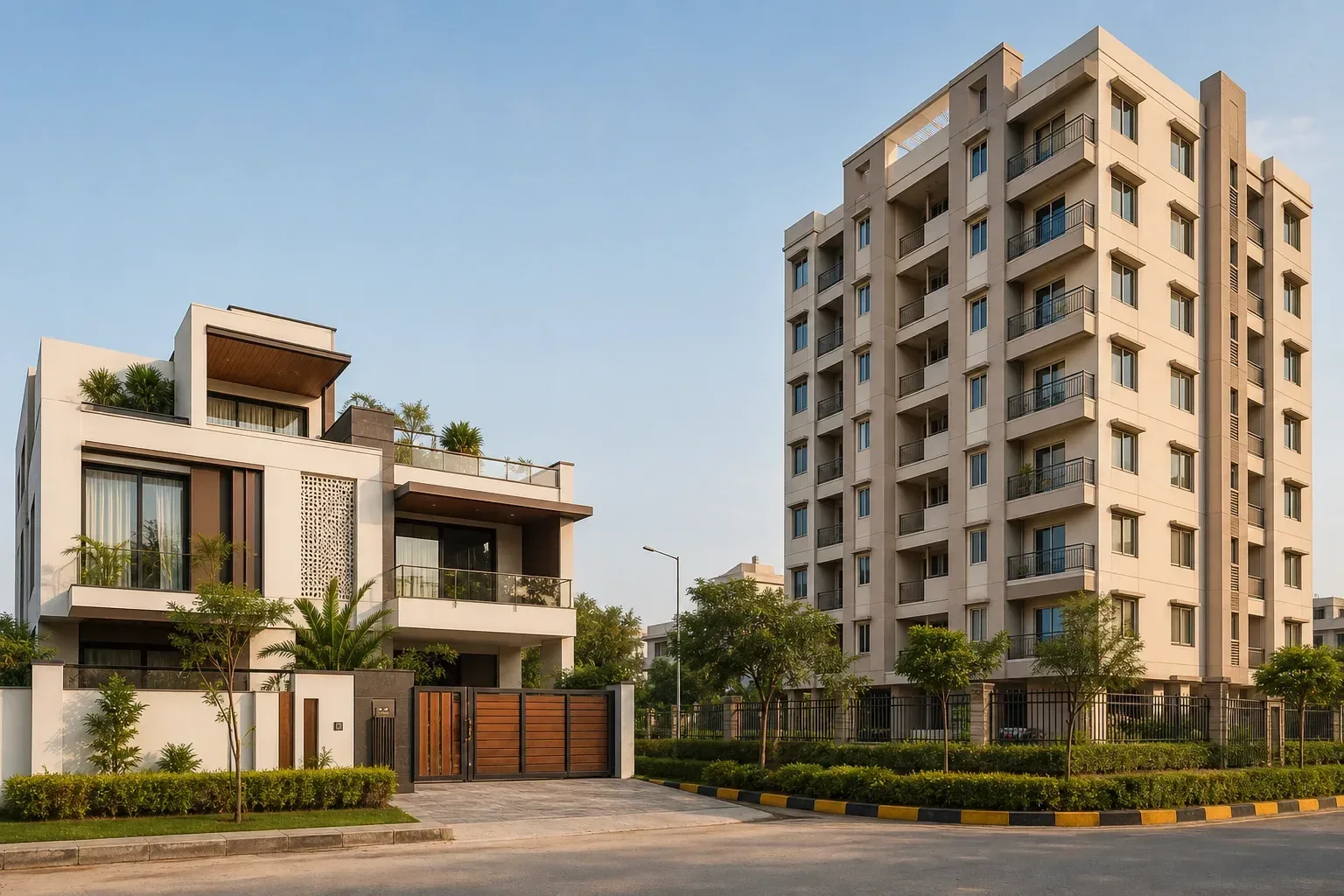
Short answer: an independent house gives you space, land ownership and full control over what you build and how you live. An apartment gives you convenience, shared amenities, managed security, easier financing and easier resale. Neither is better in the abstract; one of them fits your family, your budget and your stage of life better than the other, and this guide helps you work out which.
We have sold both in Bhiwadi since 2008. The house-versus-flat question comes up in almost every first meeting with a family buyer. The answer we give depends on who is asking. A factory manager posted here for three years and a family settling here for the next thirty need different things from the same market. Read the sections that match your situation and be honest about your own habits; that matters more than any general rule.
First, terms. In Bhiwadi, “independent house” usually means one of two things: a house you build yourself on a plot you buy, or a builder floor, which is a ready-built unit on an independent plot where each floor is a separate dwelling. “Apartment” means a flat in a multi-storey society with common areas, a lift in most newer buildings, and a maintenance body. The comparison below covers all three, and we flag where a builder floor sits between the two extremes.
Who Each Option Suits
An independent house or builder floor suits you if:
- You are settling in Bhiwadi long term. Land rewards patience; a short hold wastes its main advantage.
- Your household is large or multi-generational. Parents, children and visiting relatives fit into a house in a way no flat matches.
- You want to control your own space: park two cars inside your gate, keep a dog, build a room for your parents on the ground floor, add a floor when your son marries.
- You dislike depending on a society office, a maintenance committee or neighbours’ votes for decisions about your own home.
- You can handle, or pay someone to handle, repairs, water arrangements and security yourself.
An apartment suits you if:
- Your budget is tight. Entry-level ready flats in Bhiwadi are commonly quoted from roughly ₹16 lakh to ₹23 lakh at the entry level; treat these as indicative and contact us for current rates. A house on a plot usually costs more overall because you are paying for land plus construction, and the total depends on plot size and how you build.
- You want to move in and start living without managing anything. Lift, water, common lighting, gate security: someone else runs all of it.
- You travel often or the house will stay locked for weeks. A flat inside a gated society handles absence far better than a standalone house.
- You are buying partly for rental income. Bhiwadi’s tenant base is industrial: factory staff, supervisors and engineers posted here for work. They overwhelmingly rent functional flats near their workplaces, not houses.
- You may sell within five to seven years. Flats have a wider buyer pool at the entry and mid level, so exits are faster.
If you are not sure you will stay in Bhiwadi for the long term, buy the apartment; the house rewards commitment and punishes an early exit.
If your real question is whether to buy a bare plot and hold it rather than build, that is a different comparison; read flats vs plots in Bhiwadi first, because the plot-versus-flat logic underpins everything in this article.
The trade-offs below matter more once you know which way you already lean. Start here.
You are settling in Bhiwadi long term, with a large or multi-generational household, and want to control your own space
Lean independent house or builder floor. Land rewards patience, and you can park inside your gate, keep a dog, or add a floor when the family grows.
You dislike depending on a committee for decisions about your own home, and can handle or pay for repairs, water and security
Lean independent house. No society office, no maintenance vote, no shared decisions.
Your budget is tight, or you want to move in and manage nothing
Lean apartment. Lift, water, common lighting and gate security are run for you, and entry-level flats cost less than land plus construction.
You travel often, buy partly for rental income, or may sell within five to seven years
Lean apartment. A gated flat handles absence, suits Bhiwadi's industrial tenants, and exits faster through a wider buyer pool.
Not sure you will stay in Bhiwadi long term? Buy the apartment; the house rewards commitment and punishes an early exit.
Privacy and Space
This is where the house wins without argument. In an independent house you share no wall, ceiling or floor with a stranger. Nobody’s washing machine runs above your bedroom at midnight. No neighbour’s renovation drills through your wall for a month. Your terrace is yours, your courtyard is yours, and the only footsteps you hear are your own family’s.
Space works differently too. A house on a plot gives you ground contact: a small garden, a place for children to play inside your own gate, room to dry clothes, store a bicycle, keep plants. You can design rooms around your family instead of fitting your family into a builder’s floor plan. If your parents cannot climb stairs, their room goes on the ground floor. If you work from home, the quietest corner becomes your office.
A flat gives you a fixed envelope. What the builder drew is what you get, and part of what you pay for is not even inside your walls. The super area you are quoted includes corridors, lobbies and lift shafts; the carpet area you actually live in is meaningfully smaller. Understand the difference before comparing prices, because a house is measured in plot area and built-up area while a flat is marketed in super area, and the two numbers do not compare directly. Our guide to carpet vs built-up vs super area explains the working.
A builder floor sits in between. You share the plot with the other floors, so you hear the family above you, but there are two or three households on the stairs instead of two hundred in the towers. Many buyers who want house-like privacy at a lower ticket settle here.
The honest counterpoint: privacy has a social cost. Societies generate casual community; children find playmates in the park downstairs, festivals happen in the common area, an elderly parent alone at home has neighbours within shouting distance. A standalone house on a quiet street can be isolating, especially for a family new to Bhiwadi with no relatives nearby. Weigh what your family actually needs. Some households crave the quiet; others wilt in it.
Security
Security is the apartment’s strongest card and the house’s weakest.
A gated society gives you a manned gate, visitor entry registers or app-based approval, boundary walls, common-area CCTV and the passive security of density: two hundred families notice a stranger faster than one family does. When you lock your flat and leave for a month, the gate is still manned and the neighbours are still there. For families where both spouses work, or where elderly parents stay home alone, this matters daily, not occasionally.
An independent house makes you your own security officer. You decide the boundary wall height, the gate, the grills, the cameras, the locks. Done well, a house can be very secure, but every element is your initiative and your expense. A locked, visibly empty house is a target in a way an empty flat inside a society never is. If your work takes you away for weeks at a time, this single factor should push you towards a flat or at least towards a house on a busy, well-populated street rather than a quiet one.
Colonies matter more than construction here. An independent house inside an established, occupied colony with active neighbours is a different proposition from the same house on a half-empty street where most plots are still vacant. When we show houses, we tell buyers to visit the street at 9 pm, not just 11 am. Occupied streets are safe streets. Our guide to the best areas to buy property in Bhiwadi covers which colonies are lived-in versus still filling up.
Maintenance Responsibility
Here the two options are mirror images, and most first-time buyers underestimate both sides.
In a flat, maintenance is outsourced. You pay a monthly charge billed on super area, and in return the society handles the lift, water supply, common lighting, gate staff, garden and general upkeep. The bill arrives whether you use the amenities or not, and it tends to rise over the years. You also inherit the society’s competence: a well-run society is a joy, a badly run one means dirty stairs, a dead lift and a maintenance body that collects money and does little. Before buying any resale flat, we ask for the maintenance account and look at the arrears; a society where half the owners have stopped paying is telling you something.
In a house, maintenance is yours. Nobody bills you monthly, which feels like savings, but the responsibility never goes away. The overhead tank, the motor, the wiring, the seepage after monsoon, the exterior paint every few years, the boundary wall crack: each is your problem to notice, arrange and pay for. Bhiwadi’s summers and monsoons are hard on buildings. A house that is not actively maintained shows it within two or three seasons, and a poorly maintained house loses resale value faster than a poorly maintained flat, because the flat buyer blames the society while the house buyer blames you.
A flat’s maintenance is a predictable monthly cost; a house’s maintenance is an unpredictable lumpy cost, and over the years the totals are closer than most buyers expect.
There is also a time cost. If you enjoy running your own home, dealing with a plumber, choosing your own repairs, the house suits your temperament. If you want to lock the door and think about none of it, that convenience is precisely what the society charge buys.
Land Ownership and What Appreciates
This is the deepest structural difference between the two, and it decides the long-term money question.
When you buy a house on a plot, you own the land outright. Land in a growing industrial town does not wear out. The structure on top of it depreciates like any building, but the plot underneath tends to appreciate as Bhiwadi grows, and you can always rebuild the structure. Thirty years from now, your house’s value rests mainly on what the land is worth then.
When you buy a flat, you own a constructed unit plus an undivided share in the land under the tower, split among all the owners. Your land share is small. Most of what you paid for is structure, and structure ages: buildings look dated, fittings wear, societies decay or thrive on the quality of their management. A well-located, well-run society holds value; an aging tower in a poorly maintained society can stagnate even while plot prices around it climb.
Over a long hold, land appreciates while structures depreciate; the house owner holds mostly land and the flat owner holds mostly structure.
This is the core reason serious long-term wealth in towns like Bhiwadi has historically been built on plots and houses rather than flats. It is also why the comparison is unfair over short periods: in the first five years, a flat in a good society can perform as well as a house, because the house’s land advantage needs time to compound. The flats vs plots guide covers this appreciation logic in detail, and our plots in Bhiwadi page shows what plot options exist if you decide to build.
One caution: land ownership only pays if the title is clean. A house purchase means verifying the plot’s title chain, conversion status and approvals, which is more legal work than buying a flat in an approved project. Do not skip this to save a few thousand rupees on due diligence. Terms you will meet along the way, from patta to freehold, are explained in our Bhiwadi property glossary.
Amenities
Walk into a mid-range Bhiwadi society and you may find a park, a community hall, sometimes a gym or a small pool, power backup for the lift and common areas, and organised parking. No individual house owner can replicate this list at any sensible cost. If your children will use the park daily and your family will use the hall for functions, the society’s amenity package has real, everyday value.
But audit the amenities honestly, in person, at 6 pm on a weekday:
- Is the gym equipment working or rusting?
- Is the pool filled and cleaned or dry since last year?
- Does the power backup actually cover what the brochure claimed?
- Is the park maintained or overgrown?
Amenities cost money to run, and that money is your maintenance bill. A society with a pool nobody uses still charges everyone for the pool. Some families pay for years of amenities they never touch. If your family genuinely will not use them, you are better off in a simpler society with lower charges, or in a house.
A house has no shared amenities, but Bhiwadi is compact. Parks, markets, schools and gyms are a short drive from most residential colonies, and what an established sector offers outside your gate partly substitutes for what a society offers inside it. What daily life here actually looks like, commute times, schooling, markets, is covered in our guide to living in Bhiwadi.
Construction and Customisation
If you build your own house, you control everything: the layout, the number of floors within permissible limits, the brand of cement, the quality of wiring, the bathroom fittings, the direction the kitchen faces. Families with specific needs, a ground-floor bedroom for parents, a separate entrance for a home office or a rental floor upstairs, can only get them this way. You can also build in phases: ground floor now, first floor five years later when the budget allows. A flat can never grow with your family; a house can.
Control cuts both ways. Building a house means months of managing a contractor, materials, labour and municipal approvals, or paying a professional to manage them. Costs overrun. Timelines slip. If you have never built before, budget both extra money and extra patience, and get the plan sanctioned before the first brick, not after.
In a flat, construction quality is the builder’s decision, made before you arrived. You inspect what exists, which is actually an advantage in resale flats: the building has stood through several monsoons and its flaws are visible. What you cannot do is change much. Structural walls stay where they are; societies restrict external changes; even balcony grills may need approval. You are buying a finished product, take it or leave it.
Builder floors offer a middle path: someone else managed the construction, but you get an independent unit on a plot with more freedom over your own floor than any society flat allows.
Financing, Resale and Rental
Banks prefer flats. A flat in an approved project has clear title, a standard valuation and a familiar process, so home loans are quick and loan-to-value is good. Financing a house is done in stages: a plot loan or plot-plus-construction loan, disbursed against construction progress, with more paperwork and stricter conditions. Plot-only loans carry higher rates and shorter tenures than home loans. If your purchase depends on maximum financing with minimum friction, the flat is the easier route.
Resale follows the buyer pool. Entry and mid-level flats have the widest pool in Bhiwadi: first-time buyers, investors and employers’ staff all shop in that band, so a fairly priced flat in a decent society sells with reasonable speed. Houses sell to a narrower pool, families with bigger budgets and specific tastes, so a house takes longer to sell, and an unusual, over-customised house takes longest of all. The features you built for your own family are often features the next buyer must pay to undo. If resale flexibility matters, keep any house you build conventional.
Rental is decisively the flat’s territory in this market. Bhiwadi’s rental demand comes from its industrial workforce: staff and engineers posted here who want a functional, secure, affordable unit near work, with a gate and a lift, for a posting of two or three years. That describes a 2 BHK flat, not a three-bedroom house. Houses do rent, but slower and to fewer takers. If rental yield is part of your plan, the maths favours the flat; see current options on our flats in Bhiwadi page, and if you are weighing unit sizes for rental, our 2 BHK vs 3 BHK comparison covers which configuration tenants actually take.
For rental income in Bhiwadi, buy the flat; the industrial tenant base wants functional apartments, and a house will sit vacant longer between tenants.
Total Cost of Ownership
Compare totals, not sticker prices. The full cost of each option includes items buyers routinely forget.
For a flat: purchase price, stamp duty and registration, brokerage if resale, interiors, and then monthly maintenance for as long as you own it, plus periodic society charges for major repairs. Stamp duty in Rajasthan scales with the property value, so a costlier unit means a proportionally bigger registry cheque; the exact structure is in our guide to registry charges in Bhiwadi, and the official registration and circle-rate system sits on the state ePanjiyan portal.
For a house: plot price, plot registry, construction cost, sanction and approval fees, boundary wall and gate, water and electricity connections, and then a lifetime of self-managed maintenance. We do not quote a standard figure for a house because the spread is too wide; the total depends on plot size, floors built and finish level, and it usually exceeds the cost of a comparable flat because you are buying land plus paying for construction on top.
A hypothetical example, purely to show the structure of the comparison and not a quote: suppose a family compares a ready 3 BHK flat against building a modest house on a mid-sized plot. The flat’s total is price plus roughly 7 to 8% in registry costs plus interiors, then a monthly maintenance charge forever. The house’s total is plot plus registry on the plot plus construction, where construction alone can rival or exceed the flat’s entire price, plus no monthly society bill but lumpy repair costs every few years. The house’s total outlay is higher; its compensation is land underneath that appreciates and space no flat matches. Which side of that trade wins depends on how long you hold and how much the extra space is worth to your family in daily life. Run your own numbers with current prices before deciding; contact us for live rates.
Two timing points. First, the house lets you stage spending: buy the plot now, build in two or three years, add a floor later. A flat demands the full price on day one. For a family whose income is rising, staging is a genuine advantage. Second, an under-construction anything carries delivery risk; a ready flat or a completed house is what it is. We generally steer family buyers towards ready property.
Comparison at a Glance
| Factor | Independent house / builder floor | Society apartment |
|---|---|---|
| Privacy | Full; no shared walls, own gate and terrace | Shared walls, floors and common areas |
| Security | Self-managed; depends on your arrangements and the street | Gated, manned, CCTV; handles absence well |
| Maintenance | Your responsibility; lumpy, self-arranged costs | Society-managed; fixed monthly charge on super area |
| Land ownership | Full plot ownership; land appreciates | Small undivided land share; structure depreciates |
| Amenities | None shared; you build what you want | Park, hall, lift, backup, parking; usage varies |
| Cost | Higher total outlay; land plus construction; can be staged | Lower entry point; full payment structure at purchase |
| Financing | Plot/construction loans; staged, stricter | Standard home loan; fastest approval |
| Resale and rental | Narrower buyer pool; slower rental | Wide buyer pool; strong industrial tenant demand |
| Best for | Long-term settlers, large families, control seekers | First-time buyers, investors, frequent travellers, tight budgets |
How to Decide
Work through these questions in order. Your answers will converge on one option faster than any brochure will.
- How long will you hold? Under seven years, or unsure: flat. Fifteen years plus, settling here: the house’s land advantage gets time to work.
- What does the full budget allow? Not the plot price or the flat price, but the total including registry, construction or interiors, and running costs. If the house total strains you, a strained budget builds a compromised house; buy the good flat instead of the bad house.
- Who lives in the home? Elders who need a ground floor and space point to a house. A small family where both spouses work long shifts points to a society’s security and convenience.
- Who maintains it? If nobody in the family has time or appetite for repairs and upkeep, be honest and pick the flat.
- Is rental income part of the plan? Flat, for the reasons above.
- Does the specific option pass checks? A house needs title, conversion and sanction verification; a flat needs Rajasthan RERA status, society health and maintenance accounts. The best category still loses to a bad individual purchase.
The right question is not which is better; it is which fits how your family will actually live for the next ten years.
There is also a sequenced path many Bhiwadi families take: buy an affordable flat now for security and convenience, buy a plot when the budget allows, build the house over time, then keep the flat as a rental. It is slower, but it captures both sides of this comparison instead of forcing a choice. If that interests you, start with the flats vs plots logic and talk to us about which sectors support it.
We are a RERA-registered property dealer in Bhiwadi (Rajasthan RERA agent no. RAJ/A/2026/21898) and we show both houses and flats, so we have no reason to push you towards either. Tell us your family size, budget and holding plan, and we will show you what fits.
Frequently Asked Questions
Is an independent house cheaper than a flat in Bhiwadi?
Usually not. A house means paying for land plus construction, and the total generally exceeds a comparable flat’s price; the exact gap depends on plot size, location and how you build. Flats have the lower entry point, with ready entry-level units commonly quoted from roughly ₹16 to ₹23 lakh; contact us for current rates. The house costs more but includes land that appreciates.
Which appreciates more, a house or a flat?
Over a long hold, the house, because its value rests mainly on land, and land in a growing industrial town appreciates while built structures depreciate. Over short holds of five years or less the difference is often small, and a flat in a good society can perform just as well. A flat’s long-term value also depends heavily on how well its society is maintained.
Is a builder floor a good middle option?
For many families, yes. You get an independent unit on a plot, a share in the land, no large society and no big maintenance bill, at a ticket below a full house. The trade-offs are shared stairs and plot with two or three other households, no society amenities or gate security, and the need to verify the plot’s title and construction approvals carefully before buying.
Is an independent house safe for a family in Bhiwadi?
It can be, if you choose an occupied, established colony and invest in your own security: boundary wall, good locks, lighting, cameras if needed. A house on a lonely street with vacant plots around it is a different risk. Visit the street after dark before you decide. If the house will stay locked for long stretches, a gated society flat handles that situation better.
Can I buy a plot now and build the house later?
Yes, and it is a common Bhiwadi strategy. Buying the plot locks in the land price while you accumulate the construction budget; you can then build in phases. Verify title and conversion status before buying, and remember plot loans carry stricter terms than home loans. See our plots in Bhiwadi page for what is available and the flats-vs-plots guide for whether holding a plot suits your finances.
Ready to Shortlist? Talk It Through With Us
18+ years in this market. Real prices, verified paperwork, no pressure.
Choose what you would like to do next:
Done — our team will contact you during working hours.