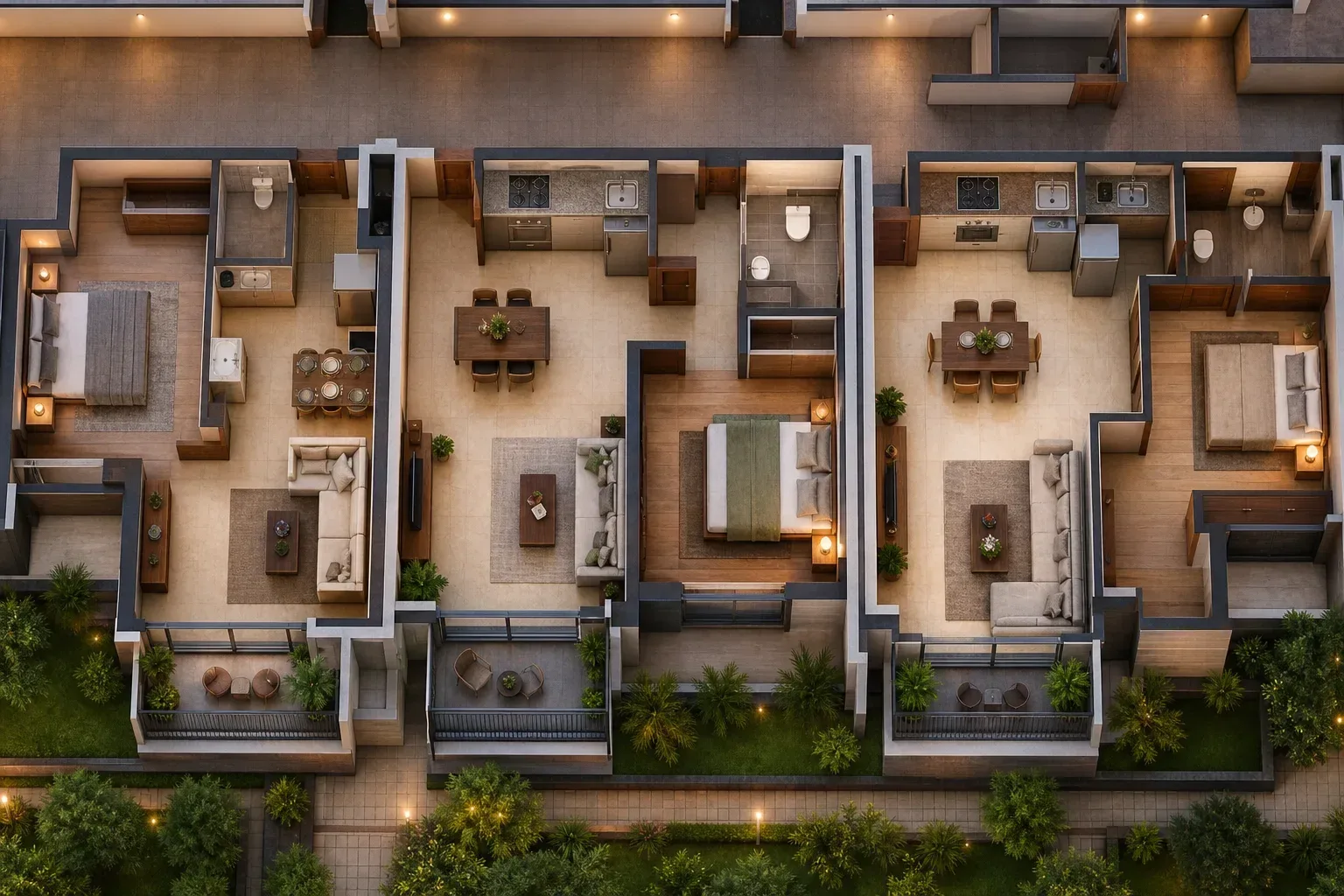
Key Answers in This Guide
- What Each Area Term Means: Three terms appear in every flat transaction.
- What Loading Is and Why Builders Quote Super Area: Loading is the percentage added to carpet area to arrive at super area.
- A Fully Worked Example: Converting a Super-Area Rate to a Carpet Rate: Total price = 3,000 × 1,000 = ₹30,00,000, that is ₹30 lakh.
- How to Compare Two Flats With Different Loading: The comparison method is one rule: reduce every flat to total price divided by carpet area, then compare only those numbers.
- What RERA Changed: The Real Estate (Regulation and Development) Act, 2016 made carpet area a defined legal term and put it at the centre of primary-market sales.
- Questions to Ask a Seller or Builder About Area: Ask these in order and write the answers down.
In this guide
Carpet area is the floor you actually live on. Super area is the number you pay for. The gap between the two is called loading, and it commonly reaches 20 to 30 per cent, which means the per-sq-ft rate on a brochure can look far cheaper than the rate you truly pay for usable space.
This guide explains all three area definitions, shows the maths for converting a quoted rate into a true carpet-based rate, and gives you a method to compare two flats with different loading. Nothing here needs more than school arithmetic. It takes ten minutes to learn and it protects every flat decision you make after that.
What Each Area Term Means
Three terms appear in every flat transaction. Sellers mix them freely. You should not.
Carpet area
Carpet area is the net usable floor area inside your flat. Picture laying carpet wall to wall in every room. The area that carpet covers is the carpet area. It includes bedrooms, living room, kitchen, bathrooms, and internal passages. Under RERA, it also includes the area covered by internal partition walls inside the flat.
Carpet area excludes the external walls, the balcony, the terrace, and every shared space outside your front door.
This is the only number that describes how much home you get. When you place a bed, a sofa, or a dining table, you are placing it on carpet area. Nothing else.
Built-up area
Built-up area is carpet area plus the thickness of the walls plus the balcony and terrace areas attached to the flat. Walls typically eat a meaningful slice of a flat’s footprint, so built-up area is noticeably larger than carpet area even before any shared space enters the picture.
Built-up area still describes only your own flat. It stops at your outer walls and your balcony edge.
Super area, also called super built-up or saleable area
Super area is built-up area plus your proportionate share of common areas. Common areas include the lift shafts, staircases, lobbies, corridors, the entrance hall, and sometimes the clubhouse, the gym, the security room, and the generator room. The builder totals these shared spaces, divides them among all flats, and adds each flat’s share to its built-up area.
You never occupy this space exclusively. You share the lift with the whole tower. Yet in most primary-market quotes, the price is calculated on this number.
The three areas are nested: your carpet area sits inside the built-up area, which sits inside the super area. Each outer layer adds space you pay for but do not exclusively occupy.
Here is the relationship at a glance:
| Area type | What it includes | Effect on the quoted rate |
|---|---|---|
| Carpet area | Usable floor inside the flat, including internal partition walls; excludes external walls and balcony | The honest base; rate per sq ft looks highest on this number |
| Built-up area | Carpet area plus wall thickness plus balcony and terrace | Larger denominator; rate per sq ft looks lower than on carpet |
| Super area | Built-up area plus proportionate share of lifts, stairs, lobbies, clubhouse and other common areas | Largest denominator; rate per sq ft looks lowest, which is why brochures use it |
Same flat, same total price, three different per-sq-ft rates. Only the denominator changed.
One more unit matters in Bhiwadi and across Rajasthan and NCR: the gaj. 1 gaj equals 1 square yard, which equals 9 sq ft. Plot dealers quote in gaj; flat sellers quote in sq ft. If a seller switches units mid-conversation, convert everything to sq ft before you compare anything. Our area converter does gaj, sq ft, and sq m conversions instantly, and the property glossary defines every area term you will hear in a Bhiwadi negotiation.
What Loading Is and Why Builders Quote Super Area
Loading is the percentage added to carpet area to arrive at super area.
Loading percentage = (Super area − Carpet area) ÷ Carpet area × 100
Suppose a flat has 800 sq ft carpet area and 1,040 sq ft super area. The loading is 240 ÷ 800 = 30 per cent. This is a hypothetical illustration, and the numbers are round on purpose, but the range is realistic: across Indian residential projects the carpet-to-super gap commonly reaches 20 to 30 per cent. Older or amenity-heavy projects can run higher.
Why does the builder quote on super area? Two reasons, one fair and one tactical.
The fair reason: common areas cost real money to build. The lift, the lobby, and the staircase are part of the project’s construction cost. The builder has to recover that cost from the flats. Spreading it across all units through loading is one way to do it.
The tactical reason: a bigger denominator makes the per-sq-ft rate look smaller. A flat priced at a fixed total looks cheaper per sq ft on super area than on carpet area, and cheaper still if the loading is aggressive. Buyers compare per-sq-ft rates across projects. A builder who quotes on super area with high loading wins that comparison on paper while charging the same or more for the same usable space.
A low per-sq-ft rate on super area tells you nothing until you know the loading. That is the single most important sentence in this article. A brochure rate is an advertisement, and the denominator is the fine print.
Loading itself is neither a scam nor a virtue. A project with wide corridors, two lifts per tower, and a proper clubhouse will have higher loading than a bare-bones building with one narrow staircase. You may happily pay for those amenities. The problem is opacity, not the concept. You need to see the loading number so you can decide whether the shared space is worth what you pay for it.
A Fully Worked Example: Converting a Super-Area Rate to a Carpet Rate
Take a hypothetical flat. These numbers are illustrations chosen for clean arithmetic, not real Bhiwadi listings.
- Quoted rate: ₹3,000 per sq ft on super area
- Super area: 1,000 sq ft
- Loading: 30 per cent
Step 1: Find the total price.
Total price = 3,000 × 1,000 = ₹30,00,000, that is ₹30 lakh.
Step 2: Find the carpet area.
If loading is 30 per cent on carpet, then super area = carpet × 1.30. So carpet = 1,000 ÷ 1.30 = about 769 sq ft.
Watch the division here. Many buyers subtract 30 per cent of super area (1,000 − 300 = 700 sq ft) and get the wrong answer. Loading is a percentage of carpet area, not of super area, so you divide by 1.30 rather than multiplying by 0.70. The two methods give different results, and the wrong one always makes the flat look worse than it is. Do the division.
Step 3: Find the effective carpet rate.
Effective rate = Total price ÷ Carpet area = 30,00,000 ÷ 769 = about ₹3,900 per sq ft.
The flat advertised at ₹3,000 per sq ft actually costs about ₹3,900 per sq ft of usable space. Same flat, same money, 30 per cent higher real rate. Nothing dishonest happened in the arithmetic; the brochure simply chose the flattering denominator.
The general formula is worth memorising:
Effective carpet rate = Quoted super-area rate × (1 + loading fraction).
At 25 per cent loading, multiply the quoted rate by 1.25. At 30 per cent, multiply by 1.30. A ₹3,000 quote at 25 per cent loading is really ₹3,750 per carpet sq ft. At 35 per cent loading it is ₹4,050. The quoted rate never changed; the truth did.
Run the same conversion the other way when a resale seller quotes on carpet area. A resale flat at ₹3,600 per sq ft carpet is cheaper per usable sq ft than a new flat at ₹3,000 per sq ft super with 30 per cent loading, because the new flat’s effective rate is ₹3,900. On brochure numbers the new flat looked ₹600 cheaper. On real numbers it is ₹300 dearer. This reversal happens constantly when buyers compare primary bookings against ready-to-move properties, because resale sellers and builders often quote on different denominators.
In Bhiwadi, entry-level ready flats are often quoted from roughly ₹16 to ₹23 lakh depending on size, sector, and condition. Treat that range as indicative only; contact us for current rates. At those ticket sizes, a 30 per cent loading difference moves the effective rate by hundreds of rupees per sq ft, which is often the entire negotiation margin. The property cost calculator lets you plug in a total price and area to see the full cost including stamp duty and registration, and the registry charges guide explains what gets added on top of the flat price at the sub-registrar’s office.
How to Compare Two Flats With Different Loading
The comparison method is one rule: reduce every flat to total price divided by carpet area, then compare only those numbers. Ignore quoted per-sq-ft rates entirely. They use different denominators and cannot be compared.
Work through a hypothetical pair. Both are illustrations.
Flat A:
- Quoted at ₹2,900 per sq ft on super area
- Super area 1,050 sq ft, so total price ₹30,45,000
- Loading 32 per cent, so carpet area = 1,050 ÷ 1.32 = about 795 sq ft
- Effective carpet rate = 30,45,000 ÷ 795 = about ₹3,830 per sq ft
Flat B:
- Quoted at ₹3,150 per sq ft on super area
- Super area 980 sq ft, so total price ₹30,87,000
- Loading 22 per cent, so carpet area = 980 ÷ 1.22 = about 803 sq ft
- Effective carpet rate = 30,87,000 ÷ 803 = about ₹3,845 per sq ft
On brochures, Flat A looks clearly cheaper: ₹2,900 against ₹3,150, a gap of ₹250 per sq ft. On carpet, they are nearly identical, and Flat B actually gives you slightly more usable space for roughly the same money. The entire ₹250 advantage was an artefact of loading.
Once effective rates are level, the decision moves to everything the arithmetic cannot capture. Which layout wastes less carpet on passages? A 795 sq ft flat with a long internal corridor lives smaller than an 803 sq ft flat with a square plan. Which building maintains its common areas? High loading buys you nothing if the lift is dead and the lobby is dark. What are the monthly maintenance charges, and are they billed on super area? Most societies bill maintenance per sq ft of super area, so higher loading quietly raises your monthly outgo for the life of your ownership, not just the purchase price.
Also compare floor, facing, age of the building, and title condition. Two flats with identical effective rates can differ hugely in resale prospects. A professional valuation accounts for these factors together rather than rate alone. And if the comparison is between a flat and a plot rather than two flats, the area arithmetic changes completely, because plots have no loading at all; the flats vs plots guide covers that decision.
A practical shortcut for site visits: carry a phone calculator and do the ÷ 1.30 division in front of the seller. Ask the loading, divide, and quote the effective rate back to them. The conversation changes immediately. Sellers negotiate differently with buyers who compute.
What RERA Changed
The Real Estate (Regulation and Development) Act, 2016 made carpet area a defined legal term and put it at the centre of primary-market sales.
First, RERA gave carpet area a single statutory definition: the net usable floor area of an apartment, excluding external walls, areas under service shafts, exclusive balconies and open terraces, but including the area covered by internal partition walls. Before RERA, every builder defined carpet area their own way, when they defined it at all.
Second, RERA requires developers of registered projects to disclose the carpet area of every apartment. The carpet area appears in the project’s RERA registration records and must be stated in the agreement for sale. A builder in a registered project cannot lawfully sell you a flat without telling you its carpet area.
Third, agreements in registered projects are tied to carpet area, so if the delivered carpet area falls short of what was agreed, the buyer has a defined basis for a proportionate refund, and compensation mechanisms exist under the Act.
What RERA did not do is ban super area. Builders may still advertise and price on super area, and most do. RERA guarantees that the carpet number exists and is disclosed; it does not force anyone to market with it. So the burden of using the carpet number still sits with you. The disclosure is there; you have to look it up and do the division.
For Bhiwadi buyers the practical step is simple. Rajasthan’s RERA portal lists registered projects with their disclosed details. Before booking in any under-construction or recently completed project, find its RERA registration and read the disclosed carpet areas for the unit type you are buying. Compare that number against what the sales office told you. If the two differ, believe the portal, and ask the seller to explain the difference in writing. As a Rajasthan RERA-registered agent (registration no. RAJ/A/2026/21898), we do this check as a matter of routine for every project we introduce.
One boundary to note: RERA’s carpet-area machinery applies to registered projects. Resale flats between two individuals sit outside it. In resale, the sale deed and the original builder documentation are your sources for area, which is one more reason to insist on the full document chain; see the documents checklist for what to collect before any resale purchase.
Questions to Ask a Seller or Builder About Area
Ask these in order and write the answers down. Verbal answers that a seller will not repeat in writing are answers you should treat as absent.
- What is the carpet area in sq ft, and will it be written in the agreement? This is the first question, not the fifth. In a RERA-registered project, the agreement must state it. In resale, ask for the figure from the original builder-buyer agreement or the sale deed.
- What is the super area, and what is the loading percentage? If the seller quotes super area but cannot state the loading, they are asking you to pay for a denominator they will not explain.
- What exactly is included in the common areas I am paying for? A lift and a staircase are one thing. If the loading includes a clubhouse, confirm the clubhouse exists, is complete, and is accessible to your tower without a separate membership fee.
- Is the balcony inside or outside the quoted carpet figure? Under the RERA definition, exclusive balconies are excluded from carpet area. Some sellers quote a “carpet” figure that quietly includes balconies to make the flat sound bigger. Ask which definition their number follows.
- Is the project RERA registered, and what carpet area is disclosed on the portal for this unit type? Then verify it yourself.
- Are maintenance charges billed on super area or carpet area, and at what rate? This converts loading into a recurring monthly cost you can compare across societies.
- If measured carpet area at possession is lower than agreed, what is the adjustment? In registered projects the Act provides for proportionate adjustment. Get the mechanism referenced in the agreement anyway.
- Can I measure the flat? For a ready flat, a tape measure and twenty minutes settle the carpet area beyond argument. Any seller who refuses a measurement has told you something important.
If you are early in your search and just want to shortlist, browse flats in Bhiwadi and ask us for the carpet figure on any listing that interests you; quoting both numbers is our default because we have been doing this since 2008 and buyers who understand area come back.
Common Tricks to Watch For
None of these is universal, and most sellers are straightforward. But each of the following appears often enough that you should recognise it on sight.
Quoting rate and area on different bases. The rate is quoted per sq ft of super area, but when you ask about size, the seller cites the carpet or built-up figure because it sounds “more honest”. You mentally multiply the low rate by the small area and underestimate the total price. Always compute total price yourself: quoted rate times the area the rate applies to.
Silent loading increases between booking and agreement. The brochure implied one loading; the agreement states a larger super area for the same carpet. Because the rate is per super sq ft, the total price rises without the rate ever changing. Fix the carpet area, the super area, and the total price in the booking documentation, all three, in figures.
The shifting balcony. Balcony area migrates to whichever figure the seller wants to inflate. It is added to “carpet” when describing size and counted again inside super area through built-up. Ask for a figure that follows the RERA carpet definition, which excludes exclusive balconies, and treat balconies as a separate line.
Percentage confusion in reverse. A seller says loading is 25 per cent and then, when you ask for carpet, deducts 25 per cent from super area. As shown earlier, that is the wrong direction and it understates carpet. Sometimes the error runs the other way to overstate carpet. Do your own division; never accept a pre-computed “effective” figure.
Amenity-inflated super area. Common areas that do not exist yet, or that will carry separate usage charges later, are included in loading. You pay for the clubhouse twice: once in the super area and again in membership. Ask which amenities are inside the loading and whether their use costs extra.
Comparing their super rate to a rival’s carpet rate. A sales pitch that says “we are ₹400 cheaper than the project next door” only means something if both rates use the same denominator. They rarely do. Redo the comparison on carpet, always.
Rounding on gaj conversions. In mixed conversations about plots and flats, a seller may round 1 gaj to 10 sq ft instead of 9 to make an area sound larger. Over a whole unit the difference is material. Convert precisely; the area converter removes the arithmetic excuse.
The common thread: every trick exploits a buyer who compares headline rates instead of computing total price ÷ carpet area. The defence is one division. Do it every time.
The Short Version
Carpet area is what you live in. Super area is what you are billed on. Loading connects them and commonly runs 20 to 30 per cent. Convert every quote to an effective carpet rate by multiplying the super-area rate by (1 + loading), or by dividing total price by carpet area. Compare flats only on that number, then on layout, maintenance, and condition. RERA guarantees the carpet figure exists for registered projects; using it is your job. Entry-level ready flats in Bhiwadi are often quoted from roughly ₹16 to ₹23 lakh, indicative only; contact us for current rates and we will give you both the super and the carpet numbers for anything we show you.
Frequently Asked Questions
What is the difference between carpet area and super area?
Carpet area is the net usable floor inside your flat, including internal partition walls but excluding external walls, balconies, and terraces. Super area adds wall thickness, balconies, and your proportionate share of common spaces such as lifts, staircases, and lobbies. Super area is always larger, commonly by 20 to 30 per cent over carpet.
Is it legal for builders to charge on super area?
Yes. RERA requires developers of registered projects to disclose carpet area and to state it in the agreement for sale, but it does not prohibit pricing or advertising on super area. The disclosure exists so you can convert the quote yourself and compare honestly.
How many square feet is 1 gaj?
1 gaj equals 1 square yard, which equals 9 sq ft. So a 100 gaj plot is 900 sq ft. Gaj is standard for plots in Bhiwadi and across Rajasthan and NCR, while flats are quoted in sq ft, so convert to one unit before comparing anything.
Does RERA carpet area include the balcony?
No. The RERA definition excludes exclusive balconies and open terraces from carpet area, along with external walls and service shafts. It includes the area under internal partition walls. If a seller’s “carpet” figure includes the balcony, it does not follow the RERA definition; ask for the RERA-basis figure.
Ready to Shortlist? Talk It Through With Us
18+ years in this market. Real prices, verified paperwork, no pressure.
Choose what you would like to do next:
Done — our team will contact you during working hours.