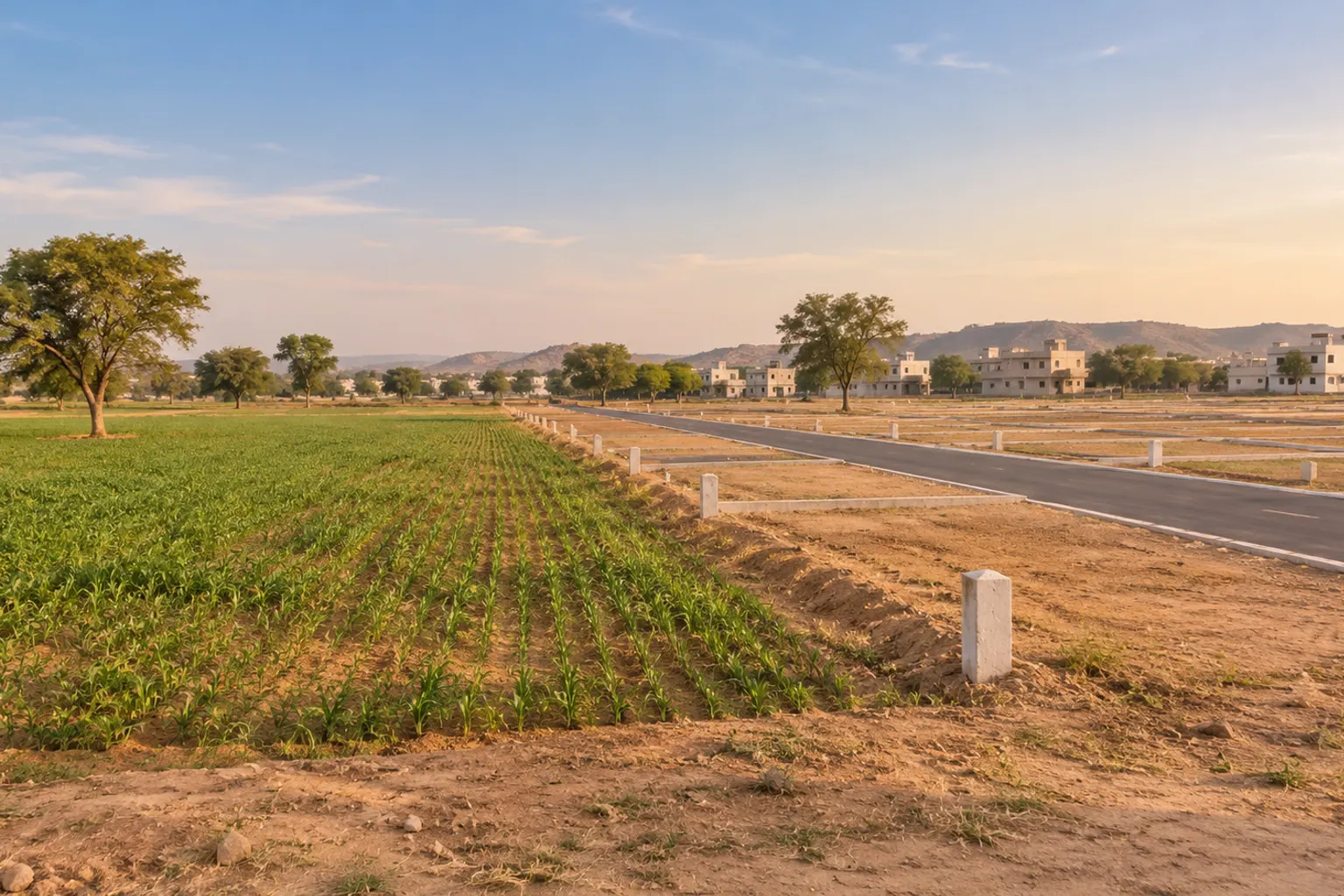
Key Answers in This Guide
- The Order, the Rules and the Office in One Table: Three things get confused in conversation here: the law, the rules made under it, and the office that actually issues the paper.
- What Conversion Is Worth on the Government's Own Schedule: The DLC schedule, the rate list the Registration and Stamps Department uses as the floor for stamp duty, values the same village two ways.
- Land Outside BIDA's Area: The Rural Rules, Amended in April 2026: Farmland and farmhouse land in revenue villages outside a development authority's urban area is converted under the Rajasthan Land Revenue (Conversion of agricultural land for non-agricultural purposes in rural areas) Rules, 2007.
- What a 90A Order Does Not Tell You: A conversion order is permission to change the land's use.
- Kacchi Colony, Gram Panchayat and Lal Dora: Where 90A Is Usually Missing: The local words carry the risk before the documents do.
- How the Townships We Sell Stand: The plotted townships on our rate card are developer colonies on land that went through conversion and layout approval before plots were sold.
In this guide
A 90A order is the written permission of the state to use agricultural land for a non-agricultural purpose, such as a residential colony, under Section 90-A of the Rajasthan Land Revenue Act, 1956. A plot carved out of farmland without it is still agricultural land in law, however it is marketed, and no amount of brochure language turns it into a residential plot. In the Bhiwadi region the order comes from the development authority, BIDA, and the revenue record (the jamabandi) is updated after it.
This guide explains what the order is, how one is obtained under the current rules, what the government’s own rate schedule says a conversion is worth around Bhiwadi, and the six checks to run on a plot’s 90A paper before you pay bayana.
The Order, the Rules and the Office in One Table
Three things get confused in conversation here: the law, the rules made under it, and the office that actually issues the paper. They are separate, and each answers a different question.
| Item | What it is | Where it applies in this belt |
|---|---|---|
| Section 90-A, Rajasthan Land Revenue Act, 1956 | The provision that requires permission before agricultural land is used for anything else | All agricultural land in Rajasthan, including every revenue village around Bhiwadi, Tapukara and Tijara |
| Rajasthan Urban Areas (Permission of Use of Agricultural Land for Non-agricultural Purposes and Allotment) Rules, 2012 | The procedure for granting that permission inside an urban area | Land inside a development authority’s area, which in this region means BIDA |
| The 90A order | The document the authority issues when it grants permission, naming the khasra numbers, area and purpose | The paper a buyer asks to see |
| 90B on an older file | The provision used for urban conversions in an earlier era | Still a valid document for the period it was issued in |
The 2012 rules are published on India Code, and their opening restriction is the line that matters for a buyer: in an urban area, a Section 90-A permission for agricultural land is granted only under those rules. Land outside an urban area is converted under separate rural rules, by the revenue officers rather than a development authority, so the first question on any plot is which of the two routes its land went through. The rural route is set out further down.
What Conversion Is Worth on the Government’s Own Schedule
The DLC schedule, the rate list the Registration and Stamps Department uses as the floor for stamp duty, values the same village two ways. Agricultural land is listed per hectare in the rural schedule; colony and abadi land is listed per square metre in the urban one. Put the two on the same unit and the gap is what conversion is worth on paper.
We did that for every village that appears in both the rural and the urban schedule of the Bhiwari and Tapukara sub-registrar offices, as retrieved from ePanjiyan on 10 August 2026. There are 40 such villages. The residential rate runs from 1.7 to 5 times the agricultural rate for land near a road, and in the typical village it is about three times.
| Village (SRO) | Agricultural, near road | Residential, interior | Per gaj, agricultural | Per gaj, residential | Multiple |
|---|---|---|---|---|---|
| Khohari Kalan (Bhiwari) | ₹1,100 per sq m | ₹5,500 per sq m | ₹920 | ₹4,599 | 5.0 |
| Chhapar (Tapukara) | ₹1,100 per sq m | ₹5,000 per sq m | ₹920 | ₹4,181 | 4.5 |
| Bilahedi (Bhiwari) | ₹2,400 per sq m | ₹10,000 per sq m | ₹2,007 | ₹8,361 | 4.2 |
| Mundana (Bhiwari) | ₹2,750 per sq m | ₹11,000 per sq m | ₹2,299 | ₹9,197 | 4.0 |
| Rampura (Bhiwari) | ₹3,800 per sq m | ₹14,000 per sq m | ₹3,177 | ₹11,706 | 3.7 |
| Chopanki (Bhiwari) | ₹2,700 per sq m | ₹9,000 per sq m | ₹2,258 | ₹7,525 | 3.3 |
| Karoli (Tapukara) | ₹3,400 per sq m | ₹11,000 per sq m | ₹2,843 | ₹9,197 | 3.2 |
| Jhiwana (Bhiwari) | ₹2,650 per sq m | ₹8,000 per sq m | ₹2,216 | ₹6,689 | 3.0 |
| Kahrani (Bhiwari) | ₹4,540 per sq m | ₹11,000 per sq m | ₹3,796 | ₹9,197 | 2.4 |
| Bureda (Tapukara) | ₹2,200 per sq m | ₹5,000 per sq m | ₹1,839 | ₹4,181 | 2.3 |
| Milakpur Gurjar (Bhiwari) | ₹8,800 per sq m | ₹15,000 per sq m | ₹7,358 | ₹12,542 | 1.7 |
The agricultural figures are the schedule’s per-hectare rates for irrigated land near a road, divided by 10,000 to give a per square metre figure. The residential figures are the interior rate for the colony entry carrying the same village name. One gaj is 0.836 square metres, which is why every per gaj figure is lower than its per square metre figure.
Read the table for what it is. A DLC rate is the stamp-duty floor, never the market price, and the residential entry for a village name covers its colony and abadi land, not a particular plot. What the table does show is the scale of the gap the state itself recognises. A 150 gaj plot in Mundana is worth about ₹3.45 lakh on the agricultural rate and about ₹13.8 lakh on the residential rate. That gap is the reason land is converted, and it is also the reason unconverted farmland gets sold by the gaj at prices that sit between the two figures, to buyers who believe they are buying the second number.
The full colony-by-colony schedule, converted into gaj and sq ft, is on our DLC rate in Bhiwadi page, and our registry charges guide explains how stamp duty is worked out on the higher of the agreed price and the DLC value.
How a 90A Order Is Obtained Under the 2012 Rules
The application is made online. The state’s user manual for the 90-A application sets out the path for a development authority, and every stage leaves a paper a buyer can later ask for.
| Stage | What happens | What it leaves on the file |
|---|---|---|
| Login | The applicant signs in to the Rajasthan SSO portal and opens “90-A for Development Authority (UDH)” under Citizen apps | An SSO reference against the applicant’s Aadhaar-verified mobile |
| Applicant details | Development authority and zone selected, applicant details and photo entered | The applicant’s name, which must match the khatedar in the jamabandi |
| Land details | Tehsil, revenue village, khasra numbers, khasra type, khatedar and area entered; the purpose of use is chosen | The khasra numbers and purpose the order will later name |
| Area calculation | The applicant chooses a single patta or a scheme layout plan, and states the land falling under sector roads, master plan roads and facility areas | A surrender deed for the land given up to roads and facilities |
| Documents and fee | Documents uploaded; the premium is calculated by the system and 10 per cent of the total fee is paid through the Rajasthan Payment Platform | A payment receipt number |
| Scrutiny | The application moves to the zonal officer and dealing assistant, and a public notice is issued in Form 10 | The public notice, which invites objections |
| Field reports | The Tehsildar, the town planning side and the engineering side each submit their compliance reports (Forms 6, 7A and 7B) | Reports on the land’s record, the plan and the ground |
| Approval | The application is approved at the top of the authority and the zonal officer issues the 90A order | The order itself, downloadable by the applicant |
| Record update | The order is sent to the Tehsildar to change the mutation and jamabandi | The updated revenue record for those khasra numbers |
Two stages in that table matter more to a buyer than the rest. The area calculation decides whether land was converted as a single patta for one owner’s use or as a scheme layout for a colony, and a colony sold under a single-patta conversion is a mismatch worth a question. The record update is the stage most often left unfinished, because the applicant already holds the order and has no pressing reason to chase the Tehsildar.
Land Outside BIDA’s Area: The Rural Rules, Amended in April 2026
Farmland and farmhouse land in revenue villages outside a development authority’s urban area is converted under the Rajasthan Land Revenue (Conversion of agricultural land for non-agricultural purposes in rural areas) Rules, 2007. Those rules were amended by the Revenue (Group-6) Department’s notification No. F.6(26)rev-6/14/28 dated 29 April 2026, which came into force at once. The amendment replaced the table of who decides an application, and the officer now depends on the purpose and the total area.
| Purpose of conversion | Who decides, by total area |
|---|---|
| Residential unit | Tehsildar, up to 1,000 sq m |
| Residential colony or project | Sub Divisional Officer up to 10,000 sq m; Collector up to 50,000 sq m; Divisional Commissioner up to 1,00,000 sq m; State Government above that |
| Commercial | Sub Divisional Officer up to 5,000 sq m, excluding cinema, petrol pump, multiplex, hotel and resort; Collector up to 50,000 sq m; Divisional Commissioner up to 1,00,000 sq m; State Government above that |
| Industrial | Sub Divisional Officer up to 10,000 sq m, excluding a tourism unit; Collector up to 1,00,000 sq m; Divisional Commissioner up to 2,00,000 sq m; State Government above that |
The same notification sets a non-refundable application fee of ₹2,000 for a residential unit and ₹20,000 for any other purpose, and the fee is not adjusted against the conversion charges. It also cut the area figure in the rules’ definition clause from 4,000 to 1,000 square metres.
For a buyer near Bhiwadi, the first row is the one that matters. A thousand square metres is about 1,196 gaj, which covers most farmhouse plots and small parcels sold in the villages, and a conversion for a single house on such a parcel now sits with the Tehsildar. A colony is a different application to a different officer, so a coloniser selling plots on a converted parcel should hold a colony-purpose order, not a residential-unit one. Our page on agricultural land in Bhiwadi covers what buying village land involves beyond conversion.
Six Checks on a Plot’s 90A Before You Pay Bayana
Run these on the paper, in this order. Each one is a match between two documents, and none needs the seller’s cooperation beyond handing over copies.
- Get the order itself, not a mention of it. A seller who says “90A ho chuka hai” and cannot produce a copy has told you something. The applicant can download the order from the SSO portal, so a developer or an original landowner has no reason not to have it.
- Match the khasra numbers. The order names specific khasra numbers in a specific revenue village. Your plot must sit on one of them. A colony can hold a conversion for part of its land and sell plots on the unconverted remainder under the same colony name, the same problem our RERA and BIDA verification guide describes for layout sanctions.
- Match the purpose. Residential, commercial and industrial are different permissions. A house plot on land converted for a commercial or industrial use has the wrong paper.
- Match the area and the layout type. The converted area should cover the plotted area, and a colony should show a scheme layout, not a single patta issued for one owner’s own use.
- Read the jamabandi for the same khasra numbers. Pull it on Apna Khata under Khairthal-Tijara district. The order is sent to the Tehsildar so the record can be updated; if the jamabandi still reads as a plain agricultural holding in a farmer’s name with no trace of the conversion or of the sale to the developer, ask for the mutation that should have followed. Our Apna Khata guide explains what each entry does and does not establish.
- Follow the name chain. The order is issued to the applicant. That name should lead, document by document, to the person selling to you: from the converting owner to the developer, to the layout, to the allotment or sale deed in the seller’s name.
When a plot passes all six, the land under it was converted for the use you are paying for. That is one question answered out of several, and the next section says which ones are still open.
What a 90A Order Does Not Tell You
A conversion order is permission to change the land’s use. It says nothing about who owns the plot today, whether a bank holds a charge on it, or whether the boundary on the ground matches the paper.
| Question | Answered by the 90A order? | Where the answer lives |
|---|---|---|
| May this land be used for houses? | Yes, if the purpose and khasra numbers match | The order |
| Was the colony layout sanctioned? | No | The sanctioned layout plan from BIDA, or from UIT on an older file |
| Does the seller own this plot? | No | The sale deed or allotment, the title chain and the revenue record |
| Is there a loan or charge on it? | No | An encumbrance search at the sub-registrar’s office |
| Can a house be built on it? | Partly | A building plan approval, which needs both conversion and a sanctioned layout |
| Is the plot where the papers say? | No | A demarcation against the layout or the revenue map |
None of these papers replaces a property-specific title review by an independent lawyer. They are the checks that tell you whether a lawyer’s fee is worth spending on this plot or whether you should walk away first.
Kacchi Colony, Gram Panchayat and Lal Dora: Where 90A Is Usually Missing
The local words carry the risk before the documents do. A kacchi colony is a plotted layout on land that was never converted, or never sanctioned, or both. A gram panchayat plot is approved at village level only, which is not a conversion of agricultural land. Lal dora or abadi land is old village settlement land, which sits outside the agricultural record altogether and so raises a different set of questions, mostly about title rather than conversion. Each term is defined in our Bhiwadi property glossary.
The price is usually the first signal. Plots in an unconverted layout sell well below the converted colony next door, and the DLC table above shows why the seller can afford to: the land being sold is valued by the state at its agricultural rate. What the buyer gets for the saving is a plot on which a building plan cannot be sanctioned, services have no formal basis, and the next buyer’s lawyer will ask the same six questions with less patience.
Some owners in an unconverted layout apply for conversion later. Whether that succeeds depends on the land, the master plan and the surrender of road and facility land the rules require, and nobody can promise the outcome in advance. A plot priced as if conversion is certain is priced for a decision the authority has not made.
How the Townships We Sell Stand
The plotted townships on our rate card are developer colonies on land that went through conversion and layout approval before plots were sold. When we visited them on 19 August 2026, five were recorded as handed over to BIDA, which means the authority has accepted the colony’s internal development:
- Omaxe Green Meadow City, Bhiwadi
- VBHC and Krish Season, in the Honda zone at Tapukara
- Terra City and Chanderlok City, on the Tapukara-Tijara stretch
Ekta Enclave is the exception on our list: whether the colony has been handed over to BIDA or is still with the builder is an open question we ask buyers to put to the developer. Handover is a fact about the colony. The six checks above are still run for the individual plot, because a sound colony does not make every resale plot in it sound. Our plot projects compared guide sets these townships side by side on rate, handover and approval status, and plots in Bhiwadi lists the plots on sale today.
Send Us the Khasra Numbers Before You Pay
If you have a plot in view anywhere in the Bhiwadi, Tapukara or Tijara belt, send us the khasra numbers, the revenue village and a photo of the 90A order. We will read the order against the jamabandi and the layout and tell you which of the six checks pass, at no charge, before any bayana changes hands. This is part of the document checks we run on every transaction.
Sources Checked
- Rajasthan Urban Areas (Permission of Use of Agricultural Land for Non-agricultural Purposes and Allotment) Rules, 2012, India Code (checked November 2026)
- Online application for 90-A permission: user manual, Government of Rajasthan, published on RajNivesh (checked November 2026)
- Notification No. F.6(26)rev-6/14/28, 29 April 2026, Revenue (Group-6) Department, amending the Rajasthan Land Revenue (Conversion of agricultural land for non-agricultural purposes in rural areas) Rules, 2007 (read November 2026)
- ePanjiyan DLC rates, Registration and Stamps Department, Rajasthan: Bhiwari and Tapukara schedules, retrieved 10 August 2026
- Apna Khata: jamabandi and mutation records (checked November 2026)
Portal screens and fee schedules change; confirm on the official site on the day you rely on them.
Frequently Asked Questions About 90A Land Conversion in Bhiwadi
What is a 90A order in Rajasthan?
It is the permission, issued under Section 90-A of the Rajasthan Land Revenue Act, 1956, to use agricultural land for a non-agricultural purpose such as housing. It names the khasra numbers, the area and the purpose. Inside the Bhiwadi region it is issued by the development authority under the 2012 urban area rules.
How do I check whether a plot in Bhiwadi has 90A conversion?
Ask the seller for a copy of the order, then match its khasra numbers, purpose and area to your plot, and read the jamabandi for the same khasra numbers on Apna Khata. The record should reflect the conversion and the chain of sales that followed it.
What is the difference between 90A and 90B?
Both are conversion provisions. 90B appears on older files from the era when it governed urban conversions, and such an order remains valid for its period. Current applications in an urban area are made under Section 90-A and the 2012 rules.
Is a 90A order the same as BIDA layout approval?
No. The 90A order permits the land’s use to change. The layout approval sanctions the colony’s plan of plots, roads and parks. A plot needs both, and a building plan cannot be approved without them.
Can I buy a plot in a colony without 90A conversion?
You can sign the papers, but you are buying agricultural land at a plot price, without a basis for a building plan or formal services. Any later conversion depends on the authority, and no seller can guarantee it.
Where is the 90A application made for land near Bhiwadi?
For land inside the development authority’s area, online through the “90-A for Development Authority (UDH)” application on the Rajasthan SSO portal. Land outside an urban area is converted under the 2007 rural rules: since the April 2026 amendment, the Tehsildar decides a residential unit of up to 1,000 sq m, and a colony goes to the Sub Divisional Officer or a higher officer depending on its total area.
Continue Reading


Want a Second Pair of Eyes on Your Paperwork?
18+ years in this market. Real prices, verified paperwork, no pressure.
Choose what you would like to do next:
Done. Our team will contact you during working hours.