Key Answers in This Guide
- Typical sizes and where they are: Independent houses here sit on plots of about 110 gaj, 150 gaj and 200 gaj, which is a substantial home by flat standards: a 150 gaj plot is roughly 1,350 square feet of land, and a house on it, often over two or three floors, gives far more built space than any apartment in the town.
- How the price of an independent house works: An independent house has no fixed price the way a flat does; its cost is the land value plus the construction, so two houses of the same plot size can differ widely on the building alone.
- Bhiwadi or the Dharuhera side for a house: Bhiwadi and the Dharuhera side are not two ends of one market, they are two legal systems, and on an independent house that matters more than it does on a flat.
- Independent house, kothi or independent floor: A full kothi is a standalone building on its own plot with every floor and your own gate and roof yours, while an independent floor is one floor of such a building sold separately, without the whole structure or the full plot beneath it.
- Villas inside a gated society: A villa in a gated society sits between a kothi and a flat.
- Independent house or a flat: the real trade-off: An independent house buys you land ownership, more built space for the money in many cases, full control over the building and no society or shared maintenance; a flat buys you gated security, shared amenities, somebody else handling the upkeep and a distinctly easier resale and rental.
In this guide
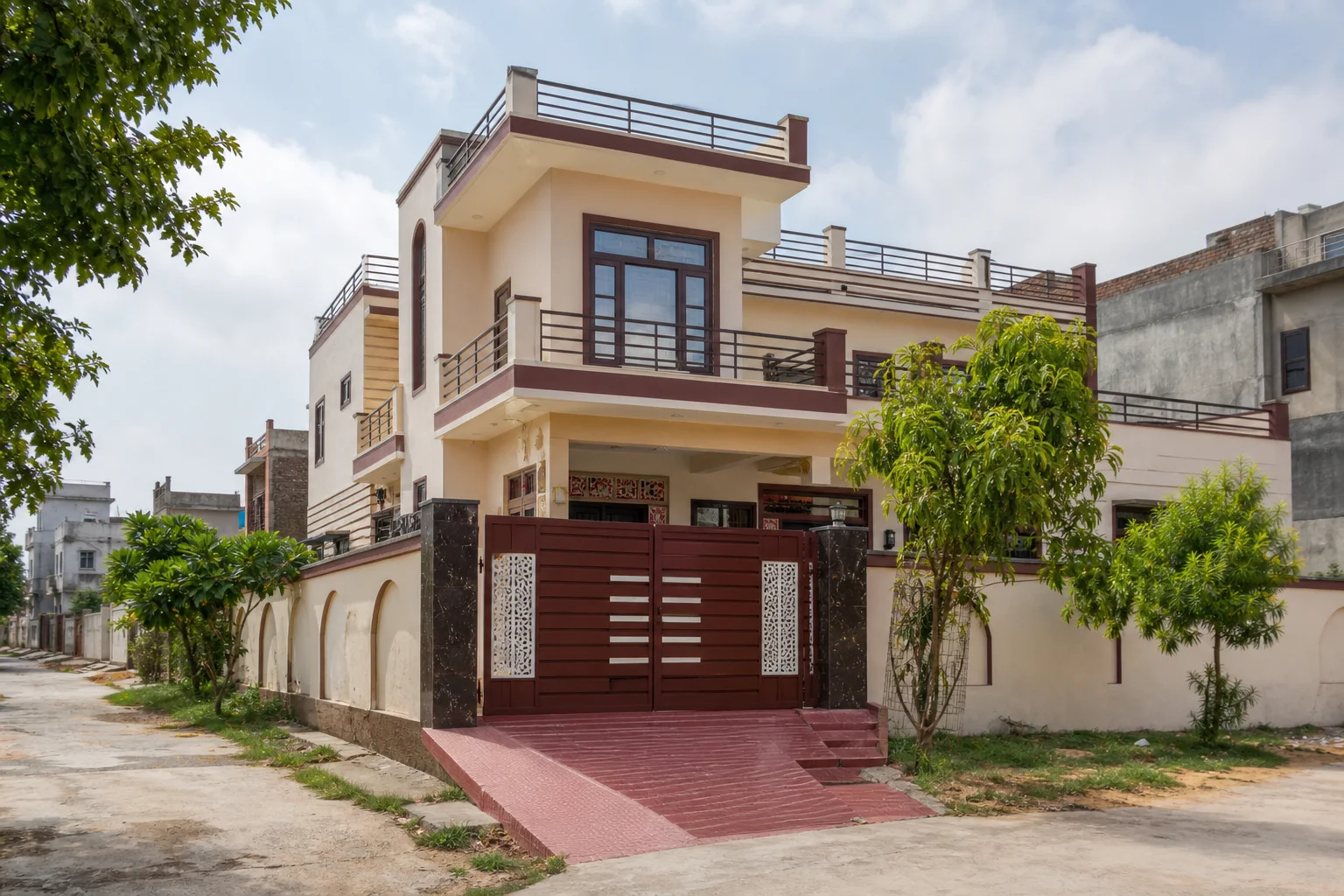
An independent house in Bhiwadi, what buyers here call a kothi, commonly sits on a plot of about 110 to 200 gaj, in the town itself or on the Dharuhera side, and unlike a flat it has no single sticker price.
| Decision | The trade-off | Where it lands |
|---|---|---|
| House vs flat | Land ownership and freedom vs shared maintenance and lower entry price | Independent house or a flat |
| Bhiwadi vs Dharuhera side | Rajasthan land rates and the Rajasthan system against Haryana prices and a shorter Gurgaon run | Bhiwadi or the Dharuhera side |
| Kothi vs independent floor | Whole plot vs one floor of it | Independent house, kothi or floor |
| Ready vs plot and build | Move in now vs control the build and stage the spend | Buy ready, or buy a plot and build |
What you pay is the value of the land plus the structure built on it: the plot measured in gaj, priced at the local rate, with the house on top. Because you own both the land and the building outright, an independent house gives you more control than a flat and asks a different set of checks in return.
An independent house is two purchases in one, a piece of land and a building, and its value, its title and its checks all separate into those two parts. A flat buyer inherits a society’s paperwork and argues about a per square foot rate. A kothi buyer values a plot and a structure separately, verifies a title chain that stands on its own, and, on the Dharuhera side, does all of it under Haryana’s system rather than Rajasthan’s.
Typical sizes and where they are
Independent houses here sit on plots of about 110 gaj, 150 gaj and 200 gaj, which is a substantial home by flat standards: a 150 gaj plot is roughly 1,350 square feet of land, and a house on it, often over two or three floors, gives far more built space than any apartment in the town.
The locations are Bhiwadi itself and the Dharuhera side, the same belt where we transact plots and flats. Independent houses tend to sit in plotted colonies and townships rather than in apartment societies, which is the whole point of the format: your own gate, your own roof, no shared society and no monthly maintenance to a builder or association in the way a flat carries. The exception is a villa inside a gated society, which keeps the house and the land but brings the society back; it has its own section below.
If you want a sense of how the plot sizes translate, and how gaj, square yards and square feet relate, our guide to land measurement units in Rajasthan sets it out, because for an independent house the plot area is half of what you are buying and you should read it precisely.
How the price of an independent house works
An independent house has no fixed price the way a flat does; its cost is the land value plus the construction, so two houses of the same plot size can differ widely on the building alone.
Start with the land, because it is the larger and the more predictable half. Our own plotted rate card runs from about ₹13,000 a gaj at the far Tijara end of the corridor to ₹70,000 a gaj at Dharuhera, and the zones sort themselves cleanly rather than blurring into one wide range:
| Zone | Rate per gaj | Land under a 150 gaj house |
|---|---|---|
| Tapukara and Tijara belt | ₹13,000 to ₹30,000 | about ₹19.5 lakh to ₹45 lakh |
| Bhiwadi proper | ₹50,000 to ₹55,000 | about ₹75 lakh to ₹82.5 lakh |
| Dharuhera, across in Haryana | ₹60,000 to ₹70,000 | about ₹90 lakh to ₹1.05 crore |
Those are Shivam Properties rate-card levels for title-clear plotted projects, reflecting transacted rather than advertised prices, recorded in August 2026. They are the land reference, not a quotation for a specific house: an older independent colony can sit off the card in either direction, and the card moves, so ask for the current rate in the actual pocket before you price anything on it.
Read the right-hand column and the point makes itself. The same 150 gaj house carries five times the land value at Dharuhera that it carries at the Tijara end of the belt, before anyone has looked at the building. The pocket, not the plot size, is the biggest single driver of the land half of the price.
Then add the structure, which is the half nobody can look up. Age, build quality, the number of floors and the standard of finish move it substantially, and unlike the land there is no rate card for it: a 150 gaj house in a prime pocket with a solid double-storey build is a different sum from a 150 gaj house in an outer colony with a basic structure, even though the plot is identical. It is also the half that a proper inspection settles and a photograph cannot, which is why the construction check further down this guide is a valuation step as much as a safety one.
A worked example on a 150 gaj house
Take the same 150 gaj plot through both halves. The land is the table above: roughly ₹19.5 lakh at the Tijara end, about ₹75 lakh to ₹82.5 lakh in Bhiwadi proper, and ₹90 lakh to ₹1.05 crore at Dharuhera. That spread is locality alone, for an identical plot.
Onto that lands the structure. A basic single-storey build adds less; a solid two or three-storey house with decent finish adds substantially more, and on a modest plot in a cheaper pocket it can be worth as much as the land under it. Stack the two and the totals separate hard: a simple house on 150 gaj in the outer belt sits in the tens of lakhs, while a well-finished double-storey kothi on the same 150 gaj at Dharuhera clears a crore on the land before the building is counted at all.
That is the whole argument for pricing the halves separately. A seller quotes one blended number, and a blended number lets a weak structure ride on a strong pocket, or a good build carry an address that will not resell. Ask what the land is worth at the current gaj rate for that specific pocket, ask what the building is honestly worth for its size, age and condition, then add them yourself and negotiate against your own figure.

Bhiwadi or the Dharuhera side for a house
Bhiwadi and the Dharuhera side are not two ends of one market, they are two legal systems, and on an independent house that matters more than it does on a flat. Bhiwadi proper puts you closer to the town’s established colonies, markets and the bulk of the industrial employment, which supports both daily convenience and resale demand, and it keeps you inside the Rajasthan system you may already know. The Dharuhera side sits across the line in Haryana, with newer plotted development, the dearest land in this belt and the shortest run towards Gurgaon and Manesar on NH-48.
Crossing that line changes every authority you deal with, not just the price per gaj. On the Dharuhera side the licensing authority for plotted development is DTCP Haryana rather than BIDA, the project regulator is Haryana RERA at Panchkula rather than Rajasthan RERA, and the district is Rewari rather than Khairthal-Tijara. The stamp duty schedule, the circle rate your registered value is tested against, the land records and the mutation route are all Haryana’s. A buyer who has registered one house in Bhiwadi has learned very little that carries across, so treat a Dharuhera kothi as a fresh transaction rather than the same one at a higher rate.
Which side suits you turns on where your daily life points, work, schools and family, on the land budget, and on which system you are willing to learn. We cover the practical differences in Bhiwadi vs Dharuhera, the pocket-by-pocket picture in best areas to buy property in Bhiwadi, and the plotted rate card zone by zone in Bhiwadi plot projects compared. For an independent house, where you are buying one specific plot in one specific colony, the exact pocket matters even more than it does for a flat.
Independent house, kothi or independent floor
A full kothi is a standalone building on its own plot with every floor and your own gate and roof yours, while an independent floor is one floor of such a building sold separately, without the whole structure or the full plot beneath it. It is a house-like home at a lower price, and the gap between the two is essentially the land you do not own. Sellers use all three words loosely, so the distinction is worth stating rather than assuming.
The distinction matters for ownership, for the land share you get, and for resale. A full kothi on 150 gaj is a different asset from one floor of a similar building, even if the living space feels comparable, because with the kothi you own the entire land and structure. When a seller says “independent house”, confirm exactly which you are being offered, the whole building on its plot or one floor of it, because the price and the ownership are not the same thing.
Villas inside a gated society
A villa in a gated society sits between a kothi and a flat. You own a house and the land under it, as with a kothi, but the gate, the internal roads, the park and the guard belong to a society you pay into, as with a flat. That changes three things a kothi buyer never has to think about: what the price per gaj means, which area the brochure is quoting, and who runs the place after you move in.
Three villas we are quoting in September 2026 show how far apart this format runs:
| Society | Villa | Land | Asking price | Seller | Rajasthan RERA |
|---|---|---|---|---|---|
| Madhuvan Residency, Sector 9, opposite Ashiana Tarang | 5 BHK, 4 bathrooms, east facing, sold furnished | 90 gaj | ₹1.15 crore | The builder, new | RAJ/P/2022/1882 |
| Ashiana Advik, near Thada village, Alwar Bypass Road | 3 BHK over two floors, 2 washrooms, senior living | 170 gaj | ₹3.5 crore | Owner, resale | Four phases; I and II (RAJ/P/2022/2012, RAJ/P/2023/2854) are delivered |
| Omaxe Green Meadow City, Alwar Bypass Road | 2 BHK, corner, semifurnished | 165 gaj | ₹73 lakh | Owner, resale | None; the township predates RERA |
Why the price per gaj stops meaning anything
On a villa the land is no longer the larger half of the price, so a per gaj figure compares nothing. ₹1.15 crore over Madhuvan’s 90 gaj is about ₹1.28 lakh a gaj all in. The Omaxe house works out at about ₹44,000 a gaj. Neither number is a land rate: the first carries five bedrooms stacked on a small footprint plus the furniture, and the second carries an older, smaller house on a bigger plot. Set either against the plotted rate card in the table above and one looks overpriced and the other looks cheap, and both readings are wrong. Price a society villa the way this guide prices any house, land and building separately, and add what the society itself is worth to you.
Three areas on one sheet
A villa brochure quotes more areas than a plot does, and the price is usually set against the largest. Ashiana’s own Phase I villa plan for Advik, the sheet on our Ashiana Advik page, states:
| Area on the sheet | Figure |
|---|---|
| Super area | 2,495 sq ft |
| Carpet area | 1,466 sq ft |
| Terrace area | 430 sq ft |
| Land (170 gaj) | about 1,530 sq ft |
The carpet area, the floor you actually walk on inside the walls, is about 59 per cent of the super area. Ask which of the three a quoted rate is set against, and compare two villas on carpet area, not on super area.
The same sheet carries a second lesson. It draws three toilets, and the Advik villa we are quoting has two washrooms. A built villa can differ from the brochure plan, so walk the unit against the sheet rather than buying from the sheet.
The society is part of what you buy
A kothi owner answers to nobody for the road outside the gate. A villa owner pays maintenance and lives under the society’s rules. At Omaxe Green Meadow City maintenance is ₹7 a square yard, collected by a registered RWA. Before you commit anywhere, ask four things: the maintenance charge and how it is billed, whether the builder or a registered RWA runs the society, what the charge covers, and whether it has risen in the last few years.
Who is selling changes the paperwork too. At Madhuvan you buy new from the builder, so the RERA registration, the allotment letter and the builder-buyer agreement are the papers to read. At Advik and Omaxe you buy from an owner, so it is the title chain back through that owner plus the society’s transfer papers. New project vs resale property in Bhiwadi sets the two routes side by side.
A senior living society narrows the resale market further than any other format here. Advik is built for older residents, and its buyers are mostly families buying for their parents, retirees buying for themselves, and a few investors. Resale stock is limited, which cuts both ways: it is hard to find a villa, and it can take longer to sell one. Our guide to senior living in Bhiwadi sets out Advik’s residence rule, its four phases and what to check when you are buying for a parent.
Independent house or a flat: the real trade-off
An independent house buys you land ownership, more built space for the money in many cases, full control over the building and no society or shared maintenance; a flat buys you gated security, shared amenities, somebody else handling the upkeep and a distinctly easier resale and rental. Neither is simply better, and the trade is not really about the property at all, it is about how much of the running of a home you want to do yourself.
We set the two against each other in detail in independent house vs apartment in Bhiwadi, and it is worth reading before you decide, because buyers often assume they want a kothi for the space and then realise a flat’s convenience suits their actual routine better, or the reverse. Decide the format first; the specific property comes second.
Buy a ready house, or buy a plot and build
Buying a ready house is a purchase; buying a plot and building on it is a purchase followed by a construction project that you run, and the two ask for different amounts of your time rather than just different amounts of money.
Buying a ready-built house is the simpler path: you see the finished home, judge the construction, verify the papers, and move in. The trade-off is that you accept someone else’s design and build quality, and you pay for both land and structure in one go. Buying a plot and building your own gives you full control over the design and the construction standard, and lets you spread the cost over the build, but it is a longer, more involved project that needs you to manage construction, approvals and time. Our plots in Bhiwadi page covers the land side if you lean towards building.
For most buyers who want a house without a construction project, a ready or nearly-ready independent house is the practical choice. For those who want exactly their own home and have the appetite to build, the plot route rewards the effort. Be honest about which kind of buyer you are before you start, because switching midway is expensive.
What to check before buying an independent house
A flat buyer checks a society and a unit; a house buyer checks a piece of land and a building that a previous owner put on it, and the land half is the one people consistently underestimate because there is no builder and no RWA standing behind it.
Verify the land title first: a clean chain of ownership on the plot, properly registered, with the seller’s name matching across the sale deed, the identity documents and the records. On the Rajasthan side, note the khasra numbers, the plot’s revenue survey numbers, while you are standing on the property, so the jamabandi, the record of rights showing who holds the land, can be pulled against them afterwards on Apna Khata; our guide to Apna Khata and Rajasthan land records covers what that record does and does not prove, and it is a reference rather than a certified copy. Where the plot sits in an authority scheme you are looking at the patta, the authority’s own title document, instead. On the Dharuhera side the equivalent records are Haryana’s and are searched on the Haryana jamabandi portal, not on Apna Khata, which is one more reason not to carry a Bhiwadi checklist across the line unchanged.
Check the demarcation and boundaries on the ground against the papers, because an independent plot can carry encroachment and boundary disputes that a flat never faces, and confirm there is no overlap with a neighbour or with a passage. Then settle the approvals, which on a house are two separate questions rather than one. The first is land use: is residential construction permitted on this plot at all. The second is the building itself, and in Bhiwadi that runs through BIDA, the local planning authority that sanctions layouts, decides land use and approves building plans, with the earlier Urban Improvement Trust’s name still appearing on older approvals. An unapproved structure on approved land is still an unapproved structure, and it is the buyer who inherits it, so ask for the sanctioned building plan and not merely the plot papers, and check that what stands on the ground matches what was sanctioned. BIDA plot versus developer plot works through the authority side in detail, and the documents required to buy property in Bhiwadi covers the paperwork, read with the land-title emphasis a house needs.
Plan for the transfer while you are still checking, because on an independent house it does not end at the registry. After the sale deed is registered, the namantaran, the mutation that moves the record into your name, has to be applied for and completed, and until it is, the records still show the seller. Our guide to namantaran after buying property in Bhiwadi sets out the sequence.
Then check the structure: the age and quality of construction, any seepage or structural issues, the condition of the plumbing, wiring and roof, and whether any additions were built with proper approval. A house is a physical object with a history, and a proper look, ideally with someone who knows construction, saves you from inheriting expensive problems. As with any purchase, get the payment terms and any brokerage in writing and follow the sequence in how to buy property in Bhiwadi.
The independent lawyer step
On an independent house the land title is everything, so an independent lawyer reading the full chain and the approvals before you pay is not optional. A flat sits inside a society’s paperwork; an independent house stands on its own land, and if that land’s title or its construction approval has a problem, it is your problem alone.
Engage your own lawyer, not the seller’s, to verify the title chain, the demarcation, the land-use permission and the sanction for the built structure. It is a small, fixed cost against the largest purchase most families make, and on an independent house it protects the two things a flat buyer never has to worry about the same way: the land boundary and the legality of the building. No checklist replaces that professional review.
Loan, resale and rental on an independent house
A home loan on an independent house is available, and lenders finance the land-plus-construction value, though they look closely at the title, the approvals and the construction, so clean papers matter for the loan as much as for the purchase itself. An unapproved structure can be as much a loan problem as a legal one. Size your borrowing on the home loan EMI calculator once you have a realistic total for the property.
On resale and rental, be realistic. An independent house appeals to a narrower pool of buyers and tenants than a flat, so it can take longer to sell or let, but it also offers something a flat cannot, land ownership and space, which the right buyer values highly. As a rental it is less standard than a flat and the yield varies more; treat an independent house primarily as a home to own and live in, with resale as a longer, more selective process than for an apartment.
The costs on top of the price
Stamp duty and registration charges, the bayana or token you pay to hold the deal, a brokerage where applicable and the mutation that follows all sit on top of the agreed price, and on an independent house the first of those is worked out on land plus construction rather than on a single per square foot rate, so it is worth confirming how your specific property will be valued before you fix a budget.
Which schedule applies depends on which side of the line the house is. For a Bhiwadi house it is Rajasthan’s, and the official registration and circle-rate framework sits on ePanjiyan; our registry charges in Bhiwadi guide works through the duty, the surcharge and the category rebates. For a Dharuhera house the duty schedule, the collector rate and the rebates are Haryana’s and none of the Rajasthan figures transfer, so price that transaction on Haryana’s numbers from the start rather than adjusting a Bhiwadi estimate; we publish the collector rate in Dharuhera with the provenance of each figure. Remember too that a circle or collector rate is the floor the government values the transfer against for duty; it is not what the house is worth, and it is not a substitute for the land-plus-structure valuation above.
What this guide is and is not
This is a buyer’s guide to independent houses and kothis in the Bhiwadi and Dharuhera belt. The zone rates are Shivam Properties rate-card levels for title-clear plotted projects, reflecting transacted rather than advertised prices and recorded in August 2026; they are a land reference and they move, an older independent colony can sit off them either way, and every house is priced individually on its own land and its own structure, so get a specific property valued in its two halves before you commit rather than reading a figure off this page. This is not legal advice, and on an independent house the land title and the construction approval genuinely need your own lawyer. If you want to see the independent houses currently available in the pockets you are considering, and have the land and the structure checked properly, site visits run every Saturday and Sunday, and if you are still weighing the format, start with independent house vs apartment in Bhiwadi.
Frequently Asked Questions About Independent House in Bhiwadi
How much does an independent house cost in Bhiwadi?
There is no fixed price; it is the land value plus the construction on it. Our plotted rate card runs about ₹13,000 to ₹30,000 a gaj in the Tapukara and Tijara belt, ₹50,000 to ₹55,000 in Bhiwadi proper and ₹60,000 to ₹70,000 at Dharuhera, so the land under a 150 gaj house ranges from roughly ₹19.5 lakh to about ₹1.05 crore on the pocket alone, with the building on top. Price the two halves separately.
What plot sizes do independent houses come in?
Commonly around 110, 150 and 200 gaj in Bhiwadi and on the Dharuhera side, which gives far more built space than any flat in the town.
Is an independent house a good investment?
It suits owner-occupiers who want land and space. As a rental or a quick resale it is less liquid than a flat and appeals to a narrower pool, so buy it to live in rather than mainly to let.
What should I check before buying a kothi?
The land title chain and demarcation, that residential construction is approved for the plot, the sanction for the built structure, and the construction quality. An independent lawyer reading the title is essential.
Are there villas in gated societies in Bhiwadi?
Yes. In September 2026 we are quoting a 5 BHK villa on 90 gaj at Madhuvan Residency (₹1.15 crore, new from the builder), a 3 BHK senior living villa on 170 gaj at Ashiana Advik (₹3.5 crore, resale) and a 2 BHK corner house on 165 gaj at Omaxe Green Meadow City (₹73 lakh, resale). A society villa carries maintenance and society rules that a kothi does not, and its price per gaj is not comparable with a plot rate.
Does a house at Dharuhera buy the same way as one in Bhiwadi?
No. Dharuhera is in Haryana, so the licensing authority is DTCP Haryana rather than BIDA, the regulator is Haryana RERA rather than Rajasthan RERA, the district is Rewari rather than Khairthal-Tijara, and the stamp duty schedule, the collector rate, the land records and the mutation route are all Haryana’s. Budget and verify it as a Haryana transaction from the start; a Bhiwadi estimate adjusted upward for the higher land rate will be wrong on almost every line.
Villas Listed for Sale Right Now
2 villas are listed on this site today, asking from ₹73 lakh to ₹1.15 Cr, across Omaxe Green Meadow City and Madhuvan Residency. Each has its own page with our photographs, the size and the asking price. Stock moves, so confirm a property is still available on WhatsApp before you plan a visit. All listings.
Continue Reading
Ready to Shortlist? Talk It Through With Us
18+ years in this market. Real prices, verified paperwork, no pressure.
Choose what you would like to do next:
Done. Our team will contact you during working hours.