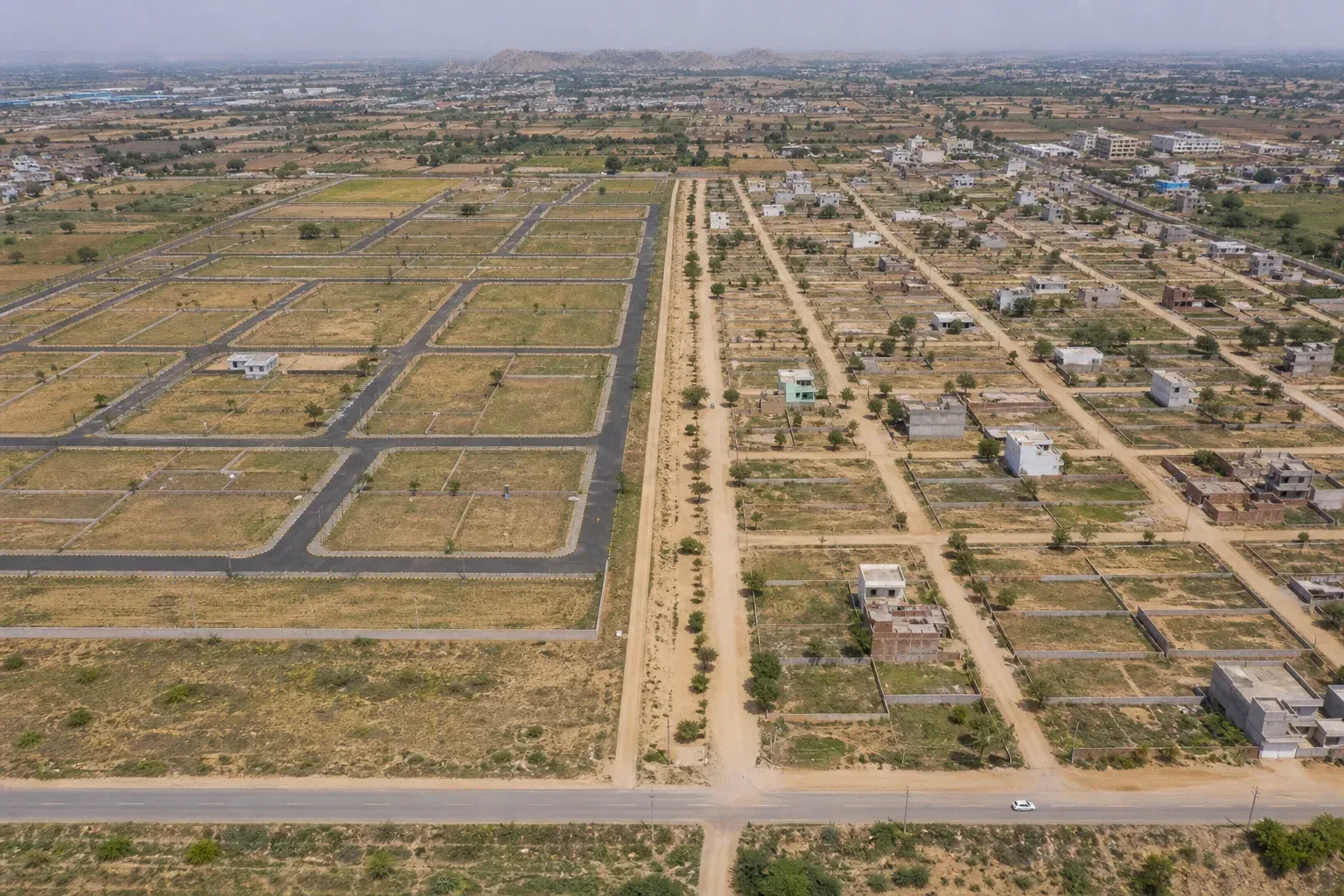
Key Answers in This Guide
- What a BIDA/UIT Scheme Plot Is: BIDA stands for Bhiwadi Integrated Development Authority.
- What a Developer Colony Plot Is: A developer colony plot sits inside a private colony.
- Authority Context and Why It Matters: Understanding who approved what, and when, saves you from most of the confusion in Bhiwadi plot paperwork.
- Layout Sanction and Land Use: These two checks decide whether a plot is legally buildable.
- Documents Each Plot Needs: The document sets overlap heavily, but the emphasis differs.
- Development Status and Infrastructure: Paper decides legality; the ground decides livability.
In this guide
A plot in a BIDA or UIT authority scheme carries the planning authority’s own backing; the authority laid out the scheme, so the layout sanction question largely answers itself. A plot in a private developer colony depends entirely on the developer’s approvals, so you verify the layout sanction, land use, and title before you pay anything. In both cases you still check the individual plot’s documents; authority backing reduces one class of risk, it does not remove the need for verification.
That is the short answer. The rest of this guide explains what each type of plot actually is, why the difference matters in Bhiwadi specifically, what documents each requires, and how you verify both before booking. We have dealt in Bhiwadi plots since 2008, and the single most common confusion we see among buyers is exactly this one: what “BIDA approved” means, what it does not mean, and how a developer plot with a proper sanction compares.
What a BIDA/UIT Scheme Plot Is
BIDA stands for Bhiwadi Integrated Development Authority. It is the local planning authority for Bhiwadi. It sanctions layouts, decides land use, and approves building plans in its jurisdiction. Before BIDA, the Urban Improvement Trust (UIT) performed this role, and you will still see UIT’s name on older approvals, allotment letters, and lease deeds. Both names circulate in the market, and for practical purposes they refer to the same authority function at different points in time.
A BIDA or UIT scheme plot is a plot inside a scheme that the authority itself planned, laid out, and allotted. The authority acquired or assembled the land, prepared the layout with roads, plot lines, parks, and service reservations, and then allotted plots to individuals through its own process. The original owner holds an allotment letter or lease deed issued by the authority, and the plot appears in the authority’s own scheme records.
The key point: in an authority scheme, the layout is the authority’s own work. You do not need to ask whether the layout was sanctioned, because the body that sanctions layouts created it. The land use is defined in the scheme itself. The roads exist on the sanctioned plan because the authority drew them.
What you still need to check is the individual plot’s chain. Authority schemes in Bhiwadi are decades deep in some cases. Plots have changed hands multiple times. Transfers may or may not have been recorded with the authority. Dues may be pending. Lease conditions may apply. A plot can sit in a perfectly legitimate authority scheme and still carry a defective ownership chain. Authority backing covers the layout; it does not certify the seller.
If you are new to these terms, our Bhiwadi property glossary explains allotment letters, lease deeds, conversion, and the other vocabulary you will meet in scheme paperwork.
What a Developer Colony Plot Is
A developer colony plot sits inside a private colony. A developer bought or aggregated land, got a layout sanctioned by the authority, cut the land into plots, built or promised internal roads and services, and sold the plots to buyers. The developer is a private party; the authority’s role is limited to sanctioning the layout, confirming the land use, and later approving building plans on individual plots.
This model dominates new plot supply in Bhiwadi. Authority schemes are largely allotted out; most fresh plotted inventory you will be shown today comes from private developers. That is not a problem in itself. A developer plot with a sanctioned layout, correct land use, clean title, and RERA registration where applicable is a perfectly sound purchase. Plenty of Bhiwadi’s established residential pockets are developer colonies.
The difference is where the burden of proof sits. In an authority scheme, the layout’s legitimacy is built in. In a developer colony, everything depends on paper the developer holds: the title documents for the parent land, the layout sanction from BIDA or UIT, the land use conversion if the land was agricultural, and the RERA registration for the project where the law requires it. If any one of these is missing or defective, every plot in that colony inherits the defect.
Bhiwadi also has unapproved colonies: layouts cut on agricultural land without sanction, sold on notarised agreements or general power of attorney. These are cheap for a reason. Registration of sale deeds can be blocked, construction permission is unavailable, and regularisation is never guaranteed. The gap between an approved developer colony and an unapproved one is far wider than the gap between an approved developer colony and an authority scheme. Our guide on plots in Bhiwadi covers the broader plot market these colonies sit in.
Authority Context and Why It Matters
Understanding who approved what, and when, saves you from most of the confusion in Bhiwadi plot paperwork.
BIDA is the current planning authority. Layout sanctions, land use decisions, and building plan approvals in Bhiwadi run through it. UIT was the earlier body. Older schemes, older allotments, and older colony sanctions carry UIT’s name. A document that says UIT is not outdated or invalid because of the name; it reflects when the approval was issued. What matters is that the approval exists, is genuine, and covers the land your plot sits on.
Why does the authority context matter to you as a buyer? Three reasons.
First, sanction is the dividing line between a legal plot and an illegal one. A plot in an unsanctioned layout cannot lawfully get building plan approval. You may build anyway, as many do, but you build without permission, and the risk of demolition, penalty, or blocked services sits with you.
Second, the authority controls land use. Bhiwadi is an industrial town with a master plan that separates residential, industrial, commercial, and institutional zones. A residential plot must sit on land designated or converted for residential use. Agricultural land cut into plots without conversion is the classic trap; the layout may look residential on the ground while the record still says agricultural.
Third, the authority is your future counterparty. When you build, you apply to BIDA for building plan approval. When you transfer a scheme plot, the authority records the transfer. When services extend, the authority or its coordinating departments extend them. A plot the authority recognises moves through all of this smoothly. A plot the authority does not recognise fights it at every step.
Sanction status is the first question to settle for any Bhiwadi plot; everything else in the purchase depends on the answer.
We explain the verification process itself in our guide to RERA and BIDA verification in Bhiwadi.
Layout Sanction and Land Use
These two checks decide whether a plot is legally buildable. They apply differently to the two plot types.
For a BIDA or UIT scheme plot, the layout sanction is inherent. The authority prepared the scheme, so the scheme map is the sanctioned layout. Your check is narrower: confirm the plot number you are being sold matches the plot number in the scheme records, confirm the plot’s size and boundaries match the scheme map, and confirm the plot’s designated use within the scheme. Some scheme plots are residential, some commercial, some mixed; the scheme map states which. A seller quoting a corner plot’s commercial potential means nothing unless the scheme designates it commercial.
For a developer colony plot, you verify the sanction from scratch. Ask the developer or seller for the sanctioned layout plan carrying the authority’s approval reference. Check that the approval covers the specific khasra numbers your plot sits on; developers sometimes sanction part of a land parcel and sell plots on the unsanctioned remainder under the same colony name. Check that the plot you are buying appears on the sanctioned plan with the same number, size, and position you are being shown on the ground. Check the land use conversion order if the parent land was agricultural.
Do not accept a brochure map as proof of sanction. A brochure is a marketing document. The sanctioned plan is a specific authority-stamped drawing with an approval reference, and the seller of a genuinely approved plot can produce it. If they cannot, or they promise “approval is in process”, treat the plot as unapproved until proven otherwise.
Land record verification runs alongside this. The khasra numbers under the colony should be traceable in the Rajasthan land records, and the mutation history should support the developer’s ownership. Our guide to Apna Khata and Rajasthan land records walks through how to pull and read these records yourself.
Documents Each Plot Needs
The document sets overlap heavily, but the emphasis differs.
For a BIDA/UIT scheme plot, ask for:
- The original allotment letter or lease deed issued by the authority to the first allottee.
- The complete chain of transfer documents from the first allottee to the current seller: sale deeds, and where the authority requires it, transfer permissions or recorded name transfers in the authority’s records.
- The authority’s current record showing the seller as the recorded holder. If the seller bought the plot but never recorded the transfer with the authority, that gap must be closed, usually before or as part of your purchase.
- A dues clearance position: lease money, transfer charges, or any other authority dues outstanding against the plot.
- The scheme map extract showing the plot’s number, size, and use.
- If any construction exists, the building plan approval for it.
For a developer colony plot, ask for:
- The developer’s title documents for the parent land: sale deeds by which the developer acquired the khasras, and the mutation entries recording that acquisition.
- The land use conversion order, if the land was agricultural.
- The sanctioned layout plan with the authority’s approval reference, covering your plot’s khasra.
- The RERA registration for the project where the project falls under RERA. Plotted developments above the threshold size require registration; check the Rajasthan RERA portal for the project and read what the registration actually covers.
- Your own chain: the allotment or booking documents, the builder-buyer agreement or agreement to sell, and finally a registered sale deed in your name.
- If buying resale within a colony, the full chain from the developer to the current seller, each link a registered document.
In both cases, the sale deed to you must be a registered sale deed. Notarised agreements, unregistered agreements to sell, and general power of attorney arrangements do not transfer ownership. In both cases, an encumbrance check for mortgages or charges on the plot is essential; a plot pledged to a bank cannot be cleanly sold to you until the charge is released.
A registered sale deed in your name, supported by an unbroken registered chain before it, is the non-negotiable end point for both plot types.
Our full checklist of documents required to buy property in Bhiwadi covers each document in detail, including what a genuine copy looks like.
Development Status and Infrastructure
Paper decides legality; the ground decides livability. The two plot types differ here in a predictable way.
Authority schemes are usually developed. Roads exist and are typically wider, because the authority planned them to master plan norms rather than to maximise saleable area. Water lines, sewer lines, and electricity networks are generally in place, because the authority executed them as part of the scheme. Parks and open spaces exist where the scheme map shows them, because the authority does not need to recover their cost from plot sales. Street lighting and drainage are usually functional. Older schemes have mature surroundings: occupied houses, shops, schools within reach.
The trade-off is age. Older scheme infrastructure can be worn. Roads may need recarpeting; drainage may struggle in monsoon. You inspect the actual condition, not the original specification.
Developer colonies vary enormously. A completed, established colony can match or beat a scheme on infrastructure quality. A newly launched colony may be a levelled field with boundary pillars and a promise. Between these extremes sits everything else. Your checks:
- Walk the internal roads. Are they built, and to what width? Compare the width on the ground with the width on the sanctioned plan; a plan showing wider roads than exist on the ground tells you the developer deviated.
- Check water supply. Is there a colony network, individual borewells, or nothing yet? Bhiwadi’s groundwater situation makes this a real question, not a formality.
- Check electricity. Are poles and transformers installed, and are connections being released to residents?
- Check drainage and sewerage. Plotted colonies without drainage flood in monsoon; visit after rain if you can.
- Count occupied houses. Occupancy is the most honest indicator of a colony’s health. A colony that sold out years ago but has five houses tells you something the brochure will not.
For a new developer colony, the RERA registration matters here too: it records what the developer committed to deliver and by when. Delivery against that commitment is checkable.
Where you buy matters as much as what you buy. Our comparison of the best areas to buy property in Bhiwadi covers how localities differ on exactly these infrastructure questions.

Possession and Construction Permission
Possession works differently for the two types.
In an authority scheme, possession of a resale plot is immediate on registration; the plot exists, demarcated, in a developed scheme. The practical step is physical demarcation: have the plot measured against the scheme map before you register, so you buy the plot you were shown and its full stated size. Encroachment on long-vacant scheme plots happens; a site inspection with measurements protects you.
In a developer colony, possession depends on the colony’s stage. In a completed colony, resale possession is immediate, same as a scheme. In an under-development colony bought from the developer, possession follows the timeline in your agreement, and the RERA registration where applicable. Read the possession clause; note what “possession” means in it. Possession of a plot should mean a demarcated plot with the committed internal development in place, not a pillar in a field.
Construction permission is where sanction status bites hardest. To build on any plot in Bhiwadi, you apply to BIDA for building plan approval. On a scheme plot, this is routine: the plot is in the authority’s own records, and approval follows the building bye-laws for the scheme. On a plot in a sanctioned developer colony, it is also routine, provided the layout sanction is genuine and your sale deed is registered. On a plot in an unapproved colony, building plan approval is unavailable. People build regardless, and then live with the consequences: no completion certificate, difficulty with formal electricity and water connections in some cases, exposure to penalty or demolition drives, and a weaker resale document set.
If a plot cannot get building plan approval, it is not a residential plot in any meaningful sense; it is a speculation on future regularisation.
Also confirm any construction-linked conditions. Some authority allotments historically carried construction timelines; some developer agreements carry them too, with penalties or buyback clauses. Read what applies to your specific plot.
Price and Negotiation Differences
Scheme plots and developer plots price differently, and the negotiation dynamics differ too.
Scheme plots are almost always resale. You negotiate with an individual owner, not a company. Prices track the locality’s prevailing resale market and the specific plot’s attributes: road width it faces, corner or internal position, park-facing or not, size, and the state of surrounding construction. Individual sellers vary widely in urgency; a motivated seller in an authority scheme can be the best value in the market, and an unmotivated one can hold above market for years. There is no launch pricing, no payment plan, and no negotiation over specifications; the plot is what it is.
Developer plots come in two forms. Primary sales from the developer carry list prices, payment plans, and launch or pre-launch discounts. There is room to negotiate, more at launch and at year-end than mid-cycle, and more on slow-moving inventory such as odd-sized or rear plots. Resale within developer colonies behaves like scheme resale: individual sellers, market-tracking prices.
On like-for-like comparison, a scheme plot in a developed locality often carries a premium over a developer plot of similar size in a newer colony. You are paying for existing infrastructure, established surroundings, and the absence of delivery risk. A new developer colony prices in its own incompleteness; the discount is real, but so is the risk it compensates for.
Indicative residential plot rates in Bhiwadi vary widely by locality and project, and quoting one number here would mislead you; contact us for current rates on the specific localities you are considering. What we can say generally: never anchor on the per-square-yard rate alone. A cheaper plot in an unapproved layout is more expensive than a costlier approved one once you price in the legal risk, the construction permission problem, and the resale discount you will suffer later.
If you are still deciding between plot and flat as an asset, our comparison of flats vs plots in Bhiwadi covers the cost and return logic of each.
Risk Profile: Where Each Can Go Wrong
Neither type is risk-free. The risks are different in kind.
Scheme plot risks concentrate in the ownership chain and the authority record:
- Broken chains. A plot sold two or three times on unregistered documents, with the authority record still showing an early owner. Fixing this can be slow or impossible.
- Unrecorded transfers. The seller holds a registered deed but never recorded the transfer with the authority; you inherit the pending compliance.
- Pending dues. Lease money, transfer fees, or penalties outstanding against the plot with the authority.
- Duplicate or fraudulent claims. Old allotments occasionally attract competing claims; the original allotment letter and the authority’s current record settle these.
- Encroachment. Long-vacant plots in older schemes get encroached; physical inspection catches this.
Developer plot risks concentrate in the developer’s own paper and delivery:
- No sanction or partial sanction. The colony’s layout was never approved, or approval covers only part of the land sold.
- Land use defects. Agricultural land sold as residential without conversion.
- Title defects in the parent land. The developer’s own acquisition was flawed, and every plot inherits the flaw.
- Mortgaged parent land. The developer pledged the land to a lender and sold plots without release; buyers discover the charge at registration or later.
- Delivery failure. Internal development promised and never completed; the colony stays half-built.
- RERA non-compliance. Projects sold without required registration, which also strips you of RERA remedies.
Note the asymmetry. Scheme plot risks are usually specific to the individual plot and discoverable through plot-level checks. Developer plot risks can be colony-wide; one defect in the parent title or sanction contaminates every plot in the layout. This is why developer colony verification starts at the colony level and only then narrows to your plot, while scheme verification starts and largely stays at the plot level.
Authority backing shrinks the layout-level risk to near zero; it does nothing for plot-level chain risk, which is where scheme plots actually fail.
BIDA Plot vs Developer Plot: Comparison Table
| Factor | BIDA/UIT scheme plot | Developer colony plot |
|---|---|---|
| Authority | Plot allotted by the planning authority in its own scheme | Private developer; authority’s role limited to sanction and approvals |
| Layout sanction | Inherent; the authority made the layout | Must be verified; sanctioned plan with approval reference covering your khasra |
| Key documents | Allotment letter or lease deed, registered transfer chain, authority record, dues clearance | Developer’s parent title, conversion order, sanctioned layout, RERA registration where applicable, registered chain to you |
| Infrastructure | Usually complete; may be aged | Varies from complete to promised; verify on the ground |
| Possession | Immediate on resale; demarcate before registration | Immediate in completed colonies; timeline-bound in new ones |
| Main risk | Broken or unrecorded ownership chain, pending dues | Colony-wide sanction, land use, or title defects; delivery failure |
| Best for | Buyers who want to build soon in an established area and will do chain diligence | Buyers who want newer stock or lower entry and will do colony-level diligence |
How to Verify Each Before You Pay
Verification is a sequence, not a single check. Run it before token money, not after.
For a BIDA/UIT scheme plot:
- Get the plot number, scheme name, and seller details in writing.
- Inspect the plot physically; measure it against the stated size; check for encroachment.
- Ask for the allotment letter or lease deed and the full transfer chain; confirm every transfer is a registered document.
- Verify the seller’s name in the authority’s current record for the plot; an unrecorded transfer is a gap to close before you pay the bulk.
- Confirm the dues position with the authority.
- Check the scheme map for the plot’s designated use and dimensions.
- Run an encumbrance check for mortgages or charges.
- Have an independent property lawyer examine the chain and draft or vet your sale deed.
For a developer colony plot:
- Get the colony name, khasra numbers, layout approval reference, and RERA registration number, if applicable, in writing.
- Verify the layout sanction with its approval reference, and confirm your plot’s khasra falls inside the sanctioned area.
- Pull the land records for the khasras and confirm the developer’s ownership and any conversion; the Apna Khata records are your starting point.
- Check the RERA portal for the project’s registration, its committed development, and its timeline.
- Inspect the colony: roads, water, electricity, drainage, occupancy.
- Match your plot on the ground to the sanctioned plan: number, size, position, and the width of the road it faces.
- Run an encumbrance check on the parent land and your plot.
- Have an independent lawyer verify the parent title and your full chain before you sign anything binding.
Our step-by-step walkthrough of how to buy property in Bhiwadi places these checks inside the full purchase sequence, from shortlist to registration.
One caution on our own role. A dealer’s check, ours included, is preliminary. We can tell you whether a colony’s sanction is known in the market, whether a scheme plot’s paperwork looks complete, and what comparable plots trade at. We cannot certify title. Only an independent lawyer examining the original documents can do that, and the few thousand rupees a title opinion costs is the cheapest insurance in the entire transaction. A property dealer in Bhiwadi who discourages you from independent legal verification is telling you something; listen to it.
Pay token money only after the layout sanction question is settled and never before a lawyer has seen the chain.
Which Buyer Suits Which Plot
There is no universally safer choice; there is a better fit for your situation.
A BIDA/UIT scheme plot suits you if you want to build within the next few years, you value established infrastructure and occupied surroundings, and you are willing to pay the premium those things command. It also suits you if you prefer risk you can fully inspect: everything that can go wrong with a scheme plot is visible in the plot’s own documents and the authority’s record, and a competent lawyer can run it to ground. The buyer profile is typically an end user, often building a family home, sometimes an investor who wants the most liquid resale asset in the plot market; a clean scheme plot in a developed locality sells faster than almost anything else.
A developer colony plot suits you if you want newer stock, a lower entry price, or a payment plan, and you are prepared to do colony-level diligence or buy only in colonies where that diligence is already conclusive. In a completed, sanctioned, well-occupied developer colony, the practical difference from a scheme plot narrows to almost nothing; you are comparing localities and prices at that point, not risk categories. In a new launch, you are additionally taking delivery risk in exchange for early pricing, and RERA registration plus the developer’s delivery record are what you lean on.
The plot type to avoid is the third one this article keeps circling back to: the unapproved colony plot, whatever name it sells under. No authority scheme membership, no layout sanction, no construction permission path. The price will tempt you; the paperwork will not survive scrutiny. If the budget only stretches to unapproved land, a smaller plot in an approved layout is the better purchase every time.
Whichever way you lean, verify before you commit, and verify in the order this guide sets out: sanction first, land use second, chain third, ground reality throughout.
Frequently Asked Questions
Is a BIDA plot always safer than a developer plot?
At the layout level, yes; the authority made the layout, so sanction risk is absent. At the plot level, no. A scheme plot with a broken ownership chain or unrecorded transfers is riskier than a developer plot with a clean sanction and a registered chain. Safety comes from verification, not from the label.
What does “BIDA approved” mean when a developer uses it?
It should mean the colony’s layout plan carries a formal sanction from BIDA, with an approval reference, covering the specific khasra numbers being sold. Ask to see the sanctioned plan itself and match your plot to it. The phrase on a hoarding or brochure proves nothing by itself; the stamped plan does.
Can I get a home loan on both types of plot?
Banks lend on plots with clear, registered title in approved layouts. A scheme plot with a complete recorded chain and a developer plot in a sanctioned, RERA-compliant colony both qualify in principle; each lender applies its own approved-project and legal checks. Plots in unapproved colonies generally do not get bank funding, which is itself a useful signal.
The seller has a UIT document, not a BIDA one. Is that a problem?
No. UIT was the earlier authority; its approvals and allotments remain valid. Older schemes and older colony sanctions naturally carry UIT’s name. What matters is that the document is genuine and the subsequent chain is complete, which your lawyer verifies regardless of which authority’s name appears.
How do I check if a colony’s layout is actually sanctioned?
Ask the seller for the sanctioned layout plan with its approval reference and confirm it covers your plot’s khasra numbers. Cross-check the khasras in the Rajasthan land records for ownership and conversion status. For RERA-registered projects, the RERA portal lists the project and its approvals. Our RERA and BIDA verification guide covers the process step by step.
Are plots on power of attorney safe to buy in either category?
No. A general power of attorney does not transfer ownership, whether the plot sits in an authority scheme or a developer colony. Insist on a registered sale deed supported by a registered chain. GPA-only deals are common exactly where the paperwork cannot support registration, which is a reason to walk away, not a workaround to accept.
What do BIDA scheme plots and developer plots cost in Bhiwadi?
Rates vary widely by locality, colony, plot size, and position, and any single number would mislead. Scheme plots in developed areas usually carry a premium over new developer colonies; completed developer colonies sit between the two. Contact us for current rates on the specific localities you are shortlisting.
Ready to Shortlist? Talk It Through With Us
18+ years in this market. Real prices, verified paperwork, no pressure.
Choose what you would like to do next:
Done — our team will contact you during working hours.