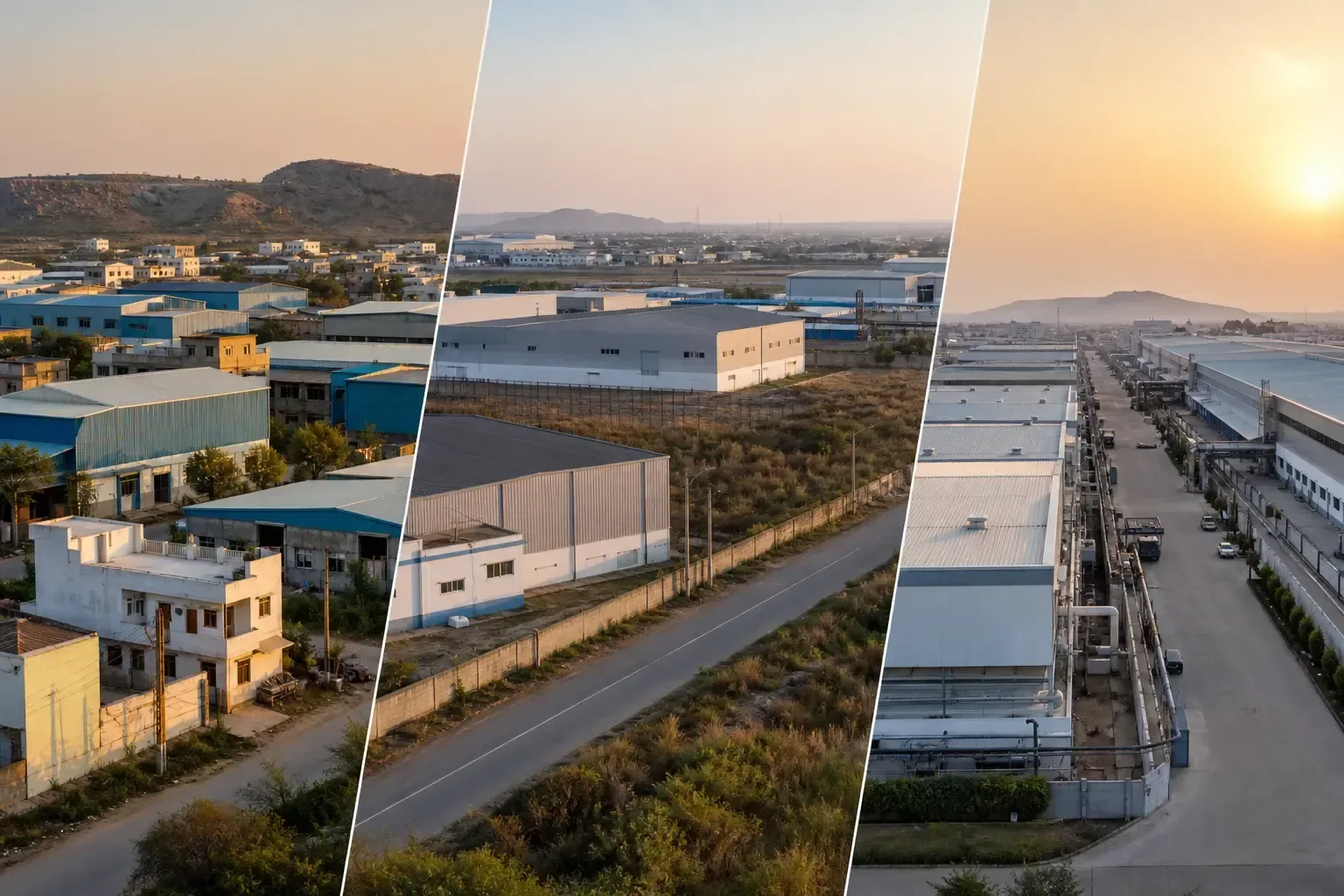
Key Answers in This Guide
- How the Three Areas Compare at a Glance: Chopanki offers liquidity and mid-size plots, Khushkhera offers scale and expansion room, and Tapukara offers proximity to an anchor manufacturer at the premium end of the belt's rate band.
- Chopanki: The Established, Liquid Middle of the Belt: Chopanki is the area we recommend most often to first-time factory buyers, because it combines mid-size plots, an active year-round resale market and the fastest transfer timelines of the three.
- Khushkhera: Scale, Corridor Position and Room to Grow: Khushkhera is where we send buyers who need large footprints, expansion room and a position on the corridor running toward Neemrana, and who can work with a thinner but bigger-ticket market.
- Tapukara: The Anchor-Plant Premium: Tapukara commands the premium end of the belt's rate band because Honda's manufacturing facilities anchor the area, and the buyers who pay that premium are usually ancillaries who need to sit near the anchor.
- Reading the Rates: What the Numbers Mean on the Ground: Every figure in this article is a range, not a price, and where your specific plot lands inside the range is decided by size, road frontage, position and the route you buy through.
- Transfer Process and Timelines: What to Expect in Each Area: All three areas run on RIICO transfer rules, but Chopanki files typically clear in 6 to 10 weeks, Khushkhera in 8 to 12 weeks, and Tapukara timelines are case-specific.
In this guide
We have been placing manufacturers in the Bhiwadi belt since 2008, and the single most common question we field from a factory buyer is not “should I come to Bhiwadi” but “which pocket of Bhiwadi.” Once someone has decided the belt makes sense for their unit, and the case for the belt is one we have laid out in detail in why manufacturers choose Bhiwadi, the real decision narrows to three names: Chopanki, Khushkhera and Tapukara. Tapukara now has its own full property in Tapukara guide covering both its residential and industrial sides.
All three sit inside the same wider industrial region, a region where 2,700+ industries already operate. All three run on RIICO land, RIICO transfer rules and broadly similar rate bands. Yet they behave very differently as markets, and a buyer who treats them as interchangeable usually ends up either overpaying for space they do not need or squeezing a growing unit onto a plot it will outgrow in five years.
This article is our working comparison. It is written for a person evaluating an actual purchase, not for a brochure. Rates quoted here are the ranges current as of July 2026, deals are always negotiated, and current availability in every one of these areas changes weekly. Treat everything below as a map, then call us for the live position.
How the Three Areas Compare at a Glance
Chopanki offers liquidity and mid-size plots, Khushkhera offers scale and expansion room, and Tapukara offers proximity to an anchor manufacturer at the premium end of the belt’s rate band.
Here is the comparison we sketch on paper for almost every industrial buyer who sits across the table from us.
| Factor | Chopanki | Khushkhera | Tapukara |
|---|---|---|---|
| Typical plot sizes | 500 to 4,000 sq m in resale, plus built-up factory units and sheds | 2,000 to 20,000+ sq m, select built-up factories | Requirement-driven; send us your specification |
| Current rate | ₹25,000 to 40,000 per sq m; built-up priced case-by-case | ₹25,000 to 40,000 per sq m; large plots negotiated case-by-case | ₹35,000 to 40,000 per sq m (partner-confirmed, July 2026) |
| Resale liquidity | Highest in the belt; supply moves fast, year-round resale market | Thinner supply than Chopanki, but deal sizes are bigger | Requirement-driven; availability changes with ancillary demand |
| Dominant industries | Auto components, light engineering, packaging, plastics, general MSME manufacturing | Auto components and ancillaries, medium engineering, large-footprint units | Ancillaries oriented around the Honda manufacturing facilities |
| Connectivity | NH-48 in 10 to 15 minutes; Bhiwadi town 10 to 15 minutes; IMT Manesar / Gurgaon side about an hour | NH-48 corridor toward Neemrana and Jaipur; Bhiwadi town 20 to 30 minutes; Delhi-Mumbai industrial corridor influence zone | Southern / Tijara side of the belt, positioned near the anchor plants |
| Transfer timeline | 6 to 10 weeks on a clean file | 8 to 12 weeks on a clean file | Case-specific; we advise after seeing the file |
| Who it suits | MSME entry, first factories, buyers who value exit liquidity | Units needing scale, expansion room and corridor position | Ancillaries and suppliers who need to sit near the anchor employer |
That table settles perhaps half the decision. What it cannot show is how each area feels as a market when you are actually trying to close a deal in it, which is what the next three sections cover.
Chopanki: The Established, Liquid Middle of the Belt
Chopanki is the area we recommend most often to first-time factory buyers, because it combines mid-size plots, an active year-round resale market and the fastest transfer timelines of the three.
Chopanki is one of the most active RIICO industrial areas in the entire Bhiwadi belt. It is an established zone, which matters more than the word suggests. In a newer area, you are betting on infrastructure that is promised. In Chopanki, the roads, the neighbouring units and the labour patterns are already in place and visible on a site visit.
Understand one structural fact about RIICO land first: fresh allotments from RIICO are episodic. Rounds open when they open, and a buyer with a machinery delivery date cannot schedule their business around an allotment calendar. Resale, on the other hand, happens year-round, and Chopanki has the most genuine year-round resale market in the belt. When we say genuine, we mean transactions that actually close, not listings that sit.
Resale supply in Chopanki moves fast. We have watched clean plots go under negotiation within days of the seller confirming their price to us, and a buyer who takes three weeks to “think it over” on a well-priced Chopanki plot frequently comes back to find it gone.
Mid-size plots dominate the resale stock here, typically 500 to 4,000 sq m. That band maps neatly onto the MSME and small-to-mid engineering segment: enough land for a production shed, a small office block, material storage and truck turning, without carrying the holding cost of surplus acreage.
Alongside vacant plots, Chopanki also offers built-up factory units and sheds, which suit buyers who want to shift machinery in and start production within months rather than build for a year. Built-up factories are priced case-by-case, because the value of an existing structure depends entirely on its condition, its approvals and whether the layout suits your process.
On rates, Chopanki trades within the belt-wide band of ₹25,000 to 40,000 per sq m. Where a specific plot lands inside that band depends on three things above all: plot size, the width of the road it fronts, and its location within the area. A corner plot on a wide internal road commands the upper end; a mid-block plot on a narrower lane sits lower. We keep a running sheet of asking prices against actual closing prices, and we walk buyers through both, because in this market the gap between the two is where the negotiation lives.
Connectivity is Chopanki’s quiet strength. NH-48 access takes 10 to 15 minutes. Bhiwadi town, with its workforce housing, markets and schools, is also 10 to 15 minutes away, which keeps daily labour commutes short and helps with retention of supervisory staff. The IMT Manesar and Gurgaon side is about an hour, close enough for units supplying OEMs and vendors on that corridor.
Industry mix here runs to auto components, light engineering, packaging, plastics and general MSME manufacturing. That diversity is itself an asset: it means the resale market does not depend on the fortunes of a single sector. For a detailed look at current listings and how we structure a Chopanki purchase, see our page on industrial plots in Chopanki.
Khushkhera: Scale, Corridor Position and Room to Grow
Khushkhera is where we send buyers who need large footprints, expansion room and a position on the corridor running toward Neemrana, and who can work with a thinner but bigger-ticket market.
Khushkhera’s defining feature is plot size. RIICO plots here run from 2,000 sq m up to 20,000 sq m and beyond, several times the size of Chopanki’s typical resale stock at the top end. That changes who buys here. A unit taking 10,000 sq m in Khushkhera is not a first factory; it is usually a second plant, a consolidation of scattered operations, or an auto-ancillary scaling to serve OEM volumes.
Two routes exist into Khushkhera. Fresh allotment rounds do occur, and when they open we help clients prepare applications. Between rounds, resale transfer is the path, and here the market character diverges sharply from Chopanki: resale supply in Khushkhera is thinner, but the deal sizes are bigger. A buyer may wait longer for the right plot to surface, and when it does, the transaction is a heavier one. Patience and prepared finance win in this market.
On money, be realistic from the start. Rates run ₹25,000 to 40,000 per sq m depending on size, corner or road position, and whether you come through the allotment or resale route, with large plots negotiated case-by-case. At these rates and these plot sizes, realistic entry for land alone typically starts at ₹5 crore and climbs from there.
We say this early in every Khushkhera conversation, because it saves everyone time. Buyers working with smaller budgets are better served in Chopanki, and there is no shame in that; liquidity there is a genuine advantage, not a consolation prize.
Positionally, Khushkhera sits on the corridor connecting Bhiwadi toward Neemrana, with NH-48 corridor access running toward Neemrana and Jaipur. Bhiwadi town is 20 to 30 minutes away. The area also falls within the Delhi-Mumbai industrial corridor influence zone, which is one reason larger manufacturers weighing a long-horizon plant decision keep it on their shortlists. The growing cluster here is auto components and ancillaries plus medium engineering, and the common thread among buyers is a need for footprint: units that want land for phase-two expansion on the same plot rather than hunting for an adjacent parcel later.
One obligation deserves emphasis. RIICO requires utilization, meaning construction and commencement, within set periods on allotted plots. A buyer taking a large Khushkhera plot as a slow land bank is misreading the instrument; RIICO land is for building on, and the conditions enforce that. We brief every allotment client on these timelines before they apply, not after.
Diligence on large plots also runs deeper. Sub-division history, built-up coverage compliance and dues reconciliation all need checking, and on a clean file we still tell buyers to expect 8 to 12 weeks for the transfer. Our current stock and process notes are on the industrial plots in Khushkhera page.
Tapukara: The Anchor-Plant Premium
Tapukara commands the premium end of the belt’s rate band because Honda’s manufacturing facilities anchor the area, and the buyers who pay that premium are usually ancillaries who need to sit near the anchor.
Every industrial belt has a pocket that trades above the rest, and in the Bhiwadi belt that pocket is Tapukara. Industrial plot rates here run ₹35,000 to 40,000 per sq m as of July 2026, partner-confirmed, which is the top of the band the belt trades in. The reason is not mysterious. Honda operates manufacturing facilities at Tapukara, and an anchor employer of that scale shapes everything around it: ancillary demand, supplier location decisions, labour flows and land pricing.
For a supplier feeding an anchor plant, proximity is not a luxury. Just-in-time delivery windows, shorter inbound logistics, easier coordination with the customer’s stores and quality teams: these are operating advantages a spreadsheet can quantify. That is why the typical Tapukara industrial buyer we meet is an ancillary weighing the premium against the logistics saving, rather than a general manufacturer shopping the whole belt on rate alone. Geographically, Tapukara sits on the belt’s southern side, toward Tijara.
We will be straight about the limits of what we can publish here. We do not carry a standing, publishable schedule of Tapukara industrial plot sizes the way we do for Chopanki and Khushkhera. Availability in Tapukara is requirement-driven: what surfaces, and when, depends on what ancillary demand is doing in a given quarter.
So rather than print size ranges we cannot stand behind, our honest advice is this: send us your specification, covering plot size, power load, industry type and timeline, and we will tell you what actually exists against it right now. That is a slower answer than a table, but it is a true one.
The residential side of Tapukara, useful for anyone planning worker or manager housing near a plant, is better documented in our files. Residential plots there typically run 100 to 600 sq yd, and transfers on clean files complete in about a month (both partner-confirmed, July 2026). Established townships include Terra and Lifestyle, and families on this side use nearby schools including Suraj School, with RPS and Rath also named by our partner network (confirm current details on a visit). Daily facilities exist locally rather than requiring a run into Bhiwadi town for everything.
On pricing, residential plots in Tapukara run ₹20,000 to 35,000 per sq yd, and most actual closings across the Tapukara-to-Tijara stretch happen at ₹16,000 to 32,000 per sq yd, both figures partner-confirmed as of July 2026.
Note the unit change: residential trades in sq yd, industrial in sq m, a distinction we unpack in residential vs industrial property in Bhiwadi. A unit that houses its supervisors ten minutes from the gate runs differently from one whose staff commute an hour each way, and Tapukara lets you solve both problems in one geography.
Reading the Rates: What the Numbers Mean on the Ground
Every figure in this article is a range, not a price, and where your specific plot lands inside the range is decided by size, road frontage, position and the route you buy through.
Buyers sometimes read “₹25,000 to 40,000 per sq m” and anchor on the bottom number. Sellers read the same range and anchor on the top. Reality sits in the negotiation between them, and a few patterns hold across all three areas.
Smaller plots tend to trade at higher per-sq-m rates than large ones, because the buyer pool for a 1,000 sq m plot is far deeper than for a 15,000 sq m plot. Road width moves price meaningfully: wide-road frontage carries a premium for truck access and visibility. Corner positions carry their own premium. Route matters too: an allotment-route plot and a resale-route plot of identical size can price differently once transfer charges and timelines are weighed in.
Built-up factories resist range pricing altogether. Two sheds of identical covered area can differ by a crore based on structure quality, power sanction, approvals and layout fit. We price built-up stock case-by-case and advise buyers to do the same rather than compute a per-sq-m figure and stop there. To model your total acquisition cost, including transfer charges and registration on top of the land price, run your numbers through the Bhiwadi property cost calculator before you commit to a budget.
And repeat this to yourself before any site visit: current availability changes weekly. A comparison written in July describes the structure of these markets accurately, but the specific plots behind it turn over constantly. Structure is durable; inventory is not.
Transfer Process and Timelines: What to Expect in Each Area
All three areas run on RIICO transfer rules, but Chopanki files typically clear in 6 to 10 weeks, Khushkhera in 8 to 12 weeks, and Tapukara timelines are case-specific.
Since almost all Chopanki activity and much of Khushkhera activity is resale, the RIICO transfer process is the machinery most of our buyers pass through. The sequence, in simplified form: a transfer application to RIICO, payment of transfer charges, an updated site plan, and clearance of all outstanding dues on the plot before RIICO endorses the new owner. Three principles apply in every one of these areas without exception: dues must be cleared, the land use must match your industry, and transfer charges must be paid.
In Chopanki, a clean file typically clears in 6 to 10 weeks. “Clean” is the operative word: dues paid up, land use matching the buyer’s industry, no pending sub-division disputes, and for built-up units, building-plan approvals in order. Files that arrive with a surprise, an old dues arrear or an unapproved structure, take longer, sometimes much longer.
Khushkhera runs 8 to 12 weeks on a clean file, and the extra weeks come from the extra diligence that large plots demand. Sub-division history needs tracing, because a 15,000 sq m plot may have been carved or merged over its life. Built-up coverage compliance needs verification against sanctioned plans. Dues reconciliation on a large plot involves bigger numbers and older paper. None of this should frighten a buyer; it should simply be scheduled into their project plan, so machinery orders and financing drawdowns line up with a realistic possession date.
For Tapukara, we deliberately publish no standard timeline, because we do not have the file-level data to state one honestly. What we do instead is review the specific file, apply the same RIICO principles, and give the buyer a case-specific estimate before they commit. If you want the full procedural walkthrough, including the document checklist we hand every client, our RIICO industrial plot buyer’s guide covers the transfer process end to end.
Which Area Fits Which Buyer
Match the area to your unit’s profile: Chopanki for MSME entry and liquidity, Khushkhera for scale and expansion, Tapukara for anchor proximity, and none of the three is the overall winner.
We refuse to crown a winner, because there is not one. There is only fit. Here is how we advise the four buyer profiles we meet most often.
Small MSME, first factory. Budget-conscious, needs 500 to 2,000 sq m, wants to be producing within months. Chopanki, almost every time. Plot sizes match the requirement, the resale market means options exist right now rather than at the next allotment round, and built-up sheds offer a shortcut to production. Just as important is the exit: if the business pivots or outgrows the plot, Chopanki’s liquidity means the asset can be sold into an active market rather than sitting listed for a year.
Mid-size engineering unit. Needs 2,000 to 5,000 sq m, established operations, possibly consolidating. This buyer genuinely straddles Chopanki and Khushkhera, and the deciding questions are growth trajectory and patience. If five-year plans stay within the current footprint, Chopanki’s liquidity and shorter transfer timeline argue for it. If expansion on the same plot is realistic, Khushkhera’s larger parcels make the case, provided the buyer can wait for the right plot to surface in a thinner market.
Large auto-ancillary. Needs 5,000 sq m upward, supplies OEMs, thinks in decades. Khushkhera or Tapukara, and the tiebreaker is the customer. An ancillary supplying the Honda facilities at Tapukara should price the proximity premium against their inbound logistics saving; often the premium pays for itself. An ancillary serving multiple OEMs across the region is usually better positioned in Khushkhera, on the corridor, with room to add a second line without moving.
Logistics and warehousing-linked operations. Highway access and footprint dominate this requirement. Khushkhera’s corridor position toward Neemrana and Jaipur, its Delhi-Mumbai industrial corridor influence zone location and its large plots fit the profile, with the caveat that the intended use must match the plot’s permitted land use. We check that compliance point before showing a single plot, because a use mismatch discovered mid-transfer wrecks timelines.
Whatever the profile, the belt-level overview on our industrial property in Bhiwadi hub is the right companion read, since it places these three areas alongside the rest of the region’s stock.
Due Diligence That Applies in All Three Areas
Regardless of which area you choose, the same four checks decide whether your transfer runs on schedule: dues clearance, land-use match, approvals on built-up structures, and sub-division history.
Buyers often ask us what goes wrong in industrial deals. Nearly every delayed file we have seen in eighteen years traces back to one of four causes, and all four are checkable before you pay a rupee of consideration.
First, RIICO dues. Every plot carries a running account with RIICO, and transfer will not complete until it is clear. We obtain the dues position early, because an arrear discovered late becomes a price renegotiation at the worst possible moment.
Second, land-use compliance. RIICO plots carry a permitted industry type, and your unit must fit it. A buyer whose process differs from the plot’s sanctioned use needs that resolved before transfer, not after possession.
Third, building-plan approvals on built-up units. A shed is only as good as its paper. Unapproved construction or coverage beyond sanctioned limits creates liability that transfers to the new owner along with the keys. This check matters most in Chopanki, where built-up stock is common, and in Khushkhera, where built-up coverage compliance on large plots needs verification against plans.
Fourth, sub-division history. Plots that have been divided or merged carry paper trails that must reconcile. Pending sub-division issues in Chopanki and complex sub-division histories on Khushkhera’s large parcels both fall under this head.
None of these checks is exotic. All of them take time, which is why “6 to 10 weeks on a clean file” begins with making the file clean.
How We Work These Three Areas
We are a RERA-registered dealer, Reg. No. RAJ/A/2026/21898, working the Bhiwadi belt since 2008, and we handle sale transactions only, no rentals.
Our method is unglamorous and it works. We maintain live positions in Chopanki and Khushkhera, refreshed as sellers confirm prices and plots go under negotiation. For Tapukara, we work requirement-first: your specification goes out to our partner network, and we come back with what actually exists, at partner-confirmed pricing, rather than recycled listings.
On every transaction we run the diligence sequence described above before the buyer commits, we manage the RIICO transfer file through to endorsement, and we tell buyers plainly when an area does not fit their requirement, even when a quicker commission was available in the wrong plot. Eighteen years in one market teaches you that the buyer you turn away from a bad fit comes back for the right one, and sends their vendors after them.
If you are weighing these three areas now, send us three numbers: your plot size requirement, your budget, and your timeline to production. We will tell you which of the three markets can actually deliver against them this quarter.
Frequently Asked Questions
These are the questions buyers ask us most often when comparing Chopanki, Khushkhera and Tapukara, answered the way we answer them across the table.
Which of the three areas is cheapest?
Chopanki and Khushkhera both trade in the ₹25,000 to 40,000 per sq m band, with the specific figure driven by plot size, road width and position. Tapukara trades at the premium end, ₹35,000 to 40,000 per sq m. But per-sq-m rate is a poor sole criterion; a Khushkhera plot at a lower rate still means a ₹5 crore-plus entry because of plot sizes, while a small Chopanki plot at a higher rate may be the cheaper total ticket.
Can I get a small plot in Khushkhera or Tapukara?
Khushkhera’s stock starts around 2,000 sq m and runs upward, so genuinely small plots are rare there. Tapukara availability is requirement-driven; send us your specification and we will tell you honestly whether anything matches. For plots under 2,000 sq m, Chopanki is where the depth of supply is.
How long does a purchase take, start to finish?
Add your search time to the transfer timeline. On the transfer itself, plan for 6 to 10 weeks in Chopanki and 8 to 12 weeks in Khushkhera on a clean file, with Tapukara assessed case by case. Search time varies with how specific your requirement is; in Chopanki’s fast-moving market, a decisive buyer can identify a plot within weeks.
Should I wait for a fresh RIICO allotment instead of buying resale?
Only if your timeline can absorb the wait. Fresh allotment rounds are episodic and their timing is not in your control; resale is available year-round, especially in Chopanki. Buyers with machinery on order or customer commitments almost always take the resale route. Remember also that allotted plots carry utilization obligations, so allotment is a build commitment, not a holding strategy.
Does buying near Honda in Tapukara guarantee ancillary business?
No, and be wary of anyone who implies it does. What Tapukara offers is proximity, which lowers logistics cost and eases coordination for units that already have, or are actively pursuing, supply relationships around the anchor plants. Proximity is an operating advantage, not a contract.
What about Kahrani, the belt’s fourth industrial area?
Kahrani sits in the same RIICO belt and currently trades at ₹25,000 to 35,000 per sq m (partner-confirmed, July 2026), which makes it the value end of the band. We transact there too. We have kept this article to the three areas we can compare in full depth; for Kahrani, send us your specification the same way and we will tell you what exists against it.
Do you handle rentals or leases in these areas?
No. We work sale transactions only, both vacant plots and built-up units, across residential and RIICO industrial property.
Are the rates in this article fixed?
No. Every figure here is a range observed as of July 2026, every deal is negotiated, and availability in all three areas changes weekly. Use this article to shortlist, then contact us for the live position before you plan a site visit.
Discuss Your Industrial Requirement
18+ years in this market. Real prices, verified paperwork, no pressure.
Choose what you would like to do next:
Done — our team will contact you during working hours.