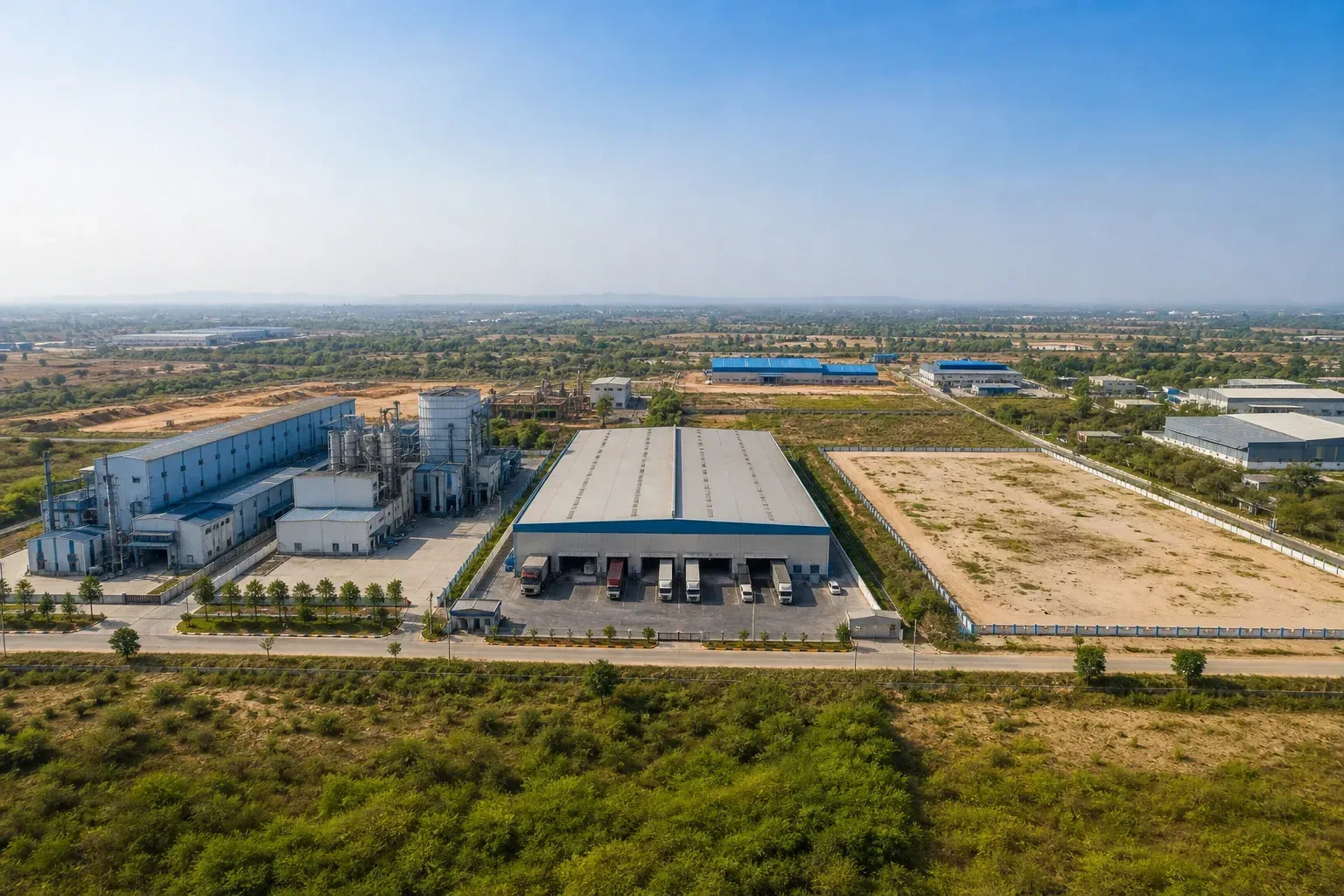
Key Answers in This Guide
- What Each Option Is: The three terms get used loosely in listings, so define them first.
- Operational Readiness and Time to Start: This is the axis that separates the three options most sharply.
- Capital and What Your Money Buys: Rank the three by upfront price and the order is usually plot, then warehouse, then factory, cheapest first.
- Construction and Customisation: The plot wins this section outright, and for some businesses this single factor decides the purchase.
- Power, Clear Height, Floor Load and Access: Match, Do Not Assume: These four technical factors sink more industrial purchases than price does, so treat them as a checklist you run on every shortlisted property.
- Permitted Use and Compliance by Activity: Industrial land is not a blank permission to do anything industrial.
In this guide
The short answer: a ready factory lets you start production fastest but costs the most, because you pay for the building, the power connection and sometimes the machinery. A warehouse or godown is ready for storage and logistics work but rarely suits manufacturing without changes. A bare industrial plot is the cheapest entry and lets you build exactly what you need, but you wait the longest before your first day of operations.
That is the trade you are making in every case: money against time against fit. This guide walks through each option as it exists in the Bhiwadi industrial belt, where RIICO governs the main industrial areas of Tapukara, Khushkhera, Chopanki and Kahrani. We have dealt in industrial property here since 2008, and the same three questions come up in almost every enquiry. What can I afford? How soon can I start? Will the property actually work for my process? Answer those three honestly and the choice between factory, warehouse and plot usually makes itself.
What Each Option Is
The three terms get used loosely in listings, so define them first.
A ready factory is an industrial building that was constructed and used, or at least designed, for manufacturing. It typically has a shed or RCC structure, a sanctioned power connection, water, internal flooring rated for machines, and often office space attached. Some factories come with plant and machinery included in the sale; others are sold as bare buildings after the seller removes their equipment. The two are very different purchases, so establish early which one you are looking at.
A warehouse or godown is a building designed for storage and material movement. The priorities are different from a factory: large clear-span floor area, height for racking, wide shutters, and space for trucks to enter, turn and dock. Power needs are usually modest because the load is lighting, material handling equipment and perhaps ventilation, not production machinery. In Bhiwadi you will find warehouses inside RIICO industrial areas and on private land along the highway corridors.
A bare industrial plot is land with industrial land use and nothing on it. In the Bhiwadi belt most industrial plots are RIICO allotments, held on lease from RIICO and transferred with RIICO’s approval, though private industrial land also exists. The plot gives you a boundary and a permitted use; everything else, from the building to the power connection to the fire systems, you create yourself. Our RIICO industrial plots buyer’s guide covers the allotment and transfer mechanics in detail, and if you are weighing RIICO land against private land, read the RIICO plot vs private industrial land comparison before you shortlist anything.
One more clarification, because we get asked: none of these are residential or commercial assets. If you are still deciding between asset classes rather than between industrial formats, start with residential vs industrial property in Bhiwadi instead.
Operational Readiness and Time to Start
This is the axis that separates the three options most sharply.
A ready factory, in the best case, is close to plug and play. The structure exists, the power connection exists, water and drainage exist. If the machinery is included and suits your process, you could be producing within weeks of taking possession, subject to transferring licences and consents into your name. Even a bare factory building, sold without machinery, saves you the entire construction cycle. You install your equipment, arrange your compliance transfers, and start.
But “ready” needs testing, not assuming. A factory built for one process may need real modification for another. The sanctioned power load may be below what your machines draw. The floor may not take your heaviest equipment. The layout may force an inefficient material flow. Walk the building with your production person, not just your finance person, before you assume the readiness premium is worth paying.
A warehouse is ready for its own purpose almost immediately. If your business is storage, distribution or third party logistics, a well built godown with good truck access can be operational as fast as a ready factory, often faster, because the compliance burden for pure storage is generally lighter than for manufacturing. The mistake we see is the reverse: buyers who purchase a warehouse cheap and plan to run manufacturing inside it. Sometimes that works for light assembly. Often it fails on power, flooring, ventilation or permitted activity, and the “cheap” building absorbs a year of modification cost.
A plot is the slowest path by a wide margin. You buy the land, get building plans approved, construct, apply for the power connection, install fire systems, obtain your pollution consents, and only then start. Depending on the size of the build and how smoothly approvals move, expect the gap between purchase and production to run into many months, sometimes beyond a year. If your order book starts next quarter, a plot cannot serve it. If you are planning a unit for two years out, the plot’s slowness stops mattering and its other advantages take over.
If your revenue depends on starting operations within a few months, a bare plot is the wrong instrument no matter how attractive its price.

Capital and What Your Money Buys
Rank the three by upfront price and the order is usually plot, then warehouse, then factory, cheapest first. But the upfront price is only part of the capital picture.
With a plot, your purchase price buys land alone. Indicative industrial land rates in the Bhiwadi belt run around ₹25,000 to ₹40,000 per sq m depending on the industrial area, plot size, corner position and road width; contact us for current rates, because these move. On top of the land you must budget the full construction cost of your shed or building, the cost of the power connection at your required load, boundary wall, internal roads, fire systems, and the soft costs of approvals. The total project cost of a plot plus construction can approach or exceed the price of a comparable ready factory. What you gain for that money is a building that fits your process exactly and carries no previous owner’s compromises.
With a warehouse, you pay for land plus a storage-grade structure. Per square foot of covered area, warehouses often price below factories of similar size because the construction is simpler: no heavy power infrastructure, lighter flooring in many cases, minimal process installations. You are paying for volume and access, which is exactly what a storage business needs and exactly what a manufacturing business finds insufficient.
With a factory, you pay the most because you buy the most: land, an industrial-grade structure, a sanctioned power connection, and possibly machinery and running utilities. Whether that premium is fair depends entirely on how much of what you are buying you would actually use. A factory with a heavy power sanction is valuable to a buyer who needs that load and irrelevant to one who does not. Machinery included in the sale is worth something only if it suits your product; otherwise it is scrap value and removal cost. Price the components separately in your head, then judge the asking price against the components you will genuinely use.
Never pay a ready-factory premium for infrastructure your process will not use.
There is also the question of hidden capital. A factory can carry dues: electricity arrears, RIICO service charges or transfer-related liabilities on leasehold plots, unpaid statutory dues linked to the previous operation. A plot carries fewer such surprises but can carry its own, such as pending RIICO conditions on construction timelines. Whatever you buy, the outstanding-dues check belongs in your due diligence before token money, not after.
Construction and Customisation
The plot wins this section outright, and for some businesses this single factor decides the purchase.
Building on a bare plot means every dimension serves your process. Column spacing that clears your machine lines. Floor thickness matched to your heaviest equipment. Height where you need height. Loading bays where your material flow wants them, not where a previous owner put them. Electrical infrastructure sized for your load with room to grow. If your manufacturing process is specific, heavy, or unusual, this fit is worth a great deal, and retrofitting an existing building to achieve it is often more expensive than building fresh.
A ready factory offers limited customisation. You can modify, but every modification fights the existing structure. Moving columns is rarely practical. Raising a roof is a major work. Upgrading a floor for heavier loads can mean breaking and recasting sections while you are trying to move in. Cosmetic and layout changes are easy; structural changes are not. Buy a ready factory when the existing structure already suits you at least broadly, and treat any promise that “it can be modified easily” with suspicion until an engineer prices the modification.
A warehouse sits in between in an odd way. As a storage building it usually needs little customisation; racking and material handling equipment are fit-outs, not construction. As a candidate for conversion to manufacturing it is usually a poor base, for the reasons covered above. The honest way to evaluate a warehouse is against warehouse uses only.
One Bhiwadi-specific note: construction on RIICO plots must follow RIICO’s building norms and timelines, and plans need approval before you build. Factor the approval period into your project schedule. The industrial property in Bhiwadi overview covers what operating inside a RIICO area involves day to day.
Power, Clear Height, Floor Load and Access: Match, Do Not Assume
These four technical factors sink more industrial purchases than price does, so treat them as a checklist you run on every shortlisted property. Do not rely on listed figures; verify each one for the specific property, in writing where possible.
Power. Know your own connected-load requirement before you view anything; your electrical consultant or machinery supplier can compute it. Then check the property’s sanctioned load from the electricity board record, not from the seller’s memory. If the sanctioned load falls short, ask the local discom what an enhancement would cost and how long it would take at that location. A factory with an already-sanctioned heavy load can justify part of its premium; a plot means applying for a fresh connection, which takes time you must schedule.
Clear height. Height matters differently by use. Warehousing wants height for racking; certain manufacturing wants height for cranes, ventilation or tall equipment; light assembly may need little. Measure the actual clear height under the lowest structural member at the property, and measure it yourself. Listings routinely quote the peak height of a sloped shed rather than the usable clear height.
Floor load. Heavy machines, heavy racking and heavy vehicle movement inside the building all demand floors built for the load. On a ready building, ask for the construction specification and have an engineer assess whether the floor takes your equipment. On a plot, you simply design for it, which is one of the plot’s quiet advantages.
Road and truck access. Trace the full route a loaded truck will take from the highway to your gate. Check the approach road width, turning space at the gate, and space inside the boundary for a truck to enter, unload and turn without reversing into a public road. For a warehouse this is close to the whole game. For a factory it matters at both ends, raw material in and finished goods out. Different Bhiwadi industrial areas differ meaningfully on internal road widths and highway connectivity; the Chopanki vs Khushkhera vs Tapukara comparison breaks this down area by area.
Verify sanctioned power load, usable clear height, floor specification and truck access for the specific property before you pay anything; listed figures are starting points, not facts.
Permitted Use and Compliance by Activity
Industrial land is not a blank permission to do anything industrial. What you may run on a given property depends on the land use, the industrial area’s norms, and the consents your specific activity requires.
Start with permitted use. On RIICO plots, the allotment specifies the purpose, and changing or expanding the activity can require RIICO’s approval. On private industrial land, the land use conversion record defines what is allowed. Confirm that your intended activity fits the permitted use before anything else, because no other check matters if this one fails.
Then map your activity’s consent requirements. Depending on what you make or store, you may need a fire NOC, and consents from the State Pollution Control Board: a Consent to Establish (CTE) before you set up, and a Consent to Operate (CTO) before you run. Pollution consent categories depend on the nature of the process; cleaner activities face a lighter path, process-heavy or emission-heavy activities a stricter one. If you are buying a running factory, check whether its existing consents cover your activity and whether they can be transferred or must be obtained fresh in your name. An existing consent for the seller’s process is not automatically a consent for yours.
The compliance burden ranks roughly as you would expect. Pure storage of non-hazardous goods generally carries the lightest load. Manufacturing carries more, scaled to the process. A bare plot carries the full set of fresh approvals but also the cleanest slate: no inherited violations, no legacy notices, no previous occupier’s shortcuts buried in the building.
That last point deserves emphasis when buying a ready factory. Inspect the compliance history, not just the current paper. Ask for past consent renewals, any show-cause notices, and the fire NOC status of the building as it stands today, including any unauthorised construction that could block renewals. Our checks as dealers are preliminary; title and compliance verification need an independent lawyer, and for a factory purchase we would add a compliance consultant familiar with pollution board procedures. The documents required to buy property in Bhiwadi guide lists the paper trail to demand, and the Bhiwadi property glossary explains terms like CTE, CTO and NOC if they are new to you.
An existing factory’s consents belong to the seller’s activity; confirm they transfer to yours or budget for fresh approvals.
Expansion Room
Businesses outgrow buildings faster than they expect, so buy with the second phase in mind.
A plot handles expansion best if you buy more land than your first phase needs. Build 60 percent of your plot in phase one, keep the rest for phase two, and expansion becomes a construction project instead of a relocation. Check RIICO’s norms on minimum construction and utilisation timelines so your held-back land does not breach a condition, but done properly, this is the cheapest expansion insurance available.
A ready factory offers whatever spare land the previous owner left, which is often little. If the plot is fully built, your expansion options are vertical construction where the structure and norms allow it, or a second property elsewhere, which splits your operation. When comparing two factories at similar prices, the one with unbuilt land on the plot is usually worth more to a growing business than its listing suggests.
A warehouse expands by racking higher within its clear height, by improving throughput, or by adding covered area if spare land exists. The same rule applies: spare land on the plot is expansion capacity, and it is routinely underpriced in listings that quote only covered area.
Whatever you buy, ask one forward question: if this business doubles in three years, what happens on this property? If the honest answer is “we move”, price the disruption of moving into today’s decision.
Financing and Risk
The three options carry different risk shapes, and lenders see them differently too.
A ready factory concentrates risk in what you inherit. Structural condition, hidden dues, compliance history, machinery condition if included, and the true transferability of connections and licences. The mitigation is depth of due diligence: engineer’s structural assessment, electrician’s verification of the power position, lawyer’s title and dues search, compliance review of consents. A factory that survives all of that scrutiny is a genuinely fast, genuinely de-risked start. One that is rushed through is a box of surprises.
A plot concentrates risk in execution. Title and RIICO transfer risk at purchase, then approval delays, construction cost overruns and connection timelines afterwards. You are effectively taking project risk in exchange for fit and lower entry cost. Buyers with construction experience, or the patience to manage a contractor properly, absorb this risk well. First-time industrial buyers under time pressure absorb it badly.
A warehouse sits between: less inherited complexity than a factory, less execution risk than a plot, but concentrated market risk if you are buying it as a rental investment, because your return depends on logistics demand at that specific location and on truck access quality more than any other factor.
On funding: banks and NBFCs treat a running factory, a leased warehouse and a bare plot as different propositions, with different loan-to-value comfort and different documentation demands. RIICO leasehold plots involve RIICO’s transfer process, which lenders know how to handle in this belt but which adds steps. Speak to your lender with the specific property’s papers before you commit, and keep your own margin for the costs a lender will not fund: stamp duty, transfer charges, fit-out and working capital for the pre-revenue months.
Bhiwadi’s underlying demand story is what supports all three formats: the Delhi NCR border location, the RIICO industrial base, and the manufacturing cluster already operating here. If you want the case for the location itself before choosing a format, read why manufacturers choose Bhiwadi.
Comparison at a Glance
| Factor | Ready Factory | Warehouse / Godown | Bare Industrial Plot |
|---|---|---|---|
| Operational readiness | Highest; near plug and play if it fits your process | Ready for storage and logistics use | None; everything to be built |
| Relative cost | Highest | Middle | Lowest entry; construction extra |
| Customisation | Limited; structural changes costly | Low need for storage use; poor base for manufacturing conversion | Total; build to your exact spec |
| Time to start | Weeks to a few months | Weeks | Many months to a year or more |
| Compliance burden | Inherited consents to verify and transfer, plus your own | Generally lightest for non-hazardous storage | Full fresh approvals, clean slate |
| Best for | Manufacturers who need to start fast and find a close fit | Storage, distribution, 3PL, rental-yield investors | Manufacturers with specific needs and a longer runway |
Which Business Suits Which
Pull the threads together and the mapping is fairly clean.
Buy a ready factory if you are a manufacturer with a live order book, your process broadly fits an existing building, and your diligence confirms the power, structure and compliance position. You pay the premium to buy time, and for a business with waiting customers, time is usually worth more than the premium. This also suits manufacturers relocating from rented premises who cannot afford a production gap.
Buy a warehouse if your business is storage, distribution or logistics services, or if you are an investor targeting rental income from logistics tenants. Judge it on clear height, floor quality, truck access and location relative to the highway network. Do not buy a warehouse as a discounted factory; it almost never is one.
Buy a plot if your process is specific enough that an existing building would compromise it, if your timeline allows a construction cycle, or if you are securing land for a planned unit ahead of need. The plot is also the natural choice for businesses that expect to expand, because held-back land is the cheapest expansion option in this market. Within plots, the RIICO versus private land question comes next; the two guides linked earlier cover it.
If you sit between categories, light assembly is the common edge case. Some light assembly runs fine in a warehouse-grade building with a modest power upgrade; some does not. Resolve it with numbers: your actual load, your actual equipment weights, your actual material flow, checked against the actual building. That is a half-day exercise with your production person and it prevents the most expensive category of mistake.
We hold shortlists across all three formats in Tapukara, Khushkhera, Chopanki and Kahrani, and since 2008 we have watched which purchases worked out and which ones the buyer regretted. The regrets almost always trace to a mismatch this article has covered: a warehouse forced into manufacturing, a factory premium paid for unused infrastructure, a plot bought on a timeline it could not meet. Tell us your process, your load, your truck sizes and your start date, and we can tell you quickly which format and which industrial area fit. Details on how we work are on the property dealer in Bhiwadi page. Our checks are preliminary; get title verified by an independent lawyer before you commit money.
Frequently Asked Questions
Which is cheaper overall: buying a plot and building, or buying a ready factory?
The plot has the lower entry price, but add full construction, the power connection and approval costs and the total project cost can approach a comparable ready factory’s price. The real difference is time and fit: the plot takes far longer but matches your process exactly. Compare total project cost against the factory’s price after discounting anything in the factory you would not use.
Can I run a small manufacturing unit inside a warehouse?
Sometimes, for light assembly with modest power and floor-load needs, and only if the permitted use and pollution consent position allow the activity. Verify the sanctioned power load, floor specification and permitted use before assuming it. Most process manufacturing does not convert well into storage-grade buildings.
If I buy a running factory, do its licences and consents transfer to me?
Not automatically. Pollution consents (CTE/CTO), the fire NOC position, the electricity connection and any activity-specific licences each have their own transfer or fresh-application process, and a consent issued for the seller’s activity may not cover yours. Have a lawyer and a compliance consultant map exactly what transfers and what you must obtain fresh before you finalise the price.
How long does it take to start production on a bare RIICO plot?
Expect many months, often beyond a year, covering transfer of the plot, building plan approval, construction, the power connection, fire systems and pollution consents. Timelines vary with the size of the build and approval cycles, so build a realistic schedule before you buy if your start date is fixed.
What do industrial plots cost in the Bhiwadi belt?
Indicative rates run around ₹25,000 to ₹40,000 per sq m depending on the industrial area, plot size, corner position and road width. These are indicative figures and move with the market; contact us for current rates on specific areas and plots.
What should I check first when shortlisting any industrial property?
Four things, verified for the specific property: permitted use for your activity, sanctioned power load against your requirement, usable clear height and floor specification against your equipment, and the full truck route from highway to gate. If any of the four fails, the price does not matter.
Is a warehouse a good rental investment in Bhiwadi?
It can be, because logistics demand in the belt draws on the NCR border location and the manufacturing base already operating here. The return depends heavily on the specific location’s truck access, building quality and clear height. Judge each property on those factors rather than on the category; a poorly accessed warehouse rents badly regardless of the market.
Discuss Your Industrial Requirement
18+ years in this market. Real prices, verified paperwork, no pressure.
Choose what you would like to do next:
Done — our team will contact you during working hours.