Key Answers in This Guide
- What a RIICO Industrial Plot Is: RIICO is the Rajasthan State Industrial Development and Investment Corporation.
- What Private Industrial Land Is: Private industrial land is land outside RIICO's schemes that is either already converted for industrial use or is capable of conversion.
- Tenure and Ownership Rights Compared: This is the deepest structural difference between the two, so slow down here.
- The Transfer Process for Each: A RIICO resale is a three-party affair: seller, buyer and RIICO.
- Permitted Use and Zoning: Inside a RIICO area, permitted use is defined by the allotment.
- Utilities and Infrastructure: Speak to any manufacturer who has run a unit in both settings and this is the section they will care about most.
In this guide
If you want an organised, regulated industrial plot with roads, drainage and a clear allotment trail, buy inside a RIICO industrial area; the trade-off is leasehold-style tenure and every transaction routing through RIICO. If you want freehold ownership with no authority sitting over your plot, buy private industrial land; the trade-off is that you verify land use, zoning and infrastructure yourself. Most first-time manufacturers in Bhiwadi are better served by RIICO; experienced buyers with legal support and patience sometimes do better on private land.
That is the short answer. The rest of this article explains why, in enough detail that you can walk into either transaction knowing what to check.
What a RIICO Industrial Plot Is
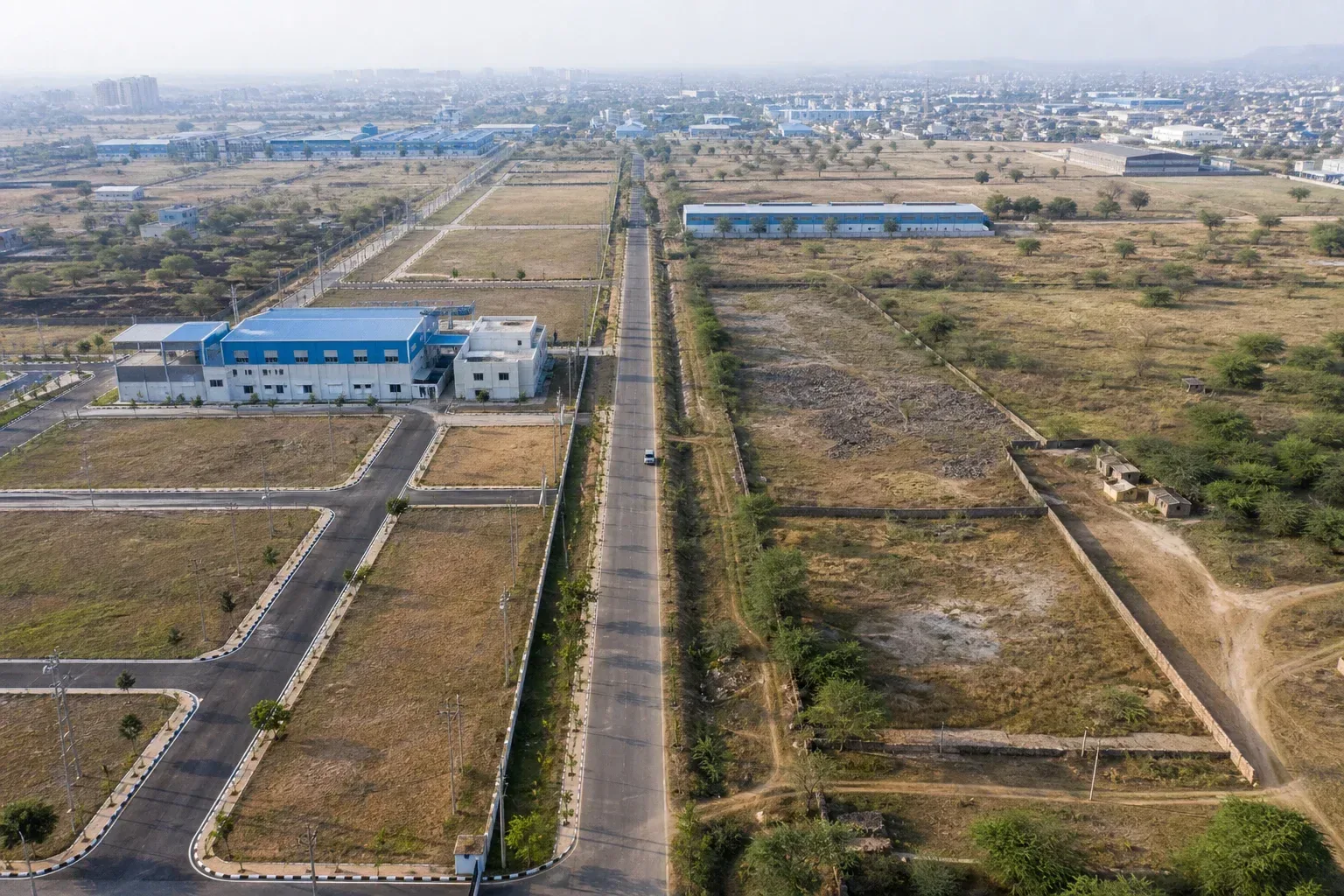
RIICO is the Rajasthan State Industrial Development and Investment Corporation. It acquires land, develops it into planned industrial areas, and then allots plots to industrial units. In the Bhiwadi belt, RIICO developed and governs the industrial areas you have heard of: Bhiwadi itself, Chopanki, Khushkhera, Kahrani and Tapukara. If a plot sits inside one of these areas, RIICO is the authority for that plot. It made the layout, built the internal roads, laid the drainage, and it keeps a file on every plot in the scheme.
A RIICO plot is not ordinary land you buy and forget. It comes with conditions. The original allottee received it for industrial use, usually under a leasehold-style arrangement with RIICO as the lessor. The allotment letter and lease documents spell out what the plot can be used for, what construction and utilisation are expected, and what dues the allottee must keep paying. When the plot changes hands, RIICO is part of the process. You do not simply register a sale deed and move on; the transfer goes through RIICO, with dues clearance and land-use checks before the plot stands in your name in RIICO’s records.
This sounds like bureaucracy, and it is. It is also protection. Because RIICO maintains the plot file, the chain of holders is traceable through one authority. Encroachment disputes, overlapping claims and forged-chain problems are far less common inside a RIICO area than on open revenue land. You are buying into a system.
For a fuller walkthrough of the allotment and resale mechanics, read our RIICO industrial plots buyer’s guide.
What Private Industrial Land Is
Private industrial land is land outside RIICO’s schemes that is either already converted for industrial use or is capable of conversion. It is typically freehold. The seller owns it outright, and when you buy it, you own it outright. No authority holds a lease over your head. No transfer application sits on an officer’s desk before the deal completes.
That freedom comes with work. Private land in the Bhiwadi belt started life as agricultural or revenue land. Somewhere in its history, someone converted it, or nobody did and the seller is hoping you will not check. Land-use conversion, zoning under the applicable master plan, and the title chain across decades of private hands are all yours to verify. There is no single authority file that tells the story. You reconstruct it from revenue records, registered deeds, conversion orders and mutation entries.
Infrastructure is the second gap. A RIICO area comes with internal roads, storm drains, street lighting and a planned layout. A private parcel may sit on a village road, with no drainage, no organised power infrastructure nearby, and neighbours whose land use you cannot control. Some private industrial pockets in the belt are well developed because clusters of factories grew there; others are bare fields with an industrial conversion order and nothing else.
Private land gives you ownership without supervision; it also gives you every verification burden the authority would otherwise have carried.
Tenure and Ownership Rights Compared
This is the deepest structural difference between the two, so slow down here.
RIICO land commonly runs on leasehold-style tenure. RIICO allots the plot under a lease arrangement, and the allottee holds it subject to the lease conditions: industrial use, timely construction and utilisation, payment of dues, and RIICO’s consent for transfers. The lease periods are long, and in practice holders treat the plot as their own for business purposes; they build on it, mortgage it and sell it. But the legal character matters. Your rights flow from the lease and the allotment conditions, and breaching those conditions has consequences that a freehold owner never faces. Confirm the exact tenure, remaining period and conditions with RIICO for the specific plot before you commit; these vary by scheme and by allotment vintage, and you should never assume.
Private industrial land is typically freehold. You hold absolute ownership. You can sell, gift, mortgage, partition or lease it out without asking anyone’s permission, subject only to general law, the applicable land-use rules and any charge on the title such as a mortgage. There is no utilisation condition, no authority dues, no consent requirement for transfer.
If the leasehold versus freehold distinction is new to you, we cover it in plain terms in freehold vs leasehold property in Bhiwadi. The short version for industrial buyers: leasehold inside a RIICO area is not a weak form of ownership in daily practice, but it is conditional ownership, and the conditions are enforceable.
One more point that buyers miss. Freehold sounds strictly better, and on paper it is. But a bank, a large tenant or a future buyer often values the RIICO plot higher per usable square metre precisely because the authority file removes doubt. Tenure is one input to value; certainty is another.
The Transfer Process for Each
Buying a RIICO plot on resale
A RIICO resale is a three-party affair: seller, buyer and RIICO. The broad sequence looks like this.
- You and the seller agree on price and terms, usually recorded in an agreement to sell with an advance.
- The seller obtains dues clearance from RIICO. Any outstanding service charges, lease money or penalties on the plot must be settled; RIICO will not process a transfer on a plot with pending dues.
- A transfer application goes to RIICO with the prescribed documents from both sides. RIICO checks the plot’s file: utilisation status, permitted use, construction compliance and any conditions attached to the original allotment.
- RIICO levies its transfer charges. Do not rely on figures you read online or heard from a broker; the applicable charges and the current procedure change, and they depend on the plot and the scheme. Confirm the current rule with RIICO for the specific plot.
- Once RIICO approves, the transfer is recorded in RIICO’s records and the lease rights stand in your name. The registered documentation between you and the seller completes alongside.
The process takes time because an authority is checking a file. Budget for that in your project timeline. The compensation is that when it completes, RIICO’s own records say the plot is yours, which is a stronger position than any privately assembled title opinion.
Buying private industrial land
A private purchase is a two-party affair plus the registrar.
- You agree on terms with the seller.
- Your lawyer conducts a full title search: the chain of registered deeds, revenue records, mutation entries, the land-use conversion order, and encumbrance checks for mortgages or attachments.
- You verify zoning and permitted use against the applicable master plan and conversion order yourself; no authority does it for you as part of the sale.
- You execute and register the sale deed, pay stamp duty and registration charges, and then apply for mutation in the revenue records.
Faster on paper. But every step that RIICO would have performed is now a step your lawyer must perform, and a step your lawyer misses is a risk you own forever. On private land, the quality of your legal diligence is the transaction.
On a RIICO plot the authority checks the file before you pay in full; on private land nobody checks anything unless you pay someone to.
Permitted Use and Zoning
Inside a RIICO area, permitted use is defined by the allotment. The plot was allotted for industrial use, sometimes for a specific category of industry, and the conditions travel with the plot. If your intended activity differs from the permitted use on the file, you need RIICO’s approval for the change, and some changes are simply not available. Check the permitted use on the plot’s file against your actual manufacturing plan before you sign anything. A plot that is perfect on location and price and wrong on permitted use is not a bargain; it is a problem.
The upside of this rigidity is neighbourhood certainty. Every plot around you is also bound to industrial use. Nobody builds a residential colony next to your stamping unit and then complains about noise. If you want to understand why that separation matters commercially, read residential vs industrial property in Bhiwadi.
On private land, permitted use depends on the land-use conversion and the master plan zoning for that location. You must verify both. Common failure points: land converted for one purpose being sold as suitable for another; conversion orders with conditions the seller never fulfilled; parcels that sit partly inside a zone where industry is restricted; and agricultural land sold with a promise that conversion “will be easy”. Never buy on a promise of future conversion. Buy what the record shows today, or price the uncertainty ruthlessly.
Pollution-category clearances are a separate layer on both routes. Whatever the land status, your unit needs consent from the pollution control board appropriate to its category, and some activities face location restrictions regardless of who owns the land. Factor this in early, not after purchase.
Utilities and Infrastructure
Speak to any manufacturer who has run a unit in both settings and this is the section they will care about most.
A RIICO industrial area is a planned layout. Internal roads exist and connect to the main road network. Storm-water drainage is laid to a plan. Street lighting, demarcated plots and planned open areas come with the scheme. Power distribution infrastructure is organised for industrial loads because the entire area was designed for factories; you still apply for your own connection and sanctioned load through the power distribution company, and you should confirm current availability for your required load before purchase, but the surrounding infrastructure was built for exactly this purpose. Water arrangements vary by area; confirm the position for the specific scheme.
On private land, infrastructure is whatever exists at that spot. Some private industrial pockets in the Bhiwadi belt are mature, with good road access and heavy power infrastructure nearby because industry clustered there over the years. Others require you to build your approach road, manage your own drainage, arrange water through borewells subject to groundwater rules, and wait for the power infrastructure to reach you. Every one of these is a cost and a timeline item that never appears in the per-square-metre price comparison.
Do the comparison honestly. Private land often looks cheaper per square metre. Add the road, the drainage, the power infrastructure contribution, the boundary protection and the time cost, and the gap narrows or reverses. Indicative industrial rates in the belt run around ₹25,000 to ₹40,000 per sq m, with Tapukara industrial around ₹35,000 to ₹40,000 per sq m; these are indicative only and move with the market, so contact us for current rates before you build a budget on them.
The location choice interacts with all of this. Chopanki, Khushkhera and Tapukara each have a different infrastructure and pricing character; our comparison at Chopanki vs Khushkhera vs Tapukara walks through it.
Compare total project cost to production start, not price per square metre; infrastructure gaps on private land are real money.
Comparison Table
| Factor | RIICO industrial plot | Private industrial land |
|---|---|---|
| Tenure | Leasehold-style, with allotment and lease conditions | Typically freehold, absolute ownership |
| Authority | RIICO governs the plot and keeps its file | No plot-level authority; general law and master plan apply |
| Transfer | Through RIICO: dues clearance, file check, transfer charges, approval | Direct sale deed and registration; your lawyer does all checking |
| Infrastructure | Planned roads, drainage, layout built for industry | Whatever exists on site; gaps are your cost |
| Permitted use | Fixed by allotment; changes need RIICO approval | Depends on conversion order and zoning; you verify |
| Documentation | Allotment letter, lease documents, dues clearance, RIICO transfer papers | Full private title chain, conversion order, mutation, encumbrance search |
| Best for | First-time and risk-averse manufacturers; buyers who want financing and resale ease | Experienced buyers wanting freehold control, larger or irregular parcels, long-hold strategies |
Documentation Each Route Needs
RIICO plot documentation
The core papers on a RIICO resale:
- Original allotment letter and the lease documents between RIICO and the allottee
- Possession letter and any building-plan approvals on the file
- Dues clearance from RIICO showing nothing outstanding on the plot
- The transfer application and RIICO’s transfer approval in favour of the buyer
- Chain documents for any earlier transfers, each with its own RIICO approval
- Seller’s identity and entity documents; board resolutions if the seller is a company
- The registered transaction documents between buyer and seller
The pattern to notice: most of the load-bearing documents come from or through RIICO. A gap in the chain shows up in RIICO’s own records, which makes gaps hard to hide and hard to ignore.
Private land documentation
The core papers on a private purchase:
- Registered sale deeds forming the complete chain of title, going back far enough to satisfy your lawyer
- Jamabandi and other revenue records showing the seller as the recorded holder
- Mutation entries reflecting each past transfer
- The land-use conversion order and proof that its conditions were met
- Encumbrance search results covering mortgages, attachments and pending litigation
- Khasra map and a physical demarcation check against the recorded boundaries
- Seller identity, and succession documents if the land came down through inheritance
Inherited land deserves special caution. Rural land in this belt often passed through generations without clean partition. A seller with siblings who never signed a release can produce a dispute years after your factory is running. Your lawyer must trace every legal heir in the chain.
We keep a general checklist at documents required to buy property in Bhiwadi, and the unfamiliar terms above are explained in the Bhiwadi property glossary. On both routes, treat a dealer’s document check as preliminary. We verify what we can see and flag what looks wrong, but only an independent lawyer’s title opinion protects you, and you should insist on one regardless of who introduces the deal.
Financing Differences
Banks and NBFCs treat the two assets differently, and the difference can decide your route.
Lenders are generally comfortable with RIICO plots. The asset is inside a planned industrial area, the authority’s records establish the holder, and lenders in this belt have processed RIICO security many times. Lease conditions are a known quantity to their legal teams. Mortgaging leasehold rights involves its own formalities with the authority, and the lender will want the RIICO file clean, but the path is well worn. Term loans for plot plus construction, and working capital secured against the property, are routine on RIICO plots for borrowers with acceptable financials.
Private industrial land gets a harder look. The lender’s panel lawyer must be satisfied with a privately assembled title chain, the conversion status and the zoning. Any weakness in the chain that you were willing to accept, the bank may not be. Valuation is also less standard; comparable transactions on private parcels are thinner than inside an established RIICO area. Clean, well-documented private land with proper conversion does get financed; marginal cases get declined or get worse terms.
If your project depends on debt, ask your lender early which security they prefer and what they will need on each route. A plot you cannot mortgage on acceptable terms is the wrong plot for a leveraged project, whatever its other merits. And remember that lender approval is a useful second check on your diligence, not a substitute for it; the bank protects its exposure, not your equity.
Risk Profile
Every property carries risk. The two routes carry different risks, and you should choose the risks you are equipped to manage.
RIICO plot risks concentrate in compliance and conditions:
- Utilisation and construction conditions on the file that the seller never met, which can complicate or block transfer
- Pending dues or penalties that surface during clearance
- A permitted use that does not match your activity
- Procedural time: the transfer waits on the authority, and your project waits on the transfer
- Lease conditions that constrain a future exit or use change you have not yet imagined
Private land risks concentrate in title and land use:
- Breaks or defects in the title chain, especially through inheritance
- Missing or conditional land-use conversion
- Zoning conflicts with the master plan
- Boundary and demarcation disputes with neighbours
- Encumbrances that a shallow search missed
- Infrastructure costs and delays that were invisible at purchase
Notice the asymmetry. RIICO risks are mostly discoverable before purchase, because they sit in one authority’s file; the transfer process itself forces many of them into the open. Private-land risks are discoverable only if your diligence is deep enough, and some, like a hidden heir, can stay dormant for years. This is why the same buyer can safely take a RIICO plot with standard care and should take private land only with heavyweight legal support.
The RIICO route trades speed and flexibility for discoverable, front-loaded risk; the private route trades verification burden for freehold freedom.
Which Buyer Suits Which
Choose RIICO if any of these describe you:
- This is your first factory purchase, in Bhiwadi or anywhere
- Your project runs on bank finance and you need smooth mortgage processing
- You want a predictable timeline from purchase to production, with infrastructure already in place
- You value resale liquidity; RIICO plots in established areas find buyers faster because the next buyer’s diligence is easier
- You do not have, and do not want to pay for, deep legal capacity for title reconstruction
Choose private industrial land if these describe you:
- You have bought industrial land before and you have a lawyer you trust with rural title chains
- You need a parcel size or shape that RIICO schemes do not offer, or you want land banking flexibility a lease cannot give
- Freehold tenure matters to your long-term plan: succession, restructuring, or uses that may evolve beyond a fixed permitted-use condition
- You can absorb infrastructure cost and timeline, and you have priced it into your comparison
- You are paying largely from your own funds, so lender comfort is not a gating factor
There is a middle path that many buyers in the belt end up taking: a RIICO plot for the operating factory, and private land later, once they know the area, for expansion or investment. The RIICO purchase teaches you the market at low structural risk; the private purchase comes when your judgement and your network are ready for it. For the broader case on why the belt works for manufacturers at all, see why manufacturers choose Bhiwadi.
Whichever route you take, walk the ground, read the file or the chain, and put a lawyer between your money and the signature. We have worked this market since 2008, we are Rajasthan RERA-registered (agent no. RAJ/A/2026/21898), and industrial property is what we do most; our checks are the start of your diligence, never the end of it. You can see how we work on the industrial property in Bhiwadi page or through our property dealer in Bhiwadi overview.
Frequently Asked Questions
Is a RIICO plot freehold or leasehold?
RIICO plots commonly run on leasehold-style tenure. RIICO allots the plot under a lease arrangement with conditions on use, utilisation and transfer. The exact tenure and remaining period vary by plot and scheme; confirm them with RIICO for the specific plot before buying.
Can I buy a RIICO plot directly from the current holder?
You negotiate with the current holder, but the transfer itself goes through RIICO. Dues on the plot must be cleared, RIICO checks the file and permitted use, transfer charges apply, and only after RIICO’s approval does the plot stand in your name in its records.
Is private industrial land cheaper than a RIICO plot?
Often per square metre, yes. But add the cost of roads, drainage, power infrastructure, boundary protection and the time to arrange them, and the total project cost can match or exceed a RIICO plot. Compare total cost to production start, not headline rate. Indicative industrial rates in the belt run around ₹25,000 to ₹40,000 per sq m; contact us for current rates.
Can I run any industry on a RIICO plot?
No. The plot’s permitted use is fixed by its allotment and lease conditions. If your activity differs, you need RIICO’s approval for the change, and some changes are not available. Match the file’s permitted use to your actual plan before you commit. Pollution-board consent is a separate requirement on any land.
Do banks finance both types of industrial land?
Banks routinely finance RIICO plots; the authority’s records make the security easy to assess. Private land is financed only when the title chain, conversion and zoning satisfy the lender’s lawyers, and terms can be tougher. If your project needs debt, check with your lender before choosing the route.
What is the biggest risk with private industrial land in Bhiwadi?
Title and land-use defects. Broken inheritance chains, missing or conditional conversion orders, and zoning conflicts are the failures that surface after purchase. Deep legal diligence before signing is the only protection; a dealer’s check is preliminary and does not replace a lawyer’s title opinion.
Which option is better for a first-time factory buyer?
A RIICO plot, in most cases. The authority’s file makes diligence tractable, infrastructure exists, financing is smoother, and resale is easier. Private land rewards experience; earn that experience on the safer asset first.
Discuss Your Industrial Requirement
18+ years in this market. Real prices, verified paperwork, no pressure.
Choose what you would like to do next:
Done — our team will contact you during working hours.