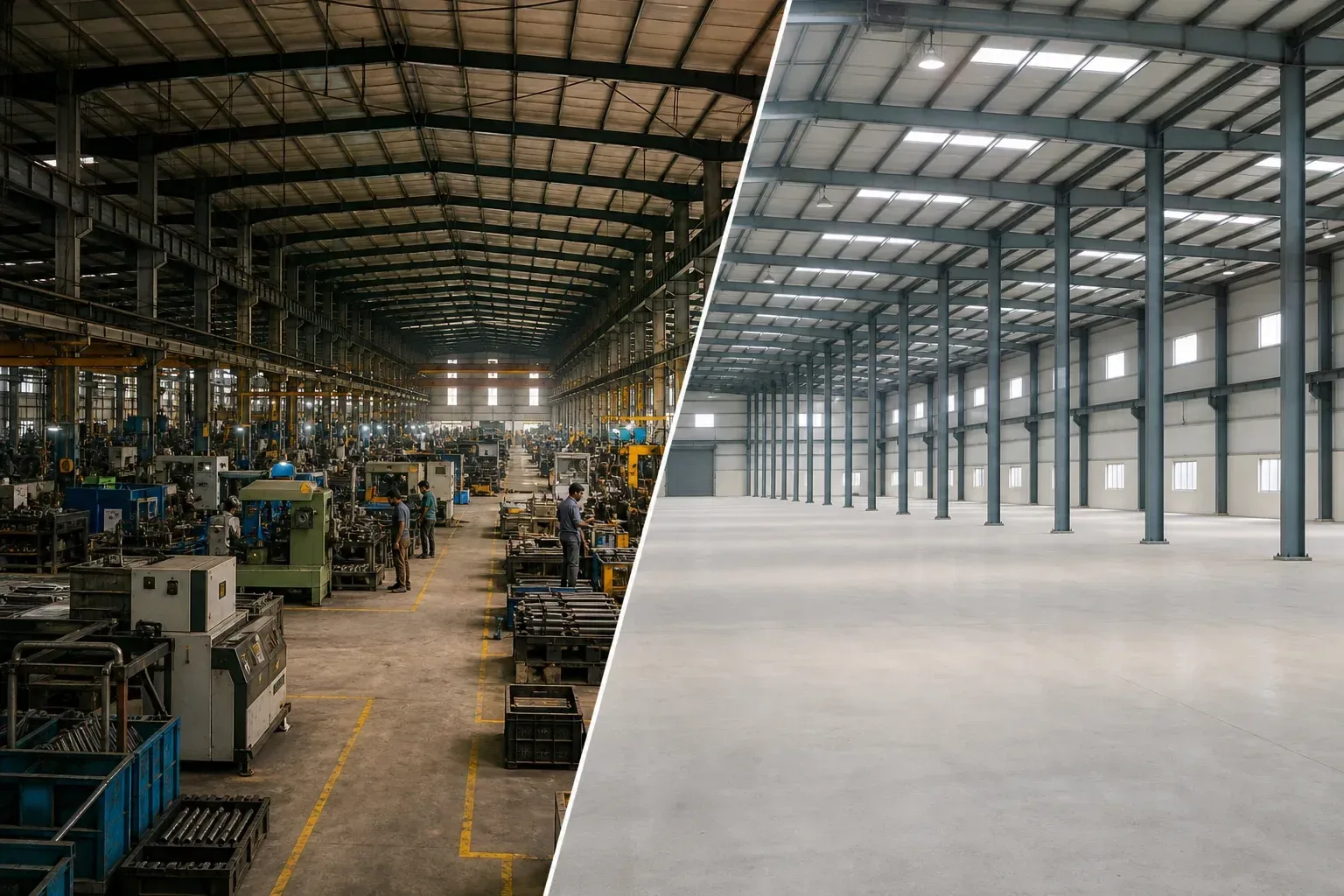
Key Answers in This Guide
- What "Operational Factory" Means and What May Be Included: An operational factory is a unit where production is running, or ran until recently, and the seller is offering the setup as a whole or in parts.
- What "Vacant Shed" Means: A vacant industrial shed is a built structure on an industrial plot with no running operation inside.
- Transaction Scope: What Is in the Sale, Put It in Writing: Scope is where operational factory deals go wrong.
- Machinery, Licences and Workforce Checks: These three items exist only in the operational factory purchase, and each needs its own verification track.
- Building Condition and Compliance: This section applies to both purchases, but the emphasis flips.
- RIICO Dues, Permitted Use and Utilisation: Both purchases in a RIICO area carry the RIICO layer.
In this guide
An operational factory buys you a running setup; machinery, licences, sometimes staff and orders come with it, but the due diligence is heavy and the transaction scope must be defined in writing before you sign anything. A vacant industrial shed is a simpler purchase; you check the building and the paperwork, then you build the operation yourself. Which one suits you depends on how fast you need to start, how much verification work you can absorb, and whether the existing setup actually matches your activity.
We have brokered both kinds of deals in the Bhiwadi belt since 2008. This article walks through what each purchase actually contains, where buyers get burnt, and how to decide between them.
What “Operational Factory” Means and What May Be Included
An operational factory is a unit where production is running, or ran until recently, and the seller is offering the setup as a whole or in parts. In the Bhiwadi belt these units sit mostly in RIICO industrial areas: Bhiwadi’s own phases, Tapukara, Khushkhera, Chopanki and Kahrani. RIICO governs allotment, permitted use and dues in these areas, so every operational factory sale here carries a RIICO layer on top of the normal property checks.
Here is the critical point most first-time buyers miss.
“Operational factory” is not a fixed package; the sale may include the building alone, the building with machinery, or the entire business, and only the written agreement decides which one you are buying.
Sellers use the phrase loosely. One seller means the land, building and installed plant. Another means the land and building only, with machinery sold separately or removed before handover. A third is selling a going concern: the company, its licences, its workforce, its customer contracts. These are three different transactions with three different price logics, three different tax treatments and three different due-diligence lists.
Items that may or may not be part of an operational factory sale:
- The RIICO leasehold or freehold land and the built structure
- Installed plant and machinery, fixed and movable
- Electrical infrastructure: transformer, panels, sanctioned power load and the connection itself
- Utilities: borewell or water connection, compressed air lines, DG set, effluent treatment plant if any
- Licences and consents: factory licence, pollution consents, fire NOC, GST registration
- Workforce: skilled operators, supervisors, statutory registrations tied to employees
- Intangibles: customer orders, vendor relationships, brand, the running company itself
None of these transfer automatically. Each must be named in the agreement, valued, and its transfer mechanism specified. A licence issued to the seller’s company does not become yours because you bought the shed it hangs in.
What “Vacant Shed” Means
A vacant industrial shed is a built structure on an industrial plot with no running operation inside. The seller hands over walls, roof, flooring, gates, whatever electrical infrastructure remains, and the plot itself. There is no machinery to value, no workforce to absorb, no business licences to transfer.
Vacant sheds in the Bhiwadi belt come in a few common situations:
- A unit that shut down; the owner removed or sold the machinery and now sells the shell
- A shed built for lease that never found a tenant, or lost one
- A unit built by an investor purely to sell
- A partially built structure the original allottee could not complete
The purchase is structurally simpler. You are buying immovable property plus fixtures. The checks concentrate on three things: title and RIICO status, building condition, and whether the permitted use fits your activity. What you do not get is anything that shortens your path to production. Power connection may need fresh sanction or load enhancement. Every licence starts from zero. The building may need repair before any machine goes in.
For a broader comparison of the asset classes themselves, see factory vs warehouse vs industrial plot; this article assumes you have already decided you want a built industrial unit rather than raw land.
Transaction Scope: What Is in the Sale, Put It in Writing
Scope is where operational factory deals go wrong. The site visit shows you a humming plant; the sale deed, months later, transfers land and building. The gap between what you saw and what you signed for is the single largest source of disputes in these transactions.
Before you negotiate price on an operational factory, get a written, itemised list of exactly what transfers: land, building, each machine, each utility connection, each licence, and each employee arrangement.
Insist on an annexure to the agreement that lists:
- Every machine included, identified by description and serial number where available, with its condition stated
- Every machine excluded, so there is no ambiguity about what the seller may remove
- Electrical assets: transformer, panels, DG set, and whether the sanctioned load transfers with the property
- Whether the sale is of assets (you buy the property and listed items) or of the company (you buy shares and the company keeps owning everything)
- Which licences the seller will assist in transferring or surrendering, and which you must apply for fresh
- The position on employees: retained by you, settled by the seller, or a mix, with dues settlement responsibility fixed
- Handover condition: running, idle but intact, or cleared
An asset sale and a share sale are entirely different animals. In a share sale the licences, contracts and liabilities stay with the company you are acquiring; that continuity is the attraction, and the hidden liabilities are the risk. In an asset sale you pick the items you want and leave the seller’s liabilities behind, but every licence must be re-obtained in your name. Your lawyer and your chartered accountant should structure this before you commit, because stamp duty, GST and income-tax consequences differ sharply between the two.
For a vacant shed, scope is shorter but not zero. Confirm in writing what fixtures stay: gates, structural mezzanine, crane gantry if any, electrical panels, borewell pump. Sellers sometimes strip a shed between agreement and registry. List what you saw and make the agreement say it stays.
Machinery, Licences and Workforce Checks
These three items exist only in the operational factory purchase, and each needs its own verification track.
Machinery
Do not accept a lump-sum machinery figure. Itemise and verify for the specific unit:
- Ownership: is each machine owned outright, on hire purchase, on lease, or hypothecated to a bank? A machine under bank charge cannot pass to you free of encumbrance until the loan is closed and the charge released.
- Condition: age, maintenance history, whether it runs. Ask to see the machines operating during your visit. A machine that “just needs servicing” is a machine that does not run.
- Suitability: does the installed plant actually serve your product? A plant configured for one process may be scrap value to a buyer in a different line. Machinery has full value only to a buyer who will use it.
- Valuation: get an independent valuation for any material machinery component of the price. Seller book value and market value diverge, usually in the seller’s favour.
Do not carry an assumed machinery value into your offer. Value each machine for what it is worth to you, not for what it cost the seller.
Licences and Consents
A running factory in the RIICO belt typically holds several approvals. Check the status of each and, crucially, whether it can transfer at all:
- Pollution consents from the Rajasthan State Pollution Control Board: Consent to Establish (CTE) and Consent to Operate (CTO). Verify they exist, are current, cover the actual process being run, and check the category. Whether your process fits the same consents is a separate question; a change in activity usually means fresh consent.
- Fire NOC: verify it is current and matches the building as it stands today, including any additions built after issue.
- Factory licence under the Factories Act: issued to the occupier, not the building. A new occupier applies afresh or seeks transfer per the prevailing procedure.
- Electricity connection: confirm the sanctioned load, whether dues are clear, and the process for transferring the connection to your name.
- GST, ESI, EPF registrations: these belong to the seller’s entity and do not transfer in an asset sale.
A licence issued to the seller does not automatically protect you; verify for each consent whether it transfers, must be re-applied for, or lapses on change of occupier.
Also verify the negative side: pending show-cause notices, closure directions, or consent conditions the unit is violating. You inherit the building’s compliance history in practical terms even where you do not inherit it legally, because inspectors know the premises.
Workforce
If the deal contemplates retaining workers, treat it as its own negotiation:
- Get the employee list with tenure and statutory registration status
- Fix in writing who pays accumulated dues: gratuity, leave encashment, bonus, PF and ESI arrears
- Decide whether employees resign and are re-hired by you, or continuity of service is preserved; the gratuity and retrenchment consequences differ
- Do not assume skilled operators will stay; ask, and discount the “trained workforce included” pitch accordingly
If you do not want the workforce, make the agreement put settlement squarely on the seller, completed before handover, with proof.
Building Condition and Compliance
This section applies to both purchases, but the emphasis flips. In an operational factory the machinery and licences distract you from the building; in a vacant shed the building is most of what you are buying.
For either unit, walk it with the industrial property site visit checklist and look at:
- Structure: roof condition, leaks, column and truss corrosion, floor cracking and load capacity for your machines
- Approved building plan versus what stands: unapproved extensions are common and become your regularisation problem
- Ground coverage and setbacks against the sanctioned plan
- Electrical installation condition and the sanctioned load against your requirement
- Drainage, effluent arrangements, and whether the site floods in monsoon
- Access: road width, turning space for the vehicle sizes your operation needs
A vacant shed deserves extra scepticism on structure. Units that sat idle for years develop roof and drainage problems nobody fixed because nobody was inside. Budget the fit-out honestly: flooring for machine foundations, electrical rewiring, roof repair, painting, gates. These costs are real and they belong in your comparison against the operational factory’s higher price.
An operational factory deserves extra scepticism on modifications. Running units get altered over years: mezzanines added, sheds extended, machine foundations cut into floors. Ask for the approved plan and compare it to what stands. Deviations affect fire NOC validity and future approvals.
A dealer’s check is preliminary; before you commit money, have an independent lawyer review the title and approvals, and where the structure matters, have an engineer inspect the building.
We say this about our own role. We verify what a dealer can verify: RIICO records, market standing of the seller, obvious red flags. We are not a substitute for legal and structural due diligence, and no dealer is.
RIICO Dues, Permitted Use and Utilisation
Both purchases in a RIICO area carry the RIICO layer. See the RIICO industrial plots buyer’s guide for the full framework; here is what changes between the two unit types.
Checks common to both:
- Allotment and lease documents: original allotment letter, lease deed, and any conversion to freehold
- Dues status: service charges, economic rent, water charges, any penalty or retention money outstanding; get a dues-clearance confirmation, because outstanding dues follow the plot
- Transfer procedure: RIICO transfer requires its process and charges; factor the timeline and cost into the deal
- Permitted use: the allotment specifies industrial use, and specific activities may be restricted by the area’s character or the consent regime; your activity must fit
Utilisation is where the two diverge. RIICO allotments carry construction and utilisation obligations; an allottee who fails to build and operate within the stipulated period faces time extension charges or, in the worst case, cancellation proceedings.
- An operational factory, by definition, has been utilised. Check whether utilisation was formally recorded and whether any time-extension charges from the construction period remain unpaid.
- A vacant shed needs more care. If the unit was built but never operated, or operated briefly and shut, ask how RIICO views its utilisation status and whether any extension charges accrued. A shed whose allotment is under a cloud is not a bargain at any price.
If you are comparing against non-RIICO options, read RIICO plot vs private industrial land; the dues-and-utilisation layer is the price of RIICO’s cleaner title and infrastructure.
Whichever unit you buy, the paperwork list in documents required to buy property in Bhiwadi applies, with the RIICO and licence documents added on top.
Time-to-Start and Cost
This is the practical heart of the decision.
An operational factory compresses your start timeline if, and only if, the setup matches your activity. If the machinery runs your process, the power load suffices, and the pollution consents cover your category, you can be producing soon after handover, subject to licence transfers and re-registrations in your name. The compression is real; industrial buyers pay for it.
But the compression evaporates when the match is poor. If you must replace half the machinery, apply for fresh consents because your process differs, and enhance the power load, you have paid an operational-factory premium for what is functionally a vacant shed with removal costs.
A vacant shed has a predictable but longer runway:
- Purchase and RIICO transfer
- Building repair and fit-out
- Power sanction or load enhancement
- Machinery procurement, delivery and installation
- Licences from scratch: CTE, then CTO, factory licence, fire NOC
- Hiring and trial production
Each step has a lead time and some run in parallel. The total is months, not weeks, and machinery delivery lead times are often the longest pole. Cost-wise, the shed’s lower purchase price must carry the full fit-out, machinery and licensing budget on top. Build both totals honestly before comparing prices, because the sticker prices of the two options describe different amounts of finished capability.
On land and building value in the belt: indicative industrial rates run ₹25,000 to ₹40,000 per sq m depending on area, road position and plot size. These are indicative; contact us for current rates on specific areas. An operational factory’s price adds machinery, infrastructure and sometimes business value on top of this base; a vacant shed prices close to land plus depreciated structure.
Price and Negotiation
The two deals negotiate differently.
A vacant shed negotiates like property. The reference points are per-square-metre land rates in the area, construction cost less depreciation, and the condition discount for repairs. Comparable transactions in the same industrial area anchor the discussion. The spread between asking and closing price is usually modest because both sides can see the same benchmarks.
An operational factory negotiates like property plus a business, and the business part is where discipline matters:
- Separate the price into components: land and building, machinery, and anything intangible. Negotiate each on its own evidence.
- Land and building: anchor to area rates, same as a shed.
- Machinery: anchor to your independent valuation and to what the plant is worth in your use, not the seller’s investment. Sellers price machinery at cost plus sentiment; buyers should price it at utility.
- Intangibles: pay for a running business only if you are genuinely acquiring the business, with its contracts and continuity, under a structure your CA has blessed. If you are buying assets, goodwill talk is negotiation noise.
- Distress matters: units sell because owners retire, relocate, or face financial pressure. A seller under bank pressure on a hypothecated plant needs a clean, fast close; that is negotiating room, but it also demands extra care on encumbrances.
Whatever the components, one rule holds for both deals: the price you agree should reflect verified facts, not the site-visit impression. Every unverified claim (sanctioned load, consent validity, machinery condition) is either verified before price is fixed or discounted in the price.
Risk Profile
The risks are different in kind, not just in size.
Operational factory risks:
- Scope disputes: what you thought was included was not
- Hidden encumbrances on machinery: bank hypothecation surfacing at handover
- Non-transferable or lapsed licences: the “fully licensed unit” that needs every approval fresh in your name
- Inherited compliance problems: pollution notices, unapproved construction, unpaid statutory dues to workers
- Overpaying for machinery that does not fit your process
- In a share purchase: unknown liabilities of the company, from tax demands to litigation
Vacant shed risks:
- Structural defects hidden by years of disuse
- Utilisation and dues issues on the RIICO allotment
- Underestimated fit-out and licensing timeline, stretching your cost of capital
- Power sanction taking longer than planned
- Permitted-use mismatch discovered after purchase
The operational factory’s risks concentrate in verification: almost every one of them is catchable with thorough due diligence before signing. The vacant shed’s risks concentrate in execution: the purchase is clean, but your own project plan carries the exposure. Buyers who are strong at due diligence and weak at project execution should lean one way; buyers with project experience and limited patience for forensic verification should lean the other.
Comparison Table
| Factor | Operational factory | Vacant industrial shed |
|---|---|---|
| What is included | Land, building, and a negotiated set of machinery, utilities, licences, sometimes workforce; scope varies deal to deal | Land, building and fixed fixtures only |
| Due-diligence burden | Heavy: property, RIICO, machinery ownership and condition, licence status, workforce dues, possibly company liabilities | Moderate: property title, RIICO status and dues, building condition, permitted use |
| Time-to-start | Short if the setup matches your activity; licence transfers and re-registrations still take time | Longer: fit-out, power, machinery, licences from scratch |
| Compliance checks | Verify existing CTE/CTO, fire NOC, factory licence; check transferability and violations | Apply fresh for all consents; verify building plan approval and RIICO utilisation status |
| Price logic | Land plus building plus machinery plus possible business value; negotiate components separately | Land plus depreciated structure; anchored to area rates |
| Main risk | Scope disputes, encumbered machinery, non-transferable licences, inherited liabilities | Structural defects, execution delays, allotment issues on idle units |
| Best for | Buyers in the same or compatible line who value speed and can fund heavy due diligence | Buyers with specific fit-out needs, custom processes, or tighter purchase budgets who can run a project |
Which Buyer Suits Which
Choose the operational factory when:
- Your process matches the installed plant, or close to it; the premium buys you months
- You are expanding an existing business and can absorb a running unit into known systems
- You have the advisors (lawyer, CA, machinery valuer) to run full due diligence, and the time to let them finish
- Continuity has value to you: existing consents in a category that is slow to obtain fresh, or a workforce trained on your kind of plant
- You are acquiring the business itself, structured as a share deal with proper disclosure and indemnities
Choose the vacant shed when:
- Your process needs specific foundations, layouts or clean-room conditions that an existing plant would fight against
- Your machinery is new or coming from elsewhere; you need a shell, not a setup
- Your purchase budget is tighter and you can phase the fit-out spend
- You would rather manage a construction-and-licensing project than a forensic verification project
- No available operational unit in the belt matches your line, which is often the case for specialised processes
There is a third path worth naming: buy a vacant shed and buy machinery separately from a different closing unit. You get the shed at property logic and the machines at utility logic, without inheriting either seller’s liabilities. It takes longer and needs two negotiations, but it often beats overpaying for a bundled deal where only half the bundle fits you.
The Bhiwadi belt supports both strategies. Manufacturing depth across Tapukara, Khushkhera, Chopanki and Kahrani means both operational units and vacant sheds come to market regularly; the reasons manufacturers choose Bhiwadi in the first place (NCR proximity, RIICO infrastructure, an established vendor base) apply equally to either purchase.
Match the purchase to your project, not to what happens to be on the market; a well-priced unit that does not fit your process is not a deal.
How We Help
Shivam Properties has worked the Bhiwadi industrial belt since 2008; we are a Rajasthan RERA-registered agent (RAJ/A/2026/21898) and industrial property is our specialty. On operational factory and vacant shed deals we shortlist units against your stated process and budget, run preliminary checks on RIICO status and seller standing, arrange inspections, and manage the negotiation and transfer process. We flag scope issues early because we have watched them sink deals late.
We are equally clear about the boundary: our checks are preliminary. Title review needs your independent lawyer; deal structure needs your CA; structural condition needs an engineer where it matters. A property dealer in Bhiwadi who tells you otherwise is overselling. Browse current industrial property in Bhiwadi or talk to us about what is actually available in your line right now. Terms you meet along the way are in the Bhiwadi property glossary.
Frequently Asked Questions
Does buying an operational factory mean the licences come with it?
No. Each licence has its own rule. Pollution consents, the factory licence, fire NOC, GST and labour registrations are issued to a specific entity or occupier; some can transfer with procedure, others must be applied for fresh in your name, and a change of activity usually means fresh consent regardless. Verify each one before pricing the deal.
Is machinery always included when a factory is sold?
No. The sale may include all machinery, some, or none; sellers sometimes remove or separately sell the plant. The agreement must itemise every included machine and confirm each is free of bank hypothecation or lease. Never rely on what you saw at the site visit.
Which is cheaper, a running factory or a vacant shed?
The vacant shed has the lower purchase price, but it is not the lower project cost until you add fit-out, machinery, power sanction and licensing to it. Compare total cost-to-production for both options, not sticker prices. Belt land-and-building rates are indicatively ₹25,000 to ₹40,000 per sq m; contact us for current rates.
How long before I can start production in a vacant shed?
Expect months, not weeks. Repair and fit-out, power sanction or load enhancement, machinery delivery and installation, and fresh consents (CTE, then CTO, fire NOC, factory licence) each carry lead times; machinery delivery is often the longest. Sequence the applications early and run steps in parallel where possible.
What RIICO checks apply to a vacant shed that do not worry an operational factory buyer as much?
Utilisation status. RIICO allotments carry construction and operation obligations; a shed that was never operated, or sat idle for years, may carry time-extension charges or an allotment under question. An operational factory has demonstrably been utilised, though its construction-period dues should still be verified.
Should I retain the existing workforce when buying a running factory?
Only if you want them and the terms are settled in writing. Fix who pays accumulated dues (gratuity, leave, PF, ESI arrears), and decide whether service continuity is preserved or workers are freshly hired. If you do not want the workforce, the agreement should oblige the seller to settle all dues before handover, with proof.
Can a dealer’s verification replace a lawyer for these deals?
No. A dealer’s check covers RIICO records, market intelligence on the seller and the area, and obvious red flags; it is preliminary. Title, encumbrances, deal structure and licence transferability need an independent lawyer and a CA, and building condition needs an engineer where the structure is material to the price.
Discuss Your Industrial Requirement
18+ years in this market. Real prices, verified paperwork, no pressure.
Choose what you would like to do next:
Done — our team will contact you during working hours.