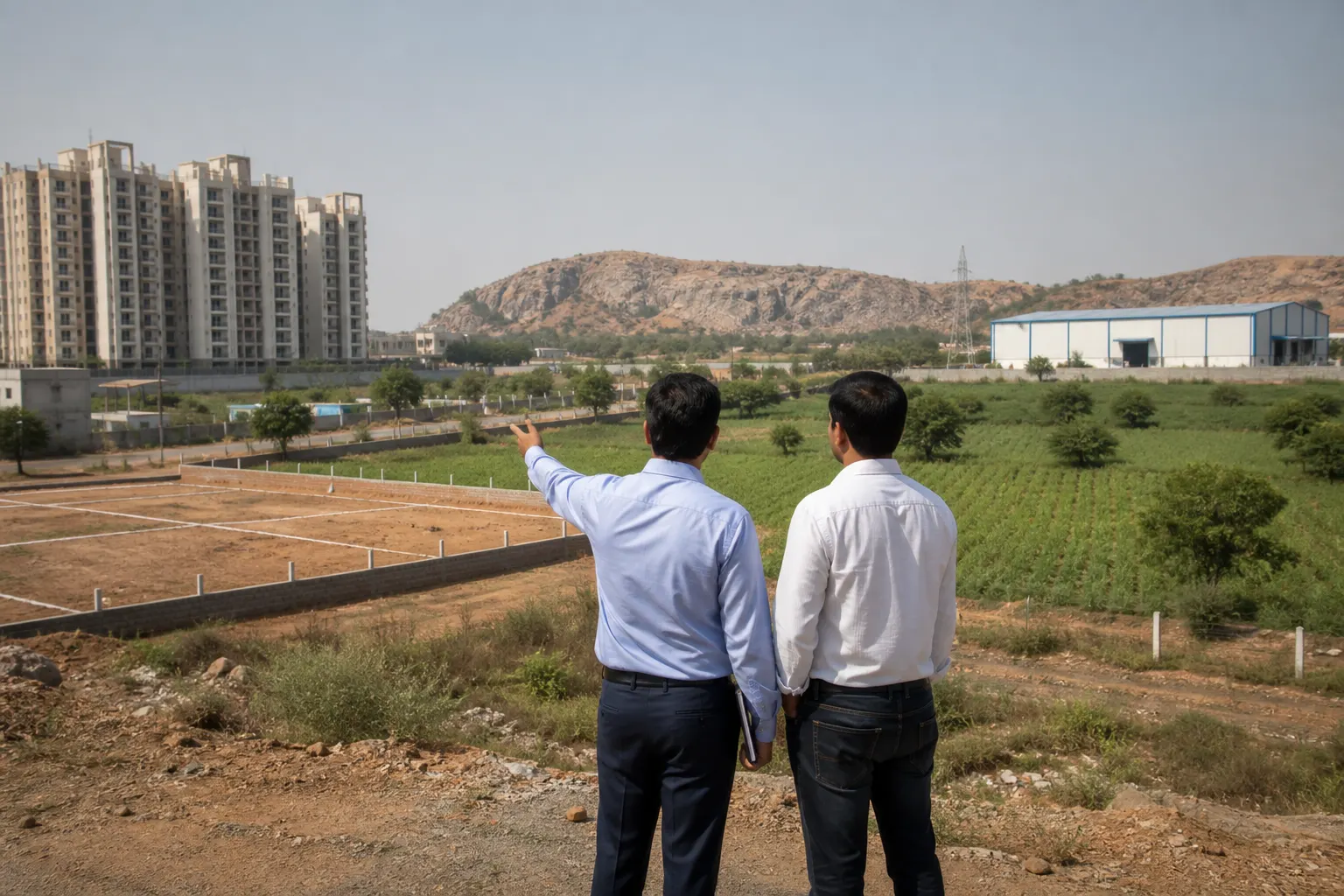
Key Answers in This Guide
- Flats: the easiest to fund, hold and get out of: A flat is the default first purchase here for reasons that have nothing to do with taste.
- Residential plots: low to hold, and you are buying optionality: A plot costs almost nothing to hold and produces nothing while you hold it.
- Farmhouse and agricultural land: the tightest restrictions of the four: This is the category where enthusiasm most often outruns the checks, because the rate per bigha looks approachable next to a flat and the arithmetic feels obvious.
- Industrial: the highest ticket and the most serious buyers: Industrial property is a different market rather than a bigger version of the residential one, and Bhiwadi is a genuine industrial belt rather than a residential town with some sheds in it.
- Holding a vacant industrial plot is not like holding a residential one: A buyer with a large budget sometimes looks at a vacant RIICO plot as land to hold, the way they would hold a residential plot.
- Four questions that settle it faster than any comparison: Most buyers arrive at the right category by answering these honestly, in this order.
In this guide
Buyers arrive at the office with a budget and no fixed idea of what to do with it, which is a more sensible starting position than it sounds. The four things they are choosing between behave so differently that the choice of asset type matters more than the choice of property within it.
The comparison below is not about which is best. It is about which demands what, because that is the question that actually decides whether a purchase suits the person making it.
| Flat | Residential plot | Farmhouse or agricultural land | Industrial | |
|---|---|---|---|---|
| Entry ticket on our rate card | From ₹19 lakh for a 1 BHK, ₹28 lakh for a 2 BHK | From ₹13 lakh at the Tijara end, ₹50 lakh and up at the Bhiwadi end | Usually sold in bigha, so the ticket rises quickly | About ₹1 crore for the smallest plot size |
| Funding | Home loans are ordinary | A plot loan needs converted land in an approved scheme | Hardest to fund; retail plot loans normally exclude it | Its own lending world |
| Holding cost | Maintenance, and it never stops | Low | Low, but the land needs watching | Dues and compliance continue |
| Effort while you hold it | Low | Low, with occasional checking | Real, and local | Highest |
| Exit pool | Widest, including loan-funded buyers | Wide, and unit-size sensitive | Narrowest, with legal restrictions on who may buy | Narrow but serious |
| Legal complexity | Lowest | Moderate: conversion, sanction, boundary | Highest | High, and RIICO sits in the middle of it |
| Who it usually suits | A first purchase, or someone who wants it occupied | Someone building later, or holding land | Someone with local presence | An operator, or a buyer who understands industrial demand |
Flats: the easiest to fund, hold and get out of
A flat is the default first purchase here for reasons that have nothing to do with taste. It is a small ticket, the lending is ordinary, and when you sell, the pool of buyers includes everyone who can arrange a home loan, which is most of the market.
On our partner rate card the smallest flat ticket is a 650 sq ft 1 BHK at Terra Heritage at ₹19 lakh, with a 555 sq ft 1 BHK at Essentia at about ₹20 lakh. A 2 BHK starts at ₹28 lakh, for 1,150 sq ft at Terra Castle. Those are the cheapest flats, not the cheapest property: a plot at the far end of the corridor costs less, as the next section shows.
The cost of that ease is that a flat is the most managed of the four. Maintenance is continuous whether or not anyone lives there, and the society’s condition, its water supply and the reliability of its power backup shape both your experience and your resale. Which societies banks lend against also matters more than buyers expect, because a project most lenders will fund has a wider exit pool, and pool size is what you feel on the way out. Our societies compared guide carries the project-level detail we hold, with the date each item was checked.
Flats suit a first purchase, a buyer who wants the property occupied rather than idle, and anyone who wants the option of exiting without a long search for the right buyer. Our flats in Bhiwadi page lists the societies we transact in.
Residential plots: low to hold, and you are buying optionality
A plot costs almost nothing to hold and produces nothing while you hold it. That single sentence explains most of the difference between plots and flats as a decision.
What you are actually buying is the option to build later, and the value of that option depends on things you must check before you pay: whether the colony layout was sanctioned, whether the land use was converted, the width of the approach road, and whether the boundaries on the ground match the plan. Our BIDA plot vs developer plot guide explains why buyers separate the two categories, and flats vs plots is the direct comparison if those are your only two candidates.
The plot market also holds both the cheapest and some of the most expensive tickets in the belt, and the gap is location. Plots here are quoted per gaj (square yard). A 100 gaj plot at Chanderlok City, at ₹13,000 per gaj, comes to ₹13 lakh, which is below any flat on our card; Chanderlok sits at the Tapukara to Tijara end. The same 100 gaj at Omaxe Green Meadow City in Bhiwadi, at ₹50,000 to ₹55,000 per gaj, is ₹50 lakh to ₹55 lakh. Across our rate card the top is ₹75,000 to ₹80,000 per gaj at Reverence (Ashadeep), which is launching.
A township’s smallest plot, not its rate, sets the lowest price you can pay there. Aqasia Homes, at ₹25,000 to ₹26,000 per gaj, sells from 100 gaj, so nothing there costs under ₹25 lakh however attractive the rate looks. Our ₹20, ₹40 and ₹75 lakh guide works each budget through every township on the card, and plot projects compared holds the colony-level detail.
Funding narrows it again. Banks generally lend on a plot only when it is residentially designated, converted land inside an approved scheme or township, and the down payment and construction conditions differ from a home loan; home loan vs plot loan sets out the difference. A buyer who needs a loan should confirm the bank will fund that specific colony before choosing it.
Size deserves a thought at purchase rather than at sale. A plot in the size band that colony actually trades in has a wide resale pool; an unusually large one has a much thinner one, and that is a decision you make on the day you buy.
Plots suit a buyer who intends to build within a few years, or who wants land exposure with minimal ongoing cost and does not need the property to do anything in the meantime. Current options are on our plots in Bhiwadi page.
Farmhouse and agricultural land: the tightest restrictions of the four
This is the category where enthusiasm most often outruns the checks, because the rate per bigha looks approachable next to a flat and the arithmetic feels obvious.
Three constraints decide whether it is even available to you. Who may buy agricultural land is restricted, and it is not open to every buyer; a non-resident, for instance, cannot buy agricultural land, a plantation or a farmhouse at all. What you may build on it depends on conversion, and land bought unconverted with an assumption about future conversion is a bet on an outcome nobody can promise, which is a different proposition from buying converted land. Funding follows the same line: retail plot loans are written for converted, residentially designated land, so agricultural land normally falls outside them and is bought with your own money. And the holding is physical: land in this belt needs someone local keeping an eye on it, which is a real requirement rather than a formality.
Our agricultural land and farmhouse guide covers what these transactions involve, including who the realistic buyers are on the way out, and land measurement units covers bigha, biswa and gaj so that quoted rates can be compared at all. The first record to read is the jamabandi, the record of rights, for the khasra (survey) numbers on Apna Khata, searched under Khairthal-Tijara district rather than Alwar; our Apna Khata guide walks through the search. What we handle in this category is on our agricultural land in Bhiwadi page. We do not take on land-use conversion work, and a seller or dealer who is relaxed about conversion is the signal to slow down rather than to hurry.
This category suits a buyer with genuine local presence and patience, and it suits almost nobody who is buying from a distance.
Industrial: the highest ticket and the most serious buyers
Industrial property is a different market rather than a bigger version of the residential one, and Bhiwadi is a genuine industrial belt rather than a residential town with some sheds in it. Our why manufacturers choose Bhiwadi guide covers the demand side.
Three things separate it from everything above. The buyer is usually an operator doing arithmetic about their own process, so the property is valued for what it lets them do rather than for how it presents. RIICO sits inside the transaction: allotment, dues, transfer permission and utilisation status all bear on whether a sale can complete, which our RIICO buyer’s guide sets out. And whether a unit is running changes its value materially, which is the subject of operational factory vs vacant shed.
On our partner rate card, industrial plots across the Bhiwadi main zone, Khushkhera, the Honda zone at Tapukara, Chopanki and Salarpur run ₹25,000 to ₹40,000 per sq m, in plot sizes of 400, 500, 1,000 and 2,000 sq m. The smallest size at the lowest rate is about ₹1 crore, a 500 sq m plot runs around ₹2 crore at current rates, and a 1,000 sq m built-up factory or shed around ₹6 crore. Current stock is on our industrial property in Bhiwadi page.
Residential vs industrial is the head-to-head if you are weighing only those two. Industrial suits a buyer who either operates here or understands industrial demand well enough to judge what a future occupier needs.
Holding a vacant industrial plot is not like holding a residential one
A buyer with a large budget sometimes looks at a vacant RIICO plot as land to hold, the way they would hold a residential plot. RIICO’s own rules price that plan differently.
Under Rule 18 of the RIICO Disposal of Land Rules, 1979, as amended up to 8 April 2026, the transfer fee is charged on the prevailing allotment rate of the industrial area, not on the price you agree. A utilised plot transfers at 0.50 per cent of that rate. A vacant one transfers at 20 per cent of the prevailing or original allotment rate, whichever is higher.
A plot held vacant and resold vacant pays the 20 per cent branch on the way out, not the 0.50 per cent one. Sale or transfer of a vacant or unutilised plot is also generally permissible only after five years from allotment, subject to the Rule 3(AJ) exception, and a vacant-plot transfer forfeits the transferor’s security deposit. Our Rule 18 guide sets out each branch, and the four numbers on a RIICO plot explains why the allotment rate the fee is charged on is not your purchase price.
The stamp-duty relief points the same way. RIPS 2024, the Rajasthan Investment Promotion Scheme in force since 8 October 2024, exempts 75 per cent of stamp duty on industrial land and reimburses the other 25 per cent, but it runs against an Entitlement Certificate issued to an enterprise investing under the scheme; our RIPS 2024 guide covers who qualifies. Both rules reward a buyer who puts the plot to use, which is why this category suits an operator first.
Four questions that settle it faster than any comparison
Most buyers arrive at the right category by answering these honestly, in this order.
- What is the money for, and when do you need it back? A holding you may have to exit quickly points at the widest buyer pool, which is flats. A holding you can leave alone points at land.
- Are you funding it with a loan? Lending availability differs sharply across the four and it constrains the choice before preference does.
- How much involvement do you actually want? A flat can be left to a society. Land needs someone checking it. Industrial needs attention.
- Are you near enough to look after it? This is the question that most often changes an overseas or out-of-state buyer’s answer, and it should be asked before the budget is.
Note what is deliberately not on that list: a forecast. What a category will be worth later is not something we will estimate for you, and a dealer who does is selling confidence. Infrastructure in this belt is at various stages of announcement and construction, and our infrastructure reality check states each item’s status as it stands rather than converting it into a price expectation. Buy for a use and a holding period you can actually sustain.
What we do at this stage
This is the conversation the office has most often: someone with a budget who wants to invest here and does not yet know in what. We work through the four questions above, tell you which categories genuinely fit, and rule out the ones that do not, including when the honest answer is that a category is not available to you or not suited to a buyer who lives far away.
Then we show you what actually exists at your number, in the categories that survived. What we will not do is put a return figure on any of it, or tell you that one category is certain to do better than another, because neither of those is something we can know.
Frequently Asked Questions About Flat, Plot, Farmhouse or Industrial
Which gives the better return, a flat or a plot?
Not a question anyone can answer honestly in advance, and the ones who do are guessing with your money. What can be compared today is entry ticket, funding, holding cost, effort and how wide the exit pool is, which is what the table above does. Choose on those and on your own horizon.
I have a small budget. Does that decide it for me?
Largely, yes. On our rate card the smallest tickets are a 100 gaj plot at the Tapukara to Tijara end, from ₹13 lakh, and a 1 BHK flat, from ₹19 lakh. Industrial starts at about ₹1 crore. Budget usually narrows the choice to two categories, and the four questions above settle which of the two.
Can I buy agricultural land and convert it later?
You can attempt it, and you should treat the outcome as uncertain rather than assumed. Land bought unconverted on the expectation of conversion is a bet on a decision that is not yours to make, and it is a materially different purchase from converted land. We do not take on conversion work.
I live abroad. Which of these suits me?
Usually a flat, and sometimes a plot in an established colony. Agricultural land is not open to you, and industrial rewards presence and process knowledge. Our NRI guide covers what the rules allow and how funding and remote signing work.
Can I buy a vacant RIICO plot as an investment and sell it later?
You can buy one, but the exit is priced against you. A vacant plot transfers at 20 per cent of the prevailing or original allotment rate under Rule 18, against 0.50 per cent for a utilised one, and a vacant or unutilised plot is generally not transferable until five years from allotment, subject to the Rule 3(AJ) exception. Check the allotment date and the plot’s status with the RIICO Unit Office before you pay anything.
Is a cheaper plot at the Tijara end the better buy than a flat in Bhiwadi?
It is a cheaper ticket, not automatically a better buy. A ₹13 lakh plot at Chanderlok City and a ₹19 lakh flat answer different needs: the plot costs little to hold and produces nothing until you build, while the flat can be occupied or let and has the wider resale pool. Distance matters too; our Tijara versus Tapukara comparison works through it.
Continue Reading


Discuss the Numbers With a Local Dealer
18+ years in this market. Real prices, verified paperwork, no pressure.
Choose what you would like to do next:
Done. Our team will contact you during working hours.