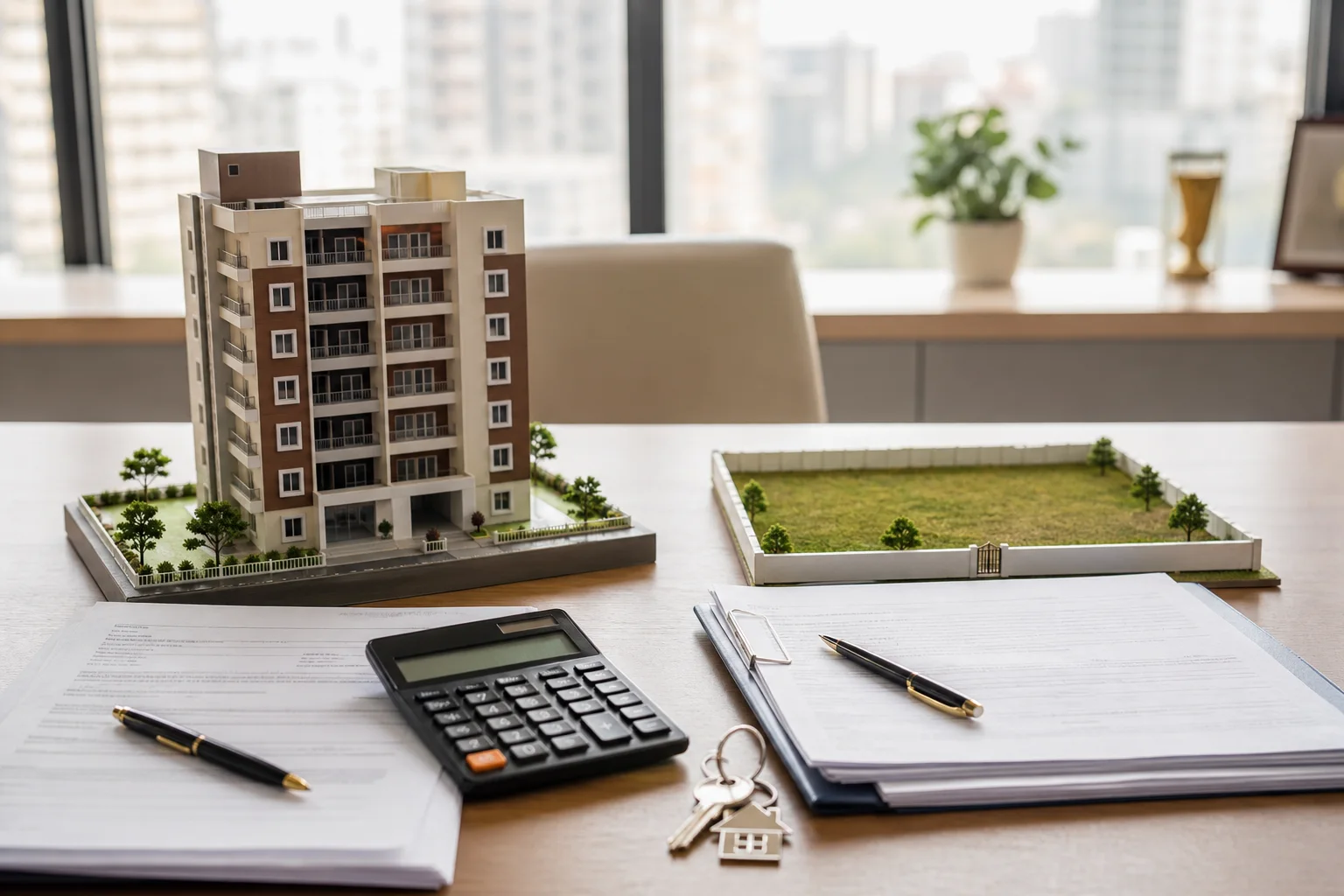
Key Answers in This Guide
- What a Home Loan Covers and Why It Is the Easiest to Get: A home loan finances the purchase of a residential dwelling.
- What a Plot Loan Is and How It Differs: A plot loan, sometimes called a land loan, finances the purchase of a residential plot.
- The Composite Loan: Plot Plus Construction in One Sanction: Between the two products sits the composite loan.
- Down Payment Reality: What Each Product Asks From Your Pocket: Buyers consistently underestimate the cash side of a plot purchase.
- Comparison at a Glance: Every cell above is direction, not promise.
- Tax Treatment: The House Gets Deductions, the Bare Plot Does Not: This difference is large enough to change decisions, so state it plainly.
In this guide
If you are buying a flat or a built house in Bhiwadi, you take a home loan. If you are buying a residential plot, you take a plot loan, which is a different product with different rules. The plot loan asks more of your own money, gives you less time to repay, and usually comes with a condition that you build on the land within a set window.
That one paragraph decides a lot. Many buyers walk into our office having compared only prices. A plot at a lower ticket than a flat can still demand more cash upfront, because the bank funds a smaller share of land than it funds of a dwelling. This article explains both products, the composite loan that sits between them, and the questions you should put to your bank before you shortlist anything. We have arranged property deals in Bhiwadi since 2008, and financing confusion is one of the most common reasons a deal stalls.
One rule before anything else. Interest rates, funded percentages, tenures and eligibility norms change, and every bank sets them case by case on your income, your credit history and the specific property. Nothing in this article is a quote. Treat every number-shaped statement here as direction, and confirm the current terms with your own bank in writing before you commit a token amount.
What a Home Loan Covers and Why It Is the Easiest to Get
A home loan finances the purchase of a residential dwelling. That means a completed flat, an under-construction flat from a builder, an independent house, or a floor in a built-up property. The unit exists or is being built by a developer under an approved plan; the bank is lending against a livable asset, or one that will become livable on a known schedule.
Home loans are the most standard retail lending product in India. Every major bank and housing finance company offers them, competes on them, and processes thousands of them. That competition works in your favour in three ways.
First, the funded share is the highest of any property loan. Banks fund a large portion of the property value for a dwelling; the exact percentage depends on the loan size and the lender’s policy, and it applies to the bank’s assessed value or the agreement value, whichever the lender uses. You bring the balance as down payment, plus stamp duty and registration, which banks generally do not finance. Our page on registry charges in Bhiwadi explains that second layer of cost.
Second, tenure is long. Home loans run for extended periods, often stretching across most of your remaining working years. A longer tenure spreads the principal thin, which keeps the monthly EMI lower for the same loan amount. You can test how tenure changes the monthly outgo on our home loan EMI calculator; the figures it produces are illustrations, not offers.
Third, process friction is lowest. For flats in known Bhiwadi projects, banks often have the project already appraised. Several lenders maintain lists of pre-approved projects where the title and approvals have been checked once at the project level. If the flat you want sits in such a project, your loan mostly rides on your own income and credit profile, not on fresh legal scrutiny of the property.
For a salaried buyer purchasing a flat in an approved project, the home loan is the smoothest financing path available in Bhiwadi.
There is a reason banks are comfortable here. A flat is a self-contained, income-verifiable, resalable asset with an occupancy trail. If the borrower defaults, the bank can value and sell it with relative ease. Land is harder for a lender to underwrite, which brings us to the plot loan.
What a Plot Loan Is and How It Differs
A plot loan, sometimes called a land loan, finances the purchase of a residential plot. In Bhiwadi that usually means a plot in a UIT-approved scheme, a RIICO residential sector, or a private township with clear approvals. Banks generally lend only against residentially designated, non-agricultural land within municipal or approved-scheme limits; raw agricultural land or land without conversion is normally outside the retail plot-loan product entirely.
The plot loan differs from the home loan on four points, and each one costs you something.
The funded share is lower. Banks fund a smaller portion of a plot’s value than they fund of a dwelling, and the gap shows up on day one as extra cash you must find. That means your down payment on a plot is a larger slice of the deal than it would be on a flat of the same price. Ask any bank for its current plot-loan funding norm before you assume anything.
The tenure is shorter. Plot loans typically run for fewer years than home loans. A shorter tenure on the same principal means a higher EMI. Combine a lower funded share with a shorter tenure and the monthly and upfront cash demands of a plot purchase both rise relative to a flat at the same ticket.
The rate is often higher. Banks tend to price plot loans above home loans because bare land is a riskier, less liquid security. How much higher varies by lender and by your profile; ask for both rates side by side from the same bank so you compare like with like.
The construction condition is the one buyers miss. Many banks sanction a plot loan with a requirement that you construct a house on the plot within a defined window, commonly a few years from disbursement. If you do not build within that window, consequences vary by lender: the rate can be reset upward, the loan can be recalled, or penal terms can apply. Some lenders are stricter than others. If your plan is to hold the plot for years and build later, or never, say so to the bank upfront and get the actual condition in writing before you sign.
A plot loan is not a cheaper home loan; it is a stricter product that assumes you will build.
None of this makes plots a bad buy. Plots in Bhiwadi have their own case, which we lay out on our plots in Bhiwadi page. But the financing gap between the two asset types is real, and it should enter your decision before location or layout does.
The Composite Loan: Plot Plus Construction in One Sanction
Between the two products sits the composite loan. It finances the plot purchase and the construction of a house on that plot under a single sanction. If you genuinely intend to buy land and build on it, this is usually the product to ask about first, because it can bring plot financing closer to home-loan treatment.
Here is how it generally works. The bank sanctions a combined amount covering the land cost and an estimated construction cost. The land portion is disbursed at purchase, like a plot loan. The construction portion is not handed over as a lump sum; it is released in stages as the house comes up. The bank ties each release to construction progress, verified through site inspection, photographs, an engineer’s or architect’s certificate, or all three. Foundation done, a tranche releases. Roof cast, another tranche. The exact stage schedule is the bank’s, not yours.
Two implications follow from staged disbursement. You need an approved building plan and a realistic construction estimate before sanction, because the bank lends against that plan. And your interest accrues on the disbursed amount, so during construction you typically pay interest only on what has been released, with full EMIs starting once disbursement completes or after a defined period. Ask the bank exactly how pre-EMI interest works in its product; practices differ.
The composite loan also usually carries its own construction deadline. The bank expects the house to be completed within a set window from the first disbursement. Miss it and the loan can be re-priced as a plot loan, which generally means a higher rate. Get the deadline, and what happens if you miss it, in writing.
The practical takeaway: if your plan is plot plus construction within the next couple of years, a composite loan can give you a better funded share and longer tenure than a standalone plot loan, and it can restore the tax treatment you would otherwise lose, which we cover below. If your plan is plot now and construction someday, the composite loan does not fit, and you are back to the stricter plot loan with your eyes open.
Down Payment Reality: What Each Product Asks From Your Pocket
Buyers consistently underestimate the cash side of a plot purchase. Walk through the layers.
On a flat with a home loan, your own money covers the unfunded share of the property value, plus stamp duty and registration, plus incidentals such as processing fees and legal charges. Because the bank funds a large share of a dwelling, the unfunded slice is the smallest it gets in property lending.
On a plot with a plot loan, your own money covers a larger unfunded share, because the bank funds less of land. Stamp duty and registration still sit on top, and in Rajasthan they are calculated on the DLC rate or the transaction value, whichever is higher. Then remember what the plot does not include: boundary wall, gate, site levelling, and eventually the entire cost of construction, none of which the plot loan touches.
On a composite loan, your own money covers the unfunded share of the combined land-plus-construction estimate, plus duties on the land purchase. The construction money arrives in stages, so your contribution is often front-loaded into the land leg.
Run your own numbers before you shortlist. Our Bhiwadi property cost calculator stacks the purchase price, duty and incidentals so you can see the full cash requirement, and the EMI calculator shows what a given loan amount costs monthly across tenures. Both tools produce illustrations; your bank’s sanction letter is the only document that counts.
A labelled hypothetical, to make the structural point and nothing more: suppose two buyers each look at a Rs 40 lakh purchase, one a flat, one a plot. The flat buyer’s bank funds a high share of the value; the plot buyer’s bank funds a visibly lower share. The plot buyer therefore brings several lakh more from savings on day one, and repays over fewer years, so each month costs more per rupee borrowed. The exact figures depend entirely on the lender’s current norms, which is why we are not printing percentages that would be stale or wrong for your case. The structure, however, holds across lenders: the plot asks more of you upfront and monthly.
Before you fall for any plot, confirm the bank’s funded share in writing and check that your savings cover the gap plus duty with margin to spare.
Read the loan through what you are actually buying. The asset points to the product.
A ready flat or a built house, with limited savings and steady income
Home loan. Small down payment, long tenure, low EMI per rupee borrowed, and tax relief from the start.
A bare plot to hold or build on later, with substantial savings
Plot loan, or buy from savings if the cash exists without straining reserves. Expect a larger down payment, a higher EMI over a shorter tenure, and a construction window to honour or a holding cost to accept.
Land and a house on it within a defined horizon
Composite loan. It converts the plot's financing disadvantages into something closer to a home loan, provided you actually build on the bank's schedule.
Choose the asset and the loan together, as one decision, not the plot first and the financing as an afterthought.
Comparison at a Glance
| Feature | Home loan | Plot loan | Composite loan |
|---|---|---|---|
| What it finances | Flat, house, or under-construction dwelling | Residential plot only | Plot plus construction of a house on it |
| Funded share | Highest; bank funds a large portion of value | Lower; you bring a bigger down payment | Between the two; assessed on land plus construction estimate |
| Tenure | Longest of the three | Shorter | Closer to home-loan tenure, per lender policy |
| Construction condition | None for a ready or builder-built unit | Often required within a set window; penalties or re-pricing if missed | Built into the product; completion deadline applies |
| Disbursement | Lump sum, or stage-linked for under-construction flats | Lump sum at purchase | Land at purchase, construction in stages against progress |
| Tax treatment | Housing deductions on principal and interest generally available, subject to conditions | Generally no housing deductions while the plot stays bare | Deductions generally become available once the house is completed, subject to conditions |
| Typical use | Buying a flat or built house to live in or let out | Holding land, building later | Buy land and build within the bank’s window |
Every cell above is direction, not promise. Lenders differ, and terms move. Verify each row with your own bank.
Which product fits your situation:
- Buying a flat or built house, savings are limited, income is steady: home loan. Smallest down payment, longest tenure, tax relief from year one.
- Buying land, savings can cover a bigger down payment, no fixed plan to build soon: plot loan, with the construction-window condition confirmed in writing before you sign.
- Buying land with a firm plan to build within the bank’s window: composite loan, so the funded share, tenure and eventual tax treatment move closer to a home loan.
Tax Treatment: The House Gets Deductions, the Bare Plot Does Not
This difference is large enough to change decisions, so state it plainly.
Income tax deductions on a housing loan, on the principal repaid and the interest paid, are tied to a house, not to land. If you take a home loan for a flat or built house, those deductions are generally available to you, subject to the conditions and limits in force under the tax regime you have opted for.
A pure plot loan, where the land stays bare, generally does not qualify for those housing deductions. You repay the loan entirely from post-tax income, with no relief on principal and none on interest, for as long as the plot remains unbuilt.
The position generally changes once you construct. When a house is completed on the plot, the loan attached to that construction, including a composite loan, is generally treated like a housing loan from that point, and interest paid during the construction period may become claimable in a defined manner after completion. The mechanics have conditions, timelines and caps, and they interact with which tax regime you have chosen, since one regime restricts several of these deductions.
We are deliberately not quoting sections, limits or amounts. Tax law changes, and your regime choice changes what applies to you. Confirm the tax treatment of your specific loan with a chartered accountant or tax professional before you count any deduction in your affordability maths. The safe planning stance: a flat gives you the tax benefit from year one; a bare plot gives you none until you build; a composite loan restores the benefit once the house is done.
Documentation: What Each Loan Asks For
Your personal file is the same for all three products: identity and address proof, PAN, income proof, which means salary slips and Form 16 for salaried applicants or ITRs and financials for the self-employed, bank statements, and your credit history, which the bank pulls itself. Where the products diverge is the property file.
For a home loan on a flat, the bank wants the builder-buyer agreement or sale agreement, the chain of title, the project’s approvals, and, for a ready unit, the occupancy or completion certificate where applicable. In a project the bank has already appraised, much of this exists in its records, which is why these loans move fastest.
For a plot loan, the property file is heavier and the scrutiny is real. Expect the bank to ask for the title deed chain establishing clean ownership, the allotment letter if it is a UIT or RIICO allotment, proof that the land is converted and residentially designated, the approved layout of the scheme, and current land-record extracts. The bank’s lawyer will trace the title back through prior transfers. Any gap in the chain, any mismatch in names or measurements, and the file stalls. This scrutiny is a feature, not a nuisance; a bank lawyer refusing a plot’s title is free due diligence telling you to walk away.
For a composite loan, add the construction layer: an approved building plan from the local authority and a construction cost estimate, usually certified by an architect or engineer. Disbursement stages will reference these documents, so they need to be realistic, not decorative.
Our checklist of documents required to buy property in Bhiwadi covers the purchase-side paperwork in detail, and the Bhiwadi property glossary explains the terms, patta, DLC rate, conversion, mutation, that will appear across these files. If a term in your bank’s checklist is unfamiliar, look it up before you sign, not after.
How the Financing Gap Shapes the Flat vs Plot Decision
The flat-versus-plot question in Bhiwadi has many angles: lifestyle, maintenance, appreciation pattern, holding cost. We compare the assets themselves on our flats vs plots in Bhiwadi page. Here, look at the question purely through the financing lens, because for most buyers the loan is what makes the purchase possible at all.
The financing lens says this. If your savings are limited and your income is steady, the home loan’s structure works for you: small down payment, long tenure, low EMI per rupee borrowed, tax relief from the start. That points to a flat, or a built house, as the path of least resistance.
If you have substantial savings and you want land, the plot loan’s demands are absorbable: you can cover the larger down payment, carry the higher EMI over the shorter tenure, and either build within the bank’s window or accept the consequences of holding. Some plot buyers in Bhiwadi skip the loan entirely and buy from savings, which removes the construction condition and the bank’s timeline from their lives altogether. That is a legitimate route if the cash exists without straining your emergency reserves.
If you want land and a house on it within a defined horizon, the composite loan is built for you, and it converts the plot’s financing disadvantages into something closer to a home loan, provided you actually execute the construction on the bank’s schedule.
The mistake we see most is the middle case handled badly: a buyer stretches savings to cover a plot loan’s down payment, plans to “build in a few years”, and then discovers the construction condition, the absent tax relief, and the standing cost of construction they never budgeted. Choose the asset and the loan together, as one decision, not the plot first and the financing as an afterthought.
The sequence of a clean purchase, from shortlist to registry, is laid out step by step in our guide on how to buy property in Bhiwadi. The loan sanction sits early in that sequence, before token money changes hands, not after.
What to Ask the Bank Before You Shortlist
Take this list to at least two lenders and get answers in writing or in the sanction terms. Verbal assurances from a sales desk are not terms.
- What share of the property value will you fund for this specific property type, and is it applied on agreement value or your assessed value?
- What is the maximum tenure you will give me at my age and income, and what does the EMI look like at that tenure versus a shorter one?
- What is the current rate for this product, is it floating or fixed, which benchmark does it float on, and how does it compare with your home-loan rate for the same profile?
- For a plot loan: is there a construction condition, what is the window, and what exactly happens if I do not build within it?
- For a composite loan: what are the disbursement stages, what proof do you need at each stage, what is the completion deadline, and how is interest charged before full disbursement?
- Is this project or scheme already on your approved list, and if not, how long does legal and technical appraisal take?
- What are the processing fee, legal and valuation charges, and are there prepayment or foreclosure charges on this product?
- What happens to my sanction if the property’s title check throws up an objection?
A bank’s answers to questions four and five reveal more about your next few years than the rate does. A quarter percent of interest matters less than a construction clause you cannot honour.
Get the sanction letter before you commit serious money to any seller. A sanction tied to a specific property, after the bank’s legal check, protects you twice: it confirms your budget, and it confirms the title passed a professional’s review.
Frequently Asked Questions
Can I take a home loan to buy a plot in Bhiwadi?
No. A home loan finances a dwelling. For a bare residential plot the bank will offer you its plot-loan or land-loan product, which funds a smaller share, runs shorter, and usually carries a construction condition. If you intend to build soon, ask for a composite loan instead, which covers plot plus construction under one sanction.
Why does the bank fund less of a plot than a flat?
Bare land is a riskier security for a lender. It generates no rent, its resale is slower and lumpier than a flat’s, and its value is harder to verify against comparable sales. Banks price and structure that risk into the product: lower funded share, shorter tenure, often a higher rate. The exact norms are each lender’s own and change over time, so confirm them directly.
What happens if I do not build within the construction window of my plot loan?
It depends on the lender and the sanction terms. Common outcomes include the rate being reset upward, penal interest, or in stricter cases the loan being recalled. Some lenders are lenient in practice; do not rely on that. Read the construction clause in your sanction letter before signing, and if you have no firm plan to build, tell the bank and ask what that does to your terms.
Do I get income tax benefits on a plot loan?
Generally not while the plot stays bare. The housing deductions on loan principal and interest are tied to a house. Once you construct a house on the plot, the loan generally starts qualifying for housing-loan treatment, subject to conditions and to which tax regime you have opted for. Confirm your specific position with a tax professional; do not build deductions into your budget on assumption.
Is a composite loan better than a plot loan?
If you will genuinely build within the bank’s window, usually yes. The composite loan can carry a better funded share and longer tenure than a standalone plot loan, and it restores tax benefits once the house is completed. If you will not build on a schedule, it is the wrong product; its staged disbursement and completion deadline assume active construction.
Can I buy an agricultural plot near Bhiwadi with a plot loan?
Generally no. Retail plot loans are meant for residentially designated, converted, non-agricultural land within approved limits, such as UIT schemes, RIICO residential sectors and approved townships. Agricultural land normally falls outside the product. If a seller tells you a bank will fund an unconverted plot, verify that claim with the bank yourself before paying anything.
Should I get the loan sanctioned before or after choosing the property?
Get a pre-assessment of your eligibility first, so you know your budget, then get the property-specific sanction before paying anything beyond a refundable token. The bank’s legal and technical check on the specific plot or flat is due diligence you benefit from. Never let a seller hurry you into a registry date ahead of your sanction.
The financing product you qualify for is as much a part of your Bhiwadi purchase as the property itself. Shivam Properties has worked with buyers and their lenders here since 2008; whichever way you lean, flat or plot, settle the loan question with your bank in writing first, and let the property decision follow from what the numbers actually allow.
Ready to Shortlist? Talk It Through With Us
18+ years in this market. Real prices, verified paperwork, no pressure.
Choose what you would like to do next:
Done — our team will contact you during working hours.