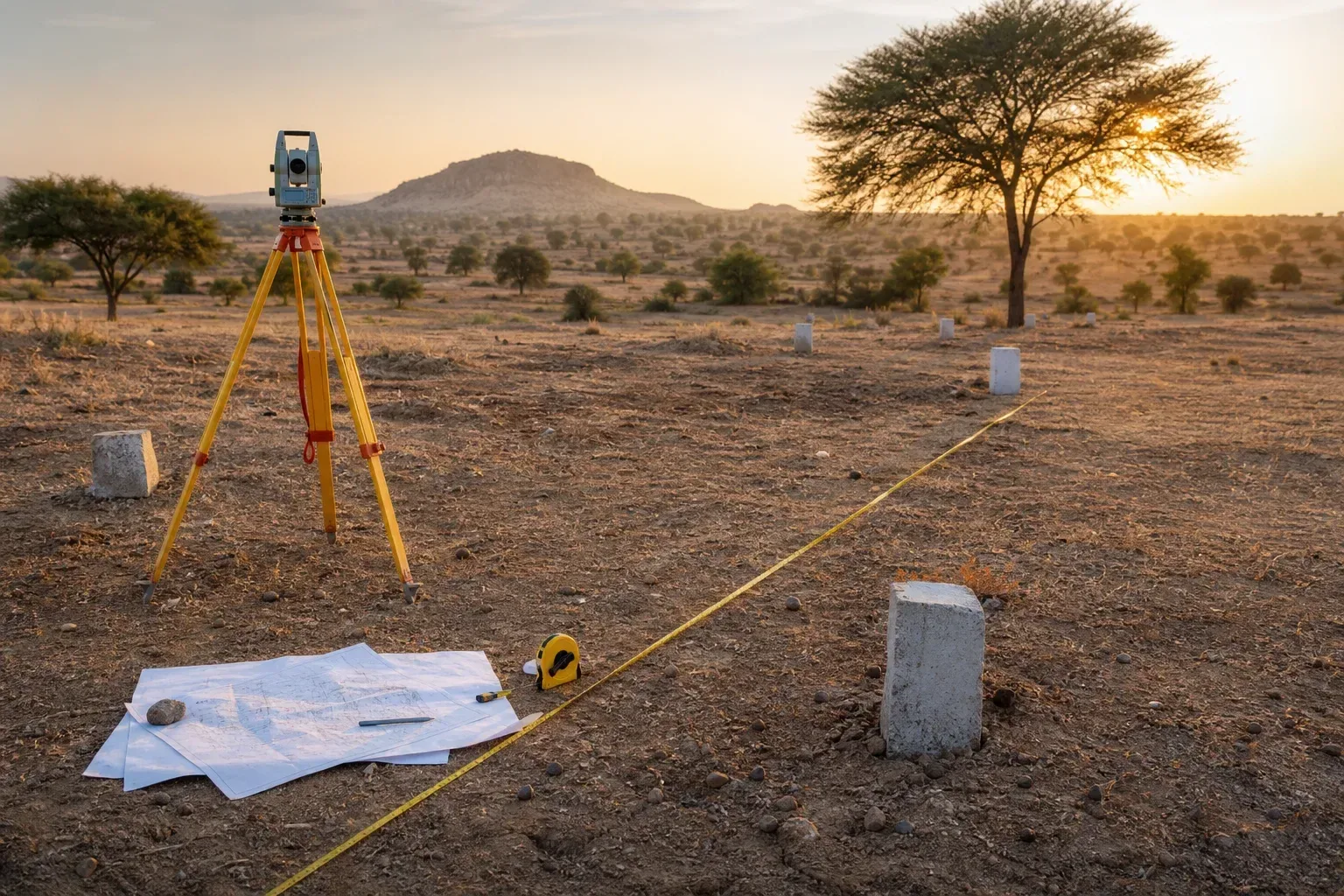
Key Answers in This Guide
- Why Units Matter When Buying Land: Land in Bhiwadi is priced per unit of area.
- Gaj, Square Yard and Square Feet: The Everyday Bhiwadi Units: Start with the units you will hear most often in Bhiwadi's residential plot market.
- Square Metre: The Official Unit: The square metre is the SI unit of area and the unit the government prefers.
- Acre and Hectare: Large Land: When land gets big, the units change again.
- Bigha and Biswa: The Core Warning: Read this section twice if you are buying agricultural land.
- How to Cross-Check a Stated Size Against Records and the Ground: A stated area has to survive three checks before you rely on it: the paper check, the map check, and the ground check.
In this guide
Most land units in Rajasthan convert cleanly into each other. One gaj equals one square yard equals nine square feet; one acre equals 4,840 square yards; official records use square metres. The trap is bigha. Bigha has no single fixed value in India, and even within Rajasthan its size depends on the district and the revenue record, so you must confirm the local definition before you pay for anything measured in it.
This guide covers every unit you will meet while buying a plot, a farmhouse parcel, or agricultural land in and around Bhiwadi. It gives you the exact conversions, explains where each unit appears, and shows you how to cross-check a seller’s stated area against the government record and the ground itself.
Why Units Matter When Buying Land
Land in Bhiwadi is priced per unit of area. A residential plot is quoted per gaj or per square yard. An industrial plot in a RIICO area is quoted per square metre. Agricultural land on the outskirts is quoted per bigha or per acre. If you misread the unit, you misread the price.
The mistakes are not small. A buyer who assumes a bigha is the same size everywhere can be off by 40 percent or more on the actual land area. A buyer who confuses square metres with square yards pays for roughly 20 percent less land than they think they are getting, because a square metre is larger than a square yard. These errors survive right up to registration if nobody checks, and after registration they are expensive to unwind.
Every land deal in Bhiwadi involves at least two unit systems: the one the seller quotes in and the one the government records in. Your job is to make them match.
There is a second reason units matter. The sale deed, the registry valuation, and the stamp duty calculation all run on the area written in the document. The DLC rate (the government’s minimum valuation rate) for Bhiwadi is published per square metre for most categories. If the area in your deed is wrong, your stamp duty is wrong, and a wrong deed area can trigger disputes with neighbours, with the revenue department, or with a future buyer when you sell.
If you want to convert between units quickly while reading listings, use the Bhiwadi area converter on this site. It handles gaj, square yards, square feet, square metres, acres and hectares. For bigha it warns you to confirm the local value first, for reasons this article explains in detail.
Gaj, Square Yard and Square Feet: The Everyday Bhiwadi Units
Start with the units you will hear most often in Bhiwadi’s residential plot market.
Gaj
Gaj is the Hindi word for yard. In north Indian property usage, one gaj means one square yard. Dealers, sellers and buyers across Bhiwadi, Alwar, Rewari and the wider NCR quote residential plots in gaj. A “100 gaj plot” means a plot of 100 square yards.
The conversion is exact and fixed:
- 1 gaj = 1 square yard = 9 square feet
- 100 gaj = 900 square feet
- 200 gaj = 1,800 square feet
There is no regional variation in gaj the way there is in bigha. A gaj in Bhiwadi is the same as a gaj in Delhi or Jaipur. This is why the residential market settled on it; everyone means the same thing.
One point of confusion: gaj is technically a unit of length (a yard, about 0.914 metre), but in property talk it always means the square unit. Nobody in the Bhiwadi market says “square gaj”. When a dealer says gaj, read square yard.
Square yard
Square yard is the formal English name for the same unit. Builder brochures, allotment letters from private townships, and older sale deeds often write “sq. yd.” where a dealer would say gaj. They are identical. One square yard is 0.836 square metre, approximately.
Square feet
Square feet appear in two places: built-up area and small plot maths. Flats and builder floors are always quoted in square feet of built-up or carpet area. Plots are sometimes broken down into square feet when comparing rates, because the per-square-foot number is small and easy to compare across options.
The relationships:
- 1 square yard = 9 square feet (exact)
- 1 square metre = 10.764 square feet (approx)
A common plot listing in Bhiwadi reads like this: “150 gaj, west facing.” That is 150 square yards, which is 1,350 square feet, which is about 125.4 square metres. All three numbers describe the same plot. When you browse plots in Bhiwadi, you will see gaj used almost universally for residential land; keep the 9x multiplier in your head and the square feet figure is instant.
Standard plot sizes in gaj
Bhiwadi’s residential colonies were largely planned around round gaj figures. You will repeatedly meet plots described as 50 gaj, 100 gaj, 150 gaj, 200 gaj and 300 gaj. In square feet those are 450, 900, 1,350, 1,800 and 2,700. In approximate square metres: 41.8, 83.6, 125.4, 167.2 and 250.8. Knowing these five conversions by heart covers most residential conversations you will have.

Square Metre: The Official Unit
The square metre is the SI unit of area and the unit the government prefers. You meet it in four places.
RIICO and industrial land
RIICO (Rajasthan State Industrial Development and Investment Corporation) allots and prices industrial plots in square metres. Every RIICO allotment letter, every rate notification, and every transfer document for an industrial plot in Bhiwadi, Chopanki, Khushkhera, Pathredi or Kahrani states the area in square metres. If you are evaluating industrial land, read the RIICO industrial plots buyer’s guide alongside this article; the unit question comes up in every RIICO transaction.
An industrial plot of 1,000 square metres is about 10,764 square feet, or about 1,196 square yards. Sellers of RIICO plots sometimes quote a per-square-yard rate to make the number look familiar to residential buyers. Convert it back to square metres before comparing with RIICO’s own reserve rates, because RIICO’s numbers are always per square metre. The industrial property in Bhiwadi page explains how these rates are structured.
Registry and DLC rates
The Rajasthan registration department publishes DLC rates predominantly per square metre. When your sale deed goes for registration, the sub-registrar’s office computes the minimum valuation from the area in square metres. Your deed may state the area in more than one unit, but the square metre figure is the one the valuation runs on.
UIT and government allotments
UIT (Urban Improvement Trust) allotments and other government housing schemes generally state plot areas in square metres, sometimes alongside a gaj figure. Where both appear, check that they actually match. A 100 gaj plot is 83.6 square metres, approximately. If the two figures in a document do not reconcile, ask why before you proceed.
Revenue records
Modern jamabandi and khasra records in Rajasthan increasingly carry areas in hectares and square metres, converted from the older bigha-biswa entries. You can view these records online; the Apna Khata Rajasthan guide walks through how to pull the jamabandi for a specific khasra number.
The key conversions:
- 1 square metre = 10.764 square feet (approx)
- 1 square metre = 1.196 square yards (approx)
- 1 square yard = 0.836 square metre (approx)
A square metre is bigger than a square yard by roughly 20 percent. Confusing the two is the single most common conversion error in Bhiwadi deals that cross the residential-industrial line.
Acre and Hectare: Large Land
When land gets big, the units change again.
Acre
The acre is the traditional large-land unit. Farmhouse parcels, land aggregations for group housing, and agricultural holdings around Bhiwadi are often discussed in acres. The conversions are fixed:
- 1 acre = 4,840 square yards = 43,560 square feet
- 1 acre = 4,046.86 square metres (approx)
- 1 acre = 0.4047 hectare (approx)
In gaj terms, one acre is 4,840 gaj. That mental bridge is useful: if agricultural land near Bhiwadi is quoted at a certain price per acre and you want to compare it with residential plot rates per gaj, divide the per-acre price by 4,840. The comparison is crude, because agricultural land cannot legally be sold as residential plots without conversion of land use, but it tells you how much of the plot price is location and approval rather than raw land.
Hectare
The hectare is the metric large-land unit and the one Rajasthan’s revenue records use in their modern, metricated form. The conversions:
- 1 hectare = 10,000 square metres (exact)
- 1 hectare = 2.471 acres (approx)
- 1 acre = 0.4047 hectare (approx)
When you pull a jamabandi from the Apna Khata portal, the holding size for many records appears in hectares. A seller may tell you the land is “five bigha”; the record may say something like 0.79 hectare or 1.26 hectare depending on the local bigha. Neither number is wrong on its own, but they must reconcile through the bigha definition used in that tehsil’s records. This is where the next section becomes essential.
Bigha and Biswa: The Core Warning
Read this section twice if you are buying agricultural land.
Bigha has no single value
The bigha is a traditional unit that predates the metric system, and it was never standardised across India. Different states use different bighas. Uttar Pradesh, West Bengal, Assam, Gujarat, Himachal Pradesh and Rajasthan each carry their own values, and some states carry more than one. There is no national bigha, and no conversion table on the internet can tell you the size of the specific bigha written in the record of the specific plot you are buying.
Never accept a bigha figure at face value. The bigha in one district’s record is not the bigha in another’s, and the difference can exceed 40 percent of the land area.
Pucca bigha and kaccha bigha
Within Rajasthan, tradition distinguishes the pucca (pakka) bigha from the kaccha bigha. The pucca bigha is the larger unit and the one more commonly reflected in revenue usage in much of the state; the kaccha bigha is smaller. Historically the kaccha bigha arose in areas where local practice measured with a shorter rod, and old records and local speech can still carry it. Two people in the same conversation can say “bigha” and mean areas that differ by a large margin.
The exact size of each varies by district and by the record system in force when the settlement (bandobast) of that area was done. This is why this article will not print a single “1 bigha = X square feet” figure. Any such figure would be correct in some tehsils and wrong in others, and printing it would cause exactly the mistake this guide exists to prevent.
Biswa and biswansi
The bigha subdivides into biswa. In common Rajasthani usage a bigha is taken as 20 biswa, and a biswa further subdivides into biswansi. Revenue records that predate metrication state holdings in bigha-biswa form, for example “3 bigha 12 biswa”. Because the bigha varies, the biswa varies with it; a biswa is a fraction of whatever the local bigha is, not a fixed area.
You will meet biswa in three situations: old jamabandi entries, partition (batwara) documents that split family holdings, and seller talk in villages around Bhiwadi such as those toward Tijara, Tapukara and the Alwar side. In each case the same rule applies: the biswa’s absolute size depends on the local bigha definition.
How to pin down the local bigha for a specific plot
You do not resolve the bigha question by asking the seller or by searching online. You resolve it against the government record for that plot. The steps:
- Get the khasra number of the land from the seller. Every parcel of revenue land has one.
- Pull the jamabandi for that khasra through the Apna Khata portal or from the tehsil office. The Apna Khata guide covers the online route.
- Read the area as recorded. Modern records state it in hectares or square metres; older ones state it in bigha-biswa. If the record itself is metric, work from the metric figure and ignore the seller’s bigha talk entirely.
- If the record is in bigha-biswa, ask the patwari (the village revenue officer) for the conversion used in that tehsil’s records. The patwari maintains the map (naksha) and knows the measurement basis of the local settlement.
- Confirm the figure against the khasra map area and, before purchase, against a physical measurement on the ground.
For any land quoted in bigha, the number that matters is the metric area in the jamabandi, verified by the patwari and by measurement on the ground; the word “bigha” in conversation is only a rough pointer.
If a seller resists this verification, treat that as a red flag. Honest sellers of agricultural land expect buyers to check the record; the record is public.
How to Cross-Check a Stated Size Against Records and the Ground
A stated area has to survive three checks before you rely on it: the paper check, the map check, and the ground check.
The paper check
Collect the documents and compare the area across all of them. For a residential plot: the allotment letter or previous sale deed, the patta or lease deed if it is UIT or municipal land, and the site plan. For agricultural land: the jamabandi, the khasra map, and any mutation (namantaran) entries. The full document list is in the documents required to buy property in Bhiwadi guide.
The areas should match across documents, allowing for unit conversion. A deed that says 167.2 square metres and an allotment letter that says 200 gaj describe the same plot; 200 multiplied by 0.836 is 167.2. A deed that says 150 square metres for a plot marketed as 150 gaj describes a plot about 20 percent larger than the marketing claim, or a documentation error; either way, stop and reconcile before you proceed.
Watch for a specific pattern in old resale plots: the original allotment states gaj, an intermediate deed converted to square metres, and a later deed converted back with rounding at each step. Small rounding drifts are normal. A drift of more than a square metre or two on a residential plot deserves a question.
The map check
For revenue land, the khasra map at the tehsil shows the shape and neighbours of the parcel. Ask for a certified copy or view it through the state’s map services. Check that the parcel’s shape on the map matches what you were shown on site, and that the khasra number you are buying is the khasra number you walked on. Buyers have paid for one field and been shown another; the map check catches this.
For plots inside approved colonies, the sanctioned layout plan serves the same purpose. The plot number, dimensions and abutting roads on the layout should match the site.
The ground check
Measure the plot physically before you sign an agreement. For a rectangular residential plot this takes a measuring tape and ten minutes: measure both widths and both depths, because plots are rarely perfect rectangles, and compute the area. For irregular plots or agricultural land, hire a licensed surveyor; the cost is small against the price of the land.
Compare the measured area with the deed area. Minor differences happen; boundary walls encroach a few inches, old measurements were taken loosely. A shortfall of a few square feet on a 200 gaj plot is a negotiation point. A shortfall of 10 gaj is a problem that must be resolved in writing before purchase, either by a price adjustment computed at the agreed per-gaj rate or by the seller correcting the boundary.
Also check demarcation. On agricultural land, ask for a demarcation (nishandehi) by the revenue staff if boundaries are unclear; this fixes the parcel’s limits on the ground with reference to the map. On colony plots, confirm that the plot’s pillars or markers align with the layout dimensions and that no neighbour’s construction crosses the line.
Measure before you sign. The deed transfers the area written in it, and the area written in it should be the area that exists on the ground.
A dealer who works these plots daily can compress much of this checking. A grounded property dealer in Bhiwadi will know which colonies have clean, consistent records and which villages have bigha-biswa entries that need patwari confirmation. Shivam Properties has done this verification work on Bhiwadi transactions since 2008.
Conversion Reference Table
Use this table for the fixed units. Bigha is deliberately excluded from the fixed rows because it has no fixed value; its row states the rule instead.
| Unit | Equals | Approx in sq ft |
|---|---|---|
| 1 gaj | 1 square yard | 9 (exact) |
| 1 square yard | 0.836 sq metre (approx) | 9 (exact) |
| 1 square metre | 1.196 sq yards (approx) | 10.764 |
| 1 acre | 4,840 sq yards; 4,046.86 sq m (approx); 0.4047 hectare (approx) | 43,560 (exact) |
| 1 hectare | 10,000 sq metres (exact); 2.471 acres (approx) | 107,639 |
| 1 bigha | Varies by region and record; commonly 20 biswa in Rajasthan usage | No fixed value; confirm in the jamabandi |
Quick residential ready-reckoner, using the exact gaj-to-square-feet relationship and the approximate square metre conversion:
- 50 gaj = 450 sq ft = 41.8 sq m approx
- 100 gaj = 900 sq ft = 83.6 sq m approx
- 150 gaj = 1,350 sq ft = 125.4 sq m approx
- 200 gaj = 1,800 sq ft = 167.2 sq m approx
- 300 gaj = 2,700 sq ft = 250.8 sq m approx
- 500 gaj = 4,500 sq ft = 418 sq m approx
For anything not on this list, the area converter does the arithmetic. Definitions of related terms such as patta, khasra, jamabandi and DLC rate are collected in the Bhiwadi property glossary.
Common Measurement Mistakes
These are the errors that actually occur in Bhiwadi deals, drawn from the patterns that repeat.
Reading square metres as square yards
The most frequent slip. A RIICO document says 500 square metres; a buyer used to residential gaj reads it as roughly 500 gaj. The plot is actually about 598 square yards. The error runs the other way too: a buyer assumes a 200 gaj plot is 200 square metres and overestimates it by about 20 percent. Whenever a document switches unit, redo the arithmetic yourself.
Trusting a universal bigha figure
A buyer searches “1 bigha in square feet”, takes the first number, and applies it to land near Bhiwadi. The number they found may belong to a different state or a different settlement basis. The correct area sits in the jamabandi in metric units or in a bigha whose local definition the patwari can state. Work from those, never from a generic web figure. This article deliberately gives you no universal bigha number, because none exists.
Confusing kaccha and pucca bigha in negotiation
Seller and buyer agree a price “per bigha” without fixing which bigha. If the seller means the smaller kaccha bigha and the buyer assumes the larger pucca bigha, the buyer pays the agreed rate for substantially less land than expected. Fix the unit in writing in the agreement to sell: state the total area in square metres or hectares as per the jamabandi, and make the price a lump sum or a rate per metric unit.
Paying on marketed area instead of deed area
Brochures and listings round up. A plot marketed as 150 gaj may be 147.5 gaj in the deed after the corner splay or road widening is accounted for. The deed area is what you own. Agree the price per gaj on the deed area, or agree a lump sum after seeing the deed area, and say so in the agreement.
Ignoring the difference between plot area and usable area
Setbacks, splayed corners on corner plots, and portions surrendered for road widening reduce what you can build on, without always reducing the deed area. This is a planning issue rather than a measurement issue, but buyers experience it as “my plot is smaller than I paid for”. Read the layout plan and the building byelaws applicable to the colony before you equate deed area with buildable area.
Skipping the physical measurement
Buyers routinely measure flats and routinely skip measuring plots. Plots are where the discrepancies live: old boundary walls built off the line, neighbours’ encroachments of a foot or two along a shared wall, and pillar markers moved over the years. Ten minutes with a tape before the agreement protects you; the same discovery after registration becomes litigation or a loss you absorb.
Rounding across multiple conversions
Each conversion step introduces rounding. Gaj to square metres to square feet and back can drift a plot’s stated size by a small amount at every hop. When documents in a chain disagree slightly, recompute from the earliest precise figure, usually the original allotment or the jamabandi, and carry that figure forward. If the drift is more than rounding can explain, treat it as a red flag and investigate.
A hypothetical worked example
This example is hypothetical and uses invented numbers to show the method, not actual Bhiwadi prices.
Suppose a seller offers agricultural land described as “4 bigha” at a stated price per bigha. You pull the jamabandi and the holding reads 0.63 hectare. First convert the record: 0.63 hectare is 6,300 square metres, which is about 1.56 acres, or about 7,535 square yards. Now test the seller’s claim: if the local pucca bigha in that tehsil’s records works out, per the patwari, to a given number of square metres, does 4 of them equal roughly 6,300 square metres? If yes, the description is honest and you can compute a true per-square-metre price. If the implied bigha is much larger than the record supports, the “4 bigha” claim overstates the land, and the per-bigha price hides a higher true rate. The method matters more than the numbers: always convert the record to metric, then test the seller’s unit against it.
Frequently Asked Questions
How many square feet is 1 gaj?
One gaj equals one square yard, which equals exactly 9 square feet. A 100 gaj plot is 900 square feet. This conversion is fixed and does not vary by region.
Is a gaj the same as a square yard?
Yes. In north Indian property usage, gaj means square yard. Strictly, gaj is a length unit (one yard), but in every plot conversation and listing in Bhiwadi it denotes the square unit. A 200 gaj plot and a 200 square yard plot are the same thing.
How many square feet is 1 bigha in Rajasthan?
There is no single answer, and any source that gives you one fixed number is unreliable for your specific plot. Bigha varies by state, and within Rajasthan the pucca and kaccha bigha differ and the exact value depends on the district and the revenue record. Confirm the definition used for the specific land: pull the jamabandi for the khasra number, read the metric area recorded there, and verify the local bigha basis with the patwari.
What is the difference between pucca bigha and kaccha bigha?
Both are traditional Rajasthani units, and the pucca bigha is the larger of the two. The kaccha bigha comes from areas that historically measured with a shorter rod. Their exact sizes vary by district and settlement record. In any negotiation quoted in bigha, get the parties to state the area in square metres or hectares as per the jamabandi, so the pucca-kaccha ambiguity cannot affect the deal.
Why do RIICO plots use square metres when residential plots use gaj?
RIICO is a state corporation and follows the metric system in all its allotments, rate notifications and transfer documents. The residential market inherited gaj from long-standing north Indian practice. If you move between the two markets, remember that one square metre is about 1.196 square yards; a 1,000 square metre industrial plot is about 1,196 gaj.
How do I verify the actual area of a plot before buying?
Do three checks. Paper: compare the area across the deed chain, allotment letter and, for revenue land, the jamabandi; areas must reconcile after unit conversion. Map: match the parcel on the khasra map or sanctioned layout with the plot shown to you on site. Ground: measure the plot physically, with a tape for simple rectangles or a licensed surveyor for irregular parcels, and resolve any shortfall in writing before the agreement.
How many gaj are in one acre?
One acre equals 4,840 square yards, so 4,840 gaj. In other units, one acre is 43,560 square feet, approximately 4,046.86 square metres, and approximately 0.4047 hectare.
Ready to Shortlist? Talk It Through With Us
18+ years in this market. Real prices, verified paperwork, no pressure.
Choose what you would like to do next:
Done — our team will contact you during working hours.